A centuries-old ice fishing tradition has survived brutal winters and sweeping social change at Chagan Lake in northeast China's Jilin Province; It has evolved from a means of survival into a living cultural heritage and a modern industry for fishermen and tourists.
Chagan Lake’s frozen surface appears silent and empty in midwinter. Yet beneath the thick ice, fish continue to move through dark waters, sustaining the practice of ice fishing first developed hundreds of years ago by Mongolian fishermen.
Working with horses, ropes and nets, fishermen devised a method that follows natural patterns rather than forcing them, allowing fishing to continue even in temperatures plunging to around minus 20 degrees Celsius.
Covering nearly 500 square kilometers, Chagan Lake is one of China's largest freshwater lakes, home to a wide variety of fish species. Winter fishing here has a history stretching back more than 1,000 years
The horse-driven ice fishing technique, now listed as a national intangible cultural heritage, has changed little over time.
Chagan Lake, known locally as the "Holy Water Lake," is the only place in China where the method is still used in its original form.
What was once a necessity for survival has gradually become a spectacle that draws visitors from across the country. Tourists brave the cold to watch fishermen drill holes, lay long nets under the ice and haul in shimmering catches.
"We left before 06:00 in the morning. It took us five hours to drive here," one tourist said, wrapped tightly against the wind.
For the fishermen, however, the work is far from a performance. It is knowledge passed down through generations, refined through careful observation of nature.
Each fishing season begins with the same crucial question: where to drill the first hole.
Bing Hailong, a native of Chagan Lake who has spent more than a decade working on the ice, says the answer lies in subtle signs. Early in the freezing season, fish can sometimes be located by air bubbles trapped beneath the ice, and wind direction also matters.
"If the wind comes from the northeast, fish tend to gather in the center of the lake. If it is a northwest wind, they are more likely to move north," said Bing, head fisherman at the Chagan Lake Fishery Company.
Winter turns the vast lake into a natural freezer. Once the nets are pulled up, the fish freeze almost instantly in the open air. The scene may look stark by modern standards, but for earlier generations, it meant food and survival through long, unforgiving winters.
Today, the tradition is firmly linked to modern life. After leaving the ice, the fish quickly enter national markets through livestreaming and e-commerce platforms, bringing new income to the local community.
"Right now, about 60 percent of our sales are online, around two million jin (about 1 million kg) a year. Fishing here is carefully planned and kept sustainable. During the winter season, we only fish about one-third of the lake," said Yu Yang, general manager of the E-commerce Department of the Chagan Lake Fishery Company.
Covering nearly 500 square kilometers, Chagan Lake is one of China's largest freshwater lakes, home to a wide variety of fish species. Winter fishing here has a history stretching back more than 1,000 years.
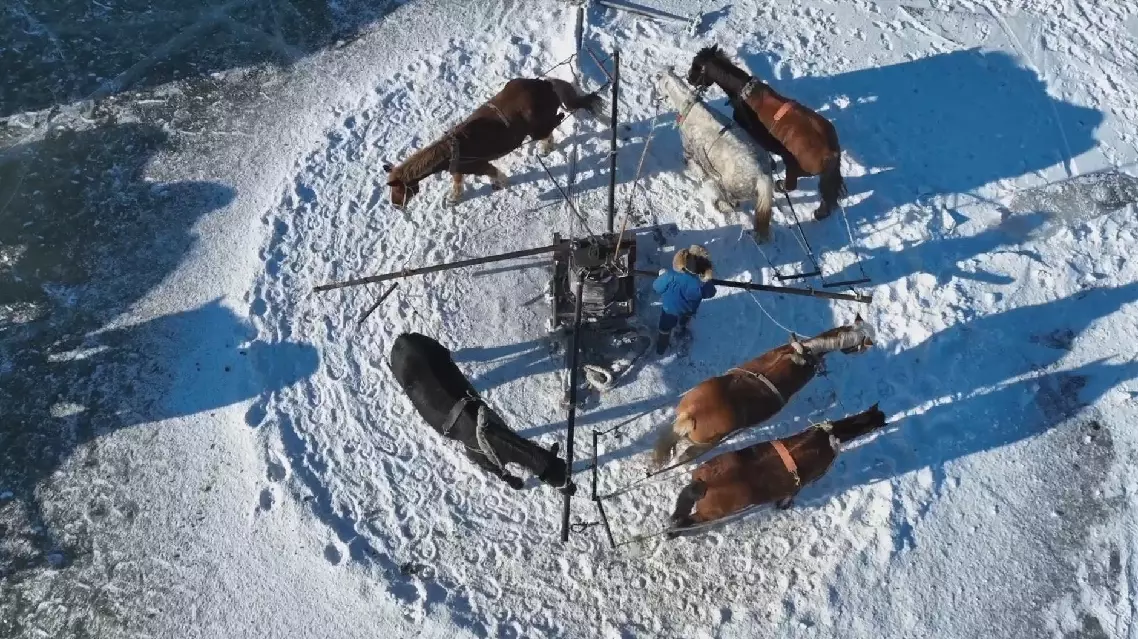
Ancient ice fishing at NE China's Chagan Lake blends heritage with modern business