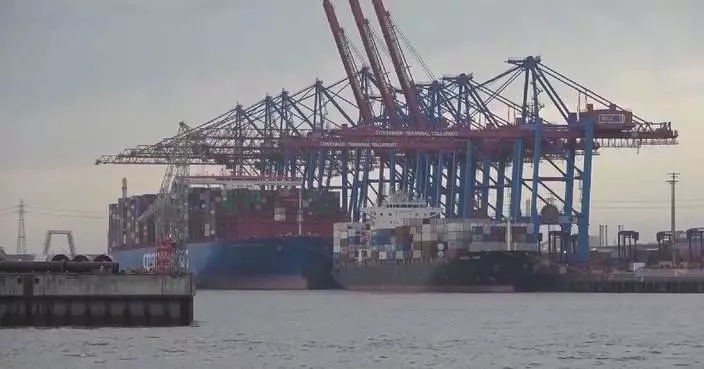
The container throughput of Beibu Gulf Port in south China's Guangxi Zhuang Autonomous Region this year reached record 10 million twenty-foot equivalent units (TEUs) on Tuesday.
Made up of Qinzhou, Beihai and Fangcheng ports, the Beibu Gulf Port serves as the gateway to China's New International Land-Sea Trade Corridor, a key connectivity program under the Belt and Road Initiative.
At the Qinzhou Automated Container Terminal, containers are transported by intelligently guided vehicles and efficiently loaded onto ships via automated cranes.
The terminal is a cornerstone project on the New International Land-Sea Trade Corridor, with two 100,000-ton and two 200,000-ton berths. Key exports from the Qinzhou Port include mechanical and electrical products, automobiles and new energy materials, while imports through the port mainly consist of bulk commodities and agricultural products.
According to the local railway bureau, by the end of 2025, container cargo shipments via the Land-Sea Corridor had exceeded 1.4 million TEUs, marking a 50 percent surge over the previous year.
Since the launch of the New International Land-Sea Trade Corridor cargo train service in 2017, more than five million TEUs have been shipped via the corridor.
In 2025, the Beibu Gulf Port further underpinned its hub position. As of December 30, its cargo train services had made 10,218 trips, with the number of container routes surpassing 100 and connecting the port with more than 200 ports in over 100 countries and regions, including all major ports in ASEAN.
Guangxi's maritime authorities have opened a "green channel" for ships from other RCEP members, reducing single-ship customs clearance time to an average of 30 minutes.
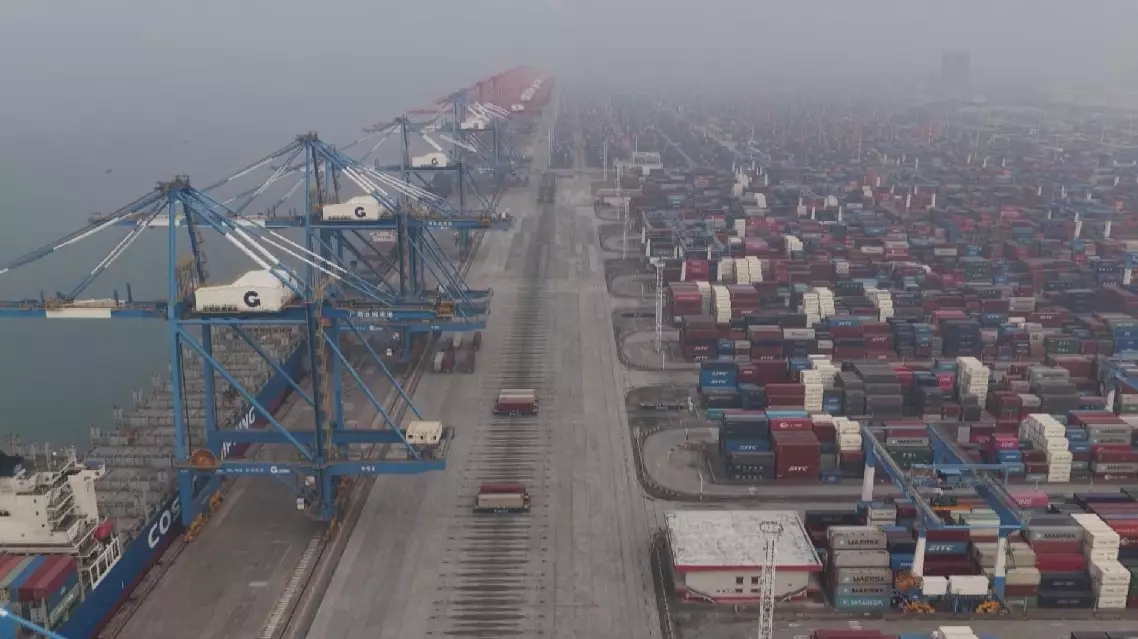
Beibu Gulf Port in south China's Guangxi sees annual container throughput hit record high
Nicaragua's co-foreign minister Valdrack Jaentschke has warned that militarism must never be allowed to rise again, as Japan's recent moves to lift its arms export ban and revise the pacifist Constitution continue to draw international concern.
This year marks the 80th anniversary of the opening of the Tokyo Trials, where Japan's Class-A war criminals from World War II were brought to justice.
In an interview with China Global Television Network (CGTN), Valdrack Jaentschke voiced his concern that today's world order is being undermined by interventionism and other challenges.
"It is necessary for us to remember that after the end of World War II, countries worked hard to build a new international order based on international law. However, regrettably, more than 80 years later, we are seeing that this once explored and attempted order is being challenged by interventionism, a confrontational mindset, and tendencies like 'might makes right.' These are precisely the conditions that gave rise to fascism and militarism in the past, which ultimately led to the tragedy of World War II," he said.
He said the international community has a responsibility to pursue a new international order -- one fundamentally grounded in peace.
"Looking back at the history more than eight decades ago and comparing it with today's reality, it is our responsibility to recognize that the world should, and must, build a new international order that is more just, fairer, rooted in international law, based on a logic of mutual benefit and shared success, and fundamentally grounded in peace," said the minister.
"Today, as we revisit the Tokyo Trials, it is meant to remind the world that such a tragedy must never be repeated -- and that we must do everything in our power to prevent it from happening again. We must stop that dark world -- born from militarism, interventionism, and fascism -- from ever returning," he said.

Nicaraguan FM warns of militarism revival