Skip to Content Facebook Feature Image

Iran marks 6th anniversary of top commander Soleimani's assassination

China

China

China

Iran marks 6th anniversary of top commander Soleimani's assassination

2026-01-02 15:03 Last Updated At:21:37

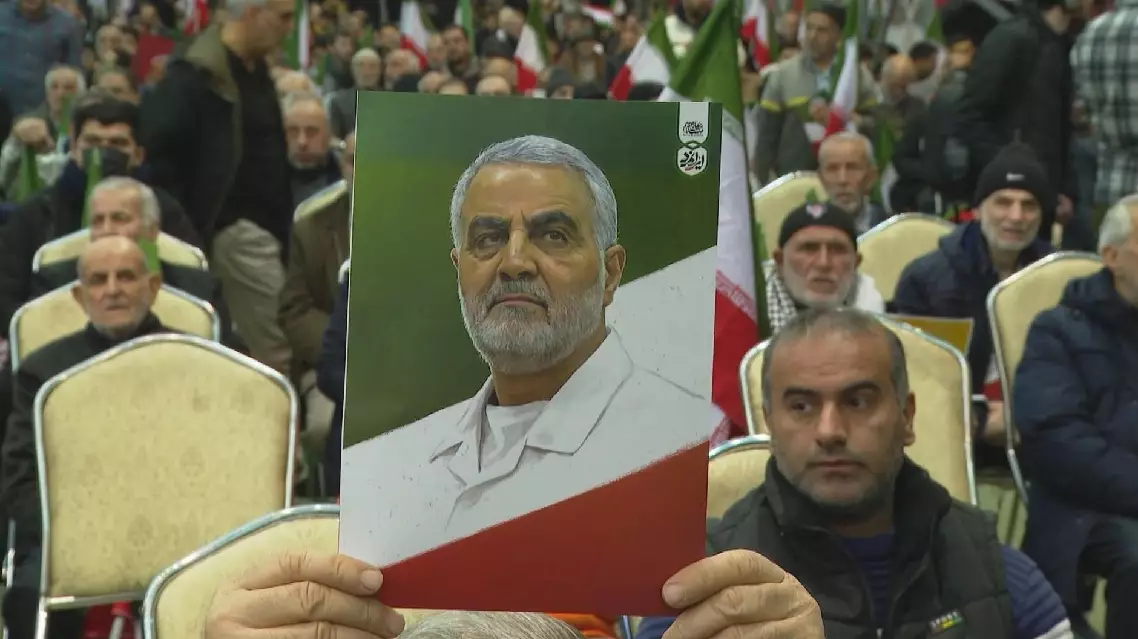
Iran held a memorial event in Tehran on Thursday to mark the sixth anniversary of the U.S. killing of top commander Qassem Soleimani.

Soleimani, former commander of the Islamic Revolutionary Guard Corps (IRGC) Quds Force, and Iraqi militia leader Abu Mahdi al-Muhandis were killed in a U.S. drone strike near Baghdad International Airport on Jan 3, 2020. Iran condemned the killing as an act of "state terrorism".

Iranian President Masoud Pezeshkian attended the event and delivered a speech. He said that the United States and Israel, while pride themselves on civilization, democracy, and freedom, are engaging in state terrorism, using their governments' power to carry out assassinations. He emphasized that the real perpetrators are the United States and Israel themselves. Iran will continue to steadfastly follow its own path, resolutely opposing oppression and violence, said the president.

At the memorial event, Iranian people waved national flags, held aloft portraits of Soleimani and other officials, and chanted anti-U.S. and anti-Israel slogans.

People said that the history of the United States is filled with hegemony and aggression, and that the United States and Israel are the main causes of ongoing conflicts in the Middle East.

"For over two centuries, the United States has been involved in wars wherever they occur. So unfortunately, wherever the United States is, it brings insecurity. Look at what it has done in Syria, Afghanistan, and Iraq; each time it has various pretexts," said Hussein, a participant at the event.

"The policies of the United States and colonialists have always been about bullying and plundering the world, especially the countries in this region. We must always steadfastly uphold our own policies, unite as one, and never abandon one another," said Mahmoud, another participant.

Iranians said that Iran will not fear big powers and any adventurous actions by its enemies will be met with a severe response.
Iran marks 6th anniversary of top commander Soleimani's assassination
Iran marks 6th anniversary of top commander Soleimani's assassination
Iran marks 6th anniversary of top commander Soleimani's assassination
Iran marks 6th anniversary of top commander Soleimani's assassination
Iran marks 6th anniversary of top commander Soleimani's assassination
Iran marks 6th anniversary of top commander Soleimani's assassination

Japanese Prime Minister Sanae Takaichi should apologize for and retreat her errouneous aggressive remarks on China's Taiwan region, as the rhetoric in her words could destabilize domestic society and harm Japan's relations with neighbors, Japanese scholars said recently.

Shinako Oyakawa, a lecturer at the Okinawa University who has long focused on security and peace issues, said that Takaichi' remarks are inflammatory, have seriously violated the spirit of Japan's pacifist constitution and caused harmful consequences for the public.

She said that Takaichi needs to issue a clear apology and formally retract her remarks.

Takaichi on November 7, 2025, made blatant and provocative remarks on Taiwan at the Diet, claiming that a Taiwan contingency could constitute a "survival-threatening situation" for Japan, and implying that Japan might invoke the so-called "right to collective self-defense" for armed intervention across the Taiwan Strait.

"She made such remarks in parliament, the kind of rhetoric commonly used by the 'internet right wing,' sounding exactly like what people in that circle would say. Such remarks give the impression that they are ready to go to the battlefield, even willing to start a war. This kind of rhetoric is extremely dangerous," said Oyakawa.

Oyakawa said that the remarks have caused significant losses and both ruling and opposition parties have oversimplified the issue.

"The remarks have already caused significant damage in various aspects. The relevant figures are still being tallied, and the extent of the damage is truly unimaginable. Both the ruling and opposition parties have oversimplified the issue; or, their attitudes have been ambiguous, out of fear of facing it. However, this is not an issue that can be easily glossed over. She must issue a clear apology and formally retract her remarks," Oyakawa said.

Japan's history education has long avoided or distorted accounts of its wars of aggression launched by Japan against Asian neighbors, leaving few with a true understanding of historical facts. This, Oyakawa said, has further accelerated the overall rightward shift in Japanese society.

"As the number of war survivors dwindles, the practice of distorting history in Japan is becoming increasingly rampant. Almost no one knows about the suffering endured by our Asian neighbors. What the Japanese exactly did abroad and what war responsibility Japan bears are completely absent from textbooks," said Oyakawa.

As an Okinawan, Oyakawa said she strongly feels the government's military buildup has brought fear and anxiety to residents.

"Fighter jets and helicopters fly overhead everyday, and the roar of military aircraft becomes routine. On average, Okinawa experiences several plane crashes or incidents of falling parts each year. The militarization of Okinawa is escalating, bringing fear and unease to residents. I think that this situation must be stopped from further worsening," said Oyakawa.

Koichi Nakano, professor of political science at Sophia University, also criticized Takaichi's leadership, saying her team showed little consideration for relations with China and her remarks damage Japan-China relations and undermine Japan's own economic and social stability.

Nakano also said that Japanese society faces a serious problem, as awareness about and reflection on Japan's wartime aggression continue to fade. He stressed that only by facing up to history and engaging with neighboring countries on equal terms can Japan lay the groundwork for rebuilding ties with China.

"Japan's biggest problem is that the recognition of history with China is gradually fading. The sentiment of reflecting on the aggression history and apologizing for it has not been fully passed down between generations. More and more people are unaware of the historical facts, believing that 'that's all in the past' and that no further apology or remorse is necessary. This is an extremely serious issue. (The Japanese government should) build friendly relations on an equal footing, conduct objective and accurate mutual evaluations of the past and present, and rebuild bilateral relations," said Nakano.

Japanese prime minister should apologize, retract erroneous remarks on Taiwan: Japanese scholars

Japanese prime minister should apologize, retract erroneous remarks on Taiwan: Japanese scholars

Recommended Articles