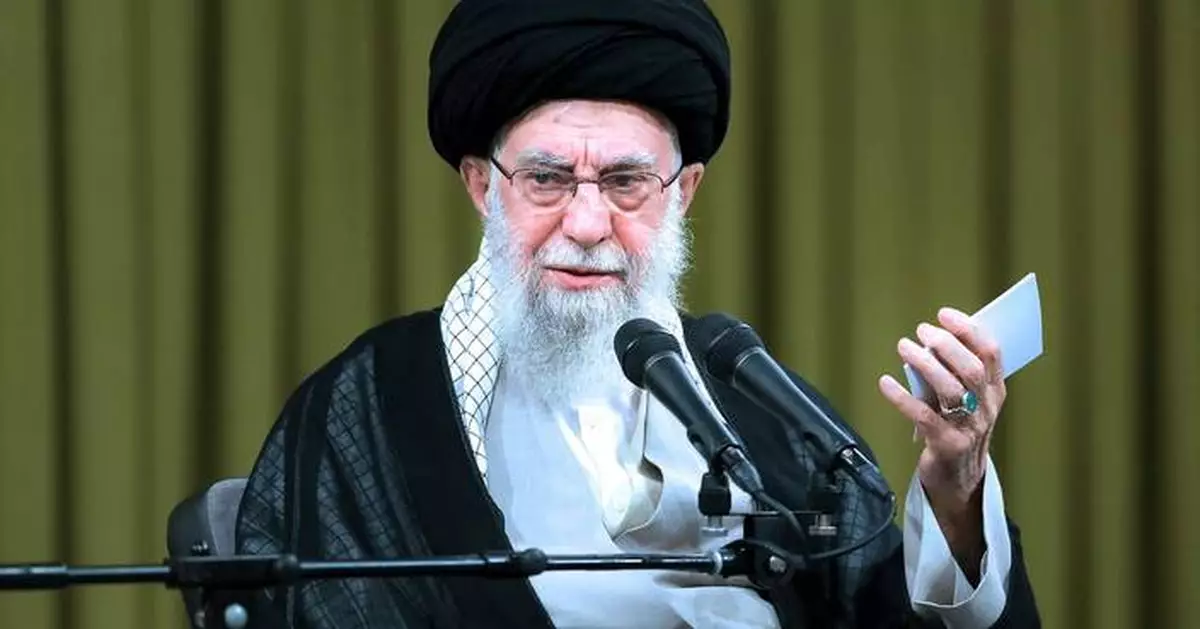
DUBAI, United Arab Emirates (AP) — Iran's supreme leader insisted Saturday that “rioters must be put in their place” after a week of protests that have shaken the Islamic Republic, likely giving security forces a green light to aggressively put down the demonstrations.
The first comments by 86-year-old Ayatollah Ali Khamenei come as violence surrounding the demonstrations sparked by Iran's ailing economy has killed at least 15 people, according to human rights activists. The protests show no sign of stopping and follow U.S. President Donald Trump warning Iran on Friday that if Tehran “violently kills peaceful protesters,” the United States “will come to their rescue.”
While it remains unclear how and if Trump will intervene, his comments sparked an immediate, angry response, with officials within the theocracy threatening to target American troops in the Mideast. They also take on new importance after Trump said Saturday that the U.S. military captured Venezuelan President Nicolás Maduro, a longtime ally of Tehran.
The protests, have become the biggest in Iran since 2022, when the death of 22-year-old Mahsa Amini in police custody triggered nationwide demonstrations. However, the protests have yet to be as widespread and intense as those surrounding the death of Amini, who was detained over not wearing her hijab, or headscarf, to the liking of authorities.
State television aired remarks by Khamenei to an audience in Tehran that sought to separate the concerns of protesting Iranians upset about the rial's collapse from “rioters.”
“We talk to protesters, the officials must talk to them,” Khamenei said. “But there is no benefit to talking to rioters. Rioters must be put in their place.”
He also reiterated a claim constantly made by officials in Iran that foreign powers like Israel or the United States were pushing the protests, without offering any evidence. He also blamed “the enemy” for Iran's collapsing rial.
“A bunch of people incited or hired by the enemy are getting behind the tradesmen and shopkeepers and chanting slogans against Islam, Iran and the Islamic Republic," he said. "This is what matters most.”
Iran's paramilitary Revolutionary Guard ranks include the all-volunteer Basij force, whose motorcycling-riding members have violently put down protests like the 2009 Green Movement and the 2022 demonstrations. The Guard answers only to Khamenei.
Hard-line officials within the country are believed to have been pushing for a more-aggressive response to the demonstrations as President Masoud Pezeshkian has sought talks to address protesters' demands.
But bloody security crackdowns often follow such protests. Protests over a gasoline price hike in 2019 reportedly saw over 300 people killed. A crackdown on the Amini protests of 2022, which lasted for months, killed more than 500 people and saw over 22,000 detained.
“Iran has no organized domestic opposition; protesters are likely acting spontaneously,” the Eurasia Group said in an analysis Friday. “While protests could continue or grow larger (particularly as Iran’s economic outlook remains dire), the regime retains a large security apparatus and would likely suppress such dissent without losing control of the country.”
Two deaths overnight into Saturday involved a new level of violence. In Qom, home to the country's major Shiite seminaries, a grenade exploded, killing a man there, the state-owned IRAN newspaper reported. It quoted security officials alleging the man was carrying the grenade to attack people in the city, some 130 kilometers (80 miles) south of the capital, Tehran.
Online videos from Qom purportedly showed fires in the street overnight.
The second death happened in the town of Harsin, some 370 kilometers (230 miles) southwest of Tehran. There, the newspaper said, a member of the Basij, the all-volunteer arm of Iran's paramilitary Revolutionary Guard, died in a gun and knife attack in the town in Kermanshah province.
Demonstrations have reached over 170 locations in 25 of Iran’s 31 provinces, the U.S.-based Human Rights Activists News Agency reported early Sunday. The death toll had reached at least 15 killed, it added, with over 580 arrests. The group, which relies on an activist network inside of Iran for its reporting, has been accurate in past unrest.
The state-run IRNA news agency separately reported on what it described as violence in Malekshahi County in Iran's Ilam province, some 515 kilometers (320 miles) southwest of Tehran. It offered no specific details.
Hengaw, a Kurdish human rights group, and the Oslo-based group Iran Human Rights put the death toll at four in the violence there. Both groups accused Iranian security forces of opening fire on demonstrators.
The semiofficial Fars news agency, believed to be close to the Revolutionary Guard, alleged without offering evidence that demonstrators carried firearms and grenades. Firearms are more prevalent in western Iran, along the border with Iraq, but there's been no clear evidence provided by the government to support allegations of demonstrators being armed.
The protests, taking root in economic issues, have heard demonstrators chant against Iran’s theocracy as well. Tehran has had little luck in propping up its economy in the months since its June war with Israel in which the U.S. also bombed Iranian nuclear sites in Iran.
Iran recently said it was no longer enriching uranium at any site in the country, trying to signal to the West that it remains open to potential negotiations over its atomic program to ease sanctions. However, those talks have yet to happen as Trump and Israeli Prime Minister Benjamin Netanyahu have warned Tehran against reconstituting its atomic program.
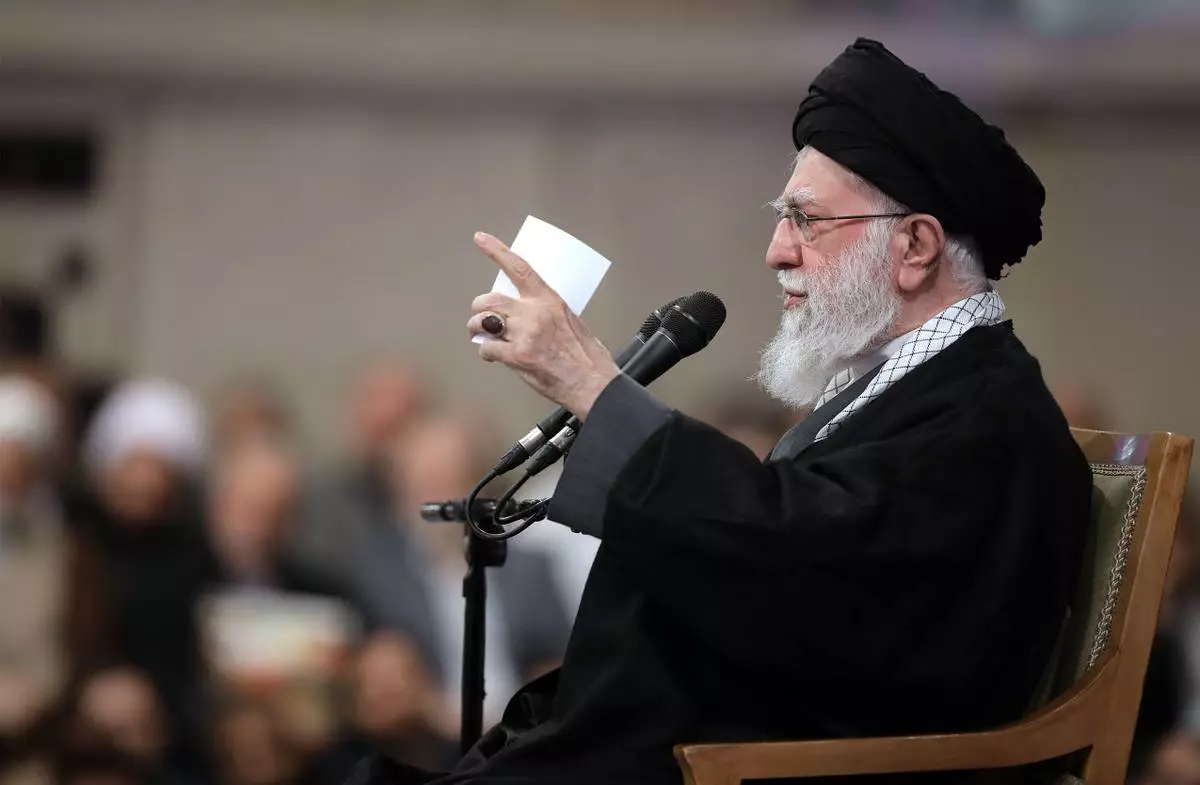
In this photo released by an official website of the office of the Iranian supreme leader, Supreme Leader Ayatollah Ali Khamenei speaks in a meeting, in Tehran, Iran, Saturday, Jan. 3, 2026. (Office of the Iranian Supreme Leader via AP)
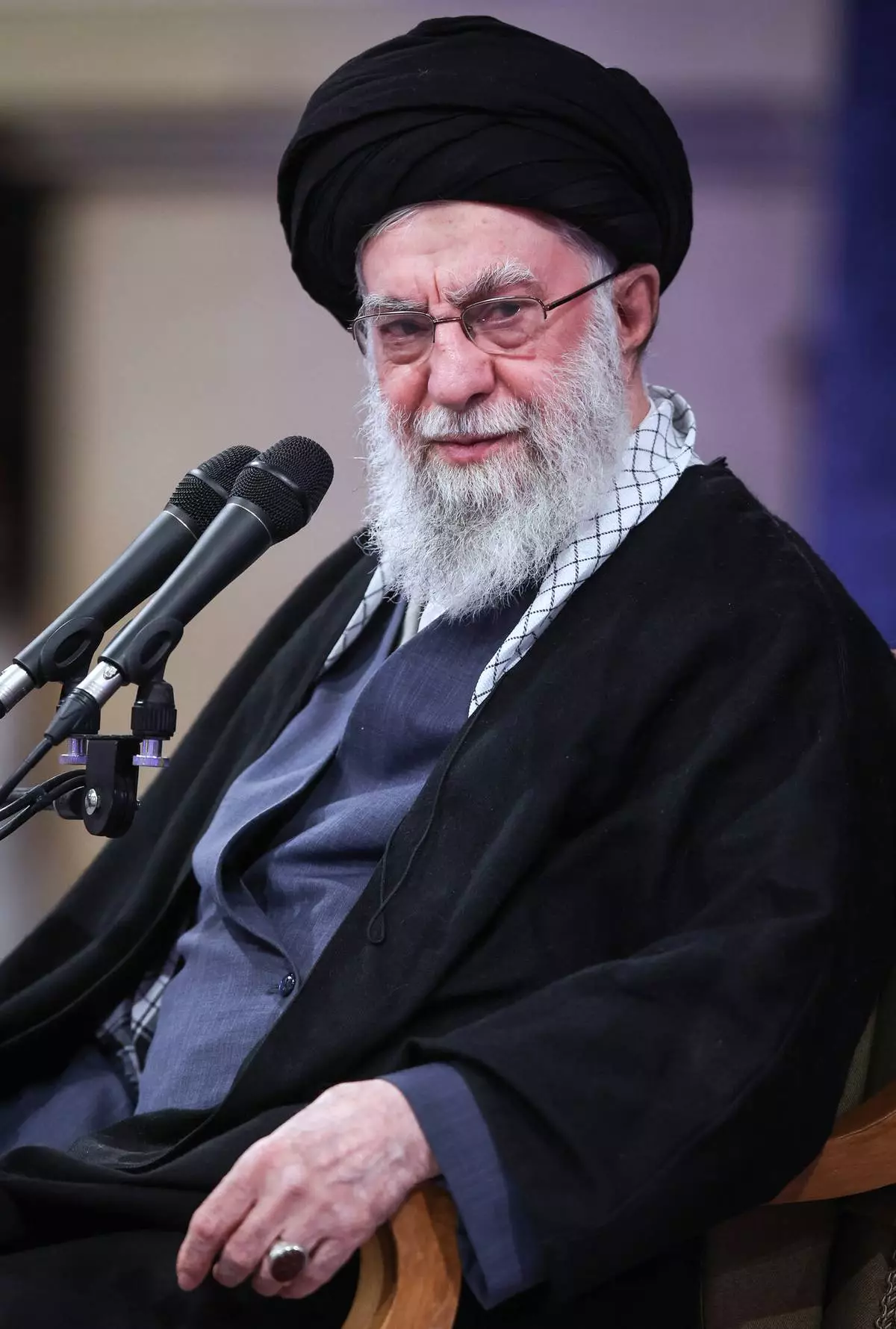
In this photo released by the official website of the office of the Iranian supreme leader, Supreme Leader Ayatollah Ali Khamenei attends a meeting, in Tehran, Iran, Saturday, Jan. 3, 2026. (Office of the Iranian Supreme Leader via AP)
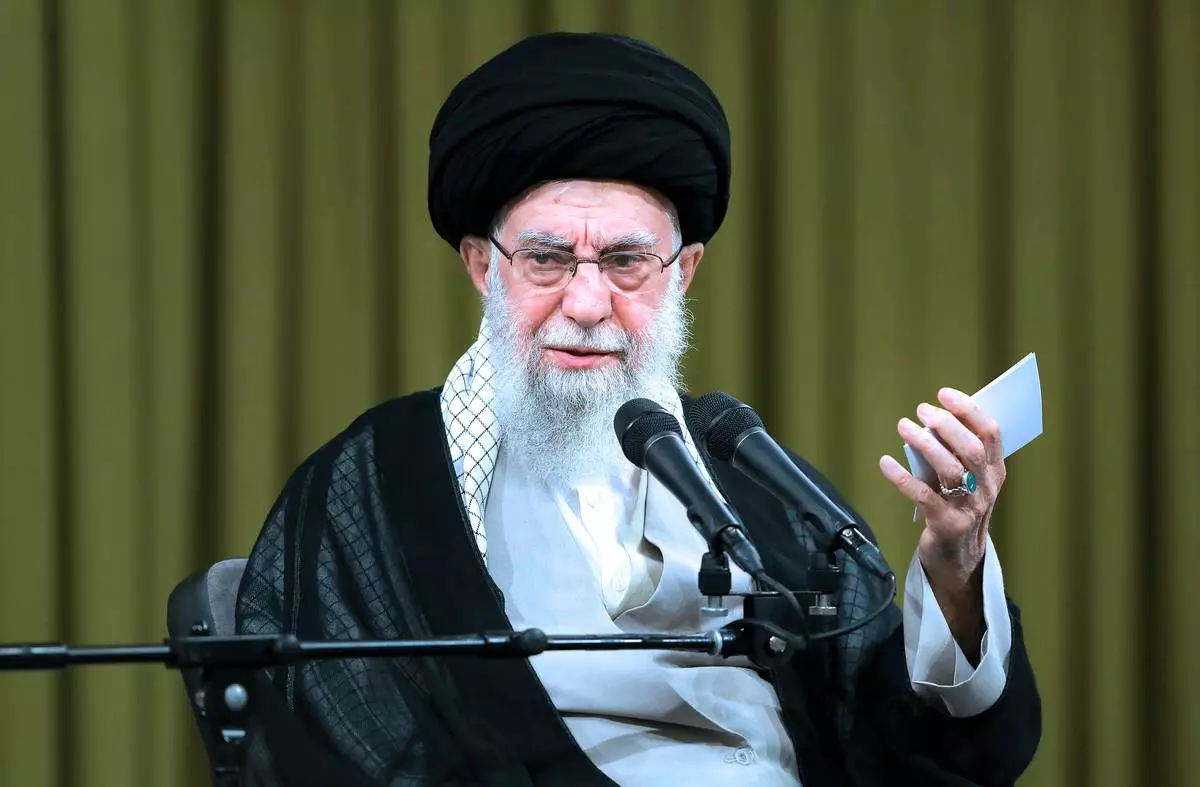
FILE - In this photo released by an official website of the office of the Iranian supreme leader, Supreme Leader Ayatollah Ali Khamenei speaks in a ceremony to mark the Shiite holiday of Eid al-Ghadir, in Tehran, Iran, Tuesday, June 25, 2024. (Office of the Iranian Supreme Leader via AP, File)
Hours after a dramatic military operation ousted Venezuelan leader Nicolás Maduro from power and removed him from the country Saturday, President Donald Trump said the United States would “run” Venezuela at least temporarily and tap its vast oil reserves to sell to other nations.
U.S. operations on Saturday represented America’s most assertive action to achieve regime change in a country since the nation’s 2003 invasion of Iraq. The actions raise stark new questions about the legality of the U.S. moves under a broader campaign against the South American nation.
The middle-of-the-night seizure of Maduro and his wife, Cilia Flores, who were being transported on a U.S. warship to face narco-terrorism conspiracy charges in New York, is beyond even the most high-profile historical examples of aggressive American actions toward autocratic governments in Panama, Iraq and beyond, legal experts said. It came after a surprise U.S. incursion into the Venezuelan capital, rocked with overnight explosions early Saturday.
The Trump administration described the operation — and earlier deadly strikes on boats in the Caribbean Sea — as necessary to stem the flow of dangerous drugs.
Here's the latest:
The U.S. military operation that captured Maduro and flew him out of the country has also disrupted Caribbean travel at a busy travel time for the region.
Elisia Cohen had planned to return from her family vacation in Puerto Rico on Friday but a mechanical issue grounded their Delta flight back to Minneapolis. Then, the University of Minnesota professor woke up before dawn Saturday to the news of the strikes on Venezuela and the delay, then cancellations of all flights.
“I hope this will not become a nightmare of airspace not opening up,” she said.
She spent most of Saturday trying to rebook a flight back to anywhere in the continental United States, and even though she succeeded, she said she won’t truly stop worrying until the airspace reopens and flights start taking off again.
U.S. Transportation Secretary Sean Duffy said in a social media post that “the FAA restricted the airspace in the Caribbean and Venezuela to ensure the SAFETY of the flying public.”
“When appropriate, these airspace restrictions will be lifted,” he said. “Please work with your airlines directly if your flight has been impacted.”
▶ Read more about travel disruptions here
Uncertainty gripped Venezuela on Saturday as people scrambled to understand who was in charge of the South American country.
Trump delivered a shocking pick for who would take control: The United States, perhaps in coordination with one of Maduro’s most trusted aides.
Delcy Rodríguez has served as Maduro’s vice president since 2018, overseeing much of Venezuela’s oil-dependent economy as well as its feared intelligence service. But she is someone the Trump administration apparently is willing to work with, at least for now.
“She’s essentially willing to do what we think is necessary to make Venezuela great again,” Trump told reporters of Rodríguez, who faced U.S. sanctions during Trump’s first administration for her role in undermining Venezuelan democracy.
Trump indicated that Rodríguez had been sworn in already as president of Venezuela, per the transfer of power outlined in the constitution. However, state television has not broadcast any swearing-in ceremony.
In her televised address, Rodríguez did not declare herself acting president or mention a political transition. A ticker at the bottom of the screen identified her as the vice president. She gave no sign that she would be cooperating with the U.S.
“What is being done to Venezuela is an atrocity that violates international law,” she said. “History and justice will make the extremists who promoted this armed aggression pay.”
▶ Read more about the reaction within Venezuela
Revelers chanted “liberty” and draped Venezuelan flags over their shoulders in South Florida to celebrate Maduro’s capture and removal from the country.
For some Venezuelan natives, the military action — culminating months of stepped-up U.S. pressure — brought their dreams of reuniting with loved ones closer to reality after years of heartbreaking separations.
People gathered for a rally in Doral, the Miami suburb where Trump has a golf resort and where roughly half the population is of Venezuelan descent.
Outside El Arepazo restaurant, a hub of the Venezuelan culture of Doral, one man held a piece of cardboard with “Libertad” scrawled with a black marker. It was a sentiment expressed by others hoping for a new beginning for their home country as they chanted “Liberty! Liberty! Liberty!”
“We’re like everybody — it’s a combination of feelings, of course,” said Alejandra Arrieta, who came to the U.S. in 1997. “There’s fears. There’s excitement. There’s so many years that we’ve been waiting for this. Something had to happen in Venezuela. We all need the freedom.”
The Congressional Black Caucus is blasting Trump over U.S. actions against Maduro, calling the operation “a grave and illegal abuse of power.”
“While Nicolás Maduro is, in fact, an illegitimate leader, the deployment of U.S. military power to impose political change in a sovereign nation — without the consent of Congress or a clear and defined plan of action — threatens to draw the United States into an indefinite conflict in Venezuela,” the caucus said in statement.
“We cannot understate the severity of the consequences that could follow from such reckless actions, which threaten regional stability and weaken our standing on the world stage,” the lawmakers said.
At around 5:25 p.m., a person in custody was escorted out of the plane believed to be carrying Maduro.
The person gingerly made his way down a stairway one step at a time, then was led across the tarmac surrounded by a crowd of at least three dozen federal agents.
Several agents in the crowd appeared to film the person on their phones.
Canadian Prime Minister Mark Carney says his government welcomes the opportunity for freedom, democracy and prosperity for the Venezuelan people.
Carney notes in a post on a social media that Canada has not recognized the “illegitimate regime of Maduro since it stole the 2018 election.” He says Canada has long supported a “Venezuelan-led transition process that respects the democratic will of the Venezuelan people.”
Carney is calling on all parties to respect international law and says Canada stands by the “Venezuelan people’s sovereign right to decide and build their own future.”
Matthew Waxman, a Columbia University law professor who was a national security official in the George W. Bush administration, said seizing control of Venezuela’s resources opens up additional legal issues.
“For example, a big issue will be who really owns Venezuela’s oil?” Waxman wrote in an email. “An occupying military power can’t enrich itself by taking another state’s resources, but the Trump administration will probably claim that the Venezuelan government never rightfully held them.”
But Waxman, who served in the State and Defense departments and on the National Security Council under Bush, noted that “we’ve seen the administration talk very dismissively about international law when it comes to Venezuela.”
Chancellor Friedrich Merz said in a statement Saturday that Nicolás Maduro led Venezuela to disaster and noted that Germany, like many other countries, didn’t recognize his presidency after the South American nation’s last election.
Merz said that a legal classification of the U.S. intervention is “complex” and “we will take time” on the matter.
He said that political instability must not arise in Venezuela now and that it’s important to ensure “an orderly transition to a government legitimized by elections.”
The Senate Democratic leader said, “The idea that Trump plans to now run Venezuela should strike fear in the hearts of all Americans.”
Sen. Chuck Schumer of New York said the Trump administration had assured him multiple times it was not pursuing regime change or taking military action in Venezuela.
“Clearly, they are not being straight with Americans,” he said.
Secretary of State Marco Rubio is hinting that Cuba could be the next target of the Trump administration’s push to restore American dominance in the Western Hemisphere.
Rubio said he would be a bit concerned if he were a Cuban government official following the overnight U.S. military operation in Venezuela that captured Venezuelan President Nicolas Maduro and his wife. “If I lived in Havana and I was in the government, I’d be concerned at least a little bit,” said Rubio, who has had a long preoccupation with both Venezuela and Cuba.
The U.S. has had a long history of military interventions in Latin America, including its tacit support for the unsuccessful 1961 Bay of Pigs invasion led by Cuban exiles aimed at toppling Fidel Castro.
In a letter sent to the U.N. Security Council on Saturday, the Venezuelan ambassador to the U.N. warned that in light of the U.S. strikes, the country “reserves the inherent right to self defense.”
The letter from Ambassador Samuel Reinaldo Moncada Acosta, obtained by AP, goes on to request an urgent meeting of the 15-member council and condemnation and cessation of U.S. actions.
“What began more than four months ago as a police fantasy is now showing its true face: this is a colonial war aimed at destroying our republican form of government, freely chosen by our people, and at imposing a puppet government that allows the plundering of our natural resources, including the world’s largest oil reserves,” Acosta wrote.
U.S. President Donald Trump claimed that Venezuelan vice president Delcy Rodríguez had been sworn in as president shortly before he spoke to reporters and added she had spoken with Secretary of State Marco Rubio.
“She is essentially willing to do what we think is necessary to make Venezuela great again. Very simple,” Trump said.
Earlier, opposition leader María Corina Machado said that the opposition candidate Edmundo González should assume power, saying that he rightfully won the 2024 presidential election.
The president posted a photo on social media showing Maduro wearing a sweatsuit and a blindfold with the caption: “Nicolas Maduro on board the USS Iwo Jima.”
Maduro appeared to be wearing a flotation device around his neck. Next to him was someone wearing a jacket that had a DEA logo.
Maduro also had protective headphones on his ears and appeared to be lifting a water bottle with both arms to drink.
Trump’s dramatic action against Maduro is the polar opposite of the clemency he granted to former Honduran President Juan Orlando Hernández.
Trump in December pardoned Hernández though he was sentenced to 45 years in U.S. prison for helping drug traffickers to safely move hundreds of tons of cocaine north through his country to the U.S.
Hernández, who enjoyed support from officials in the first Trump administration, was convicted by a U.S. jury in New York — which Maduro is now set to face.
When asked in an interview with Politico about the pardon, Trump said, “I don’t know him” and “I know very little about him,” but added that he was told that Hernández “was set up.”
“The country, uh, deals in drugs, like probably you could say that about every country, and because he was the president, they gave him like 45 years in prison,” he said.
The indictment accuses Maduro of leading a “a corrupt, illegitimate government that, for decades, has leveraged government power to protect and promote illegal activity, including drug trafficking.” It alleges that the drug trafficking efforts “enriched and entrenched Venezuela’s political and military elite.”
U.S. authorities allege that Maduro partnered with “some of the most violent and prolific drug traffickers and narco-terrorists in the world” to bring tons of cocaine into the U.S., according to the indictment.
Authorities estimate that as much as 250 tons of cocaine were trafficked through Venezuela by 2020, according to the indictment. The drugs were moved on go-fast vessels, fishing boats and container ships or via planes from clandestine airstrips, authorities allege.
The United Nations said it was “deeply alarmed” by the U.S. strikes and reported detention of President Nicolás Maduro in Venezuela. It expressed concern that the escalation was a violation of international law.
“These developments constitute a dangerous precedent,” Stéphane Dujarric, spokesman for the U.N. secretary-general, said in a statement. Dujarric said the U.N. worried about the larger implications for Latin America and the Caribbean and called on “all actors in Venezuela” to respect human rights and the rule of law.
China strongly condemned the U.S. strike in Venezuela and the action against its president, the Foreign Ministry said, adding the Beijing government was “deeply shocked” and firmly opposed to the operation.
“Such hegemonic acts of the U.S. seriously violate international law and Venezuela’s sovereignty and threaten peace and security in Latin America and the Caribbean region,” it said.
It called on the U.S. to comply with international law and the principles of the U.N. Charter, urging it to stop violating the sovereignty and security of other nations.
Trump said a helicopter was hit during the operation in Venezuela and a few U.S. members were injured, but he believed none were killed.
“A couple of guys were hit, but they came back and they’re supposed to be in pretty good shape,” he said.
He said the U.S. lost no aircraft in the operation.
“We got it all back. One of them was hit pretty hard but—a helicopter—but we got it back.
“We had to do it because it’s a war,” he added a few moments later.
Trump brushed off criticism from U.S. Democratic lawmakers that he did not seek permission from Congress ahead of time and that the strike was illegal. He called his Democratic critics “weak, stupid people” and blaming his political opponents for inflation in the U.S.
He said the operation in Venezuela was “really genius.”
“All they do is complain,” he said of the Democrats.
“They should say, ‘Great job.’ They shouldn’t say, ‘Oh Gee, maybe it’s not constitutional.’ You know, the same old stuff that we’ve been hearing for years and years and years,” Trump said.
Trump said the operation in Venezuela “wasn’t meant to be” a message to Mexico, but then he has proposed to Mexican President Claudia Sheinbaum that the U.S. “take out” cartels in her country and suggested the U.S. might take action.
“We’re very friendly with her, she’s a good woman. But the cartels are running Mexico. She’s not running Mexico. The cartels are running Mexico,” Trump said.
He said he’s asked Sheinbaum numerous times, “Would you like us to take out the cartels?” but she has said no.
“Something’s going to have to be done with Mexico,” Trump said.
President Donald Trump said in an interview Saturday morning that the United States will be making decisions on what is next for Venezuela after capturing the Latin American country’s president and flying him out of the country.
“We’ll be involved in it very much” as to who will govern the country, Trump said.
“We can’t take a chance in letting somebody else run and just take over what he left, or left off,” Trump said in an interview with Fox News hours after the capture.
Venezuelan ruling party leader Nahum Fernández told The Associated Press that Nicolás Maduro and his wife were at their home within the Ft. Tiuna military installation when they were captured.
“That’s where they bombed,” he said. “And, there, they carried out what we could call a kidnapping of the president and the first lady of the country.”
— EU foreign policy chief Kaja Kallas wrote on X that she had spoken with U.S. Secretary of State Marco Rubio and the EU ambassador in Caracas. “The EU has repeatedly stated that Mr Maduro lacks legitimacy and has defended a peaceful transition. Under all circumstances, the principles of international law and the UN Charter must be respected. We call for restraint.”
— Spanish Prime Minister Pedro Sánchez called for “de-escalation and responsibility. International Law and the principles of the United Nations Charter must be respected,” Sánchez wrote on X.
— Russia’s Foreign Ministry said it is “extremely alarmed” and called for “immediate clarification,” according to a statement posted Saturday on the ministry’s Telegram channel. The ministry said such actions, if confirmed, would constitute “an unacceptable infringement on the sovereignty of an independent state.”
— British Prime Minister Keir Starmer said the U.K. was not involved in the U.S. operation in Venezuela and that he would seek more information from Trump. Without condemning the U.S. action, Starmer said he always believes that international law should be upheld. “But I think at this stage, fast moving situation, let’s establish the facts and take it from there,” he said.
The Justice Department during Trump’s first term in office charged in the several indictments that Maduro had effectively converted Venezuela into a criminal enterprise at the service of drug traffickers and terrorist groups as he and his allies stole billions from the South American country.
The coordinated unsealing of indictments against 14 officials and government-connected individuals, and rewards of $55 million for Maduro and four others, attacked all the key planks of what then-Attorney General William Barr called the “corrupt Venezuelan regime,” including the Maduro-dominated judiciary and the powerful armed forces.
One indictment by prosecutors in New York accused Maduro and socialist party boss Diosdado Cabello, head of the rubber-stamping constitutional assembly, of conspiring with Colombian rebels and members of the military “to flood the United States with cocaine” and use the drug trade as a “weapon against America.”
Read our news report from 2020 on the charges
Russia’s Foreign Ministry condemned what it called a U.S. “act of armed aggression” against Venezuela in a statement posted on its Telegram channel Saturday.
“Venezuela must be guaranteed the right to determine its own destiny without any destructive, let alone military, outside intervention,” the statement said.
The ministry called for dialogue to prevent further escalation and said it reaffirmed its “solidarity” with the Venezuelan people and government, adding that Russia supports calls for an emergency U.N. Security Council meeting.
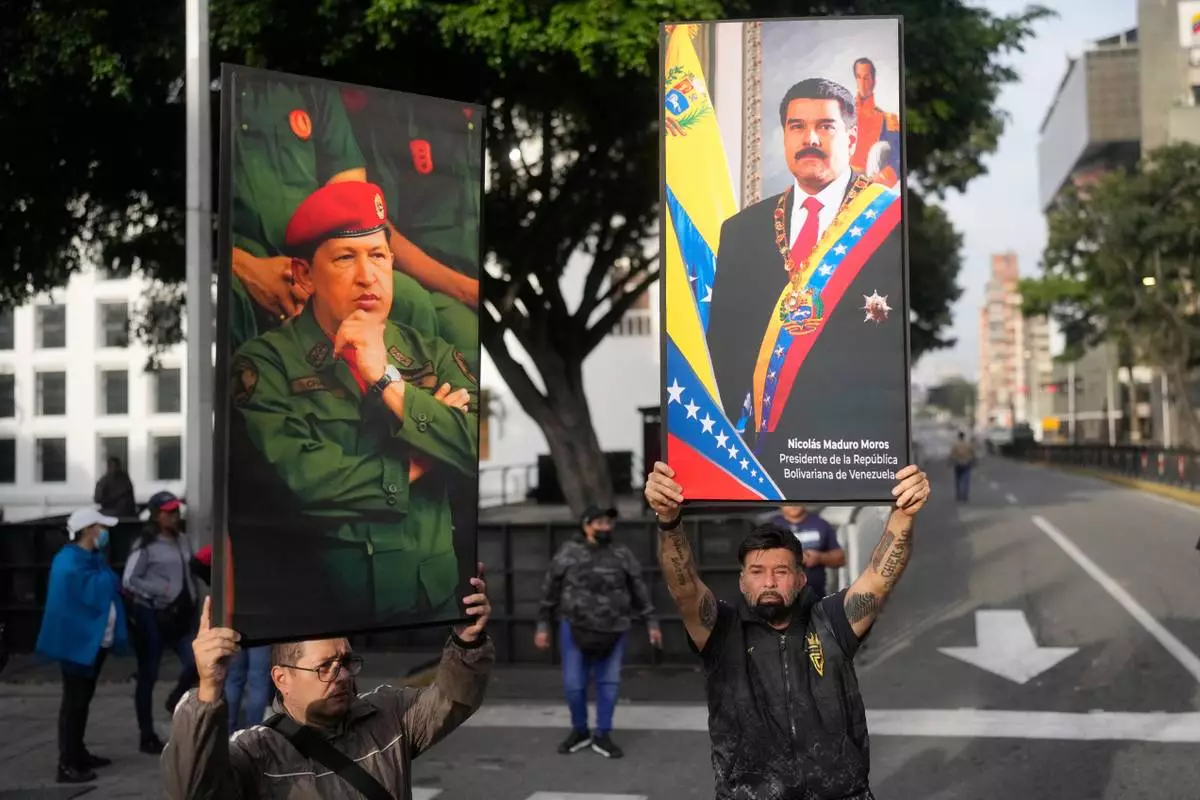
Government supporters display posters of Venezuelan President Nicolás Maduro, right, and former President Hugo Chávez in downtown Caracas, Venezuela, Saturday, Jan. 3, 2026, after U.S. President Donald Trump announced that Maduro had been captured and flown out of the country. (AP Photo/Matias Delacroix)
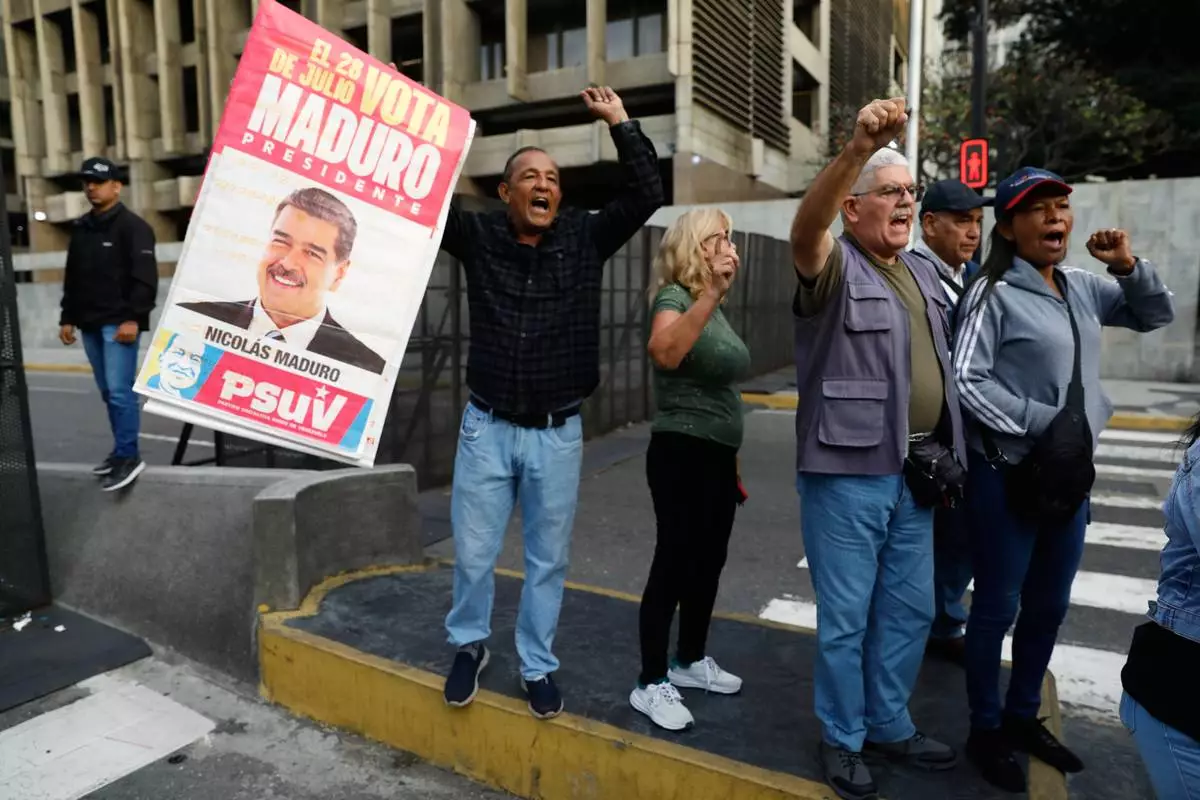
Supporters display a poster of Venezuelan President Nicolás Maduro in Caracas, Venezuela, Saturday, Jan. 3, 2026, after U.S. President Donald Trump announced Maduro had been captured and flown out of the country. (AP Photo/Cristian Hernandez)
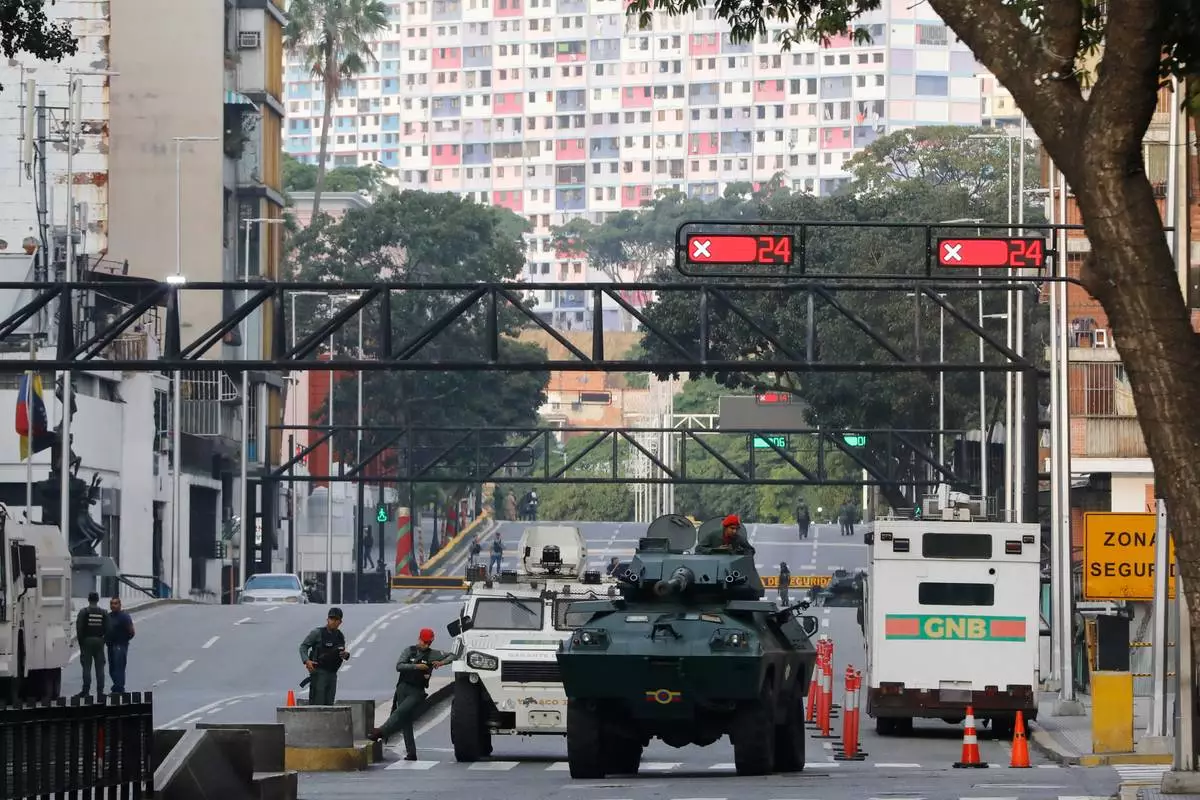
National Guard armored vehicles block an avenue leading to Miraflores presidential palace in Caracas, Venezuela, Saturday, Jan. 3, 2026. (AP Photo/Cristian Hernandez)
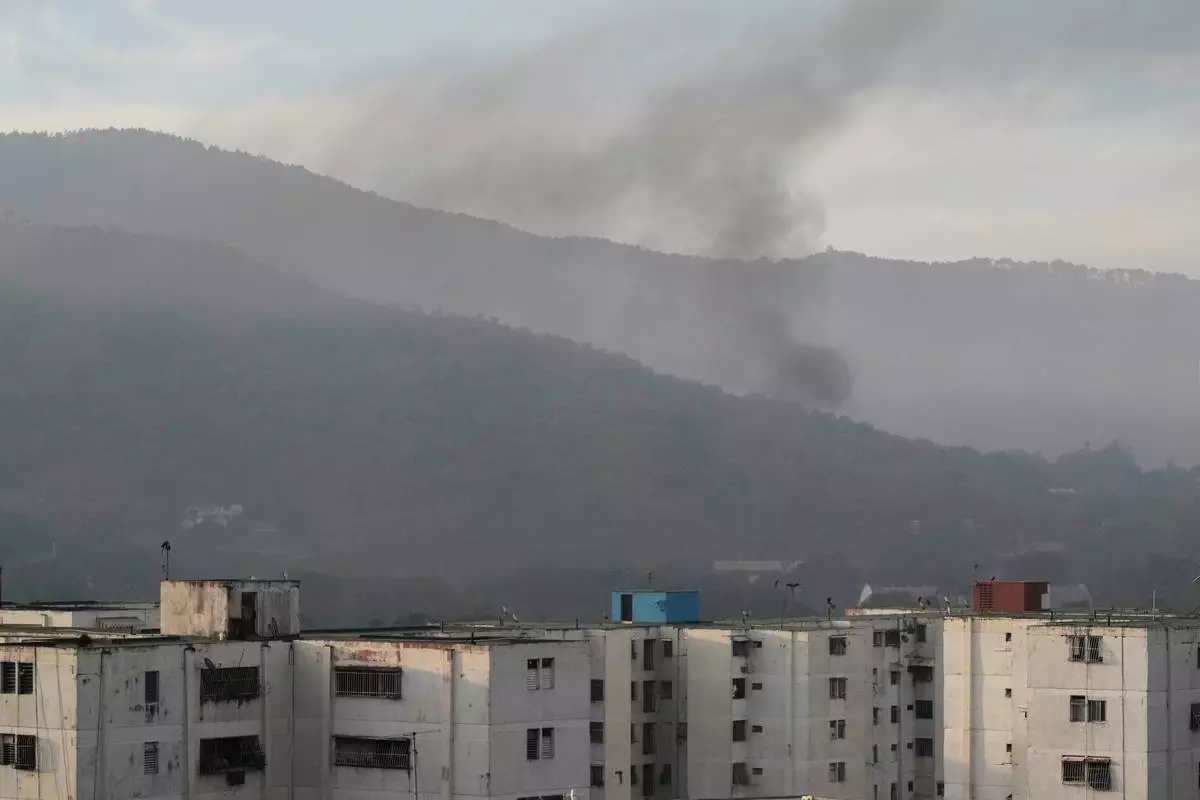
Smoke rises from Fort Tiuna, the main military garrison in Caracas, Venezuela, after multiple explosions were heard and aircraft swept through the area, Saturday, Jan. 3, 2026. (AP Photo/Matias Delacroix)
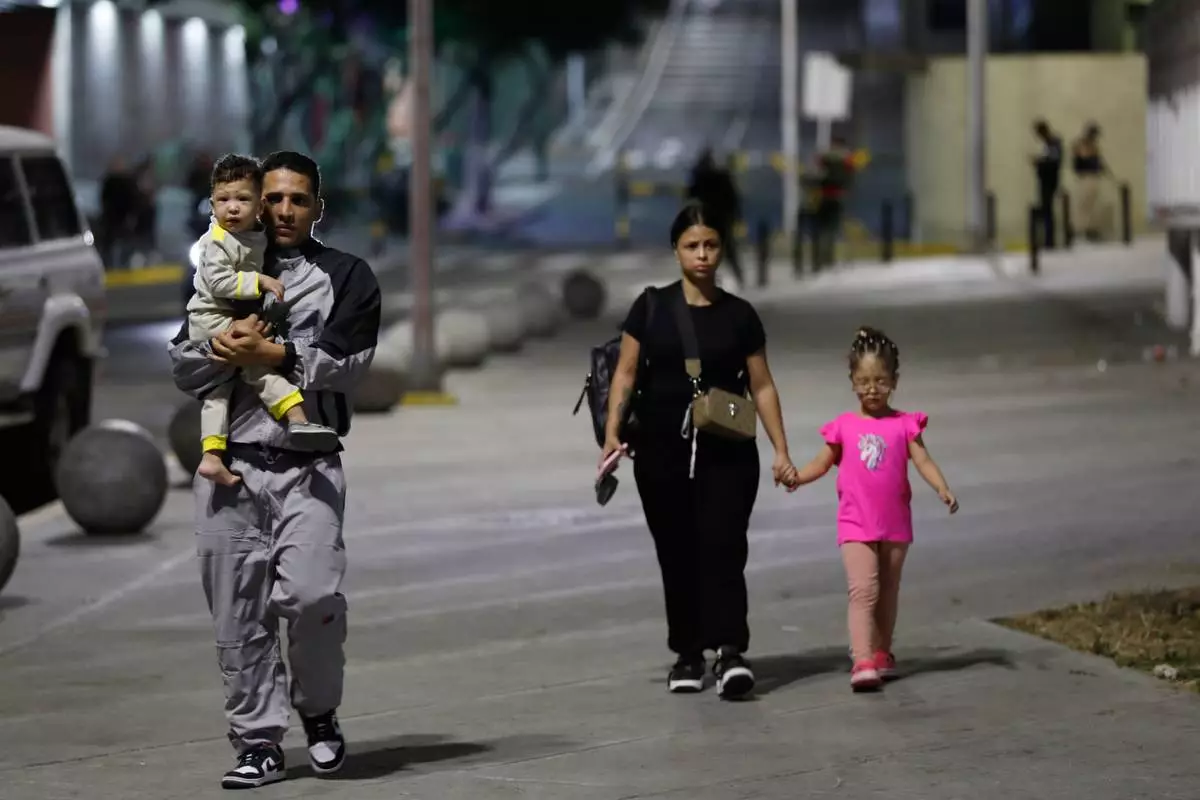
Pedestrians walk past the Miraflores presidential palace after explosions and low-flying aircraft were heard in Caracas, Venezuela, Saturday, Jan. 3, 2026. (AP Photo/Cristian Hernandez)
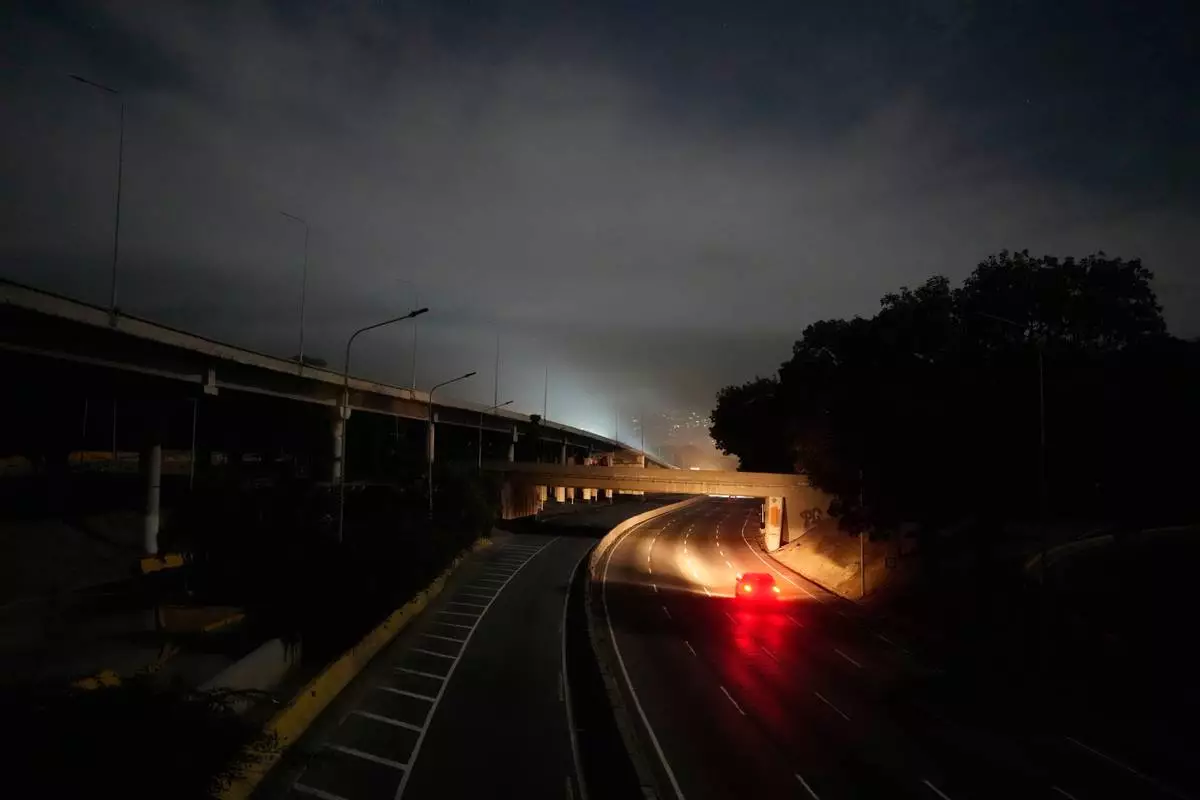
A vehicle drives along a darkened highway next to Fort Tiuna, the main military garrison in Caracas, Venezuela, after explosions and low-flying aircraft were heard, Saturday, Jan. 3, 2026. (AP Photo/Matias Delacroix)
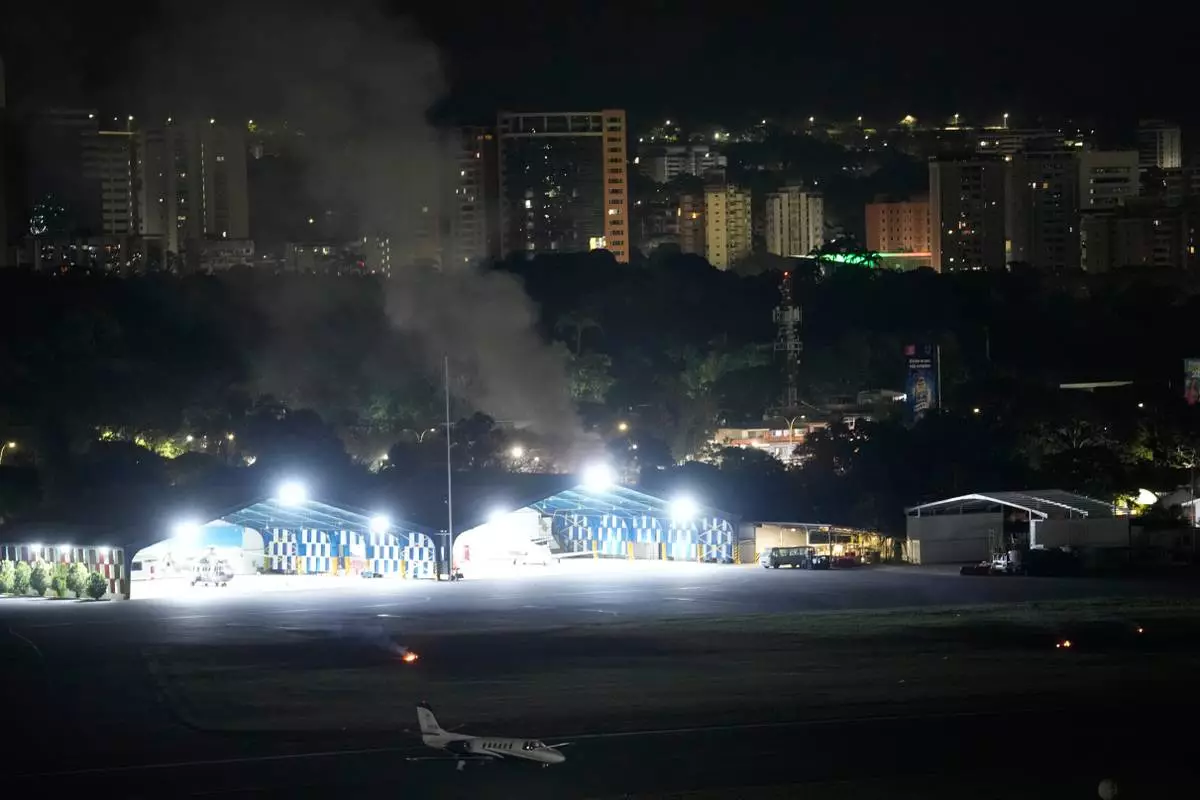
Smoke raises at La Carlota airport after explosions and low-flying aircraft were heard in Caracas, Venezuela, Saturday, Jan. 3, 2026. (AP Photo/Matias Delacroix)