The Chinese People's Liberation Army (PLA) Rocket Force, Joint Logistics Support Force and Armed Police began annual training for 2026 on Sunday, employing new weapons and equipment, and focusing on live-fire drills to boost combat readiness. At a unit of the PLA Rocket Force, officers and soldiers conducted full-process live-fire drills involving emergency mobilization, cross-area redeployment, and firepower assault. Multiple new missile launchers were heading to the training ground.
"This missile system we've deployed is a new high-precision killer weapon designed for rapid response and overwhelming strike capability. It features exceptional speed, strong penetration capabilities, and high accuracy, and all-weather operation readiness," said Li Dong, a member of the Rocket Force unit.
At the training zone, missile operators quickly established network connectivity and initiated launch procedures, while security teams deployed drones and robotic dogs to conduct comprehensive and multi-dimensional surveillance.
Amid complex electromagnetic interference, the troops immediately implemented camouflage measures, evacuated casualties, rotated combat positions, and performed emergency equipment repairs.
Confronted with an unidentified chemical threat, they operated in full protective gear and completed simulated missile launch operations as schedule.
At a motor transport brigade of the Joint Logistics Support Force, the soldiers collaborated with drivers from a combined arms brigade of the PLA Army to conduct joint training on multiple subjects in temperatures below minus 20 degrees Celsius, including rapid loading of heavy equipment, emergency repairs, mass refueling, and unmanned transport operations.
They also practiced complex maneuvers such as turning and climbing on icy roads, and switched seamlessly between driving empty and fully loaded vehicles.
"On snow-covered field training routes, vehicle traction drops significantly, making deviation and rollovers highly likely. This places considerable demands on drivers' skills and mental toughness. By intensifying snow driving training across varied terrains, we continuously build experience to enhance our capability in executing diverse support missions," said Cao Shuai, a member of the brigade under the Shenyang Joint Logistics Support Center.
In Kunming, capital city of southwest China's Yunnan Province, the armed police conducted multi-subject training. The engineering rescue platoon simulated search-and-rescue operations to evacuate individuals stranded in high-rise buildings.
At a chemical defense training ground simulating a contaminated zone, officers and soldiers identified chemical agent types, marked the contamination perimeter, and precisely mixed decontamination solutions to carry out comprehensive decontamination operations.
At a bomb disposal training site, the soldiers operated robots to hone explosive ordnance disposal capabilities in complex environments.
The counter-terrorism exercise, set in a residential area, posed significant challenges due to complex weather conditions and terrains. The armed police force rappelled from helicopters onto high-rise rooftops or descended along the exterior walls of high-rises to storm into rooms for counter-terrorism operations and emergency response, hostage rescue, execution of arrests, and emergency rescue, which tested their psychological resilience and honed their efficient team coordination and synergy capabilities.
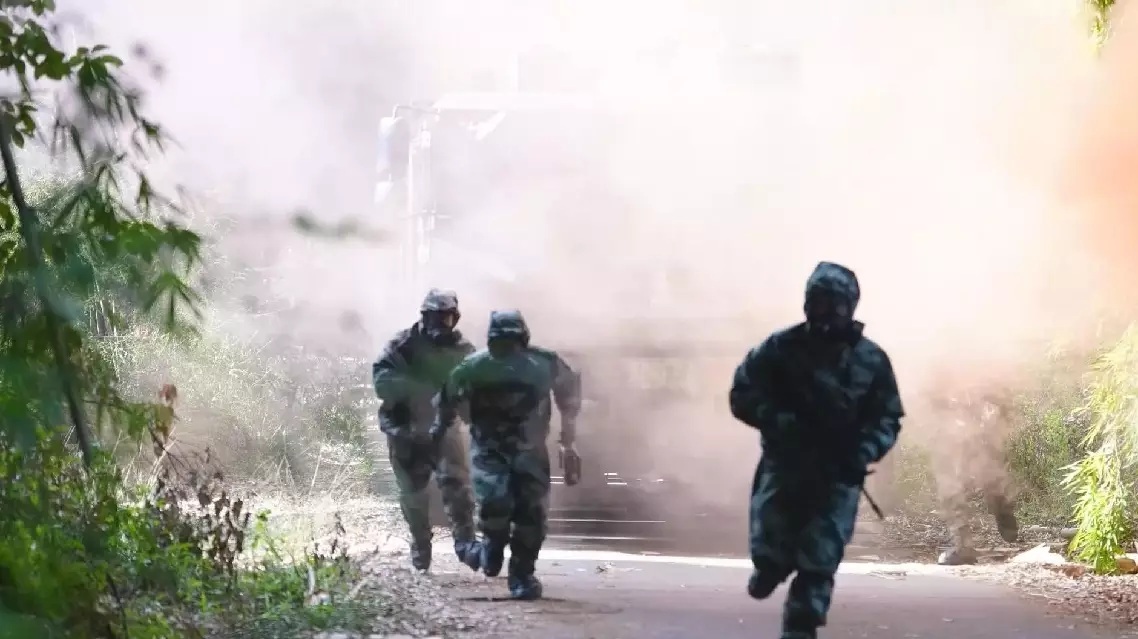
PLA Rocket Force, Joint Logistics Support Force, Armed Police start annual training for 2026