European countries on Monday gave their support to Denmark after U.S. President Donald Trump once again asserted that the United States needs Greenland, which is currently ruled by Denmark.
On his social media platform on Monday, Finnish President Alexander Stubb expressed his country's full support for Greenland and Denmark, stating that "No one decides for Greenland and Denmark but Greenland and Denmark themselves. Our Nordic friend Denmark has our full support."
Also on Monday, Norwegian Prime Minister Jonas Gahr Store said on social media that "Greenland is an integral part of the Kingdom of Denmark. Norway stands in full solidarity with the Kingdom of Denmark."
When asked about France's reaction, Foreign Ministry spokesman Pascal Confavreux said in an interview on Monday that Greenland belongs to the people of Greenland and Denmark, and it is up to them to determine their own future.
Trump said in a telephone interview on Sunday with The Atlantic that the United States "absolutely" needs Greenland. In response, Danish Prime Minister Mette Frederiksen said in a statement that the United States has no right to annex Greenland, urging Washington to stop making threats against a close ally and the Greenlandic people.
Last month, Trump announced the appointment of Louisiana Governor Jeff Landry as the U.S. special envoy to Greenland, renewing diplomatic tension between Washington and Denmark.
Since taking office in January 2025, Trump has repeatedly expressed interest in gaining control of Greenland, saying that he would not rule out the use of "military or economic coercion" to achieve that goal.

European countries voice support for Denmark following Trump's remarks on Greenland

European countries voice support for Denmark following Trump's remarks on Greenland
China registered smooth progress in carrying out space science research, application experiment and technology test projects aboard the country's space station in orbit, covering multiple fields such as life sciences, microgravity physics, and new space technologies and applications, according to the Technology and Engineering Center for Space Utilization (CSU), the Chinese Academy of Sciences.
The latest official data released by the CSU indicate that in 2025, the number of new scientific research and application projects for the country's space application system increased by 31, with about 867.5 kilograms of scientific materials such as uplink experimental modules, units and samples taken to the space station, with 83.92 kilograms of space science experiment samples brought back to the Earth, and with over 150 terabytes of scientific data obtained.
These developments enabled scientific-technological research teams in various fields to realize a series of original, cutting-edge and innovative progress and achievements, said the CSU. In the field of space life sciences, China successfully conducted its first space science experiment on mice on the Space Station, laying an important foundation for future systematic research on the impact of the space environment on mammals.
The four mice involved in the experiment had been sent into space aboard the Shenzhou-21 crewed spaceship on Oct 31, 2025, and were housed in a specialized habitat on the space station before returning to the Earth on Nov 14.
An in-situ electrochemical and optical research project on lithium-ion batteries for space applications was also carried out on the Space Station.
The research is expected to further advance the fundamental theories of electrochemistry and provide a basis for optimizing current on-orbit battery systems and designing next-generation high-energy-density, high-safety space batteries. "In the future, China plans to launch two flagship astronomical facilities. One is the Chinese Survey Space Telescope (CSST), also known as the Xuntian Space Telescope. It's capable of making significant scientific discoveries in cosmology and from nearby galaxies and the Milky Way. The other is the HERD -- a high energy cosmic radiation detection facility, which is capable of detecting cosmic rays with extremely high sensitivity, to further understand dark matter, and the origin of cosmic ray acceleration and other related extreme cosmic phenomena. It is also capable of making new and more comprehensive insights into gamma-ray surveys," said Ba Jin, senior engineer of the CSU.
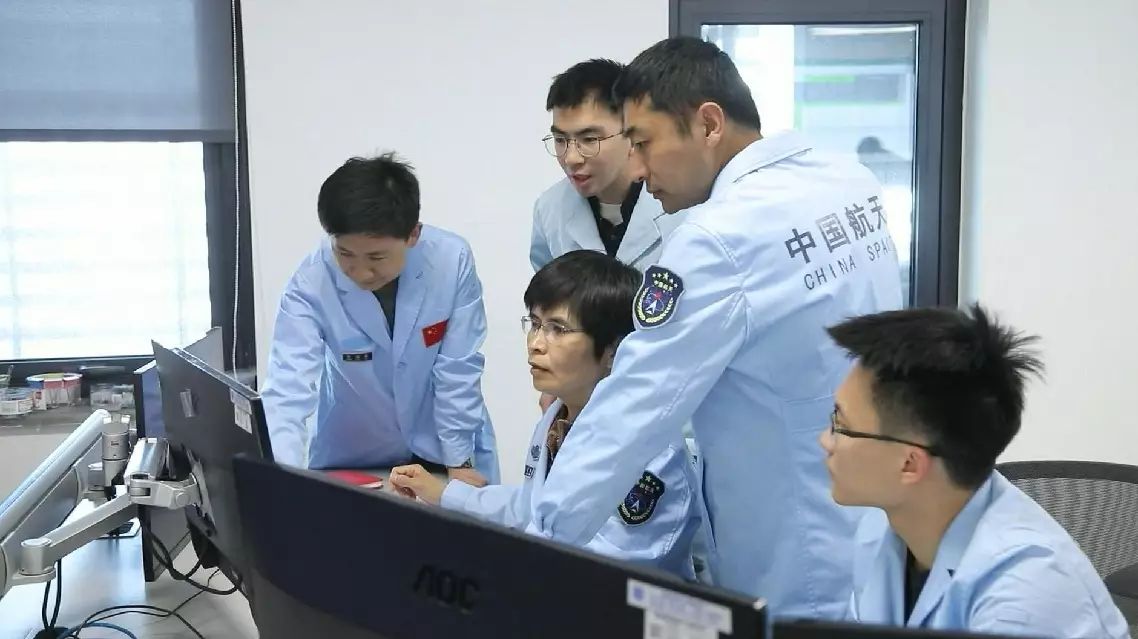
China registers smooth progress in space science research on space station in 2025