Skip to Content Facebook Feature Image

Lyte Emerges From Stealth With $107 Million to Build the Perception Foundation for Physical AI

Business

Lyte Emerges From Stealth With $107 Million to Build the Perception Foundation for Physical AI
Business

Business

Lyte Emerges From Stealth With $107 Million to Build the Perception Foundation for Physical AI

2026-01-06 07:22 Last Updated At:13:26

MOUNTAIN VIEW, Calif.--(BUSINESS WIRE)--Jan 5, 2026--

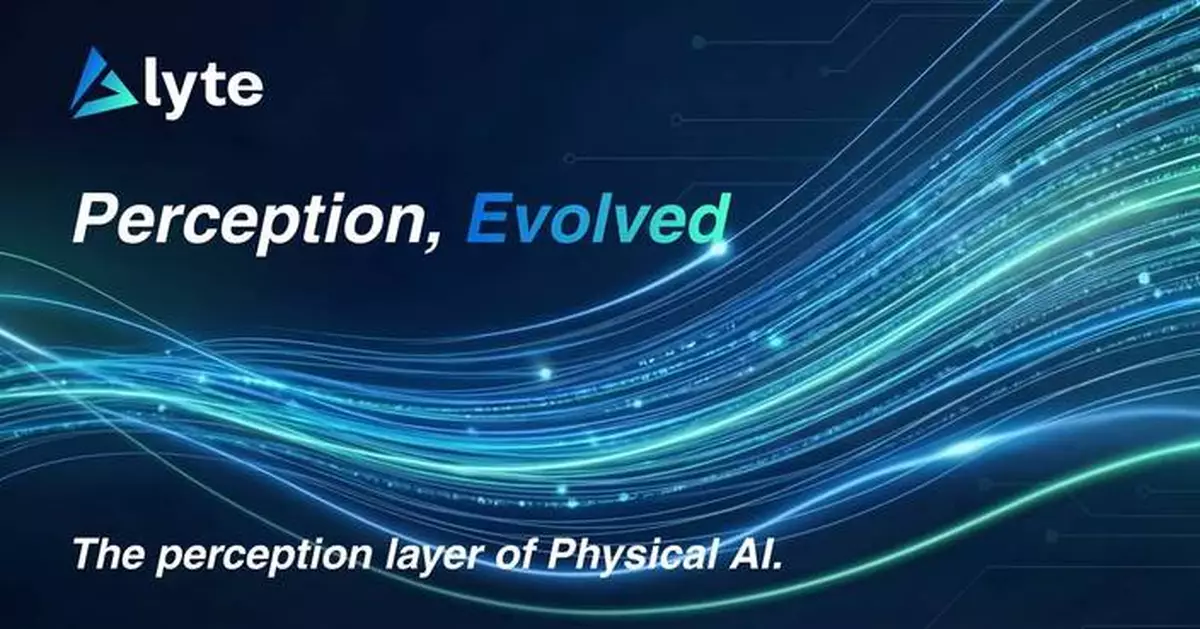
Lyte, an end-to-end integrated perception company for robotics and Physical AI, today emerged from stealth with $107 million in aggregate funding. Its mission is to give robots the ability to see, understand, and operate safely in the physical world.

This press release features multimedia. View the full release here: https://www.businesswire.com/news/home/20260105818373/en/

Headquartered in Mountain View, California, Lyte was founded by Alexander Shpunt, Arman Hajati, and Yuval Gerson, the key architects behind Apple’s depth-sensing and perception technologies. CEO Alexander Shpunt co-founded and served as CTO of PrimeSense, the 3D sensing company that powered Microsoft Kinect and later became the foundation of Apple’s depth platform after its 2013 acquisition.

Lyte has assembled a world-class team spanning sensing, silicon, and Physical AI. The company’s founding investor and Chairman of the Board is Avigdor Willenz, a pioneering semiconductor entrepreneur behind several of the most influential silicon platforms of the past three decades.

The company has raised an aggregate of $107M from some of the industry's premier investors, including Avigdor Willenz's group, Fidelity Management & Research Company, Atreides Management, Exor Ventures, Key1 Capital, and Venture Tech Alliance. With this funding, Lyte is building the perception foundation for autonomous machines. Its core product, LyteVision, integrates advanced 4D sensing, RGB imaging, and motion awareness into a single platform, delivering unified spatial and visual data through one connection. LyteVision enables a wide range of Physical AI platforms, including autonomous mobile robots, robotic arms, quadrupeds, robotaxis, and humanoids. Engineered for safety, reliability, and performance from the hardware up, the system is paired with an AI-driven operating layer that continuously advances alongside breakthroughs in vision, language, and action models - enabling Physical AI systems to perceive, reason, and act with increasing intelligence over time.

The AI robotics market is projected to reach $125 billion by 2030, according to leading researchers 1, yet over 60% of industrial companies lack the internal capability to implement robotic automation, including sensor integration, according to McKinsey.

The company's approach addresses a structural problem in robotics. Teams today assemble perception from multiple vendors, then spend months calibrating sensors, writing fusion software, and debugging integration failures. Lyte's vertically integrated stack eliminates that cycle.

"Physical AI will change how the world works, but only if robots can see it clearly," said Alexander Shpunt, CEO and Co-Founder. "After helping shape how billions of people interact with technology, we’ve assembled an extraordinary team to build the perception layer that enables robots to operate safely and reliably at scale."

“Lyte is building at the right layer, at the right moment,” said Avigdor Willenz, founding investor and Chairman. “I’ve seen how foundational technologies unlock entire industries. What stands out here is the depth of the team and the discipline to solve perception as a system - where lasting value is created.”

"Lyte is building core infrastructure for Physical AI: a perception platform that helps robots safely understand and interact with the real world," said Gavin Baker, Managing Partner, Atreides Management. "The founders already pioneered one era of 3D sensing and are among the select few with the credibility and technical depth to usher in a new frontier defined by coherent 4D vision and full-stack perception."

Lyte’s perception platform was recognized at CES 2026 with a Best of Innovation Award in Robotics and as an Honoree in Vehicle Tech and Advanced Mobility, selected from a record 3,600 submissions. Lyte will present the technology at CES through private, by-appointment demonstrations. Inquiries: info@lyte.ai.

About Lyte

Lyte builds perception systems for Physical AI operating in complex environments. The company combines custom silicon, integrated sensors, and software into a unified platform for robotics, mobility, and next-generation automation. Lyte is headquartered in Mountain View, California, with a global presence. For more information, visit www.lyte.ai.

1All About AI aggregated research, including from Grand View Research, Mordor Intelligence, and Precedence Research; Investor Place
Learn more at lyte.ai

Learn more at lyte.ai

CARACAS, Venezuela (AP) — Venezuela’s opposition supporters have long hoped for the day when Nicolás Maduro is no longer in power — a dream that was fulfilled when the U.S. military whisked the authoritarian leader away. But while Maduro is in jail in New York on drug trafficking charges, the leaders of his repressive administration remain in charge.

The nation's opposition — backed by consecutive Republican and Democratic administrations in the U.S. — for years vowed to immediately replace Maduro with one of their own and restore democracy to the oil-rich country. But U.S. President Donald Trump delivered them a heavy blow by allowing Maduro’s vice president, Delcy Rodríguez, to assume control.

Meanwhile, most opposition leaders, including Nobel Peace Prize winner María Corina Machado, are in exile or prison.

“They were clearly unimpressed by the sort of ethereal magical realism of the opposition, about how if they just gave Maduro a push, it would just be this instant move toward democracy,” David Smilde, a Tulane University professor who has studied Venezuela for three decades, said of the Trump administration.

The U.S. seized Maduro and first lady Cilia Flores in a military operation Saturday, removing them both from their home on a military base in Venezuela’s capital, Caracas. Hours later, Trump said the U.S. would “run” Venezuela and expressed skepticism that Machado could ever be its leader.

“She doesn’t have the support within, or the respect within, the country,” Trump told reporters. “She’s a very nice woman, but she doesn’t have the respect.”

Ironically, Machado's unending praise for the American president, including dedicating her Nobel Peace Prize to Trump and her backing of U.S. campaigns to deport Venezuelan migrants and attack alleged drug traffickers in international waters, has lost her some support at home.

Machado rose to become Maduro's strongest opponent in recent years, but his government barred her from running for office to prevent her from challenging — and likely beating — him in the 2024 presidential election. She chose retired ambassador Edmundo González Urrutia to represent her on the ballot.

Officials loyal to the ruling party declared Maduro the winner mere hours after the polls closed, but Machado's well-organized campaign stunned the nation by collecting detailed tally sheets showing González had defeated Maduro by a 2-to-1 margin.

The U.S. and other nations recognized González as the legitimate winner.

However, Venezuelans identify Machado, not González, as the winner, and the charismatic opposition leader has remained the voice of the campaign, pushing for international support and insisting her movement will replace Maduro.

In her first televised interview since Maduro's capture, Machado effusively praised Trump and failed to acknowledge his snub of her opposition movement in the latest transition of power.

“I spoke with President Trump on Oct. 10, the same day the prize was announced, not since then,” she told Fox News on Monday. “What he has done as I said is historic, and it’s a huge step toward a democratic transition.”

U.S. Secretary of State Marco Rubio on Sunday seemed to walk back Trump's assertion that the U.S. would “run” Venezuela. In interviews, Rubio insisted that Washington will use control of Venezuela’s oil industry to force policy changes, and called its current government illegitimate. The country is home to the world’s largest proven crude oil reserves.

Neither Trump nor Rodríguez have said when, or if, elections might take place in Venezuela.

Venezuela’s constitution requires an election within 30 days whenever a president becomes “permanently unavailable” to serve. Reasons listed include death, resignation, removal from office or “abandonment” of duties as declared by the National Assembly. That electoral timeline was rigorously followed when Maduro’s predecessor, Hugo Chávez, died of cancer in 2013.

On Tuesday, U.S. Sen. Lindsey Graham, a close Trump ally who traveled with the president on Air Force One on Sunday, said he believes an election will happen but did not specify when or how.

“We’re going to build the country up – infrastructure wise – crescendoing with an election that will be free,” the South Carolina Republican told reporters.

But Maduro loyalists in the high court Saturday, citing another provision of the constitution, declared Maduro's absence “temporary” meaning there is no election requirement. Instead, the vice president — which is not an elected position — takes over for up to 90 days, with a provision to extend to six months if approved by the National Assembly, which is controlled by the ruling party.

In its ruling, Venezuela’s Supreme Court made no mention of the 180-day limit, leading to speculation that Rodríguez could try to cling to power as she seeks to unite ruling party factions and shield it from what would certainly be a stiff electoral challenge.

Machado on Monday criticized Rodríguez as “one the main architects of torture, persecution, corruption, narco-trafficking … certainly not an individual that can be trusted by international investors.”

Even if an election takes place, Machado and González would first have to find a way back into Venezuela.

González has been in exile in Spain since September 2024 and Machado left Venezuela last month when she appeared in public for the first time in 11 months to receive her Nobel Prize in Norway.

Ronal Rodríguez, a researcher at the Venezuela Observatory in Colombia’s Universidad del Rosario, said the Trump administration's decision to work with Rodríguez could harm the nation's “democratic spirit.”

“What the opposition did in the 2024 election was to unite with a desire to transform the situation in Venezuela through democratic means, and that is embodied by María Corina Machado and, obviously, Edmundo González Urrutia,” he said. “To disregard that is to belittle, almost to humiliate, Venezuelans.”

A government supporter holds an image of President Nicolas Maduro during a women's march to demand his return in Caracas, Venezuela, Tuesday, Jan. 6, 2026, three days after U.S. forces captured him and his wife. (AP Photo/Matias Delacroix)

A government supporter holds an image of President Nicolas Maduro during a women's march to demand his return in Caracas, Venezuela, Tuesday, Jan. 6, 2026, three days after U.S. forces captured him and his wife. (AP Photo/Matias Delacroix)

In this courtroom sketch, Venezuelan President Nicolas Maduro, left, and his wife, Cilia Flores, second from right, appear in Manhattan federal court with their defense attorneys Mark Donnelly, second from left, and Andres Sanchez, Monday, Jan. 5, 2026, in New York. (Elizabeth Williams via AP)

In this courtroom sketch, Venezuelan President Nicolas Maduro, left, and his wife, Cilia Flores, second from right, appear in Manhattan federal court with their defense attorneys Mark Donnelly, second from left, and Andres Sanchez, Monday, Jan. 5, 2026, in New York. (Elizabeth Williams via AP)

FILE - Venezuelan Vice President Delcy Rodriguez smiles during a press conference at the Miraflores presidential palace in Caracas Venezuela, Nov. 18, 2024. (AP Photo/Ariana Cubillos, File)

FILE - Venezuelan Vice President Delcy Rodriguez smiles during a press conference at the Miraflores presidential palace in Caracas Venezuela, Nov. 18, 2024. (AP Photo/Ariana Cubillos, File)

Recommended Articles