Artificial intelligence is already reshaping China's industrial landscape, moving beyond conceptual buzzwords to become a tangible force driving the transformation of work and productivity.
In sectors from manufacturing to energy, AI is taking on complex tasks, optimizing processes, and creating new dynamics between human workers and intelligent systems.
In Wuhu, east China's Anhui province, the cement industry offers a window into this shift.
Veteran technician Pei Jun used to grapple with the immense complexity of a core part of cement production -- the calcination of cement clinker. The process requires real-time monitoring of hundreds of parameters under increasingly stringent environmental and efficiency standards. The mental and physical toll was significant.
Now, AI systems handle this relentless data analysis and parameter adjustment, having absorbed the deep knowledge of experts like Pei. But rather than replacing him, this shift has redirected his role. He now collaborates with engineers to train algorithms and helps steer his company's broader AI integration strategy.
"When we were operators, we might have only focused on internal operations or optimizing energy consumption data for a single shift. However, with the advancement of its own capabilities and applications, particularly in terms of generalization and scenario-based deployment, AI now covers a much broader scope and addresses a wider array of scenarios. To describe the role AI plays now, I think the term 'partner' is appropriate. It is certainly more efficient than a single individual, and it can process hundreds or even thousands of data groups simultaneously, alleviating the burden (on human workers) of these repetitive tasks," Pei said.
This evolution towards partnership aligns with national policy. Last year, the State Council's "AI Plus" action guideline called for smarter work models, emphasizing AI's role in creating new jobs and empowering existing ones, while exploring new frameworks for human-machine teamwork.
Experts stress that the future lies in complementary strengths. Machines excel at processing scale and pattern recognition, while humans bring irreplaceable creativity, critical judgment, and emotional intelligence to the table.
"In this era of AI, which abilities will be most vital? I see two core ones. First is creativity: the capacity to pose entirely new questions within an existing framework or body of knowledge. It means breaking free from the constraints of past understanding and conventional boundaries—thinking unconventionally to generate transformative innovations. Second is critical thinking. As AI produces vast amounts of information, we must discern quality, relevance, and what truly aligns with human values. The choice cannot be purely algorithmic; it requires both rational analysis and the empathy that defines our humanity. That human dimension—our warmth and discernment—is what will make our decisions meaningful," said Liu Jia, chair of the Department of Psychology and Cognitive Science at Tsinghua University.
This transition prompts deeper reflection on human identity in the age of machines. At a recent Peking University symposium on the intelligent revolution and social restructuring, scholars urged a thoughtful approach, advocating for guardrails that ensure technology serves humanity.
"AI serves a supportive role and is, in essence, a partner, perhaps more precisely, a 'governed partner.' Clear and well-defined regulations must be established concerning laws, regulations, ethical governance, and related aspects to guide the development of artificial intelligence. We must adhere to the principle of using technology for good. That is to say, the ultimate purpose of developing artificial intelligence is to serve the comprehensive development of humanity," said Gong Piming, associate researcher of the Institute of Macroeconomic Research of the National Development and Reform Commission.
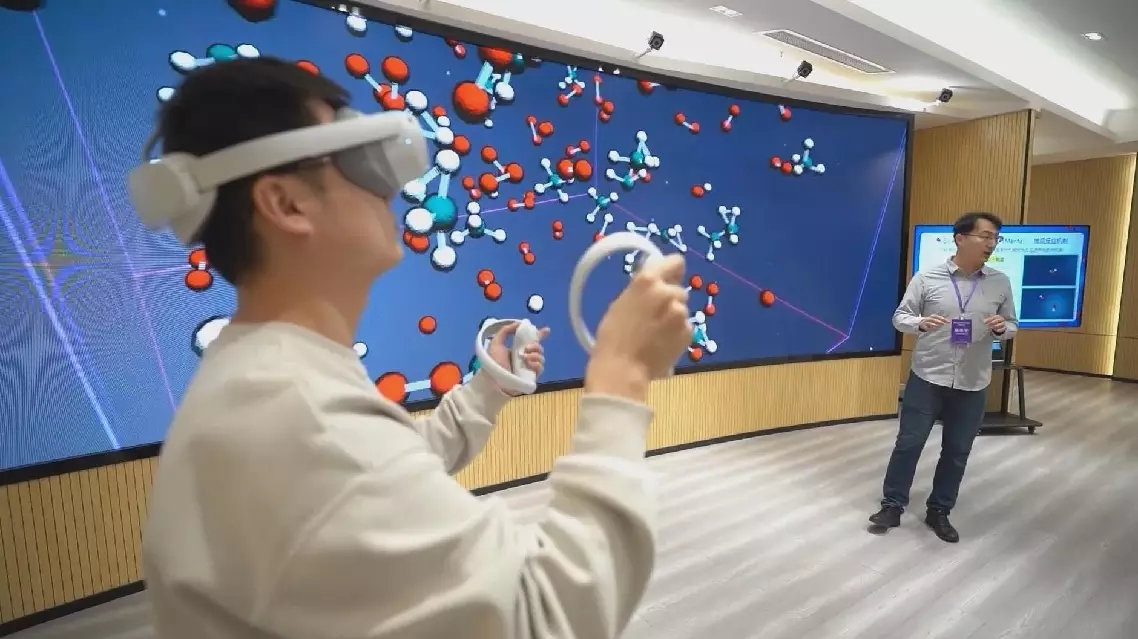
AI reshapes traditional industries, fostering new model of human-machine collaboration