Skip to Content Facebook Feature Image

Transcarent Adds Scheduling, Symptom Checking, Total Recall Memory Engine™, and Personalized Health Path™ to its WayFinding™ 2.0 Platform

Business

Transcarent Adds Scheduling, Symptom Checking, Total Recall Memory Engine™, and Personalized Health Path™ to its WayFinding™ 2.0 Platform
Business

Business

Transcarent Adds Scheduling, Symptom Checking, Total Recall Memory Engine™, and Personalized Health Path™ to its WayFinding™ 2.0 Platform

2026-01-07 01:02 Last Updated At:13:22

SAN FRANCISCO & LAS VEGAS--(BUSINESS WIRE)--Jan 6, 2026--

Today at the Consumer Electronics Show, Transcarent announced major new agentic capabilities added to its WayFinding platform, the first and only health and care experience to use generative AI to directly and comprehensively improve people’s health. New capabilities include voice AI scheduling to match Members with the right high-quality providers, book appointments, and offer advanced symptom-checking. The platform includes a Total Recall Memory Engine that learns each person’s preferences, history, and patterns to anticipate their next best action to take.

This press release features multimedia. View the full release here: https://www.businesswire.com/news/home/20260106204248/en/

New Features Expand on the WayFinding Platform’s Existing Strengths

Since the launch of the WayFinding platform in 2024, our Members have had the benefit of personalized benefits navigation, real-time clinical guidance, and access to care in as little as 60 seconds, all in one easy to use experience.

Advanced agentic capabilities remove additional friction that people face daily in healthcare:

These new capabilities empower health consumers with AI agents, moving from answers to action. Innovative applications of AI, powerful data and intelligence, trusted partners, high-quality networks, and one comprehensive and simple consumer experience make the WayFinding 2.0 platform a powerful and hyper-personalized necessity for health consumers.

“We were the first to put the power of clinically developed, trusted, generative AI into the hands of health consumers, and now more than a million people have access to our WayFinding experience,” said Glen Tullman, Chief Executive Officer of Transcarent. “To lead in the AI space today, you need a combination of vision, capabilities, and the willingness to invest. Our continued product progress and innovation, along with our prioritization of safety, demonstrate that commitment. We’ve officially moved beyond the ‘chat assistant era’ into the ‘agentic action era’ in healthcare.”

Our Commitment to Safe and Responsible AI

As a member of the Data & Trusted AI Alliance (D&TA), Transcarent collaborates with leading global companies to create transparent and trustworthy AI data standards that promote responsible use and provide real value to inform policy creation. Transcarent AI is built for healthcare from the ground up. Transcarent acts as a HIPAA covered entity and is certified to HITRUST, SOC 2, and ISO 27001. Our governance model is guided by the Organization of Economic Co-operation and Development (OECD), the first intergovernmental standard on AI that promotes innovative and trustworthy AI, and the National Institute of Standards and Technology (NIST) whose risk management framework incorporates trustworthiness considerations in the design, development, deployment, and use of AI systems. We apply these principles through human-in-the-loop testing, code review, and regular audits and monitoring to prevent bias, protect privacy, and ensure safe, ethical use. The company’s generative AI products are developed under clinician oversight. These capabilities are built to support consumers in navigating their care, not to diagnose, treat, or replace clinical judgment.

About Transcarent

Transcarent is the One Place for Health and Care ™, bringing medical, pharmacy, and point solutions together with the WayFinding ™ experience, the first and only generative AI-powered health and care platform for health consumers. Our WayFinding experience, paired with transparent and consumer-driven pharmacy care, 2nd.MD expert medical opinions, and virtual primary care, works seamlessly with comprehensive Care Experiences – Cancer Care, Surgery Care, and Weight Health – to support people with all of their health needs, simple or serious. More than 1,700 employers and health plans rely on us to provide information, guidance, and care, empowering health consumers with more choice, an experience they love, access to higher-quality care, and lower costs for more than 21 million people. For more information, visit www.transcarent.com, and follow us on LinkedIn.
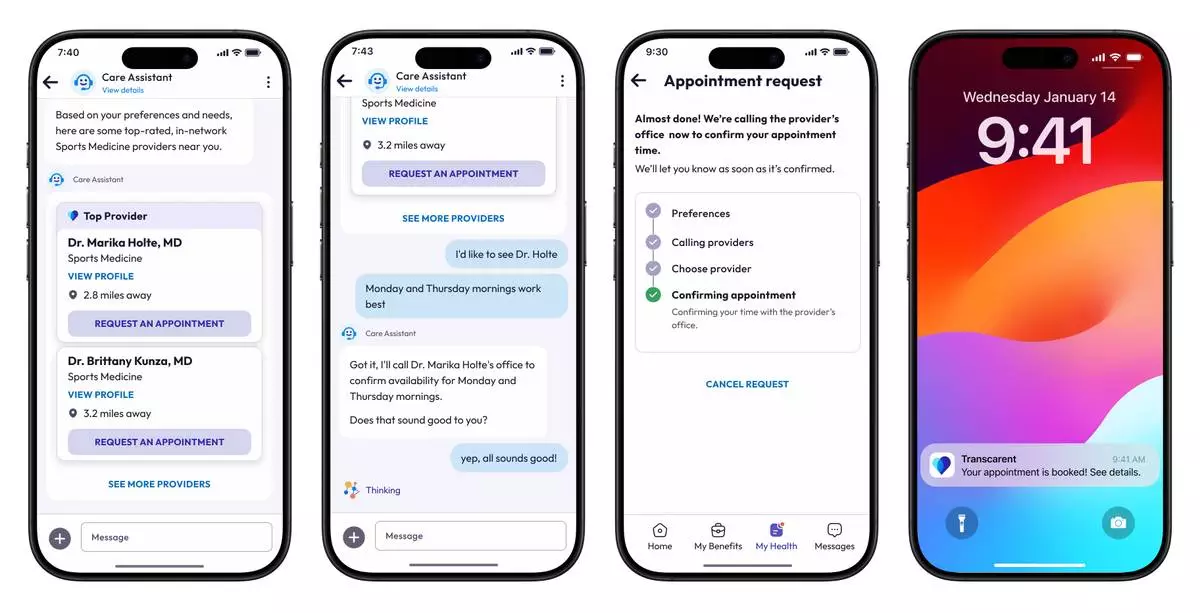
Transcarent announced major new agentic capabilities added to its WayFinding™ platform, including voice AI scheduling to match Members with the right high-quality providers, book appointments, and offer advanced symptom-checking.


Transcarent announced major new agentic capabilities added to its WayFinding™ platform, including voice AI scheduling to match Members with the right high-quality providers, book appointments, and offer advanced symptom-checking.

WASHINGTON (AP) — President Donald Trump's administration on Wednesday sought to assert its control over Venezuelan oil, seizing a pair of sanctioned tankers transporting petroleum and announcing plans to relax some sanctions so the U.S. can oversee the sale of Venezuela’s petroleum worldwide.

Trump's administration intends to control the distribution of Venezuela’s oil products globally following its ouster of President Nicolás Maduro in a surprise nighttime raid, with the Energy Department saying the “only oil transported in and out of Venezuela” will be through approved channels consistent with U.S. law and national security interests. That level of control over the world’s largest proven reserves of crude oil could give the Trump administration a tight hold on oil supplies globally in ways that could enable it to influence prices.

The seizures of the tankers in the North Atlantic and the Caribbean Sea reflect the Republican administration’s determination to enforce an existing oil embargo on Venezuela as Trump has pledged the U.S. will “run” the country.

Speaking to reporters on Capitol Hill, Secretary of State Marco Rubio suggested the oil seized by the U.S. with sanctioned vessels would be sold as part of the deal announced by Trump on Tuesday under which Venezuela would provide up to 50 million barrels of oil to the U.S.

“One of those ships that was seized that had oil in the Caribbean, you know what the interim authorities are asking for in Venezuela?” Rubio said. “They want that oil that was seized to be part of this deal. They understand that the only way they can move oil and generate revenue and not have economic collapse is if they cooperate and work with the United States.”

The press office for Venezuela’s government did not immediately respond to an Associated Press request for comment on the seizures.

U.S. European Command announced in a social media post the merchant vessel Bella 1 was seized in the North Atlantic for “violations of U.S. sanctions." The U.S. had been pursuing the tanker since last month after it tried to evade a blockade on sanctioned oil vessels around Venezuela.

Homeland Security Secretary Kristi Noem then revealed U.S. forces also took control of the motor tanker M Sophia in the Caribbean Sea. Noem said in a social media post both ships were “either last docked in Venezuela or en route to it."

The two ships taken over Wednesday join at least two others taken by U.S. forces last month, the Skipper and the Centuries.

The Bella 1 had been cruising across the Atlantic nearing the Caribbean on Dec. 15 when it abruptly turned and headed north, toward Europe. The change in direction came days after the first U.S. tanker seizure of a ship on Dec. 10 after it had left Venezuela carrying a cargo of oil.

The U.S. Coast Guard tried to board the Bella 1 in the Caribbean in December as it headed for Venezuela. Instead, the ship fled across the Atlantic. U.S. European Command said a Coast Guard vessel had tracked the ship “pursuant to a warrant issued by a U.S. federal court."

It was sanctioned by the U.S. in 2024 on allegations of smuggling cargo for a company linked to Lebanese militant group Hezbollah, which is backed by Iran.

As the U.S. pursued it, the Bella 1 was renamed Marinera and flagged to Russia, shipping databases show. A U.S. official, who spoke on the condition of anonymity to discuss sensitive military operations, also confirmed that the ship’s crew had painted a Russian flag on the side of the hull.

The Russian Foreign Ministry said Wednesday that it had information about Russian nationals among the Marinera's crew.

“Taking into account the incoming information about Russian citizens among the crew, we demand that the American side ensure humane and dignified treatment of them, strictly respect their rights and interests, and not hinder their speedy return to their homeland,” the ministry said in a statement carried by Russia’s state news agencies Tass and RIA Novosti.

Separately, senior Russian lawmaker Andrei Klishas decried the U.S. action as “blatant piracy.”

Meanwhile, the Trump administration is “selectively” removing sanctions to enable the shipping and sale of Venezuelan oil to markets worldwide, according to an outline of the policies published Wednesday by the Energy Department.

The oil sales are slated to begin immediately with the sale of 30 million to 50 million barrels from the South American country. The U.S. government said the sales “will continue indefinitely,” with the proceeds settling in U.S.-controlled accounts at “globally recognized banks.” The money would be disbursed to the U.S. and Venezuelan populations at the “discretion” of Trump’s government.

The U.S. plans to authorize the importation of oil field equipment, parts and services to increase Venezuela’s oil production, which has been roughly 1 million barrels a day. The Trump administration has indicated it also will invest in Venezuela’s electricity grid to increase production and the quality of life for people in Venezuela, whose economy has been unraveling amid changes to foreign aid and cuts to state subsidies, making necessities, including food, unaffordable to millions.

Earlier Wednesday, open-source maritime tracking sites showed the position of the now-named Marinera as between Scotland and Iceland, traveling north.

Flight tracking websites showed several U-28A U.S. special operations aircraft landing at Wick John O’Groats airport on the northern tip of Scotland, before flying further north toward Iceland. P8 Poseidon submarine-hunting aircraft and KC-135 refueling planes were also seen on tracking websites and heading to the area near the tanker.

After the seizure, the U.K. defense ministry said Britain’s military provided support, including surveillance aircraft and a support ship, for the operation. It said the “enabling support” — including the use of U.K. bases — was “in full compliance with international law.”

U.K. Defense Secretary John Healey said the action was part of global efforts to crack down on sanctions-busting.

“This ship, with a nefarious history, is part of a Russian-Iranian axis of sanctions evasion which is fueling terrorism, conflict, and misery from the Middle East to Ukraine,” he said. “The U.K. will continue to step up our action against shadow fleet activity to protect our national security, our economy, and global stability — making Britain secure at home and strong abroad.”

The capture of the second tanker announced Wednesday was much less prolonged. A ship named M Sophia is on the U.S. sanctions list for moving illicit cargos of oil from Russia.

The ship is “running dark,” not having transmitted location data since July. Tankers involved in smuggling often turn off their transponders or broadcast inaccurate data to hide their locations.

Samir Madani, co-founder of TankerTrackers.com, said his organization used satellite imagery and surface-level photos to document that at least 16 tankers had left the Venezuelan coast since Saturday, after the U.S. captured Maduro.

The M Sophia is among those ships, Madani said, citing a recent photo showing it in the waters near Jose Terminal, Venezuela’s main oil export hub.

Lawless reported from London.

A local walks past a mural featuring oil pumps and wells in Caracas, Venezuela, Tuesday, Jan. 6, 2026. (AP Photo/Matias Delacroix)

A local walks past a mural featuring oil pumps and wells in Caracas, Venezuela, Tuesday, Jan. 6, 2026. (AP Photo/Matias Delacroix)

A government supporter holds an image of President Nicolas Maduro during a women's march to demand his return in Caracas, Venezuela, Tuesday, Jan. 6, 2026, three days after U.S. forces captured him and his wife. (AP Photo/Matias Delacroix)

A government supporter holds an image of President Nicolas Maduro during a women's march to demand his return in Caracas, Venezuela, Tuesday, Jan. 6, 2026, three days after U.S. forces captured him and his wife. (AP Photo/Matias Delacroix)

Recommended Articles