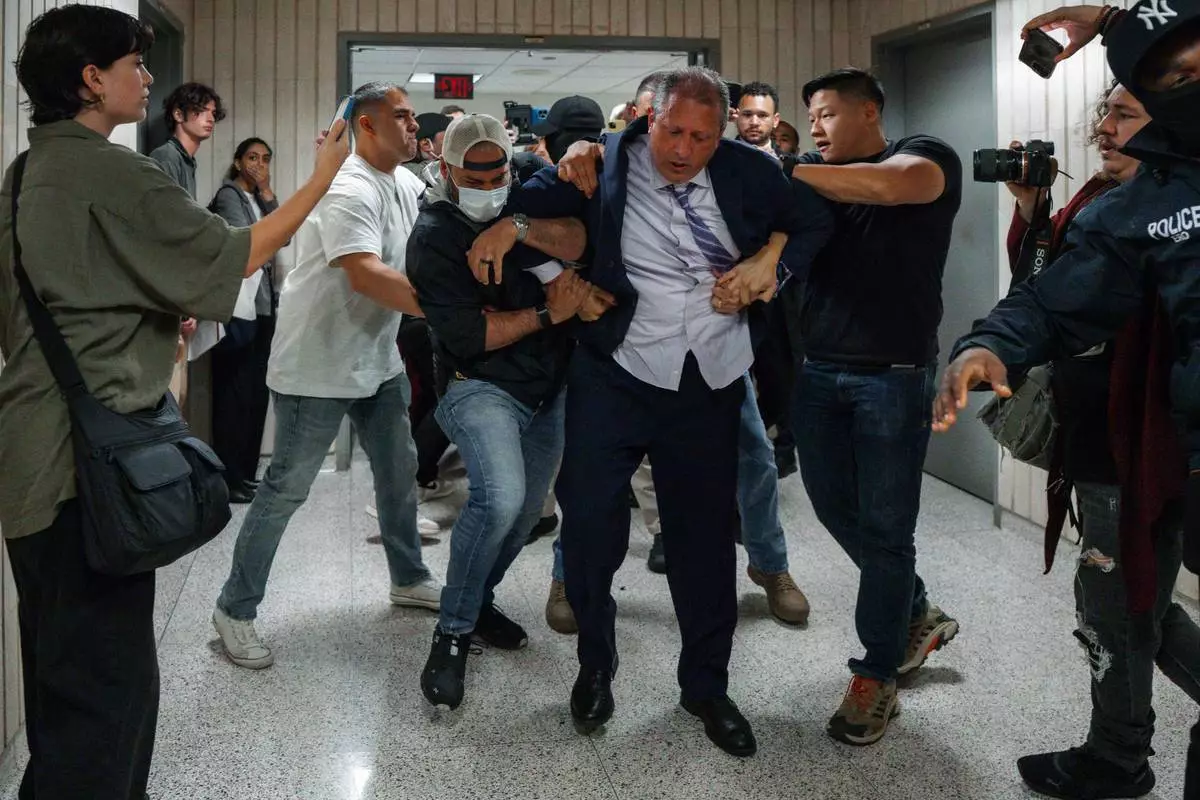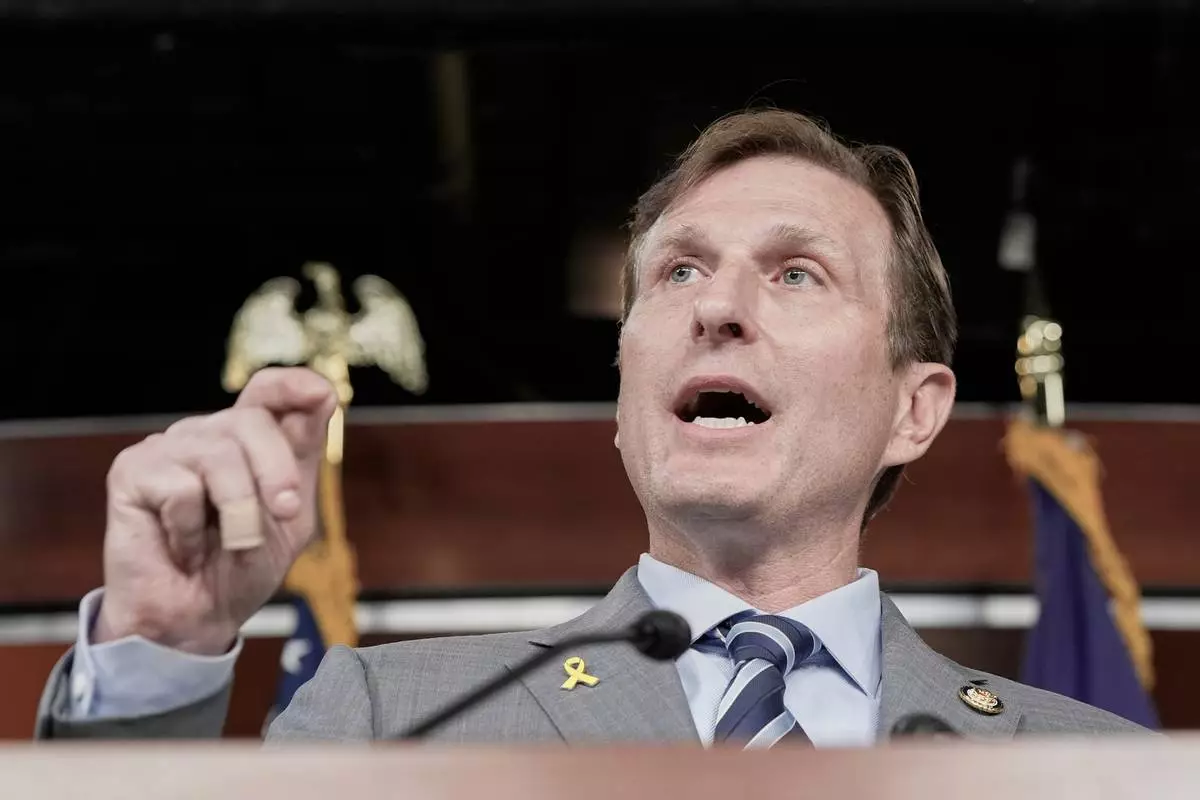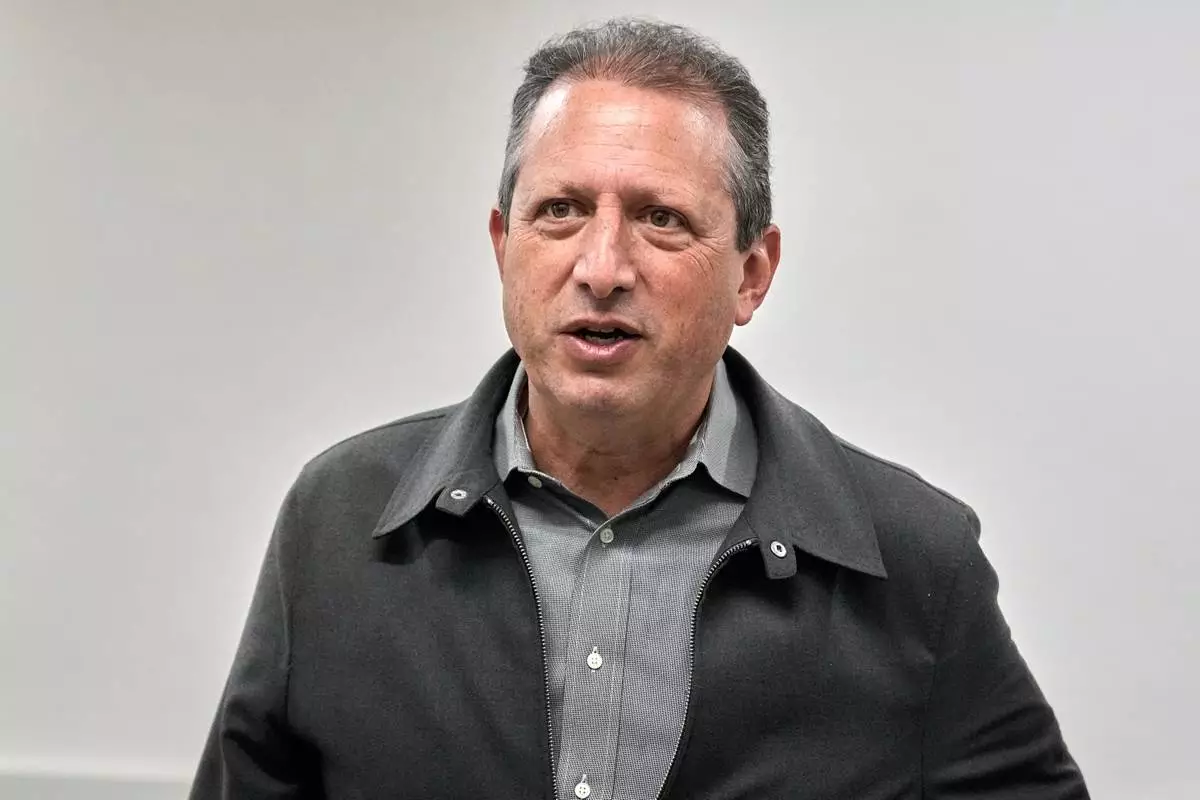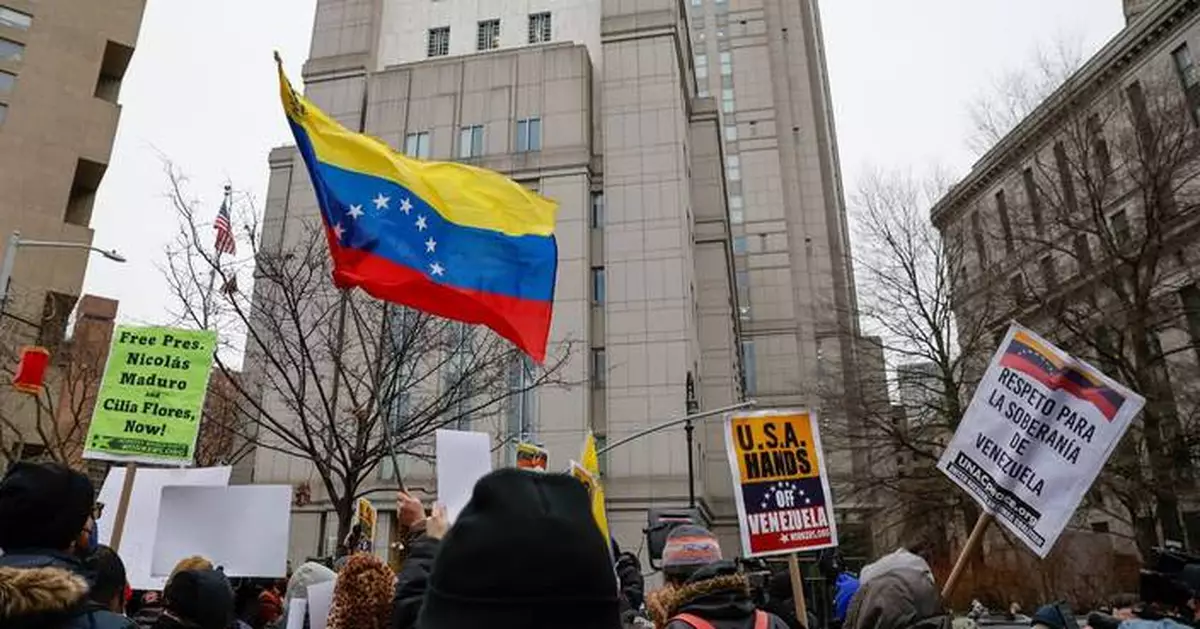
NEW YORK (AP) — Nicolás Maduro’s first court hearing in the U.S. — a spectacle where he proclaimed he is still Venezuela’s president — was merely the beginning of a legal odyssey that could keep him locked up and out of power for years, maybe even the rest of his life.
The deposed South American leader and his wife, Cilia Flores, were arraigned Monday on drug trafficking charges, days after U.S. forces seized them from their Caracas home in a stunning middle-of-the-night raid. Both pleaded not guilty.
President Donald Trump’s administration has defended the military action as a “surgical law enforcement operation” to apprehend Maduro in a criminal case that U.S. prosecutors first brought six years ago. In court, Maduro called it a kidnapping and declared himself a prisoner of war.
While Venezuela reckons with the geopolitical fallout, Maduro and Flores are locked up in New York City, about 2,100 miles (3,400 kilometers) away. Their next court appearance is scheduled for March 17.
Here’s what’s likely to happen next in their legal case:
It is a long shot, but Maduro, 63, and Flores, 69, can ask the judge to release them on bail, which would allow them to await trial at a location other than jail. Neither defendant made that request on Monday, but their lawyers suggested they might in the future.
The judge, Alvin Hellerstein, told the lawyers he will welcome requests for bail “whenever, and as often you think it appropriate.” But that doesn’t mean he would agree to let Maduro and Flores out.
Both are charged with serious offenses that could carry life sentences, and prosecutors could argue they are flight risks — meaning they may try to leave the country to avoid prosecution if they are freed. Maduro is accused of narco-terrorism conspiracy. He and his wife are accused of being part of a conspiracy to import cocaine into the U.S. and possessing machine guns.
Judges rarely grant bail in such cases. Manuel Noriega was not granted bail after the U.S. accused him of drug trafficking, invaded Panama and removed him as that country's leader in 1989. Sometimes defendants don’t even ask. Lawyers for the recently pardoned former president of Honduras, Juan Orlando Hernandez, never sought bail when he was charged in the U.S. with drug trafficking. Nor did lawyers for Joaquín Guzmán, the drug lord known as “El Chapo,” when he was brought to the U.S from Mexico.
Flores’ lawyer, Mark Donnelly, said she sustained “significant injuries” during her capture and needs an X-ray and medical evaluation because she may have a fracture or severe bruising on her ribs. She appeared in court with bandages on her forehead and over her temple and eyelid.
Maduro’s lawyer, Barry Pollack, told the judge Maduro has “health and medical issues that will require attention” while he is detained. He did not specify what those issues are. The judge told both lawyers to work with prosecutors to ensure Flores and Maduro receive the proper care.
The federal jail where Flores and Maduro are being held, the Metropolitan Detention Center, has a medical unit with examination rooms and a dental suite. But the jail has also been accused of botching treatment, including missed cancer diagnoses.
Non-citizens charged with crimes in the U.S. are legally entitled to get a visit from consular officials from their home country.
Speaking in Spanish through an interpreter, Maduro told the judge he and Flores would like such a visit.
But it is unclear exactly what that will entail or what will be available to Maduro after he ordered the closure of the Venezuelan embassy and consulates in the U.S. in early 2019. A message seeking comment was left by The Associated Press for Venezuela’s still-open mission to the United Nations.
Maduro may need the meetings, though, in part to ensure that his legal bills can be paid. Maduro and Flores have been under U.S. sanctions for years, making it illegal for any American to take money from them without securing a license from the Treasury Department.
Hellerstein instructed prosecutors to work with Maduro and Flores’ lawyers to assure they “can represent their clients zealously and fully.”
On Tuesday, Maduro expanded his legal team, adding Bruce Fein, a constitutional and international law specialist who served as the assistant deputy U.S. attorney general under President Ronald Reagan.
Pollack promised “substantial” challenges to the validity of Maduro’s indictment and noted there were complicated legal issues to confront.
“Mr. Maduro is the head of a sovereign state and is entitled to the privileges and immunities that go with that office," Pollack told Hellerstein on Monday. "In addition, there are issues about the legality of his military abduction.”
After Noriega's capture by the U.S. military in 1989, his lawyers argued that he was immune from prosecution as a sovereign head of a foreign state. That argument ultimately failed, however, in part because Noriega never held the title of president during his six-year de facto rule.
Maduro claims to have won three popular elections, but the U.S. hasn't recognized him as Venezuela's legitimate leader for years, and thus not entitled to sovereign immunity.
It is possible that a legal battle over the legality of the U.S. prosecution will stretch on for some time, eventually landing with appeals courts.
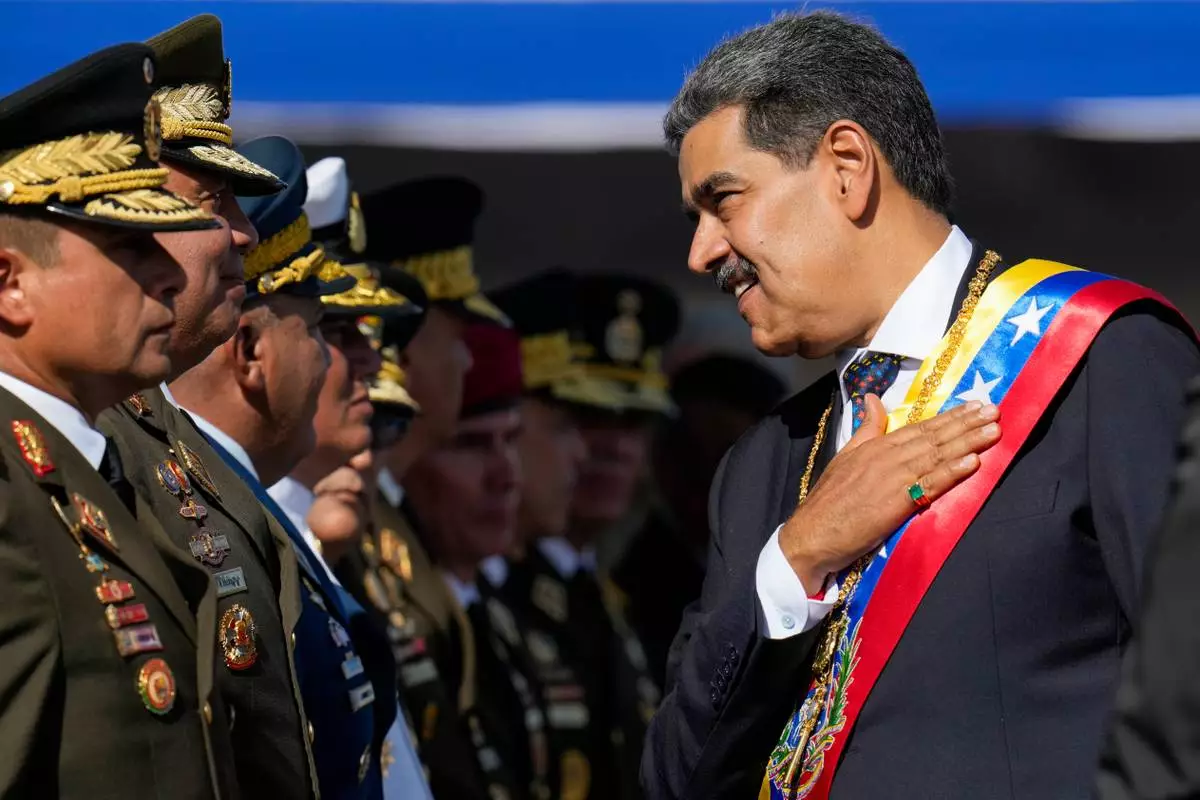
FILE - Venezuela's President Nicolas Maduro places his hand over his heart while talking to high-ranking officers during a military ceremony on his inauguration day for a third term, in Caracas, Venezuela, Jan. 10, 2025. (AP Photo/Ariana Cubillos, File)
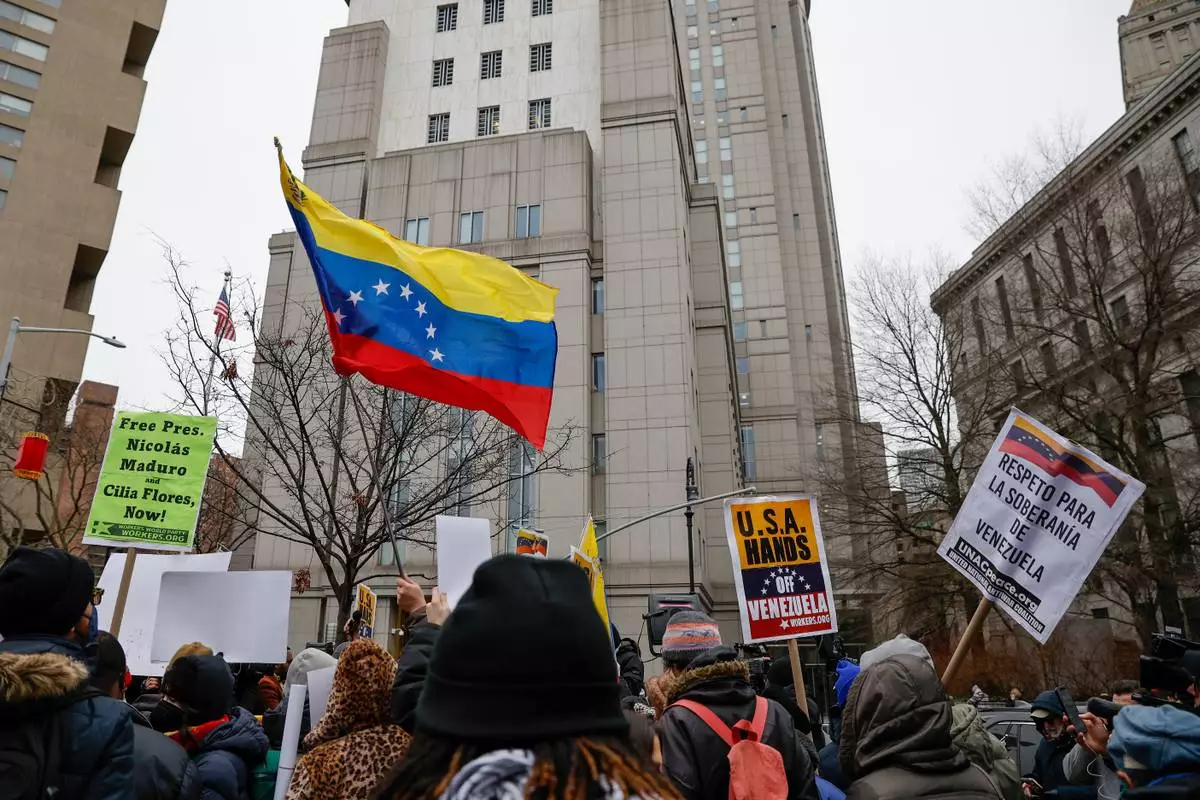
People protest outside Manhattan Federal Court before the arraignment of Venezuelan President Nicolas Maduro, Monday, Jan. 5, 2026, in New York. (AP Photo/Stefan Jeremiah)
Denmark and Greenland are seeking a meeting with U.S. Secretary of State Marco Rubio after the Trump administration doubled down on its intention to take over the strategic Arctic island, a Danish territory.
President Donald Trump has argued that the U.S. needs to control the world’s largest island to ensure its own security in the face of rising threats from China and Russia in the Arctic. Secretary of State Marco Rubio told a select group of lawmakers that it was the administration’s intention to eventually purchase Greenland — a self-governing territory of Denmark and part of NATO — rather than use military force.
The remarks, first reported by the Wall Street Journal, were made in a classified briefing Monday evening on Capitol Hill, according to a person with knowledge of his comments who was granted anonymity because it was a private discussion.
On Wednesday, Rubio told reporters that Trump has been talking about acquiring Greenland since his first term. He was on Capitol Hill for a briefing with the entire Senate and House, where questions from lawmakers centered not only on the administration’s operation to capture former Venezuelan leader Nicolás Maduro — but also on Trump's recent comments about Greenland.
Tensions with NATO members escalated after the White House said Tuesday that the “U.S. military is always an option." Danish Prime Minister Mette Frederiksen warned earlier this week that a U.S. takeover would amount to the end of NATO.
“The Nordics do not lightly make statements like this,” Maria Martisiute, a defense analyst at the European Policy Centre think tank, told The Associated Press on Wednesday. “But it is Trump, whose very bombastic language bordering on direct threats and intimidation, is threatening the fact to another ally by saying ‘I will control or annex the territory.’”
The leaders of France, Germany, Italy, Poland, Spain and the United Kingdom joined Frederiksen in a statement Tuesday reaffirming that the mineral-rich island, which guards the Arctic and North Atlantic approaches to North America, “belongs to its people.”
Danish Foreign Minister Lars Løkke Rasmussen and his Greenland counterpart, Vivian Motzfeldt, have requested a meeting with Rubio in the near future, according to a statement posted Tuesday to Greenland's government website.
Previous requests for a sit-down were not successful, the statement said.
Thomas Crosbie, an associate professor of military operations at the Royal Danish Defense College, said an American takeover would not improve upon Washington's current security strategy.
“The United States will gain no advantage if its flag is flying in Nuuk versus the Greenlandic flag,” he told the AP. “There’s no benefits to them because they already enjoy all of the advantages they want. If there’s any specific security access that they want to improve American security, they’ll be given it as a matter of course, as a trusted ally. So this has nothing to do with improving national security for the United States.”
Denmark’s parliament approved a bill last June to allow U.S. military bases on Danish soil. It widened a previous military agreement, made in 2023 with the Biden administration, where U.S. troops had broad access to Danish airbases in the Scandinavian country.
Rasmussen, in a response to lawmakers’ questions, wrote over the summer that Denmark would be able to terminate the agreement if the U.S. tries to annex all or part of Greenland.
But in the event of a military action, the U.S. Department of Defense currently operates the remote Pituffik Space Base, in northwestern Greenland, and the troops there could be mobilized.
Crosbie said he believes the U.S. would not seek to hurt the local population or engage with Danish troops.
“They don’t need to bring any firepower. They don’t to bring anybody.” Crosbie said Wednesday. “They could just direct the military personnel currently there to drive to the center of Nuuk and just say, ‘This is America now,’ right? And that would lead to the same response as if they flew in 500 or 1,000 people.”
The danger in an American annexation, he said, lies in the “erosion of the rule of law globally and to the perception that there are any norms protecting anybody on the planet.”
He added: “The impact is changing the map. The impact I don’t think would be storming the parliament.”
French Foreign Minister Jean-Noël Barrot said he spoke by phone Tuesday with Rubio, who dismissed the idea of a Venezuela-style operation in Greenland.
“In the United States, there is massive support for the country belonging to NATO – a membership that, from one day to the next, would be compromised by … any form of aggressiveness toward another member of NATO,” Barrot told France Inter radio on Wednesday.
Asked if he has a plan in case Trump does claim Greenland, Barrot said he would not engage in “fiction diplomacy.”
While most Republicans have supported Trump’s statement, Senators Jeanne Shaheen and Thom Tillis, the Democratic and Republican co-chairs of the bipartisan Senate NATO Observer Group, have criticized Trump’s rhetoric.
“When Denmark and Greenland make it clear that Greenland is not for sale, the United States must honor its treaty obligations and respect the sovereignty and territorial integrity of the Kingdom of Denmark,” their statement on Tuesday said. “Any suggestion that our nation would subject a fellow NATO ally to coercion or external pressure undermines the very principles of self-determination that our Alliance exists to defend.”
Kim reported from Washington. Geir Moulson in Berlin and Mark Carlson in Brussels contributed to this report.
FILE - Danish military forces participate in an exercise with hundreds of troops from several European NATO members in the Arctic Ocean in Nuuk, Greenland, Sept. 15, 2025. (AP Photo/Ebrahim Noroozi, File)
FILE - A plane carrying Donald Trump Jr. lands in Nuuk, Greenland, Jan. 7, 2025. (Emil Stach/Ritzau Scanpix via AP, file)
FILE - United States Homeland Security Advisor Stephen Miller reacts on the sidelines of the ASEAN Summit in Kuala Lumpur, Malaysia, Sunday, Oct. 26, 2025. (AP Photo/Mark Schiefelbein), File)
CORRECT THE ORDER OF SPEAKERS, FILE - Denmark's Prime Minister Mette Frederiksen, right, and Greenland's Prime Minister Jens-Frederik Nielsen, left, speak on April 27, 2025, in Marienborg, Denmark. (Mads Claus Rasmussen/Ritzau Scanpix via AP, File)