2025 ranked among the three warmest years on record, underscoring the continued acceleration of climate warming, according to data released by the China Meteorological Administration's National Climate Center.
The data shows that the global average surface temperature in 2025 was 1.40 degrees Celsius higher than pre-industrial levels, defined as average temperatures between 1850 and 1900, and 0.52 degrees Celsius above the long-term norm, the center said.
The past three years have also been the warmest three consecutive years since meteorological records began, indicating a persistent warming trend worldwide, according to the data.
The warming was particularly pronounced at the start of the year. In January 2025, average global surface temperatures exceeded previous records for the same period. On an annual basis, record-high temperatures were observed in northeastern and southern Europe, northeastern East Asia, much of Central Asia, northern and southwestern North America, and the Antarctic Peninsula.
The Arctic recorded an average temperature 1.17 degrees Celsius above the norm in 2025, ranking as the third warmest year on record for the region.
Average temperatures in Antarctica were 0.43 degrees Celsius above normal, and temperatures in the so-called "Third Pole" region, referring to China's Qinghai-Tibet Plateau that spans a vast area including Xizang Autonomous Region and Qinghai Province, were 1.12 degrees Celsius above normal, both setting new historical highs, the data showed.
Yang Guowei, an expert with the center, said the world's Third Pole region is among the most climate-sensitive areas in the world.
"In 2025, the average temperature of the Third Pole region reached a record high, marking the fourth consecutive year that the regional average has broken historical records. From 1961 to 2025, the warming rate on the Qinghai-Tibet Plateau was significantly higher than the global average over the same period, while annual precipitation across most parts of the plateau showed an increasing trend. Against the backdrop of rapid regional warming, the plateau has seen more frequent extreme heat and heavy rainfall events; mountain glaciers are generally melting and retreating, while permafrost degradation has become increasingly evident," he said.
Meteorologists said a major effort was needed to advance emissions reduction, which remains the fundamental path for global climate governance.
Combined efforts across the world were also called to better adapt to climate change and to strengthen the overall capacity to cope with extreme weather and climate events such as heatwaves, floods and strong typhoons.

2025 among warmest years on record: China Climate Center
An international academic symposium was held on Saturday at the Xizang Museum in Lhasa, capital of southwest China's Xizang Autonomous Region, to mark the 75th anniversary of the peaceful liberation of the region.
Perched on the Roof of the World, the Xizang Museum is the first modern museum on the plateau.
On the 75th anniversary of Xizang's peaceful liberation, it welcomed a group of international scholars to reflect on the region's transformation and future.
Greening efforts on the highest region on Earth have seen major strides.
Forest coverage has risen from less than 1 percent in 1951 to 12.5 percent today.
"Even here you see around the mountains of Lhasa here, the massive large-scale plantation. There is a big lesson to learn now to other parts of the world and other countries also to come. This is the conservation. We should move this way," said Krishna Prasad Oli, former Nepali ambassador to China. Nestled in the Himalayas is not just Xizang's natural beauty, but its unique culture.
Over the past few decades, the central government has invested billions of yuan in the region's heritage protection.
"In general there are so many rumors that are just not true. For example, there are rumors in our media that China suppresses the Tibetan language. A very simple thing is on the street that you see signs and two languages everywhere (in Mandarin and in Tibetan). Even in Austria and the minority areas, there are big discussions if we should write something in minority languages. But in China it is not a problem. So China's handling this is far better than Austria," said Georg, Vavra, an Austrian historian.
The most ambitious and costly undertaking on the plateau since its liberation has been building modern infrastructure.
Today, Xizang boasts a network of roads and railways that continues to expand.
"It just so happens that yesterday I traveled by train from Nyingchi to Lhasa. The UK is a country of 60 million people and has been struggling and failing for 17 years to build 150 kilometers of high speed rail. Now if you consider Xizang with a population of 4 or 5 million, they could never undertake a project of that scale, and that is what China is trying to do. China is the only country in the world that has a genuine interest in the prosperity and the development of Xizang," said David Ferguson, a Scottish commentator.
Beyond traditional industries, emerging sectors are also taking root in China's western frontier.
"In the 75 years since its peaceful liberation, Xizang has built its scientific and technological capabilities from the ground up. It has become a driving force behind the region's economic and social progress," said Nyima Tashi, a professor with the School of Information Science and Technology under Xizang University.
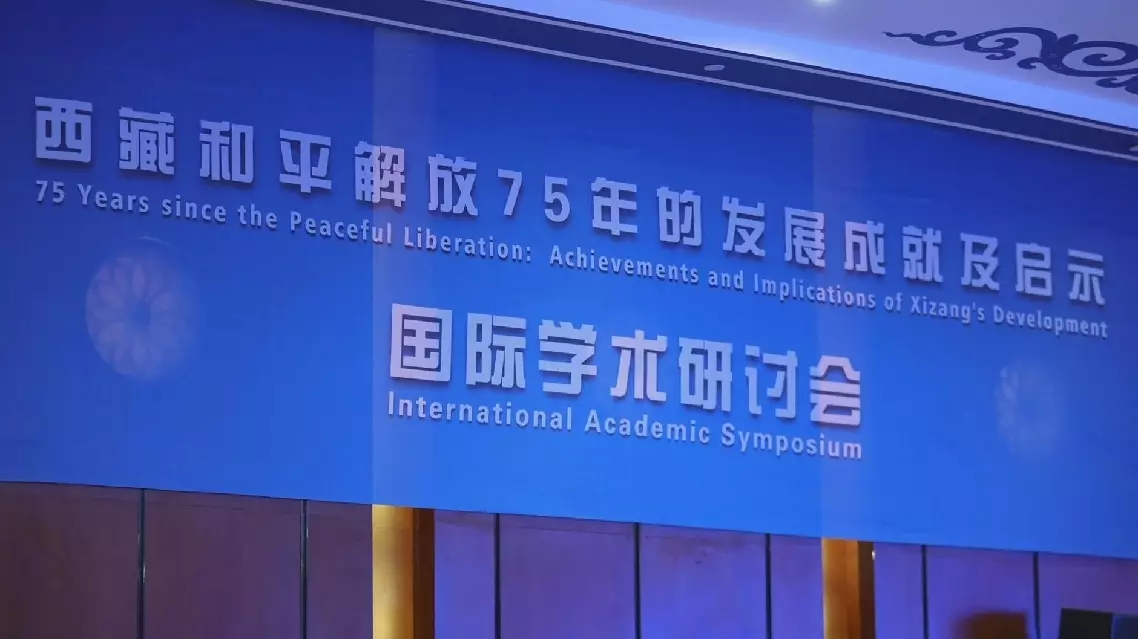
Int'l scholars gather in Xizang to review regional development over past 75 years