Pakistani Prime Minister Shehbaz Sharif announced on Wednesday that Iran and United States, along with their allies, have agreed to an immediate ceasefire across all conflict zones, including Lebanon.
"I warmly welcome the sagacious gesture and extend my deepest gratitude to the leadership of both countries, and invite their delegations to Islamabad on Friday, 10th April 2026, to further negotiate for a conclusive agreement to settle all disputes," Sharif wrote on X.
The ceasefire between Iran and the United States will take effect at 03:30 Tehran time on Wednesday, said the Pakistani prime minister.
Pakistan has been a key negotiator seeking to reach a diplomatic solution between the two warring parties.
The announcement came on the heels of a declaration by U.S. President Donald Trump, who said that he had agreed to suspend planned bombing and attacks on Iran for a period of two weeks following his conversations with Sharif and Pakistan's Chief of Army Staff Field Marshal Asim Munir.
Trump tied the suspension to Iran's agreement to the "complete, immediate, and safe opening of the Strait of Hormuz," describing the arrangement as a "double-sided ceasefire," in a statement on his Truth Social account.
He said that the United States has already met and exceeded all military objectives and is far advanced in negotiations toward a long-term peace agreement with Iran.
The U.S. president confirmed that Washington has received a 10-point proposal from Tehran, describing it as "a workable basis on which to negotiate."
He said that almost all points of contention have been agreed upon, with the two-week window allowing the agreement to be finalized.
He also said that the current long-term problem is close to resolution.
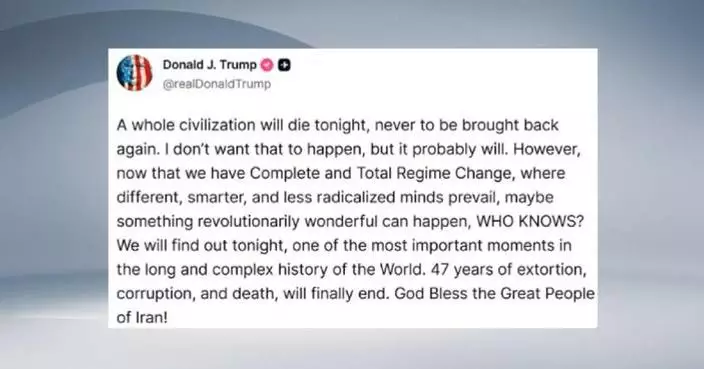
Trump's declaration on social media represents an abrupt turnaround from earlier in the day, when he threatened that Iran's "whole civilization would die tonight" if a deal is not reached.
A senior White House official revealed on Tuesday that Israel had agreed to join the two-week ceasefire agreement with Iran announced by Trump.
Meanwhile, Iranian Foreign Minister Seyed Abbas Araghchi promised safe passage through the Strait of Hormuz during the two-week ceasefire under "coordination" with Iranian armed forces, saying that Iran will cease "defensive operations" if attacks against it stop.
He also said Iran would hold negotiations with the United States in Islamabad, stressing that the temporary ceasefire does not mean an end to war, pending negotiations on details of its 10-point plan.
Israel and the United States launched joint attacks on Tehran and several other Iranian cities on Feb. 28, killing Iran's then Supreme Leader Ali Khamenei, along with senior military commanders and civilians. Iran responded with waves of missile and drone strikes against Israel and U.S. assets in the Middle East, while tightening control over the Strait of Hormuz by restricting passage to vessels belonging to or affiliated with Israel and the United States.
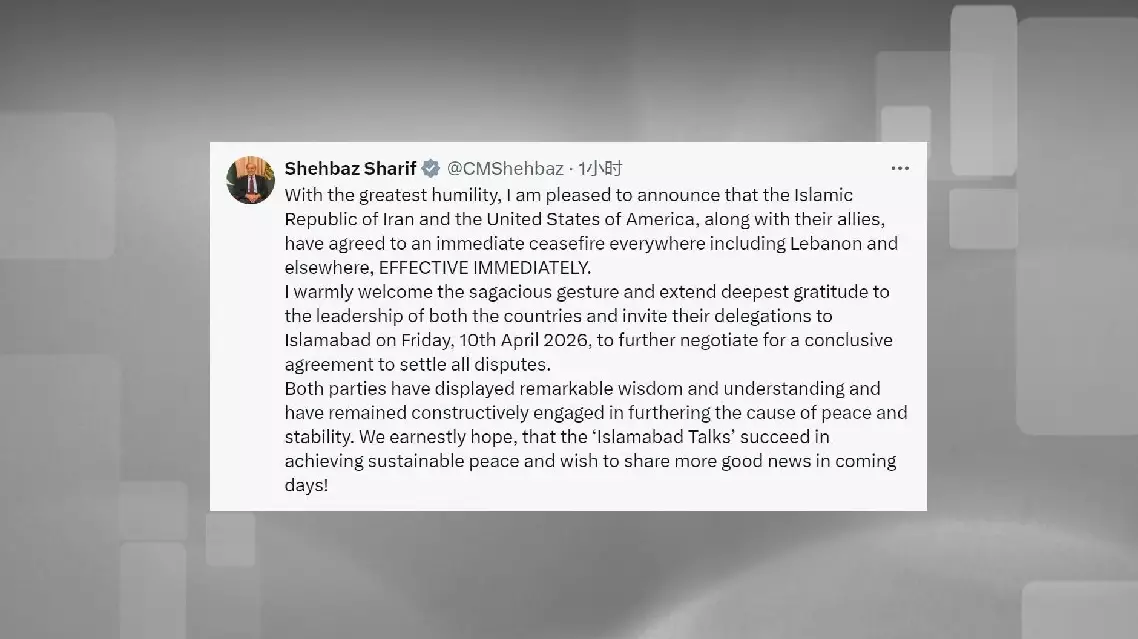
Pakistani PM confirms Iran, US agreed to immediate ceasefire
Pakistani PM confirms Iran, US agreed to immediate ceasefire