LAS VEGAS--(BUSINESS WIRE)--Jan 8, 2026--
Echo Water, the industry leader in hydrogen water innovation, today announced the launch of the Echo One —a next-generation hydrogen water system engineered to deliver ultra-pure, high-performance hydration. The Echo One is designed to replace the company’s existing filtration systems with a cleaner design and versatile installation options for both under-sink and countertop use.
This press release features multimedia. View the full release here: https://www.businesswire.com/news/home/20260108868842/en/
The Echo One builds on years of expertise in water purification and hydrogen science. It integrates a multi-stage reverse osmosis process, advanced UV sanitization, and a premium hydrogen infusion system—all in one sleek, user-friendly unit.
“The Echo One is the most advanced water system we’ve ever built,” said Josh Carr, CEO of Echo. “It’s designed to deliver the purest, most advanced hydrogen water available, whether you’re focused on performance, recovery, or daily wellness. This is our answer to what modern hydration should look like—powerful, pure, and effortlessly integrated into your life.”
Key Features of the Echo One:
The Echo One delivers clean, molecular hydrogen directly into every glass—supporting wellness goals ranging from cellular recovery and anti-inflammatory support to antioxidant protection and optimized hydration. It’s a powerful upgrade for any home or professional wellness space.
“The flow rate of the Echo One really matters because it expands how you can use the system,” added Carr. “For the first time, you can use hydrogen water for everything in your kitchen. Traditional RO systems can take up to 30 minutes to produce a gallon—we do it in under a minute. That completely transforms the hydrogen water experience at home.”
Availability:
The Echo One will be showcased this week at CES 2026 in Las Vegas at the Venetian Expo, booth #53800, and will be available globally in early Spring 2026 with a suggested retail price of $2,499.
About Echo Water
Echo Water is a pioneer in hydrogen health, dedicated to helping people unlock and sustain peak performance by transforming water into a clean source of cellular support. From advanced home water systems to portable wellness solutions, Echo promotes internal balance, resilience, and consistent energy—backed by peer-reviewed science and trusted by health experts. For more information, visit www.echowater.com.

The Echo One
DES MOINES, Iowa (AP) — The near-daily changes in U.S. gas prices are dizzying for drivers, who are left feeling frustrated and cash-strapped by the highest fuel costs since 2022.
With the Iran war pushing up prices worldwide, the U.S. average for a gallon of gas topped $4 on Tuesday, according to AAA. The uncertainty at the pump is trickling down from a massive, volatile oil and gas market that’s making it hard for gas stations to keep up.
Oil prices soared when U.S. markets opened Thursday following President Donald Trump’s speech Wednesday promising to hit Iran “extremely hard” in the coming weeks. He asked Americans for patience.
U.S. drivers have spent the past month gaming out when to fill up or hunting for deals as gas prices can change from one day to the next, or from one nearby station to another.
Lonnie McQuirter, director of operations at 36 Lyn Refuel Station in south Minneapolis, said wholesale fuel prices are going up, sometimes multiple times a day, and are the main reason he’s had to charge more for gas than a month ago.
About a mile (1.6 kilometers) off Interstate 35, the neighborhood convenience store posted $3.399 a gallon for regular gas on Thursday, which is about 20 cents lower than the metro average, according to AAA.
“We price based on what we’re able to buy fuel at, and how well we can operate,” McQuirter said. He declined to speculate about his competitors, saying, “They’ve got different economics.”
McQuirter said his margins have gotten much tighter. He’s also facing higher credit card fees and rising costs to maintain pumps. Still, in times like these, with consumers “screaming for help,” McQuirter said small operators like him act on emotion more than greed.
“We’re in our stores every day looking our customers in the eye,” he said. “It really takes a toll when people are having to cut back on certain things in order to afford to live.”
A lot of it is outside the gas retailer’s control. Roughly half the price at the pump pays for the cost of crude oil, the main ingredient in gasoline, according to the U.S. Energy Information Administration. About 20% goes to refiners who turn crude into gas.
Those costs have risen as crude oil prices jumped in response to the war and shipping disruptions in the Strait of Hormuz. Gas retailers are adjusting the price at the pump to account for the higher price they just paid for their next shipment of gasoline.
Taxes — federal, state and local — account for nearly 20% of the price, while about 10% is left for retailers, who still have to pay for transportation, labor and other expenses.
Retailers' markup has averaged about 38 cents a gallon over the past five years, according to the convenience store trade group NACS, citing data from research firm OPIS. After expenses, stations may keep roughly 15 cents per gallon, said Jeff Lenard, a vice president at NACS.
“Some make more, some make less,” Lenard said.
Patrick De Haan, head of petroleum analysis at GasBuddy, compared it to a homeowner’s role in setting their sale price.
“If I was selling a house today, I’d be beholden to whatever the housing market is,” De Haan said. “That’s the same for gas station owners. Whatever the price of oil and gasoline are, they are a price taker, not maker.”
Although the national average just passed $4 a gallon, the price that drivers pay varies widely by state, city and station.
Taxes alone can create large gaps. California's gas taxes and fees totaled about 71 cents per gallon last year, compared with roughly 9 cents in Alaska.
Distance from refineries, the type of retailer, how much volume the location goes through and whether there are other fuel options nearby also play a role.
Gas stations near competitors may choose to price gasoline competitively on large outdoor signs to attract drivers, hoping they'll come inside and buy higher-margin items, said Neal Walters, a partner focused on energy at the global management consulting firm Kearney.
“It’s one of the only retail locations where you don’t have to go into the store to find out what you’re paying,” Walters said.
While U.S. retailers sell hundreds of millions of gallons of gas a day nationwide, they typically won't see large gains when prices rise.
“The margins shrink when prices go up because it’s harder for them to pass along the increases as quickly as they themselves get them,” De Haan of GasBuddy said.
When oil prices start to fall, retailers may recover some of those losses, particularly if there’s uncertainty about future supply costs. Prices can rocket up but tend to drift down like a falling feather, said Garrett Golding, assistant vice president for energy programs at the Federal Reserve Bank of Dallas.
Higher gas prices can also hurt sales inside the gas stations, if customers who are being squeezed at the pump spend less on other things.
“So it’s not always the case that higher prices mean the service station owners are actually doing better,” Golding said.
Most profits in the oil and gas supply chain are made upstream, he said, by companies that extract and refine crude oil. Still, Golding said they aren't necessarily celebrating; at some point, a significant spike in prices could hurt demand.
“It may be a good stretch of days or weeks for them,” he said, “but they’re also cautious of what it could portend.”
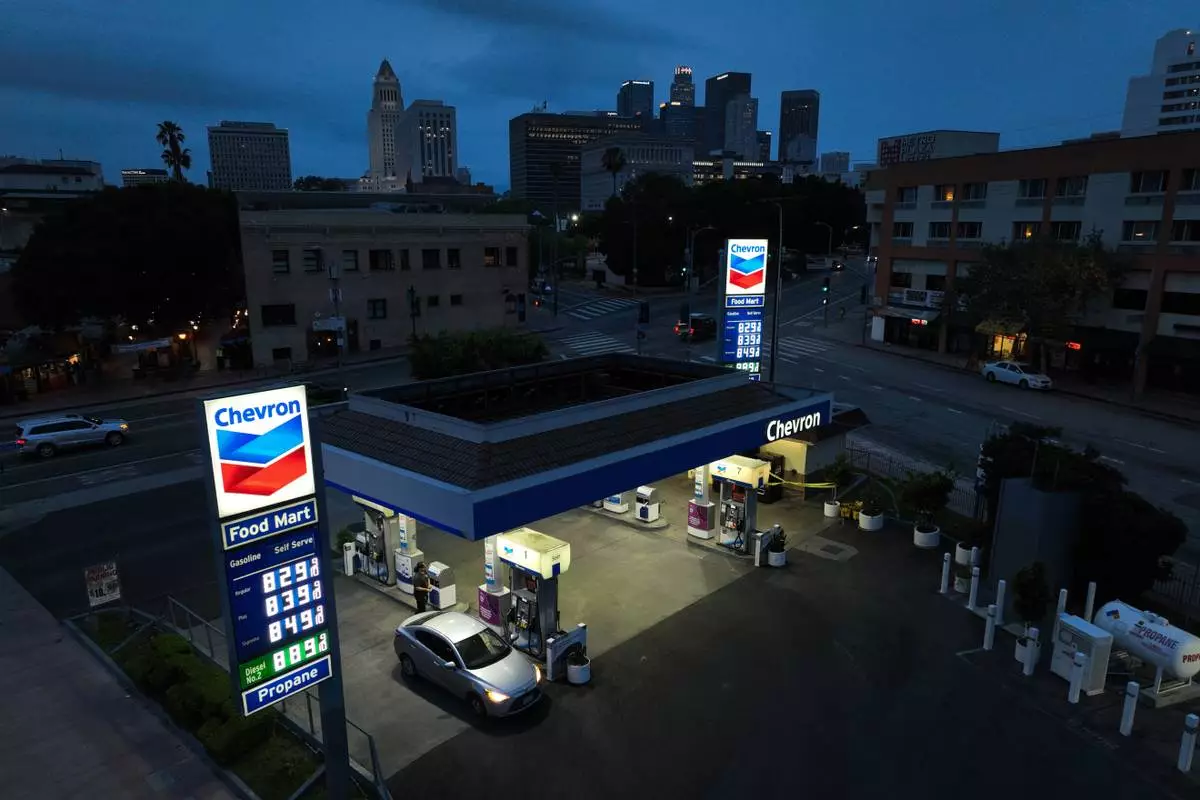
Gas prices are displayed at a Chevron gas station, in downtown Los Angeles, Tuesday, March 31, 2026. (AP Photo/Jae C. Hong)