Skip to Content Facebook Feature Image

Chinese LLM developers' listing boom signals shift to commercial application

China

China

China

Chinese LLM developers' listing boom signals shift to commercial application

2026-01-10 00:05 Last Updated At:12:26

A recent listing boom among Chinese large language model (LLM) developers indicates the industry's transformation from technological exploration to commercial application, according to experts.

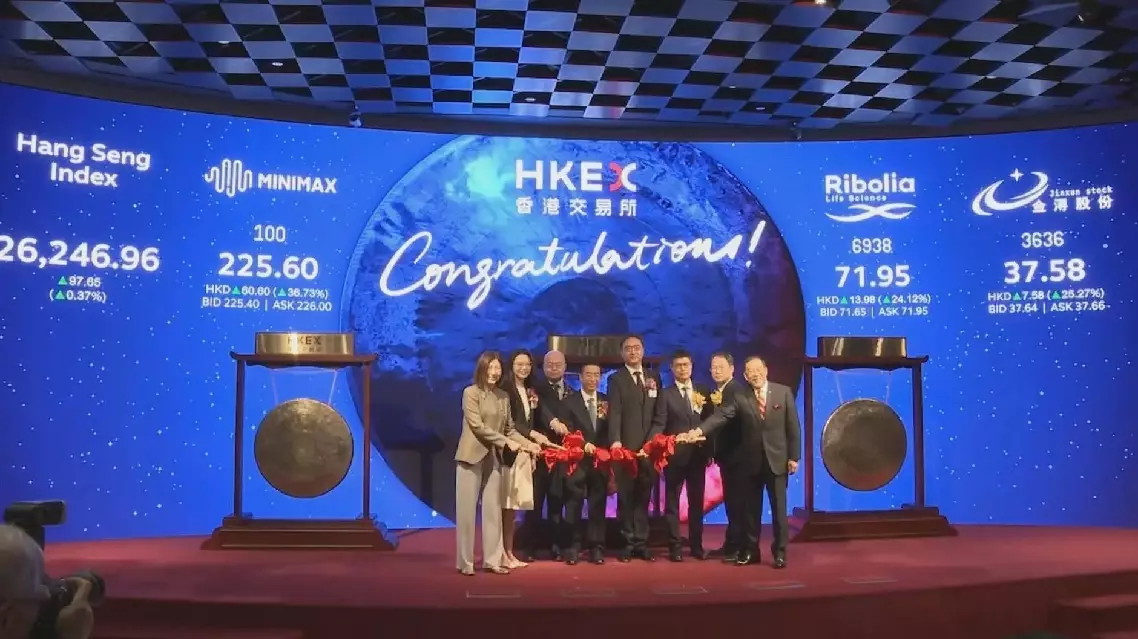
Knowledge Atlas Technology Joint Stock Co. Ltd., a Chinese artificial intelligence firm known as Zhipu, began trading in Hong Kong on Thursday, followed by the listing of another AI startup, MiniMax, on Friday.

Both listings have garnered significant market attention.

Experts say Hong Kong is an ideal listing venue for large language model developers, which spend heavily on research and development and are still refining their business models, because the city's stock exchange has relatively flexible revenue and profitability requirements.

Meanwhile, the Hong Kong stock market's global reach, they add, will enable the AI upstarts to connect with international investors.

China's six leading LLM companies -- including Zhipu and MiniMax -- have taken different paths in technology and commercialization.

Zhipu focuses on enterprise-level and industry applications, centered on an artificial general intelligence foundation model, while MiniMax relies on multimodal models and targets the consumer market with AI-native products.

Meanwhile, Moonshot AI and Stepfun continue to update their model technologies and applications. Baichuan AI and 01.AI are focusing on medical and enterprise commercialization, respectively.

Industry insiders say this wave of IPOs by Chinese large language model developers may mark the sector's shift from pure research and development toward the parallel advancement of technology and commercialization, as business models become clearer.

The shift will provide a basis for future financing and valuations of LLM companies.

From a longer-term perspective, the AI sector is still undergoing rapid growth.

According to a report by market research firm Frost and Sullivan, China's LLM market reached 5.3 billion yuan (about 758.90 million U.S. dollars) in 2024 and is estimated to grow to 101.1 billion yuan by 2030, representing a compound annual growth rate of 63.5 percent.
Chinese LLM developers' listing boom signals shift to commercial application
Chinese LLM developers' listing boom signals shift to commercial application

The International Organization for Mediation (IOMed), the world's first intergovernmental legal organization dedicated to resolving international disputes through mediation, fills an institutional gap in international mediation, the body's Secretary-General Teresa Cheng said.

In a recent interview with the China Global Television Network (CGTN) in Beijing, Cheng talked about the significance of IMOed's inauguration in October 2025.

"If we look at the United Nations Charter again, Article 33, we've provided for these forms of dispute resolution. Yet for 80 years, somehow there is not a body that is dedicated exclusively to mediation. And I think that triggered these 19 countries when they made their joint statement to say, let's establish such a body, so it is filling the institutional gap. The second thing is that it also complements the existing dispute resolution mechanisms. Litigation arbitration is at the moment still a prevailing form of dispute resolution, but the states see the need, also called upon by the UN Charter, to establish something exclusively for mediation to complement the existing systems," said Cheng. "There are a number of states, in particular those from the Global South, are very interested in having a say in the development of this new body. Therefore, through this organization, there are, as I said, 38 signatory states now. I think the world is in a very interesting stage at the moment. There are a lot of differences, sometimes views get entrenched. By having a body that brings into effect inclusivity multilateralism, and of course, accommodating and understanding each other through dialogue, is a very important feature." she said.

Housing the organization in the Hong Kong Special Administrative Region(HKSAR) also showed China's willingness to contribute to international mediation, said Cheng.

"The fact that we are housed and placed in the Hong Kong SAR, part of China, is because China is willing to contribute to this development, and Hong Kong very generously allows us to put our headquarters in one of the heritage buildings in Hong Kong," she added.

IOMed fills institutional gap in international mediation: secretary-general

IOMed fills institutional gap in international mediation: secretary-general

Recommended Articles