China's Qinling Station in Antarctica continues to operate steadily, with key self-developed systems performing reliably under extreme conditions.
Since its operation on Feb 7, 2024, the station has withstood harsh conditions such as extreme cold, strong winds, and blizzards. The steady operation of its core systems, including seawater desalination, renewable energy generation, and wastewater treatment has ensured the station's smooth functioning.
At the seawater desalination facility, Wang Zhechao, head of Qinling Station with China's 41st Antarctic expedition team, introduced the system, which features independent intellectual property rights and was fully designed and built domestically.
"All freshwater used at the station is produced through this desalination system, which can generate 20 tonnes of water per day. We operate under a 'one-in-use, one-on-standby' model, with one system running normally and the other serving as backup. Our water production capacity fully meets, and in fact exceeds, the station's operational needs," said Wang.
Even during peak periods in the austral summer, daily water consumption amounts to only a little over ten tonnes, meaning that the output of a single desalination system is sufficient to meet the station's entire water demand.
In addition to the desalination system, the stable operation of the station's renewable energy power generation system is another source of pride for Wang.
The station is equipped with photovoltaic, wind, and hydrogen generation systems. Electricity generated by these three renewable energy systems accounts for more than 60 percent of Qinling Station's total power consumption.
"At present, the proportion of electricity generated from renewable sources at Qinling Station is relatively high compared with nearby research stations. Looking across Antarctica as a whole, the integrated application of these three energy systems is also a pioneering and innovative approach. In terms of green energy utilization in Antarctica, we are among the frontrunners," said Wang.
The increasing deployment of domestically developed equipment in Antarctica highlights China's steadily improving capabilities in the research, development and application of polar scientific equipment.
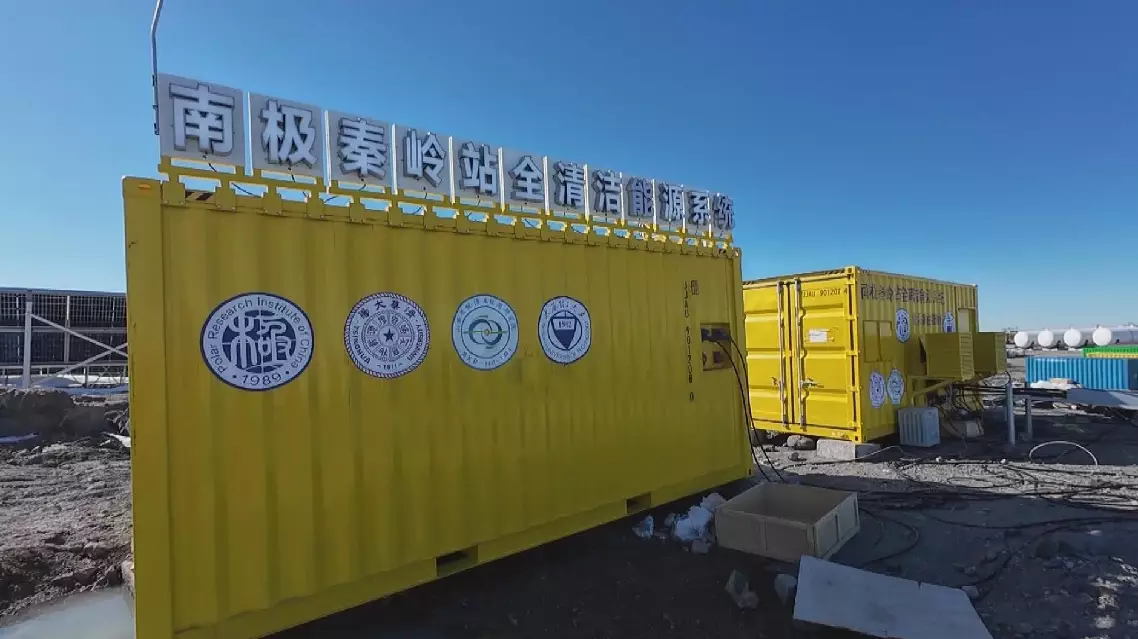
China’s Antarctic Qinling Station runs smoothly with homegrown desalination, renewable energy systems
The Guangdong–Hong Kong–Macao Greater Bay Area (GBA) is emerging as a key engine for China's fast-growing low-altitude economy by leveraging its dense industrial networks, efficient logistics systems, and rapid innovation capacity.
From logistics and manufacturing to urban services, the region is building an integrated industrial chain that allows low-altitude industries to scale up at unprecedented speed, thus turning drone-based applications from isolated trials into large-scale, commercial operations.
China's 15th Five-Year Plan, covering 2026 to 2030, calls for the cultivation of new pillar industries and the accelerated development of strategic emerging industrial clusters, including the low-altitude economy.
At a drone operations center in Bao'an District, Shenzhen City in south China's Guangdong Province, a dozen logistics drones take off and land within minutes. Urgently needed production parts, documents, and small parcels are dispatched from here to cities in the province including Dongguan, Zhongshan, and Zhuhai.
Behind these high-flying aircraft lies what observers describe as an "invisible industrial chain", built on speed and efficiency.
"Look at this aircraft. About 90 percent of its components come from nearby areas. Relying on Shenzhen's strong logistics capabilities and its complete supply chain, these parts can be delivered to our factory within half an hour for assembly, processing, and production," said Li Kunhuang, person-in-charge of Shenzhen GODO Innovation Technology Co., Ltd.
Once a new product is unveiled, testing and calibration begin immediately at the drone testing field. As soon as the process is completed, the new models can be put into real-world operation, realizing almost “zero delay” from research and development to application.
Supported by a robust industrial chain, low-altitude routes in Shenzhen are effectively connecting the urban landscape. From its Bao'an District to Songshan Lake in Dongguan City, production components can be delivered within one hour. Supplies are transported between Zhuhai City's Xiangzhou Port to Dong'ao Island in just 25 minutes. And light industrial goods can travel round-trip within a single day between Guzhen Town in Zhongshan City and Xinhui District in Jiangmen City.
More low-altitude application scenarios are expected to be implemented in the near future.
In Qianhai District, Shenzhen is accelerating the construction of a pilot demonstration zone of low-altitude integrated three-dimensional transportation hub.
"We have built the country's first low-altitude integrated three-dimensional transportation hub, and are gradually developing a pilot flight zone that integrates multiple scenarios such as inspection, logistics, and cultural tourism. This will provide technical support for the next step of commercializing cross-border logistics and emergency rescue services across the Guangdong–Hong Kong–Macao Greater Bay Area," said Wu Xuemin, head of the Shenzhen Qianhai Low-Altitude Integrated Three-Dimensional Transportation Hub Pilot Demonstration Zone.
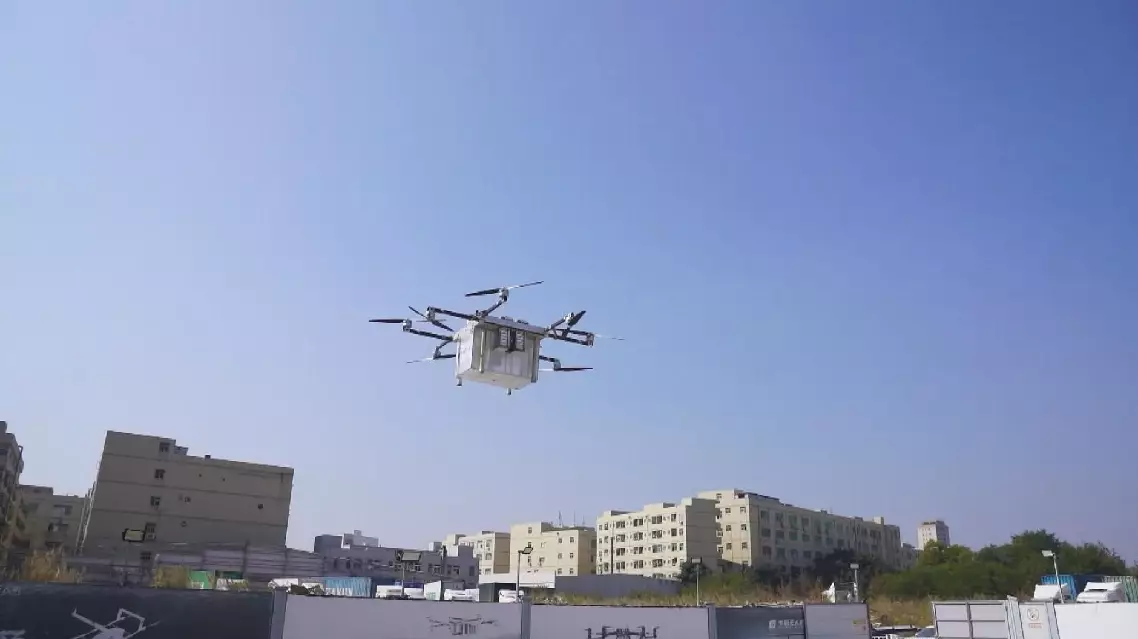
Integrated supply chains propel Greater Bay Area's low-altitude economy growth