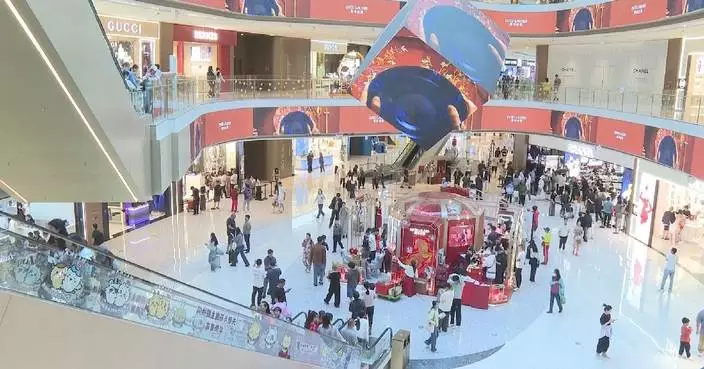
Following the official rollout of China’s national policy on large-scale equipment renewal and consumer goods trade-in programs in 2026, replacement initiatives have been fully launched across multiple sectors, including automobiles, home appliances, and digital smart products.
Since the New Year's Day holiday, localities have been actively capitalizing on the new policy benefits, continuously invigorating the consumer market.
New categories, such as smart watches and smart glasses, have been included in the subsidy scope for the first time, driving sustained consumer enthusiasm.
As the trade-in program continues to gain momentum, consumer markets across multiple locations in east China's Anhui province have experienced another surge in activity.
At a car dealership in Wuhu City, many residents have come to view and select vehicles.
"I've always been interested in switching to a new energy vehicle. When I learned about the really attractive national subsidy available this year, I immediately brought my family to check it out. Factoring in the national subsidy, manufacturer discounts, and the trade-in incentive, I estimate total savings could exceed 20,000 yuan (about 2,866 U.S. dollars)," said Hu Jing, a local resident.
In major shopping centers across north China's Hebei Province, consumers have been inquiring about and processing trade-in services, taking advantage of the newly activated national subsidies.
"I'm mainly considering these two TV models. Currently, a television priced around 10,000 yuan (about 1,433 U.S. dollars) can receive a subsidy of about 1,500 yuan (about 215 U.S. dollars), which is quite a substantial discount. Therefore, I'm planning to make the purchase within the next couple of days," said a local consumer.
"Essential categories like air conditioners and refrigerators are selling the best. On New Year's Day alone, over 600 units of air conditioners, televisions, and refrigerators were sold, which is more than ten times the sales volume of a typical weekend," said Yin Yanying, counter director of the Qingxian Xinyulou Department Store.

China's 2026 trade-in policy fuels strong consumer spending
The Guangdong–Hong Kong–Macao Greater Bay Area (GBA) is emerging as a key engine for China's fast-growing low-altitude economy by leveraging its dense industrial networks, efficient logistics systems, and rapid innovation capacity.
From logistics and manufacturing to urban services, the region is building an integrated industrial chain that allows low-altitude industries to scale up at unprecedented speed, thus turning drone-based applications from isolated trials into large-scale, commercial operations.
China's 15th Five-Year Plan, covering 2026 to 2030, calls for the cultivation of new pillar industries and the accelerated development of strategic emerging industrial clusters, including the low-altitude economy.
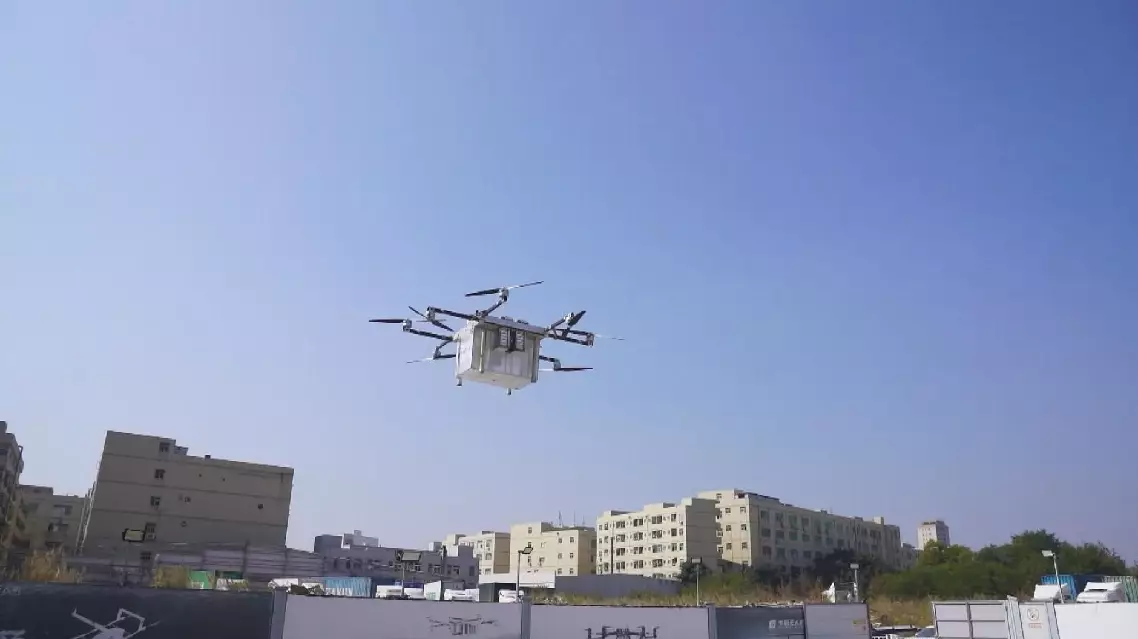
At a drone operations center in Bao'an District, Shenzhen City in south China's Guangdong Province, a dozen logistics drones take off and land within minutes. Urgently needed production parts, documents, and small parcels are dispatched from here to cities in the province including Dongguan, Zhongshan, and Zhuhai.
Behind these high-flying aircraft lies what observers describe as an "invisible industrial chain", built on speed and efficiency.
"Look at this aircraft. About 90 percent of its components come from nearby areas. Relying on Shenzhen's strong logistics capabilities and its complete supply chain, these parts can be delivered to our factory within half an hour for assembly, processing, and production," said Li Kunhuang, person-in-charge of Shenzhen GODO Innovation Technology Co., Ltd.
Once a new product is unveiled, testing and calibration begin immediately at the drone testing field. As soon as the process is completed, the new models can be put into real-world operation, realizing almost “zero delay” from research and development to application.
Supported by a robust industrial chain, low-altitude routes in Shenzhen are effectively connecting the urban landscape. From its Bao'an District to Songshan Lake in Dongguan City, production components can be delivered within one hour. Supplies are transported between Zhuhai City's Xiangzhou Port to Dong'ao Island in just 25 minutes. And light industrial goods can travel round-trip within a single day between Guzhen Town in Zhongshan City and Xinhui District in Jiangmen City.
More low-altitude application scenarios are expected to be implemented in the near future.
In Qianhai District, Shenzhen is accelerating the construction of a pilot demonstration zone of low-altitude integrated three-dimensional transportation hub.
"We have built the country's first low-altitude integrated three-dimensional transportation hub, and are gradually developing a pilot flight zone that integrates multiple scenarios such as inspection, logistics, and cultural tourism. This will provide technical support for the next step of commercializing cross-border logistics and emergency rescue services across the Guangdong–Hong Kong–Macao Greater Bay Area," said Wu Xuemin, head of the Shenzhen Qianhai Low-Altitude Integrated Three-Dimensional Transportation Hub Pilot Demonstration Zone.
Integrated supply chains propel Greater Bay Area's low-altitude economy growth