Residents in the central Philippine city of Cebu recalled the spooky moment when a landfill collapsed on Thursday, killing one person and injuring several others.
"When I went out and looked around, the building was already submerged in trash. When I went down, there were already many people shouting for help. Before, they used to put the trash piles in a rice-terrace-style, like steps, so if they collapsed, the garbage would not fall all at once. But now they just keep dumping everything from the top," said Junel Arcilla, a Cebu resident.
"When I went out and looked behind the house, the trash had already been swept away. The metal sheets had collapsed, and something exploded. Some structures were broken. There were people bleeding and asking for help," said Cristy Arcilla, another resident who was at the site when the landfill collapsed.
"I crawled and crawled until I found a way out. When I finally emerged, my companions saw me. It was fighting spirit, for my children and my family. I survived and was not trapped. I crawled until I saw the light," said Jaylord Antigua, who survived the collapse.
Cebu City Mayor Nestor Archival said in a social media post that more than 100 workers were at the landfill when the structure gave way on Thursday afternoon.
At least four people have been confirmed dead as search and rescue operations continued on Saturday for those still missing.
Archival said in a social media post that 12 injured individuals have been extricated from the debris and rushed to a local hospital for treatment.
Local officials warned that the death toll could rise further as rescuers worked to locate those still missing, while the mayor said unstable ground conditions and the risk of acetylene have made search-and-rescue operations extremely dangerous, forcing teams to proceed with caution.
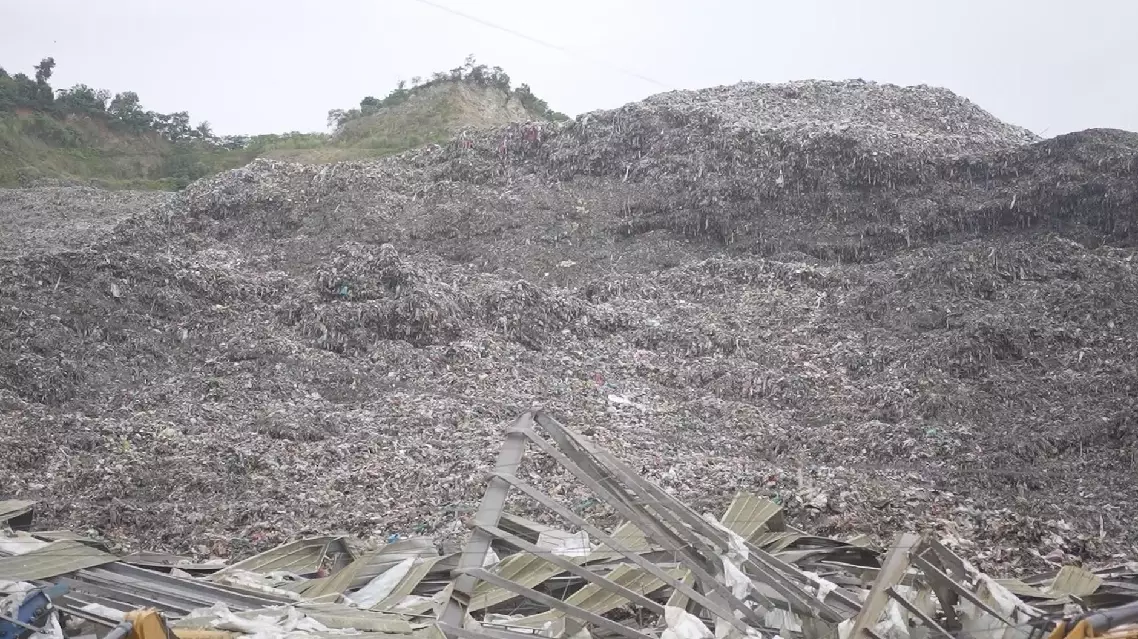
Residents recall horrific moments in Philippines landfill collapse as rescue efforts continue
The Guangdong–Hong Kong–Macao Greater Bay Area (GBA) is emerging as a key engine for China's fast-growing low-altitude economy by leveraging its dense industrial networks, efficient logistics systems, and rapid innovation capacity.
From logistics and manufacturing to urban services, the region is building an integrated industrial chain that allows low-altitude industries to scale up at unprecedented speed, thus turning drone-based applications from isolated trials into large-scale, commercial operations.
China's 15th Five-Year Plan, covering 2026 to 2030, calls for the cultivation of new pillar industries and the accelerated development of strategic emerging industrial clusters, including the low-altitude economy.
At a drone operations center in Bao'an District, Shenzhen City in south China's Guangdong Province, a dozen logistics drones take off and land within minutes. Urgently needed production parts, documents, and small parcels are dispatched from here to cities in the province including Dongguan, Zhongshan, and Zhuhai.
Behind these high-flying aircraft lies what observers describe as an "invisible industrial chain", built on speed and efficiency.
"Look at this aircraft. About 90 percent of its components come from nearby areas. Relying on Shenzhen's strong logistics capabilities and its complete supply chain, these parts can be delivered to our factory within half an hour for assembly, processing, and production," said Li Kunhuang, person-in-charge of Shenzhen GODO Innovation Technology Co., Ltd.
Once a new product is unveiled, testing and calibration begin immediately at the drone testing field. As soon as the process is completed, the new models can be put into real-world operation, realizing almost “zero delay” from research and development to application.
Supported by a robust industrial chain, low-altitude routes in Shenzhen are effectively connecting the urban landscape. From its Bao'an District to Songshan Lake in Dongguan City, production components can be delivered within one hour. Supplies are transported between Zhuhai City's Xiangzhou Port to Dong'ao Island in just 25 minutes. And light industrial goods can travel round-trip within a single day between Guzhen Town in Zhongshan City and Xinhui District in Jiangmen City.
More low-altitude application scenarios are expected to be implemented in the near future.
In Qianhai District, Shenzhen is accelerating the construction of a pilot demonstration zone of low-altitude integrated three-dimensional transportation hub.
"We have built the country's first low-altitude integrated three-dimensional transportation hub, and are gradually developing a pilot flight zone that integrates multiple scenarios such as inspection, logistics, and cultural tourism. This will provide technical support for the next step of commercializing cross-border logistics and emergency rescue services across the Guangdong–Hong Kong–Macao Greater Bay Area," said Wu Xuemin, head of the Shenzhen Qianhai Low-Altitude Integrated Three-Dimensional Transportation Hub Pilot Demonstration Zone.
Integrated supply chains propel Greater Bay Area's low-altitude economy growth