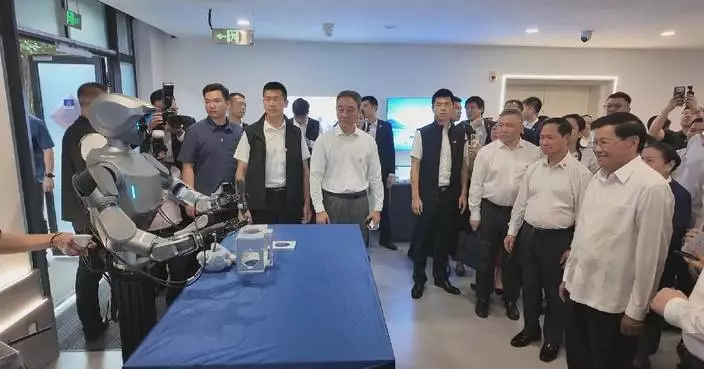
A wealth of cutting-edge technologies, including artificial intelligence (AI), highlighted the 2026 Beijing Book Fair, which concluded on Saturday, creating an immersive and interactive reading experience and bringing economic gains for publishers.
At the exhibition, the Children's Publishing Division of the Publishing House of Electronics Industry launched its first AI-powered reading and interactive platform.
The platform pioneers a multi-modal reading experience combining text, audio, and interactive guidance, transforming online reading from simple e-book browsing into an immersive digital interaction tailored to the cognitive habits of children across different age groups.
"For AI-generated audio and video, the publishers previously relied more on manual production methods. Now, with the advent of the AI era, we can significantly reduce production time and costs. This allows for deeper exploration of a book's content, enabling AI to present it through enhanced interactive methods," said Li Jian, an exhibitor.
Publications are continuously integrating new technologies to enrich the reading experience.
For publishing institutions, books can also generate new revenue streams through data conversion and transactions.
Additionally, integrated one-stop services for the book publishing supply chain covering printing, warehousing, logistics, new media marketing, and information services, aim to reduce operational costs for publishing institutions while enhancing economic benefits and market competitiveness.
"Traditionally, our publishing house invested significant efforts in coordinating with printing plants, warehouses, and information providers. Going forward, through this integration, we'll achieve a comprehensive intelligent digital supply chain to facilitate publishers' digital transformation," said Luo Min, an exhibitor.
The 2026 Beijing Book Fair kicked off on Thursday, with over 400,000 titles on display. This year's edition features more than 10 themed zones as well as an exhibition area for various cultural products.

More digital techs like AI highlight 2026 Beijing Book Fair
China's two major power grid operators -- the State Grid Corporation of China (State Grid) and China Southern Power Grid (CSG) -- reported a surge in investment in the first quarter of 2026, underscoring efforts to strengthen infrastructure construction and support high-quality socioeconomic development in China.
The State Grid said it completed fixed-asset investment worth 129 billion yuan (about 18.77 billion U.S. dollars) in the first three months of this year, up 37 percent the corresponding period of the previous year. The spending has driven more than 250 billion yuan (36 billion U.S. dollars) of investment across the wider industrial chain.
Key projects such as the Panxi ultra-high-voltage (UHV) alternating current (AC) line and the Anhui-Hubei back-to-back direct current (DC) project have seen ground broken for their construction, while several west-to-east power transmission projects have been upgraded.
Investment in connecting renewable energy generation to the grid was reported to have exceeded 10 billion yuan (1.45 billion U.S. dollars) from January to March, a year-on-year rise of more than 50 percent.
The CSG also reported robust growth in investment in the three-month period, with fixed-asset investment reaching 38.45 billion yuan (5.58 billion U.S. dollars), up about 50 percent from a year earlier.
Among its achievements, the company completed and commissioned 80 key projects, including the 220 kV cross-sea power grid interconnection project, which was officially put into operation on March 20. The project ended years of grid isolation on the Weizhou Island in south China by linking it to the main power system of the Guangxi Zhuang Autonomous Region.
The construction of 17 other major energy projects, including one linking the power grid of the Xizang Autonomous Region in southwest China with that of Guangdong Province in south China, is advancing rapidly. These projects are expected to bolster regional industries, the maritime economy, digital collaboration and the transition to green energy.
"By accelerating major project construction, investment during the 15th Five-Year Plan period (2026-2030) is expected to approach 1 trillion yuan (145 billion U.S. dollars), driving a further 2 trillion yuan (290 billion U.S. dollars) of investment across upstream and downstream industries," said Dong Yanle, deputy general manager of the Engineering Construction Department under the China Southern Power Grid.
China ramps up power grid investment in January-March to boost growth