SAN MATEO, Calif.--(BUSINESS WIRE)--Jan 12, 2026--
Hammerspace, the high-performance data platform for AI anywhere, today announced it has been named to the 2026 CRN® Cloud 100 list by CRN®, a brand of The Channel Company. The annual list includes the most innovative channel-focused cloud technology companies transforming how enterprises deploy and scale cloud infrastructure.
This press release features multimedia. View the full release here: https://www.businesswire.com/news/home/20260112379979/en/
Hammerspace was recognized as it shapes the market for how organizations run AI training and inference with the cloud. Its data platform delivers Tier 0 storage performance to speed AI results, then automatically transitions data to cost-efficient object storage once demand subsides.
Hammerspace software was purpose-built to operate across on-premises, cloud and hybrid environments, allowing enterprises to move data to compute wherever GPUs are available.
This architecture makes Hammerspace ideal for organizations that need to:
“The performance of GPU clusters is often limited by cloud storage that can’t feed data to the GPUs fast enough,” said David Flynn, Founder and CEO of Hammerspace. “Hammerspace delivers Tier 0 performance to AI workloads and can then move the data to object storage the moment that speed is no longer required. That’s how you keep GPUs productive and costs under control in the real world.”
Tier 0: Maximum Performance, Without Permanent Cost
Hammerspace’s Tier 0 delivers direct, NVMe-class storage performance to GPUs, eliminating the I/O bottlenecks that commonly stall GPU pipelines in the cloud. Unlike traditional cloud storage models that force customers to pay premium prices for ongoing high-performance storage, Hammerspace enables a dynamic, workload-aware approach. This allows organizations to:
The result is faster AI, higher GPU cluster efficiency, and dramatically lower cloud storage costs.
How Hammerspace’s Data Platform Works
1. AI Workload Starts - Tier 0 Becomes Engaged: Data is delivered directly to cloud GPUs using Tier 0 NVMe-class performance, eliminating I/O bottlenecks and keeping GPUs fully utilized.
2. Workload Completes, Hammerspace Orchestrates Data Movement: Hammerspace’s Data Platform automatically transitions outputs to object storage, where cost-efficient, scalable capacity makes economic sense.
3. Unified Namespace = No Silos, No Rewrites: Applications see a single global namespace across on-premises and cloud environments, which means no application changes, no manual data movement, no vendor lock-in.
4. Repeat On-Demand: When demand spikes again, data is instantly staged back to Tier 0 for performance — without permanent high-performance cloud storage infrastructure costs.
CRN’s Cloud100 companies demonstrate dedication to supporting channel partners and advancing innovation in cloud-based products and services. The list is the trusted resource for solution providers exploring cloud technology vendors that are well-positioned to help them build cloud portfolios that drive their success.
In 2025, Hammerspace launched several new campaigns and resources to help its partner community drive success, including extensive cloud marketplace and enablement resources, new distribution models, an expanded partner portal and continued growth of its global team. In addition, the international “Hammerspace Partner Roadshow 2025: AI Anywhere” equipped Hammerspace partners with critical insight, tools, and connections to accelerate their AI businesses.
Learn More
About Hammerspace
Hammerspace is the high-performance data platform built to simplify AI infrastructure at scale. It makes all your data immediately accessible — anywhere across on-premises and cloud environments — without copying or migrating data. By integrating with existing storage, networking, and applications, Hammerspace creates a unified, high-speed data backbone for AI, enabling organizations to accelerate every stage of the AI pipeline while eliminating data silos. Learn more at https://hammerspace.com.
Hammerspace and the Hammerspace logo are trademarks of Hammerspace, Inc. All other trademarks used herein are the property of their respective owners.
©2026 Hammerspace, Inc. All rights reserved.

Image: The Hammerspace Data Platform provides a single, unified namespace that spans existing on-premises storage and cloud resources, giving users and applications a single, secure way to see and access data across storage types, clouds and multiple sites.
TALLINN, Estonia (AP) — Belarus’ authoritarian President Alexander Lukashenko on Thursday ordered the release of 250 political prisoners as part of a deal with Washington that lifted some U.S. sanctions, the latest step in the isolated leader’s effort to improve ties with the West.
Lukashenko pardoned the prisoners after meeting with U.S. President Donald Trump’s special envoy for Belarus, John Coale, in the Belarus capital of Minsk. Coale hailed the release as a “significant humanitarian milestone” and a testament to Trump’s “commitment to direct, hard-nosed diplomacy.” It marked the largest one-time release of political prisoners in the country.
Coale told reporters that the U.S. will lift sanctions from two Belarusian state banks and the country's Finance Ministry, and that the top Belarusian potash producers have been removed from a sanctions list.
Belarus' opposition leader-in-exile, Sviatlana Tsikhanouskaya, hailed the prisoners' release as “a moment of great relief and hope.”
“After years of isolation, people are now free and can finally embrace their loved ones,” Tsikhanouskaya told The Associated Press. “There is nothing more powerful than seeing someone who endured unjust imprisonment reunited with their family.”
She thanked Trump and his officials for their "tireless efforts to secure the release of political prisoners," adding that “these humanitarian efforts are saving lives.”
The last time U.S. officials met with Lukashenko, in December, Washington announced the easing of sanctions on Belarus' potash sector, a key source of export revenue, and 123 prisoners were released and sent to Ukraine and Lithuania.
A close ally of Russia, Minsk has faced isolation for years. Lukashenko has ruled the nation of 9.5 million with an iron fist for more than three decades, and the country has been sanctioned repeatedly by Western countries — both for its crackdown on human rights and for allowing Moscow to use its territory in the full-scale invasion of Ukraine in 2022.
Lukashenko’s rule was challenged after a 2020 presidential election, when tens of thousands poured into the streets to protest a vote they viewed as rigged. They were the largest demonstrations since Belarus became independent following the 1991 collapse of the Soviet Union.
In an ensuing crackdown, tens of thousands were detained, with many beaten by police. Prominent opposition figures either fled the country or were imprisoned.
Five years after the mass demonstrations, Lukashenko won a seventh term last year in an election that the opposition called a farce.
More recently, Belarus has freed some political prisoners to try to win favor with the West. Since Trump returned to the White House last year, Lukashenko has released dozens of prisoners, including Nobel Peace Prize laureate Ales Bialiatski and key dissident figures Siarhei Tsikhanouski, Viktar Babaryka and Maria Kolesnikova.
Trump spoke to Lukashenko by phone in August 2025 after one such release and even suggested a face-to-face meeting in what would be a big victory for the Belarusian leader, who has been dubbed “Europe’s Last Dictator.”
Dzianis Kuchynski, an adviser to Tsikhanouskaya, said that 15 of the 250 prisoners arrived in Lithuania following their release.
They included Valiantsin Stefanovich and Marfa Rabkova of the prominent Belarus human rights group Viasna. Stefanovich was serving a nine-year sentence on charges of smuggling money to finance activities violating the public order after his arrest in 2023. Rabkova was sentenced to 14 years and nine months following her 2020 arrest and conviction on charges of organizing riots and inciting hatred, accusations widely seen as a punishment for documenting human rights abuses.
Nasta Loika, 37, an activist with the international rights group Human Constanta, was also released. She was sentenced to seven years in prison after her arrest in 2022 on charges of organizing mass unrest and inciting hatred - charges widely seen as retaliation for her activism.
Also freed was Katsiaryna Bakhvalava, 32, who also goes by the last name of Andreyeva, a journalist of the Polish-funded Belsat TV channel who was arrested in 2020 while covering mass anti-government protests in Minsk. She was sentenced to more than eight years in prison on convictions for violating public order and treason.
Eduard Palchys, a 35-year-old opposition blogger, was also among those pardoned by Lukashenko. He was convicted of causing harm to Belarus’ national security and organizing mass unrest over his role in coordinating the demonstrations in 2020. and sentenced to 13 years in prison.
Like previously released prisoners, they were all sent to Lithuania without passports or other identity papers. Kuchynski denounced it as a “mockery” by Belarusian authorities seeking to make the lives of the released prisoners more abroad more difficult.
Just before the latest announcement of releases, the Viasna group had estimated that there were more than 1,100 political prisoners in the country.
Tsikhanouskaya emphasized that “many people are still behind bars” and "our goal remains unchanged — to free them all and to put a final end to repression, so that every Belarusian can live freely in their own country.”
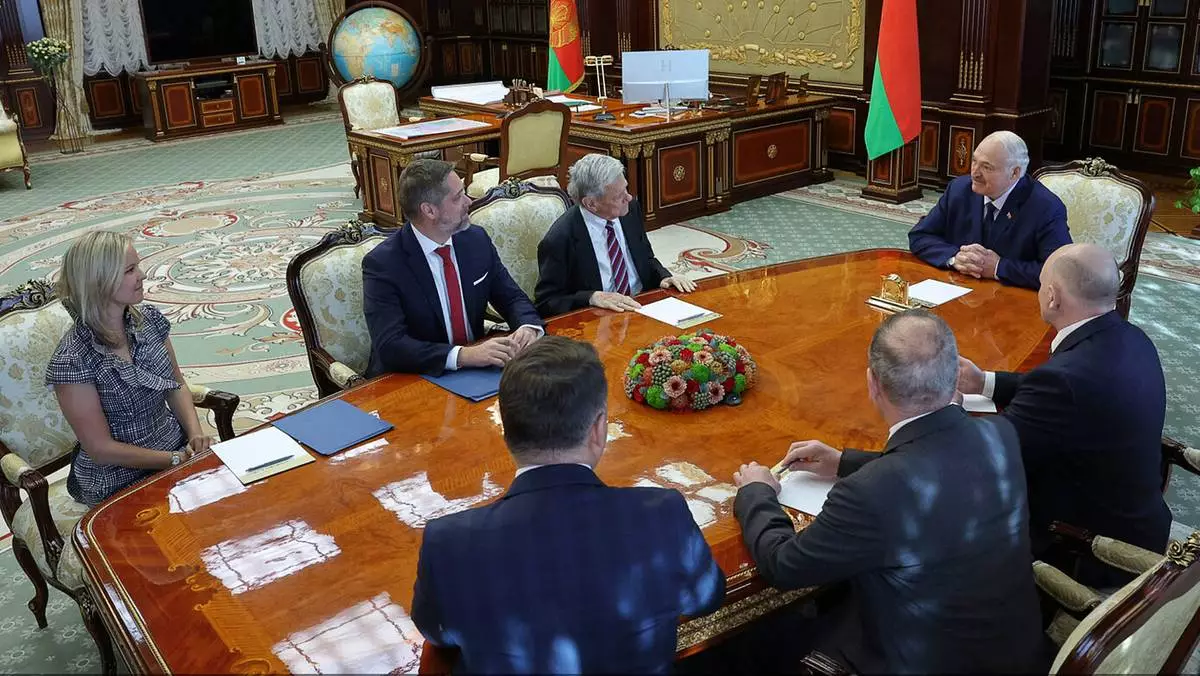
In this photo released by Belarusian presidential press service, Belarusian President Alexander Lukashenko, right, and U.S. Presidential envoy John Coale, second right, talk during their meeting in Minsk, Belarus, Thursday, March 19, 2026. (Belarusian Presidential Press Service via AP)
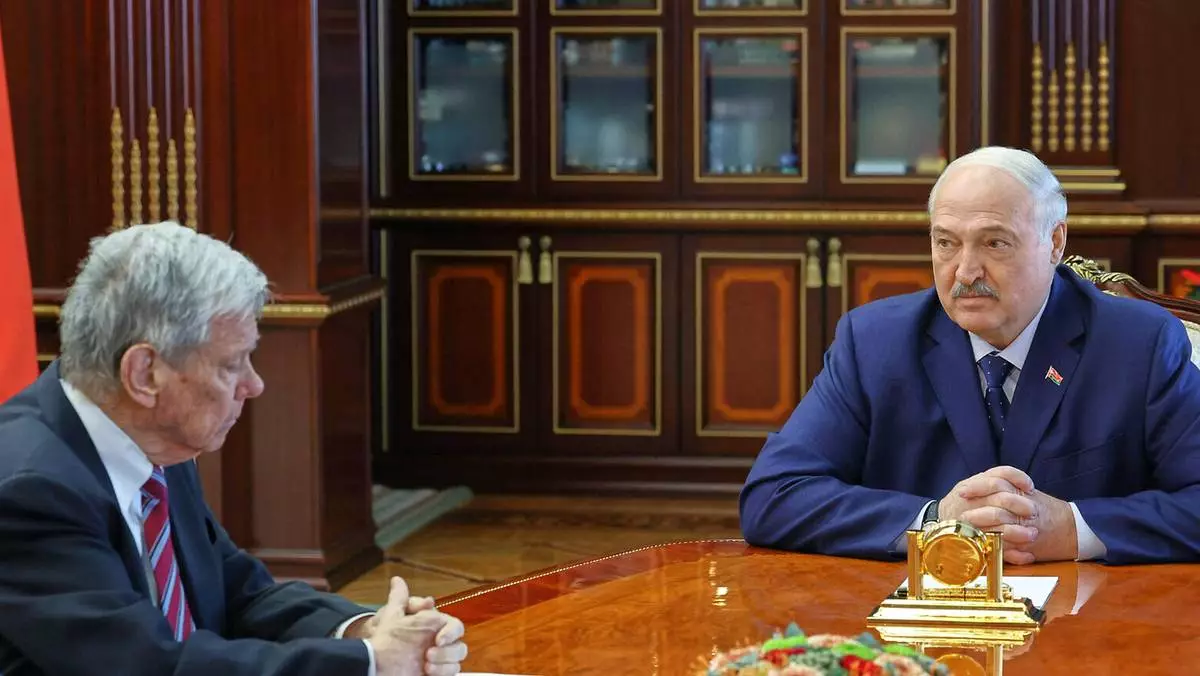
In this photo released by Belarusian presidential press service, Belarusian President Alexander Lukashenko, right, and U.S. Presidential envoy John Coale talk during their meeting in Minsk, Belarus, Thursday, March 19, 2026. (Belarusian Presidential Press Service via AP)