Major League Baseball is entering an official partnership with Polymarket and has an agreement with the federal commission overseeing prediction markets to collaborate on integrity concerns.
MLB said in a statement Thursday it has a memorandum of understanding with Michael S. Selig, the chair of the Commodity Futures Trading Commission, to “further protect the integrity of baseball by ensuring swift response to incidents and anticipating emerging trends more strongly.”
Prediction markets have raised concerns from sports leagues already working to combat issues around legal sports gambling. While legal sports books must follow regulations set by states, prediction markets have argued their trades — called event contracts — are derivative markets, and thus fall under the CFTC's jurisdiction.
One year ago, MLB sent a letter to the commission calling for strong integrity protections.
“The new agreements that we formed with Polymarket and the CFTC are imperative steps in proactively managing the new and rapidly growing prediction market space,” MLB Commissioner Rob Manfred said in a statement. “Protecting the integrity of the game on the field is our top priority. By engaging in this community, we are able to work together to create clear boundaries with the goal of mitigating risk while providing fan engagement opportunities.”
This partnership with Polymarket will give the company and its brokers exclusive access to MLB logos to be used within its prediction market products. Polymarket will also get access to official league data from Sportradar, MLB’s exclusive global distributor of data for prediction markets.
Under terms of the memorandum, MLB and the CFTC agreed to share information regarding the integrity of professional baseball and related prediction markets. Shared information will be treated confidentially. Designated representatives will meet regularly.
“We’ve committed to work together to protect the integrity and resilience of prediction markets relating to professional baseball,” Selig said on X. "Through this partnership, the @CFTC is well-positioned to add additional tools to protect our markets from fraud, manipulation, and other abuses. Thanks to @MLB and Commissioner Manfred for working with us to protect the integrity of these growing markets.
Although it has established this partnership with Polymarket, MLB said it wants integrity relationships with all other prediction market exchanges offering baseball contracts. Those exchanges will be required to integrate the necessary integrity protections into their individual rulebooks.
The rapid growth of sports offerings on prediction markets has provided leagues with another revenue opportunity while also causing concerns about the regulation of prediction markets.
Prediction markets provide an opportunity to trade — or wager — on the result of future events. Trades are made as simple yes-no wagers
The NHL announced in October it had reached multiyear partnership agreements with Polymarket and Kalshi, another major prediction markets platform. Major League Soccer announced a partnership with Polymarket on Jan. 26. NBA star Giannis Antetokounmpo of the Milwaukee Bucks announced last month that he has become a shareholder in Kalshi.
MLB had a presentation on prediction markets during its owners’ meetings in Florida last month.
AP MLB: https://apnews.com/hub/mlb
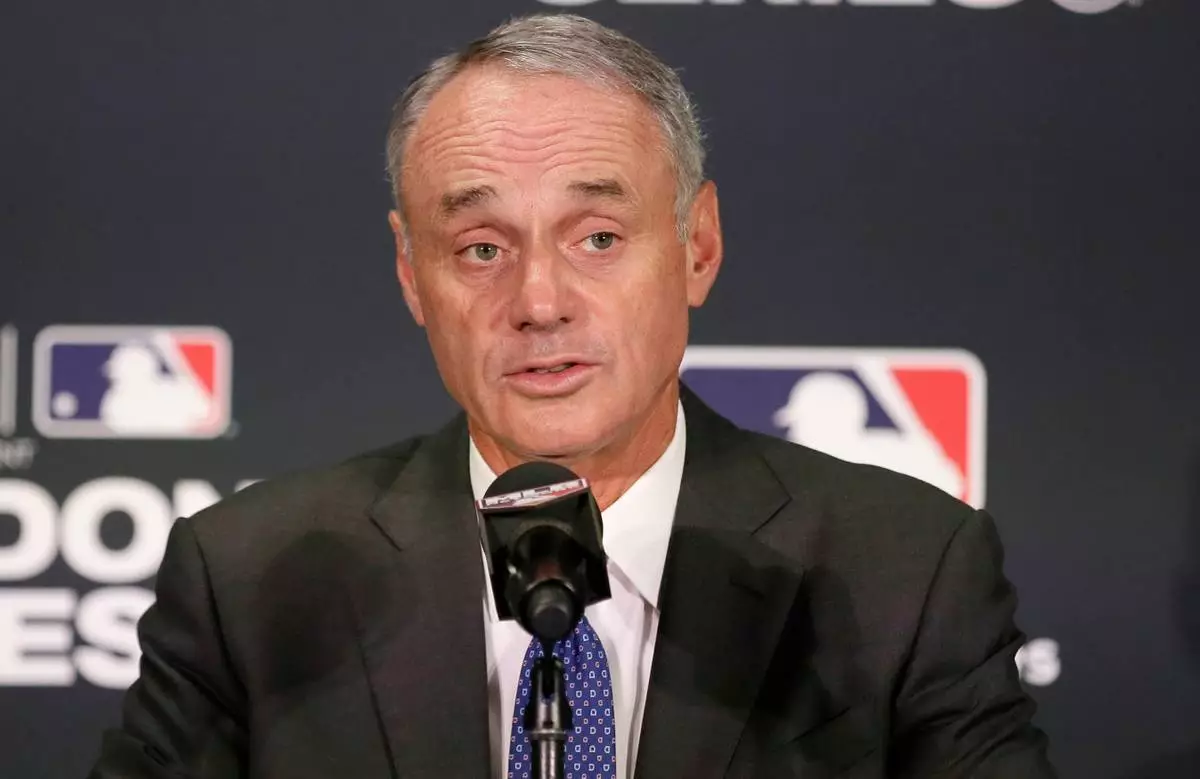
FILE - Major League Baseball commissioner Rob Manfred speaks during a news conference, June 29, 2019, in London. (AP Photo/Tim Ireland, file)
WASHINGTON (AP) — The Pentagon is seeking $200 billion in additional funds for the Iran war, a sizable amount that is certain to be met with questions from Congress, which would need to approve any new money.
The department sent the request to the White House, according to a senior administration official, who spoke on condition of anonymity to discuss the private information. Asked about the figure at a press conference Thursday, Defense Secretary Pete Hegseth did not directly confirm the amount, saying it could change.
“It takes money to kill bad guys,” Hegseth said.
But he said “we’re going back to Congress and our folks there to ensure that we’re properly funded.”
It’s an extraordinarily high number and comes on top of extra funding the Defense Department already received last year in President Donald Trump’s big tax cuts bill. Such a request would need to be approved by Congress, and it is not at all clear such spending would have political support. The nation's debt has surged past a record $39 trillion.
Congress has been bracing for a new spending request but it is not clear the White House has transmitted the request for consideration. Lawmakers have not authorized the war, and Congress is showing growing unease with the military operation’s scope and strategy.
The new funding request was first reported by The Washington Post.
The White House on Thursday did not answer further questions about the $200 billion request.
House Speaker Mike Johnson said it’s a “dangerous time” and “we have to adequately fund defense.”
Asked whether he supported the amount, Johnson said he has not seen the details, but “I support what’s needed to ensure that the American people remain safe."
While the House and Senate are controlled by the president’s Republican Party many of the more conservative lawmakers are also fiscal hawks, with little political appetite for big spending, on military operations or other matters. Most Democrats are likely to reject such a request and demand more detailed plans from the Trump administration about the U.S. military goals and objectives.
Rep. Ken Calvert, the Republican chair of the House subcommittee with oversight over defense spending, said he was already advocating for a supplemental spending bill to allow the Pentagon to replenish munitions.
“That was going to happen, and now we have this conflict with some additional costs. So, that’s where we’re at," Calvert of California said Thursday.
"I know there are peripheral issues out there that people are concerned about, but right now, this is about our national security and it’s important that we get this done,” he said.
But Rep. Betty McCollum of Minnesota, the ranking Democrat on the House subcommittee with oversight over defense spending, said the president has taken the U.S. into a war without coming to Congress and she’s demanding more details.
“This is not going to be a rubber stamp for the president of the United States,” McCollum said.
She said Congress is still waiting for the administration to explain where it would be spending the additional $150 billion funding that went to the Pentagon through Trump’s tax and spending cut bill. It’s also waiting on the president’s budget request for this year.
“I’m not writing blank checks to the Department of Defense,” McCollum said.
It all points to a monumental battle ahead in Congress over any new Pentagon spending that would almost certainly need support from Republicans and Democrats in a bipartisan package to push past objections toward approval.
The requested amount would be a hefty boost to the Pentagon’s annual budget, which Congress approved at more than $800 billion for the current fiscal year.
That’s on top of some $150 billion that Congress gave the Defense Department in last year’s tax cuts bill, much of it for specific projects and overall upgrades to the Pentagon's operations.
The nonpartisan Congressional Budget Office has projected that the federal government will run a $1.9 trillion annual deficit this year, and that’s before adding any spending done through a supplemental bill.
While some of the military's biggest champions on Capitol Hill have welcomed new spending as a way to replenish munitions stockpiles and upgrade the U.S. defense capabilities in the face of emerging threats, others will certainly point to health care and other domestic needs that they view as more important priorities.
Rep. Rosa DeLauro, the ranking Democrat on the House Appropriations Committee, said of the $200 billion price tag: “It’s outrageous.”
To muscle a package to passage, Republican leaders could either try to go it alone through an arduous budget process, or cut deals with Democrats on other priorities that would likely balloon the overall price tag.
House Majority Leader Steve Scalise, R-La., signaled the negotiations ahead.
“Ultimately we’re going to have negotiations with the White House on an exact amount,” Scalise said. “We’re not at that point yet.”
Associated Press writers Konstantin Toropin and Michelle L. Price contributed to this report.

Defense Secretary Pete Hegseth speaks to members of the media during a press briefing at the Pentagon in Washington, Thursday, March 19, 2026. (AP Photo/Manuel Balce Ceneta)

Defense Secretary Pete Hegseth speaks to members of the media during a press briefing at the Pentagon in Washington, Thursday, March 19, 2026. (AP Photo/Manuel Balce Ceneta)