RIYADH, Saudi Arabia & DUBAI, United Arab Emirates & BENGALURU, India--(BUSINESS WIRE)--Jan 15, 2026--
ITC Infotech, a leading global technology services provider, today announced the inauguration of its Digital & AI Engineering Hub in Riyadh, as the company completes 15 years of operations in the Middle East.
This press release features multimedia. View the full release here: https://www.businesswire.com/news/home/20260114855302/en/
The new hub was inaugurated by Mr. Sanjiv Puri, Chairman & Managing Director, ITC Ltd and Chairman of ITC Infotech., underscoring ITC Infotech’s long-term commitment to the Kingdom of Saudi Arabia and the broader Middle Eastern Region.
The Digital & AI Engineering Hub has been established to enable enterprises to accelerate their digital transformation initiatives. The hub will focus on digital engineering, AI-led innovation, cloud, automation, and platform-based solutions, to improve agility, operational efficiency, and scalability for organisations while delivering measurable business outcomes.
Commenting on the launch, Vishal Kumar, President & Regional Head – MEA, India & APAC, ITC Infotech, said:
“Our expansion in Riyadh reflects ITC Infotech’s long-standing commitment to the Middle East and our confidence in the region’s digital growth trajectory. The new Digital & AI Engineering Hub will enable us to work more closely with our clients, deliver advanced technology solutions at scale, and support Saudi Arabia’s ambition of building a globally competitive, innovation-led economy.”
This strategic expansion aligns closely with Saudi Arabia’s Vision 2030, which emphasizes strengthening digital and AI capabilities, fostering innovation, and developing a knowledge-based economy.
The opening of the Digital & AI Engineering Hub in Riyadh underscores ITC Infotech’s commitment to Saudization and the development of talent within the Kingdom. The hub will cultivate a skilled local workforce, build digital capabilities, and deliver expertise-led solutions from Saudi Arabia. This investment strengthens a sustainable ecosystem that accelerates digital transformation, enhances delivery excellence, and enables faster collaboration for our customers across the region.
About ITC Infotech
ITC Infotech is a leading global technology services and solutions provider, led by Business and Technology Consulting. ITC Infotech provides business-friendly solutions to help clients succeed and be future-ready, by seamlessly bringing together digital expertise, strong industry specific alliances and the unique ability to leverage deep domain expertise from ITC Group businesses. The company provides technology solutions and services to enterprises across industries such as Banking & Financial Services, Healthcare, Manufacturing, Consumer Goods, Travel and Hospitality, through a combination of traditional and newer business models, as a long-term sustainable partner.

A glimpse into the exciting launch of ITC Infotech’s Digital & AI Engineering Hub in Riyadh
Anthropic's moral stand on U.S. military use of artificial intelligence is reshaping the competition between leading AI companies but also exposing a growing awareness that maybe chatbots just aren't capable enough for acts of war.
Anthropic's chatbot Claude, for the first time, outpaced rival ChatGPT in phone app downloads in the United States this week, a signal of growing interest from consumers siding with Anthropic in its standoff with the Pentagon, according to market research firm Sensor Tower.
The Trump administration on Friday ordered government agencies to stop using Claude and designated it a supply chain risk after Anthropic CEO Dario Amodei refused to bend his company's ethical safeguards preventing the technology from being applied to autonomous weapons and domestic mass surveillance. Anthropic has said it will challenge the Pentagon in court once it receives formal notice of the penalties.
And while many military and human rights experts have applauded Amodei for standing up for ethical principles, some are also frustrated by years of AI industry marketing that persuaded the government to apply the technology to high-stakes tasks.
“He caused this mess,” said Missy Cummings, a former Navy fighter pilot who now directs the robotics and automation center at George Mason University. “They were the No. 1 company to push ridiculous hype over the capabilities of these technologies. And now, all of a sudden, they want to be for real. They want to tell people, ‘Oh, wait a minute. We really shouldn’t be using these technologies in weapons.’”
Anthropic didn't immediately respond to a request for comment. The Defense Department declined to comment on whether it is still using Claude, including in the Iran war, citing operational security.
Cummings published a paper at a top AI conference in December arguing that government agencies should prohibit the use of generative AI “to control, direct, guide or govern any weapon.” Not because AI is so smart that it could go rogue, but because the large language models behind chatbots like Claude make too many mistakes — called hallucinations or confabulations — and are “inherently unreliable and not appropriate in environments that could result in the loss of life.”
“You’re going to kill noncombatants,” Cummings said in an interview Tuesday with The Associated Press. “You’re going to kill your own troops. I’m not clear whether the military truly understands the limitations.”
Amodei sought to emphasize those limitations in defending Anthropic's ethical stance last week, arguing that “frontier AI systems are simply not reliable enough to power fully autonomous weapons. We will not knowingly provide a product that puts America’s warfighters and civilians at risk.”
Anthropic, until recently, was the only one of its peers to have approval for use in classified military systems, where it has partnered with data analysis company Palantir and other defense contractors. President Donald Trump said Friday, around the same time he was approving Saturday's military strikes on Iran, that the Pentagon would have six months to phase out Anthropic's military applications.
Cummings, a former Palantir adviser, said it's possible that Claude has already been used in military strike planning.
“I just fundamentally hope that there were humans in the loop,” she said. “A human has to babysit these technologies very closely. You can use them to do these things, but you need to verify, verify, verify.”
She said that's a contrast to the messaging from AI companies that have suggested that their technology is evolving to the point where it is “almost sentient.”
“If there’s culpability here, I’d say half is Anthropic's for driving the hype and half is the Department of War’s fault for firing all the people that would have otherwise advised them against stupid uses of technology,” Cummings said.
One social media commentator this week described Anthropic's government problems as a “Hype Tax” — a message that was reposted by President Donald Trump's top AI adviser, David Sacks, a frequent critic of the company.
And while it has caused legal hassles that could jeopardize Anthropic's business partnerships with other military contractors, it has also bolstered its reputation as a safety-minded AI developer.
“It’s applaudable that a company stood up to the government in order to maintain what it felt were its ethics and were its business choices, even in the face of these potentially crippling policy responses,” said Jennifer Huddleston, a senior fellow at the libertarian-leaning Cato Institute.
Consumers have already spoken, leading to a surge of Claude downloads that made it the most popular iPhone app starting on Saturday and for all phone systems in the U.S. on Monday, according to Sensor Tower. That's come at the expense of OpenAI's ChatGPT, which saw its consumer reputation damaged when it announced a Friday deal with the Pentagon to effectively replace Anthropic with ChatGPT in classified environments.
In the Apple store, the number of 1-star reviews — the worst rating — of ChatGPT grew by 775% on Saturday and continued to grow early this week, forcing OpenAI to do damage control.
“We shouldn’t have rushed to get this out on Friday,” OpenAI CEO Sam Altman said in a social media post Monday. “The issues are super complex, and demand clear communication. We were genuinely trying to de-escalate things and avoid a much worse outcome, but I think it just looked opportunistic and sloppy.”
Altman was planning to gather employees for an “all-hands” meeting on Tuesday to discuss next steps.
“There are many things the technology just isn’t ready for, and many areas we don’t yet understand the tradeoffs required for safety,” Altman said. “We will work through these, slowly, with the (Pentagon), with technical safeguards and other methods.”
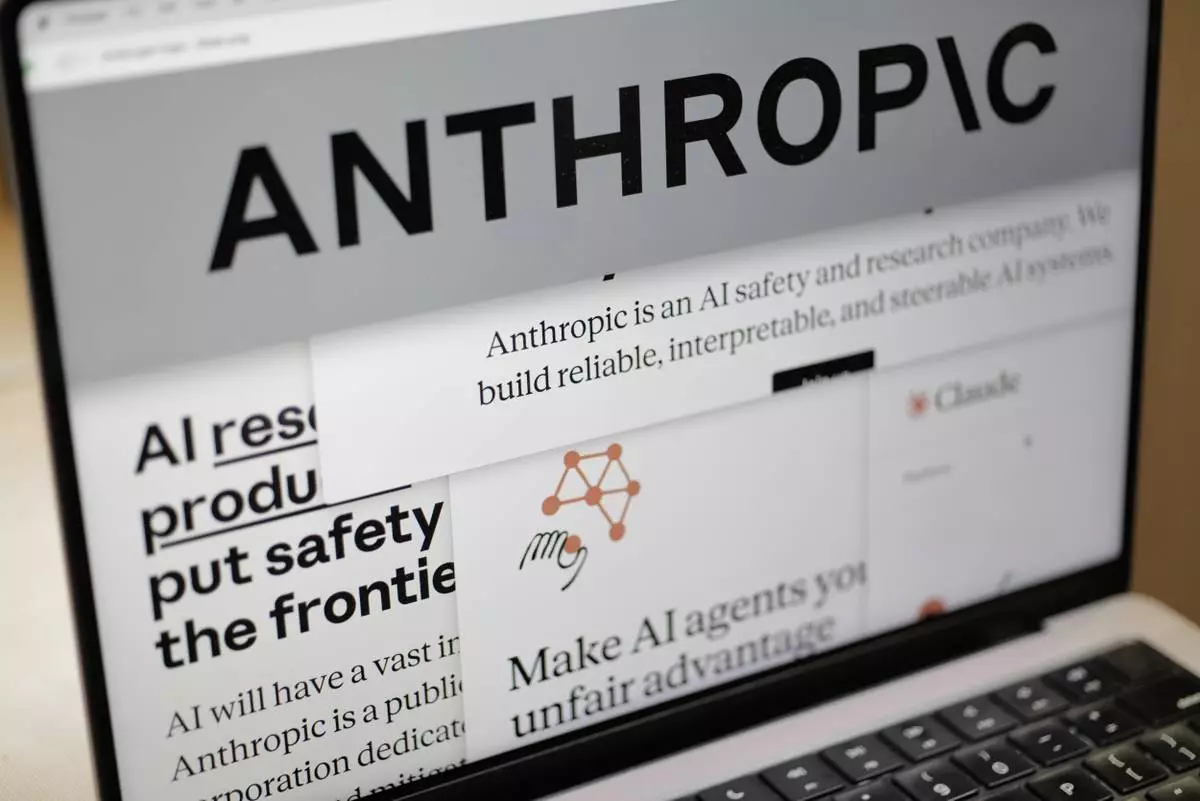
Pages from the Anthropic website and the company's logo are displayed on a computer screen in New York on Thursday, Feb. 26, 2026. (AP Photo/Patrick Sison)