Twenty-eight Chinese astronauts have taken a cave-training mission in deep mountains of southwest China's Chongqing Municipality to better endure extreme environments.
Divided into four teams, the 28 astronauts were trained on environmental monitoring, cave mapping, simulated space-to-ground communications and team-focused psychological tests.
Each team spent six days and five nights in a natural cave where the average temperature hovered at eight degrees Celsius and humidity reached 99 percent.
They were required to explore the cave, conduct scientific research, logistics management and life-support operations.
Along the way they squeezed through ultra-narrow passages, rappelled down sheer walls, endured prolonged cold and dampness, and pushed their physical limits.
They also had to conquer the mental pressure stemming from absolute darkness and sensory deprivation.
Song Lingdong, who participated in China's Shenzhou-19 mission, said the harsh environment in the cave training helped them improve their teamwork.
"Throughout our training, although the external environment was quite harsh, it actually stimulated our compatibility as a team, brought us even closer, and made us more passionate in the work. We all wanted to complete the mission soon and do the work well," Song said.
Zhu Yangzhu, a crew member of China's Shenzhou-16 mission, said the extreme quietness in the deep cave feels like being in the space.
"While crawling slowly, I tried to enjoy and savor the pleasure in the process. This way I could offset the difficulties in the psychological environment and the sense of pressure. Later, I even suggested turning off all the lights. Then it was truly pitch-dark, where you couldn't see your fingers. In that state, we could feel our own heartbeat and breath. That allowed one to experience the extreme quietness in the space," he said.
Astronaut Tang Hongbo, who acted as the commander of the Shenzhou-17 mission, served as a team commander again in the cave training.
"This time I was the commander, and encountered many challenges and difficulties. Firstly, it was all dark underground and it was extremely. Secondly, it was pitch dark, where you couldn't see your own hands. Thirdly, it was the challenge to our safety. As I was the commander and I must be responsible for everyone's safety, I felt immense pressure on me about that," Tang said.
Liu Yang, the first Chinese woman in space who participated in the Shenzhou-9 and Shenzhou-14 missions, said the training is a rewarding experience.
"When we walked out of the cave mouth, it truly felt like the moment our spacecraft's re-entry module lands on the Earth safely, and everyone exits the cabin. We were all excited and thrilled. In our past missions, it was the moment to report back to our motherland that we accomplished the mission. This time, with all our team members safely out, we could report to the training commander our success," she said.
To find a venue that replicates the extremes of space, researchers of the China Astronaut Research and Training Center (CARTC) has scouted more than 10 caves across seven provincial-level regions since 2016, including Guangxi, Guizhou, Hunan, Anhui and Chongqing.
Rating each based on the training challenge, geological stability and basic life-safety, they selected the cave deep in the mountains of Wulong District, Chongqing for the training this time.
The CARTC will run the same cave-training mission for astronauts who missed this training, as well as for all new recruits.
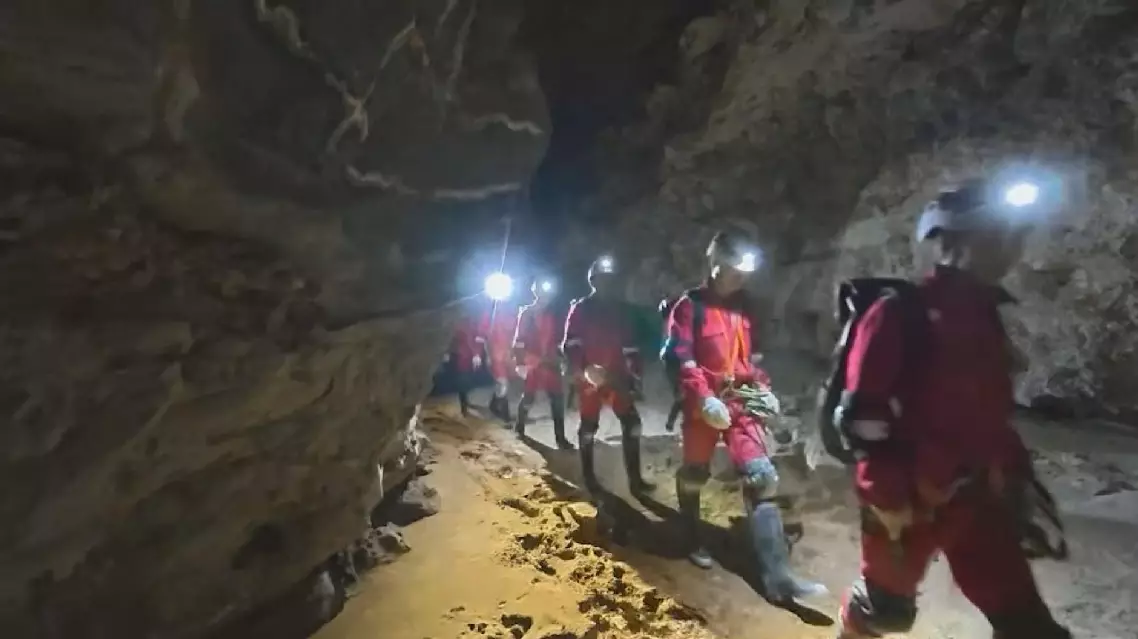
Cave-training enables astronauts to better endure extreme environments