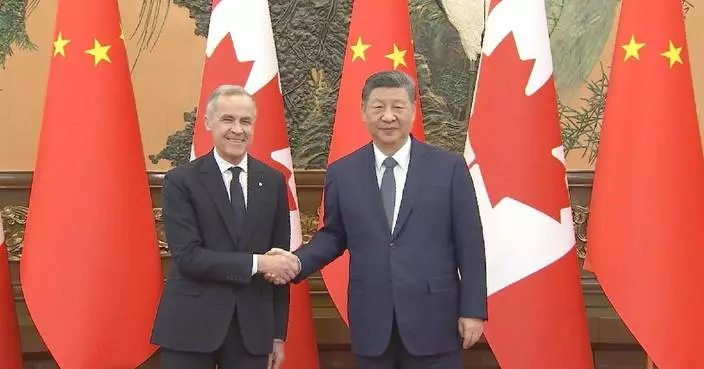
China and Canada should leverage their strongly complementary economies to expand practical cooperation in key areas such as agriculture, energy and climate response, a Chinese trade expert said on Friday, while urging Canada to translate its trade principles into fairer treatment for Chinese businesses.
Ties between the two sides are in the spotlight this week as Canadian Prime Minister Mark Carney is currently embarking on an official visit to China, the first by a Canadian Prime Minister to the country in eight years.
Carney, who arrived in Beijing on Wednesday, held talks with Chinese President Xi Jinping on Friday, with Xi stressing that the sound and stable development of China-Canada relations serves the common interests of both countries.
In an interview with the China Media Group (CMG), Zhou Mi, a senior research fellow at the Chinese Academy of International Trade and Economic Cooperation, highlighted both the opportunities and the challenges facing the bilateral economic relationship.
Noting China and Canada are both firm supporters of global trade, Zhou said the key is translating this consensus into practice. He pointed to the findings of an anti-discrimination probe launched by China last year, which found that Canada's restrictive measures against some Chinese products had disrupted normal trade order and harmed the legitimate rights and interests of Chinese enterprises.
"I think it's natural for us to understand that if Canada is going to reach some consensus with China in a better way, they should try to change their behaviors," Zhou said.
Against the backdrop of tariffs launched by the U.S. administration, Zhou acknowledged that as Canada is part of North America, formulating a truly independent policy poses a significant challenge, but urged the Canadian side to focus on the strengths it can cultivate in its ties with China.
"There are so many complimentary advantages by both sides. But I think we need some actions instead of just saying something that they will change their attitude towards Chinese companies. We do not need more, we just want some fairness for the treatment of the enterprises and products from China," he said.
Zhou further emphasized the strong complementary nature of the two economies and noted the considerable room for growth amid the thawing ties between the two sides.
He noted that such space exists in the agriculture sector, where China has been a vital market for Canada's canola products, and cited Canada's desire to increase oil experts as well as the potential for cooperation in the green transition such as speeding up the shift to new energy vehicles.
"Like for the agricultural products of Canada, we want to import more from them. But at the same time, they have the energy, especially the crude oil and the gas. We want to import more from them, and both sides have agreed that the climate change is a challenge for both of us and the world. So we can do more to improve our abilities to deal with that problem, like in the new energy vehicles. We can try to support the development of these industries to support our goals of fulfillment on these climate change issues," he said.
Zhou added that many Chinese provinces are interested in building stronger ties with Canadian provinces, highlighting the significant potential for cooperation in education, culture and other areas including the digital economy. He hopes that authorities on both sides can offer a more stable and predictable policy framework to enhance mutual confidence and create better conditions to allow businesses to flourish.
"There are so many possibilities, if both governments can provide better certainties or policies, frameworks for both sides, we can try to do better and have more confidence for the companies," he said

China, Canada should deepen cooperation to unleash potential of complementary economies: expert