NEW YORK (AP) — The U.S. flu season appears to be waning with two straight weeks of decline in measures of flu activity, according to the latest government data released Friday.
The Centers for Disease Control and Prevention posted data — for flu activity through last week — that showed a big drop in flu hospitalizations and a smaller but significant decrease in medical office visits due to flu-like illness.
The number of states reporting high flu activity also fell — from 44 to 36.
Meanwhile, there have not been large surges in two other winter menaces — COVID-19 and RSV.
CDC officials are calling the current respiratory virus season “moderate.” But that doesn't mean the season is over, especially for flu. Second surges in flu activity often occur after the winter holidays.
“We've had other seasons where we've had a peak, it's gone down, but we've nonetheless had a prolonged season," said Dr. William Schaffner, an infectious diseases specialist at Vanderbilt University in Tennessee.
“Most of us are crossing our fingers,” he added. ”But I don't think we can rely on the concept that flu is abating very early this year."
Medical experts have worried about this season because it has been dominated by a kind of flu virus, called A H3N2, that historically causes the most hospitalizations and deaths in older people.
Even more concerning, about 90% of the H3N2 infections analyzed this season were a new strain that differs from the version accounted for in this year’s flu shots.
So far this season, there have been at least 18 million flu illnesses and 230,000 hospitalizations, according to the CDC. The agency also estimates there have been 9,300 deaths from flu so far, including at least 32 children. For those children whose vaccination status is known, 90% were not fully vaccinated against flu.
The Associated Press Health and Science Department receives support from the Howard Hughes Medical Institute’s Department of Science Education and the Robert Wood Johnson Foundation. The AP is solely responsible for all content.

FILE - A pharmacist gives a patient a flu shot in Miami on Sept. 9, 2025. (AP Photo/Daniel Kozin, File)
WASHINGTON (AP) — President Donald Trump ’s White House ballroom project is way too big and should be scaled back, an architect and member of the board of the National Trust for Historic Preservation said Wednesday — one of a number of changes he has suggested for a project he says could permanently alter the nation's most recognizable historic home.
David Scott Parker, a Fellow of the American Institute of Architects whose firm specializes in residential design and historic preservation, shared his views with The Associated Press as a key federal agency, the National Capital Planning Commission, prepared to meet Thursday to vote on whether to approve the 90,000-square-foot (8,361-square-meter) project. A separate federal panel, the U.S. Commission of Fine Arts, approved the project at its February meeting.
“Everything here feels inflated,” said Parker, who has been an architect for more than 35 years. “The net effect of this is to adversely impact what is the most important historic — the most identifiable historic — house in the entire United States. This is permanent, what it will do to the White House.”
Trump announced last summer he would be add a ballroom to the White House, citing the need for space other than a tent on the lawn to entertain important guests. He demolished the East Wing in October with little warning and underground construction to prepare the site has been underway since then. White House officials have said above-ground construction would not start before April, at the earliest.
The National Trust for Historic Preservation, a private, nonprofit group, asked a federal judge to temporarily halt construction until the White House submitted the construction plans to both federal panels and to Congress for approval, and allowed the public to comment. U.S. District Judge Richard Leon rejected the request last week, and the Trust has said it plans to file an amended lawsuit.
Parker's architectural analysis was based on renderings and other information the White House submitted to the fine arts commission last month.
The ballroom itself takes up about 22,000 square feet (2,043 square meters) of the total space, and Parker said that is far larger than needed for the 1,000 guests Trump has said it would accommodate. The industry standard for a ballroom allots 15 square feet (1.4 square meters) per person, Parker said. By that measure, Trump's ballroom could be 47% smaller — or no bigger than 15,000 square feet (1,394 square meters), he said.
The proposal includes a 4,000-square-foot (372 square meters), south-facing porch and staircase. Parker said these are unnecessary since they don't provide guests with direct access to the interior of the building. He said the porch doesn't comply with the Americans with Disabilities Act.
The White House said Wednesday that the ballroom will comply with the federal law requiring accommodations for people with disabilities, but did not provide further comment on Parker's critique.
The proposed portico is significantly larger than the portico on the south side of the White House and the south side of the Treasury Department building nearby.
Concerns about the project's size have followed it from the start. At nearly twice the size of the main White House itself, which is 55,000 square feet (5,110 square meters), critics have argued the addition would overwhelm the mansion and throw off the symmetry of the complex.
Parker said his other main concern is that the addition would stick out just enough so that it impedes the line of sight along Pennsylvania Avenue between the White House and the Capitol as it was purposely designed hundreds of years ago by Pierre L'Enfant, who was hired by George Washington to lay out the U.S. capital.
“It's hard to fathom that ... one addition could have so many adverse impacts, symbolically, architecturally and historically,” Parker said. “This literally violates the Founding Fathers' intentions.”
Parker is listed among more than 100 people registered to speak at Thursday's commission meeting, which is scheduled to be conducted online, according to the agency's website. Thousands of people submitted comments in advance and many were opposed to Trump's project.

President Donald Trump speaks about the new ballroom construction before a Medal of Honor ceremony in the East Room of the White House, Monday, March 2, 2026, in Washington. (AP Photo/Mark Schiefelbein)
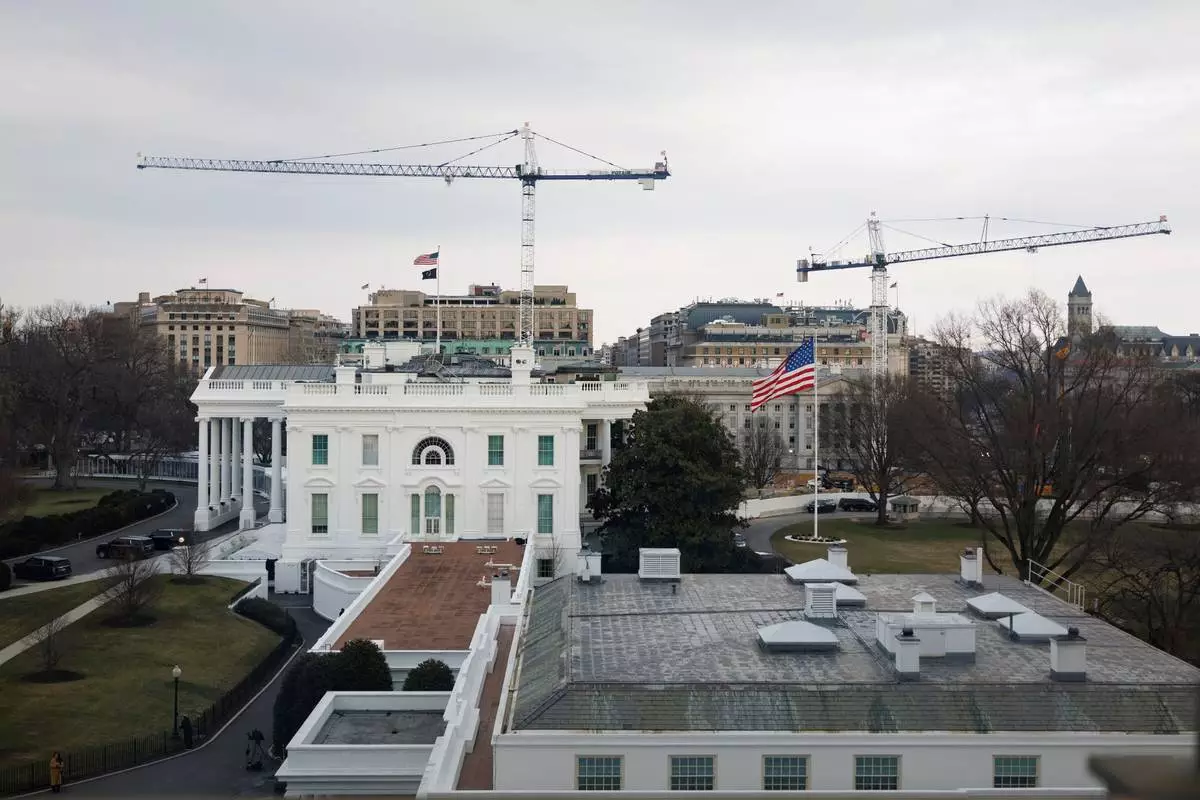
The White House, including the West Wing and construction of the new ballroom, is seen from the Old Eisenhower Executive Office Building on the White House campus Wednesday, Feb. 25, 2026, in Washington. (AP Photo/Tom Brenner)