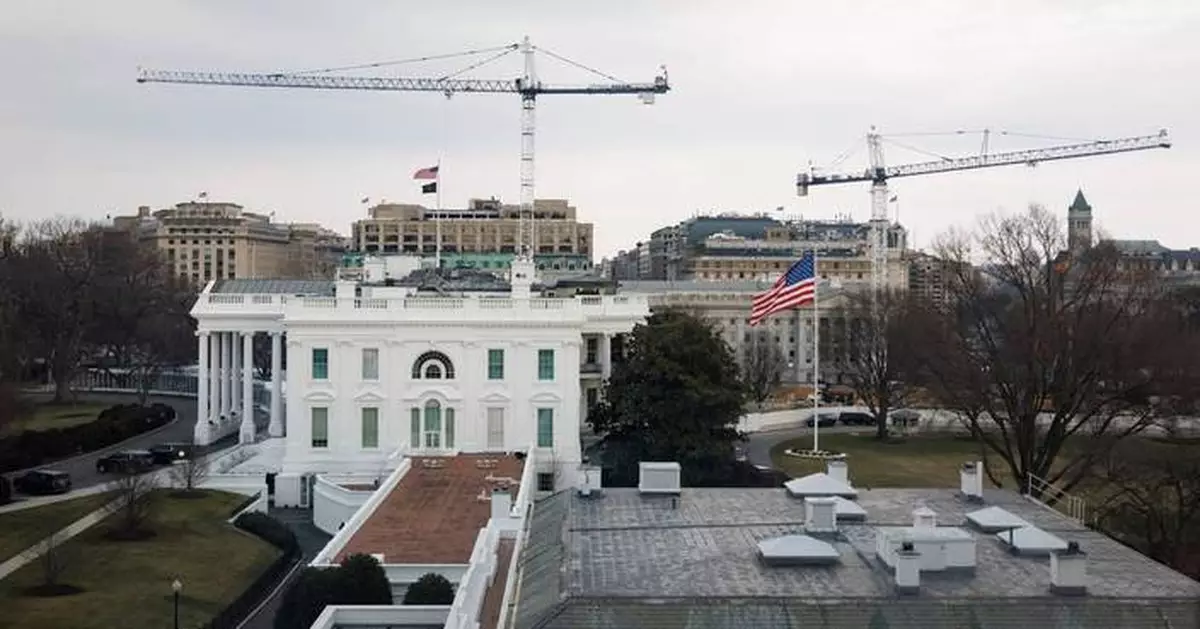
WASHINGTON (AP) — President Donald Trump ’s White House ballroom project is way too big and should be scaled back, an architect and member of the board of the National Trust for Historic Preservation said Wednesday — one of a number of changes he has suggested for a project he says could permanently alter the nation's most recognizable historic home.
David Scott Parker, a Fellow of the American Institute of Architects whose firm specializes in residential design and historic preservation, shared his views with The Associated Press as a key federal agency, the National Capital Planning Commission, prepared to meet Thursday to vote on whether to approve the 90,000-square-foot (8,361-square-meter) project. A separate federal panel, the U.S. Commission of Fine Arts, approved the project at its February meeting.
“Everything here feels inflated,” said Parker, who has been an architect for more than 35 years. “The net effect of this is to adversely impact what is the most important historic — the most identifiable historic — house in the entire United States. This is permanent, what it will do to the White House.”
Trump announced last summer he would be add a ballroom to the White House, citing the need for space other than a tent on the lawn to entertain important guests. He demolished the East Wing in October with little warning and underground construction to prepare the site has been underway since then. White House officials have said above-ground construction would not start before April, at the earliest.
The National Trust for Historic Preservation, a private, nonprofit group, asked a federal judge to temporarily halt construction until the White House submitted the construction plans to both federal panels and to Congress for approval, and allowed the public to comment. U.S. District Judge Richard Leon rejected the request last week, and the Trust has said it plans to file an amended lawsuit.
Parker's architectural analysis was based on renderings and other information the White House submitted to the fine arts commission last month.
The ballroom itself takes up about 22,000 square feet (2,043 square meters) of the total space, and Parker said that is far larger than needed for the 1,000 guests Trump has said it would accommodate. The industry standard for a ballroom allots 15 square feet (1.4 square meters) per person, Parker said. By that measure, Trump's ballroom could be 47% smaller — or no bigger than 15,000 square feet (1,394 square meters), he said.
The proposal includes a 4,000-square-foot (372 square meters), south-facing porch and staircase. Parker said these are unnecessary since they don't provide guests with direct access to the interior of the building. He said the porch doesn't comply with the Americans with Disabilities Act.
The White House said Wednesday that the ballroom will comply with the federal law requiring accommodations for people with disabilities, but did not provide further comment on Parker's critique.
The proposed portico is significantly larger than the portico on the south side of the White House and the south side of the Treasury Department building nearby.
Concerns about the project's size have followed it from the start. At nearly twice the size of the main White House itself, which is 55,000 square feet (5,110 square meters), critics have argued the addition would overwhelm the mansion and throw off the symmetry of the complex.
Parker said his other main concern is that the addition would stick out just enough so that it impedes the line of sight along Pennsylvania Avenue between the White House and the Capitol as it was purposely designed hundreds of years ago by Pierre L'Enfant, who was hired by George Washington to lay out the U.S. capital.
“It's hard to fathom that ... one addition could have so many adverse impacts, symbolically, architecturally and historically,” Parker said. “This literally violates the Founding Fathers' intentions.”
Parker is listed among more than 100 people registered to speak at Thursday's commission meeting, which is scheduled to be conducted online, according to the agency's website. Thousands of people submitted comments in advance and many were opposed to Trump's project.

President Donald Trump speaks about the new ballroom construction before a Medal of Honor ceremony in the East Room of the White House, Monday, March 2, 2026, in Washington. (AP Photo/Mark Schiefelbein)
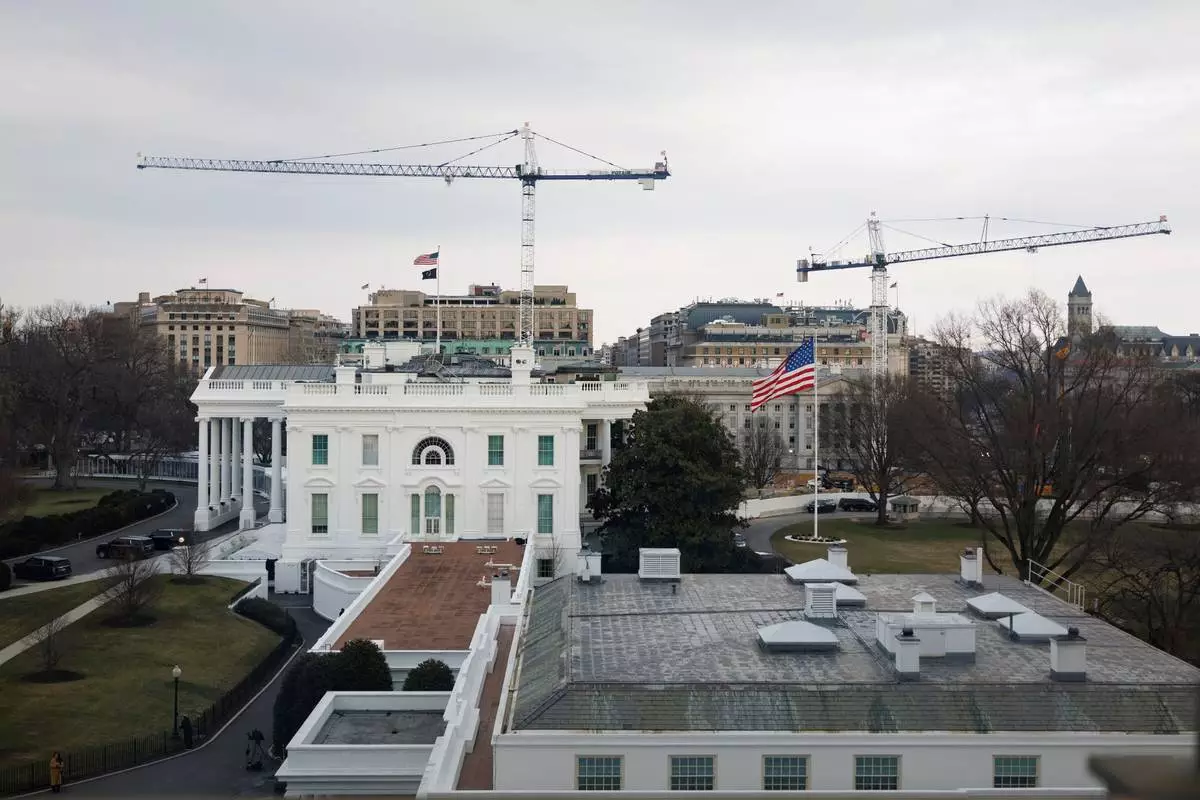
The White House, including the West Wing and construction of the new ballroom, is seen from the Old Eisenhower Executive Office Building on the White House campus Wednesday, Feb. 25, 2026, in Washington. (AP Photo/Tom Brenner)
BILLINGS, Mont. (AP) — Republican U.S. Sen. Steve Daines of Montana dropped his bid for reelection to a third term Wednesday.
Daines withdrew his name just minutes before the deadline for candidates to file for the November election with the Montana Secretary of State’s office. A spokesperson for Daines confirmed his withdrawal and said a statement would be forthcoming.
Montana U.S. Attorney Kurt Alme, who is also a Republican, entered the race shortly before the deadline.
The moves came the same day former University of Montana President Seth Bodnar launched an independent campaign for Daines’ seat.
Democrats have been broadly sidelined by the state’s voters in recent years, and Bodnar’s decision to run without party backing underscores their diminished status. Montana Democrats control no statewide offices following the 2024 defeat of three-term incumbent Sen. Jon Tester.
No well-known Democrats have entered the Senate race.
Daines is a former business executive and close ally of President Donald Trump.
Republicans have a slim majority in the Senate, holding 53 seats to Democrats’ 45 plus two independents.
Bodnar said in a video message that America’s political system is broken and elected officials in Washington are looking out only for people who are wealthy and connected.
“The American dream is getting crushed, and both parties are to blame. They pit us against each other while they line their own pockets,” Bodnar said. “We need a new approach, an independent senator who will fight for hardworking Montanans.”
The 47-year-old native of Grove City, Pennsylvania, graduated first in his class from West Point and served in the Army special forces before working as an executive at GE Transportation.
The GOP’s Senate fundraising group, the National Republican Senatorial Committee, criticized Bodnar Wednesday as “an early champion” of allowing transgender athletes to participate in college sports during his eight years leading the University of Montana.
“Now, Both Ways Bodnar wants Montanans to believe he’s transitioning from a Democrat to a fake independent,” the committee said.
A spokesperson said Bodnar’s allegiances are to the people of Montana, not a political party, when asked if he would align with Democrats or Republicans if elected.
“When Seth gets into the Senate, he will fight for new leadership and negotiate a role that gives Montanans the strongest possible voice,” Roy Loewenstein said.
If he collects the 13,327 voter signatures needed to qualify, Bodnar would appear on the general election ballot, not during the primary.
Federal Election Commission campaign filings show Daines raised more than $8 million since his last election in 2020. He had about $5 million in cash on hand as of Dec. 31, according to the filings.
Total spending in the 2024 Senate race between Tester and Republican Tim Sheehy topped $300 million, a record for a congressional race on a per-voter basis, according to party officials.
Daines, 63, who was born in Van Nuys, California, and grew up in Bozeman, Montana, was an executive at Right Now Technologies before his election to the House in 2012.
He served one term before a successful 2014 run for the Senate seat formerly held by Democrat Max Baucus. Daines won by a wide margin over a little-known opponent after Baucus’ would-be Democratic successor, former Lt. Gov. John Walsh, dropped out of the race following reports that he plagiarized parts of his thesis while attending the U.S. Army War College.
In 2020, Daines beat Democratic Gov. Steve Bullock by 10 percentage points. At that time the campaign was the most expensive in Montana political history, only to be eclipsed by the Tester-Sheehy race.
From 2023 to 2025, Daines led Senate GOP fundraising efforts as chair of the National Republican Senatorial Committee.
Montana until recent years had a history of “ticket splitting” among voters willing to back officials from both major parties. That purple streak faded as national issues including immigration and health care took a more central role in Treasure State politics.
The shift came at the expense of Democrats, who since 2014 lost control of the governor’s office, the state’s two Senate seats and all other statewide positions they once held.
In 2022 independent Gary Buchanan outperformed Democrat Penny Ronning in the general election for a Republican-held U.S. House seat representing eastern Montana. Republican former Rep. Matt Rosendale received more votes than Buchanan and Ronning combined.
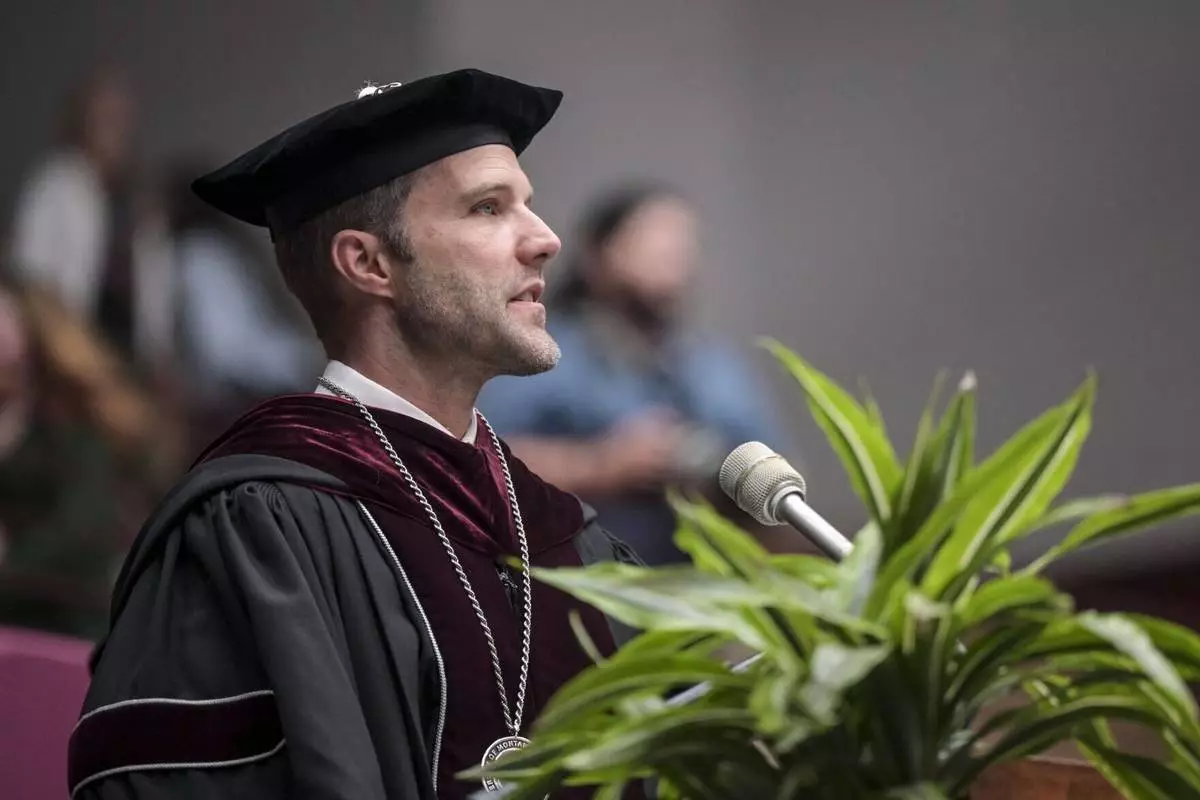
FILE - University of Montana President Seth Bodnar speaks during spring commencement at the Adams Center in Missoula, Mont., on May 10, 2025. (Ben Allan Smith/The Missoulian via AP, File)

FILE - University of Montana President Seth Bodnar, right, and his wife, Dr. Chelsea Bodnar, ride in the university's homecoming parade in Missoula, Mont., Saturday, Oct. 11, 2025. (Ben Allan Smith/The Missoulian via AP, File)