MINNEAPOLIS (AP) — U.S. Customs and Border Protection has opened an internal investigation into whether Gregory Bovino, the one-time architect of President Donald Trump's large-scale immigration crackdown, made disparaging comments about the Jewish faith of the U.S. attorney for Minnesota.
“Following a letter from a Congressman inquiring about reporting on anonymous allegations, CBP opened an internal inquiry to determine the full story,” a U.S. Department of Homeland Security spokesperson said in an emailed statement Wednesday. “This is standard procedure and does NOT indicate any confirmation of wrongdoing.”
Customs and Border Protection is part of Homeland Security.
The investigation comes after The New York Times and then CBS News reported on remarks Bovino allegedly made during a Jan. 12 phone call held to coordinate a Saturday meeting to discuss the deployment of immigration agents in the Minneapolis area.
During the call, the reports said, Bovino allegedly complained that Attorney for the District of Minnesota Daniel N. Rosen was unreachable for part of the weekend because of the Sabbath, which in Judaism is observed from sunset Friday to nightfall Saturday.
Bovino allegedly used the term “chosen people” in a disparaging way and asked, in a sarcastic tone, whether Rosen understood that some Orthodox Jewish people don’t take the Sabbath off work, the reports said.
“Do Orthodox criminals also take off on Saturday?” he asked, according to CBS.
The Times reported Rosen delegated the call to a deputy and that he himself was not part of the conversation.
The Times first reported on the investigation. It said an investigator with Customs and Border Protection’s office of professional responsibility wrote in an email that he had opened an “official inquiry into the allegation” that Bovino made “unprofessional comments."
Bovino was the public face of the Trump administration’s city-by-city immigration sweeps until late January. The Border Patrol chief led agents in Los Angeles, Chicago and New Orleans before he headed to Minnesota in December for what Homeland Security called its largest-ever immigration enforcement operation.
The administration removed Bovino from his leading role after federal officers in Minneapolis fatally shot 37-year-old mother Renee Good and 37-year-old nurse Alex Pretti on different days, leading to nationwide demonstrations and criticisms of Homeland Security's use-of-force policies.
On Monday, a Minnesota prosecutor said her office would investigate Bovino and other federal officers for misconduct. Hennepin County Attorney Mary Moriarty said she would look into an instance in which Bovino threw a smoke canister at protesters on Jan. 21. Homeland Security said in a statement that states cannot prosecute federal officers.
——-
This story has been corrected to show Department of Homeland Security emailed a statement on Wednesday, not Tuesday.
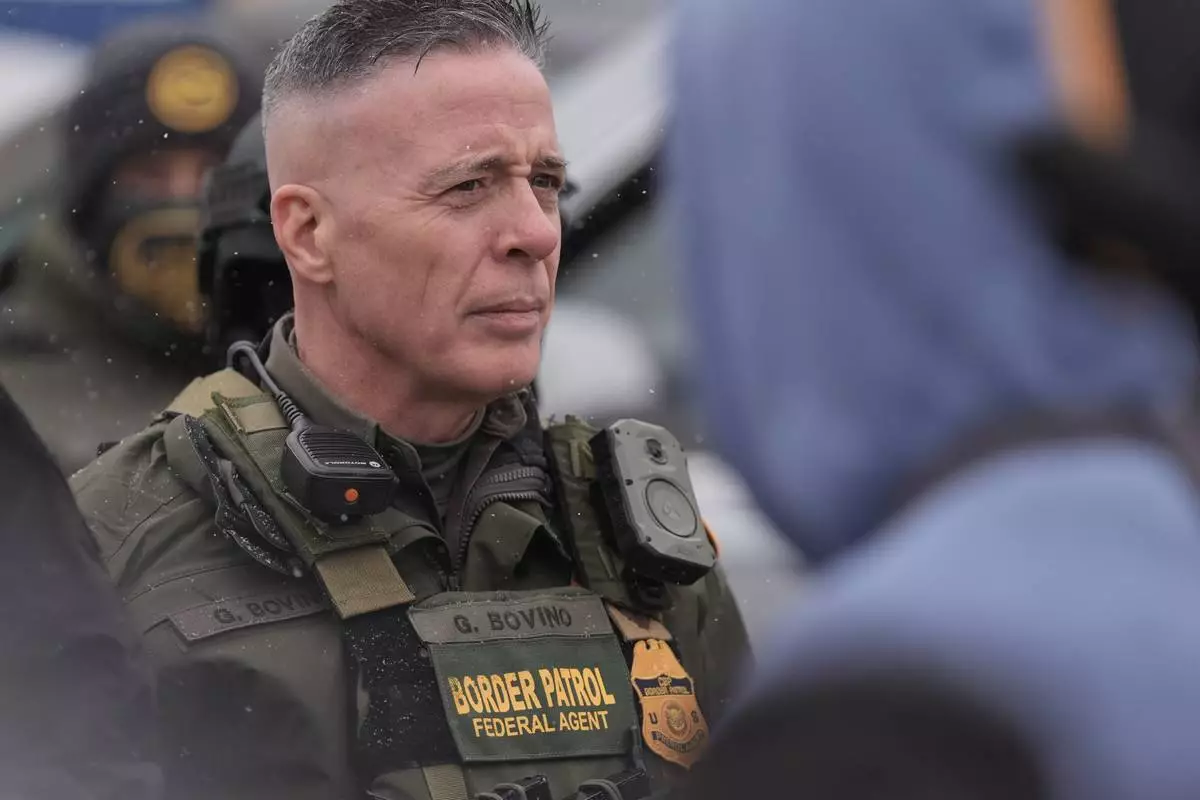
FILE - U.S. Border Patrol Cmdr. Gregory Bovino stands with Federal agents outside a convenience store, Jan. 21, 2026, in Minneapolis. (AP Photo/Angelina Katsanis, File)
WASHINGTON (AP) — Defense Secretary Pete Hegseth acknowledged Wednesday that some Iranian air attacks may still hit their targets even as he asserted that U.S. military superiority is quickly giving it control of the Islamic Republic's airspace.
The United States has spared “no expense or capability” to enhance air defense systems to protect American forces and allies in the Middle East, Hegseth told reporters at the Pentagon, days after the U.S. and Israel attacked Iran in a war that has widened throughout the region.
“This does not mean we can stop everything, but we ensured that the maximum possible defense and maximum possible force protection was set up before we went on offense,” he said.
The acknowledgment that additional drone or missile strikes could cause damage and harm to troops comes as President Donald Trump and top defense leaders have warned that more American casualties were expected in a conflict that began Saturday and could last months. The U.S. and Israeli bombardment intensified and Iran hit back Wednesday, when the Trump administration revealed that a U.S. submarine fired a torpedo that sank an Iranian warship in the Indian Ocean.
U.S. service members “remain in harm’s way, and we must be clear-eyed that the risk is still high,” Gen. Dan Caine, chairman of the Joint Chiefs of Staff, said at the news conference with Hegseth.
Six soldiers were killed when an Iranian drone strike hit an operations center Sunday in the heart of a civilian port in Kuwait, more than 10 miles from the main Army base. The husband of one of the slain soldiers, who was part of a supply and logistics unit based in Iowa, says the center was a shipping container-style building and had no defenses.
Caine declined to answer a question about the possibility of deploying ground troops in Iran, which Trump has not ruled out.
“I’m not going to comment on U.S. boots on the ground,” Caine said. “I think that’s a question for policymakers. And I don’t make policy, I execute policy.”
White House press secretary Karoline Leavitt told reporters that it was “not part of the plan for this operation at this time” but noted that "I’m not going to remove an option for the president that is on the table.”
Hegseth also signaled a possible longer time frame for the conflict than has previously been floated by the administration, saying it could last eight weeks but that the U.S. has the munitions and the equipment to beat Iran in a war of attrition. He declined to set a specific time range, saying the specific duration of the war would depend on how it unfolds.
“You can say four weeks, but it could be six, it could be eight, it could be three,” Hegseth said. “Ultimately, we set the pace and the tempo. The enemy is off balance, and we’re going to keep them off balance.”
More forces are arriving in the region, including jet fighters and bombers, Hegseth said, and the U.S. “will take all the time we need to make sure that we succeed.”
Supplies of weaponry are not an issue, Hegseth and Caine said, with the defense secretary noting that the military used more advanced weapons at the start of the campaign but was switching to gravity bombs now that the U.S. has gained control of the Iranian sky. Stockpiles of the advanced weapons remain “extremely strong," Hegseth said.
Caine said U.S. attacks on Iranian missile sites and other offensive targets have been successful enough that forces can strike deeper inland, allowing for the shift from sophisticated weapons that can be launched from far away to more traditional, precision bombs dropped by aircraft.
Caine said the U.S. has “sufficient precision munitions for the task at hand, both on the offense and defense.” He noted that the military would not be releasing quantities, citing operational security.
“Our air defenses and that of our allies have plenty of runway,” Hegseth said. “We can sustain this fight easily for as long as we need to.”
Trump said this week the campaign is likely to last four weeks to five weeks but he was prepared “to go far longer than that.”
Tehran has pledge to completely destroy Iran's military and economic infrastructure, signaling the war was nowhere near over and could expand further. But Iran's use of missiles and drones is putting a dent in its arsenal.
The number of ballistic missiles fired by Iran is down 86% from the first day of the U.S. military’s campaign, with a 23% drop in the past 24 hours, Caine said Wednesday, and Iran's use of one-way attack drone shots is down 73% from the opening days. The decrease could indicate that Iran is holding some weapons in reserve to prolong the conflict.
The administration promoted its efforts to help Americans depart the region. It had abruptly advised those in 14 countries to leave immediately even as the threat of missiles and drones closed airspace in the region and caused widespread flight cancellations.
The State Department said it has assisted nearly 6,500 Americans since the start of the war and has began charter flights and other transportation. Caine said the military has opened up available seats as military transport planes arrive “to try to help folks get out.”
The State Department said one charter flight departed the Middle East for the U.S. on Wednesday. It did not say where the flight originated, though it has said it is arranging charter aircraft from the United Arab Emirates, Qatar, Saudi Arabia and Israel.
More than 17,500 Americans have returned to the U.S. from the region since Saturday, including more than 8,500 on Tuesday alone, the department said. It acknowledged that the vast majority of those used commercial transportation without any government assistance.
Associated Press writers Ben Finley, Meg Kinnard, Matthew Lee and Michelle L. Price contributed to this report.

A Dept. of Defense map entitled, Operation EPIC FURY Timeline - First 100 Hours, is displayed during a news conference with Defense Secretary Pete Hegseth and Chairman of the Joint Chiefs of Staff Gen. Dan Caine, at the Pentagon, Wednesday, March 4, 2026, in Washington. (AP Photo/Konstantin Toropin)

Chairman of the Joint Chiefs of Staff Gen. Dan Caine, speaks during a press briefing at the Pentagon, Wednesday, March 4, 2026, in Washington. (AP Photo/Konstantin Toropin)

Staff members watch as Defense Secretary Pete Hegseth, reflected in a window, speaks during a press briefing at the Pentagon, Monday, March 2, 2026, in Washington. (AP Photo/Mark Schiefelbein)

Defense Secretary Pete Hegseth and Chairman of the Joint Chiefs of Staff Gen. Dan Caine take questions during a press briefing at the Pentagon, Monday, March 2, 2026, in Washington. (AP Photo/Mark Schiefelbein)