Skip to Content Facebook Feature Image

Venezuelan opposition leader is confident about return of democracy but says little of her plans

News

Venezuelan opposition leader is confident about return of democracy but says little of her plans
News

News

Venezuelan opposition leader is confident about return of democracy but says little of her plans

2026-01-17 05:55 Last Updated At:06:00

WASHINGTON (AP) — Venezuelan opposition leader María Corina Machado said on Friday she’s confident of her country’s eventual transition to democracy after the U.S. military ousted former President Nicolás Maduro.

But she acknowledged the challenge of holding free elections after decades of autocratic rule and declined to set any timetable. When pressed, she also took pains to avoid giving any details on her plans to return home, saying only that she would return “as soon as possible.”

More Images
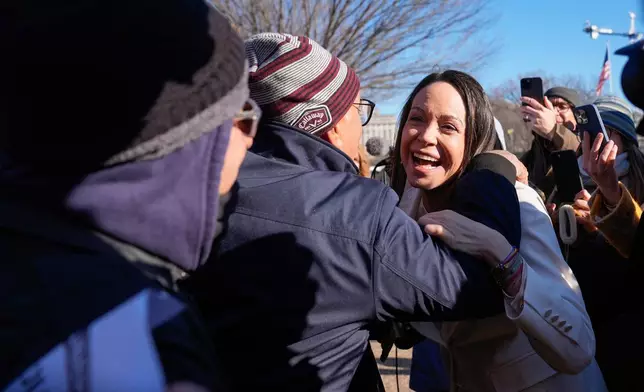
Venezuelan opposition leader MarÌa Corina Machado greets supporters on Pennsylvania Avenue near the White House after meeting with President Donald Trump Thursday, Jan. 15, 2026, in Washington. (AP Photo/Pablo Martinez Monsivais)
Venezuelan opposition leader MarÌa Corina Machado greets supporters on Pennsylvania Avenue near the White House after meeting with President Donald Trump Thursday, Jan. 15, 2026, in Washington. (AP Photo/Pablo Martinez Monsivais)
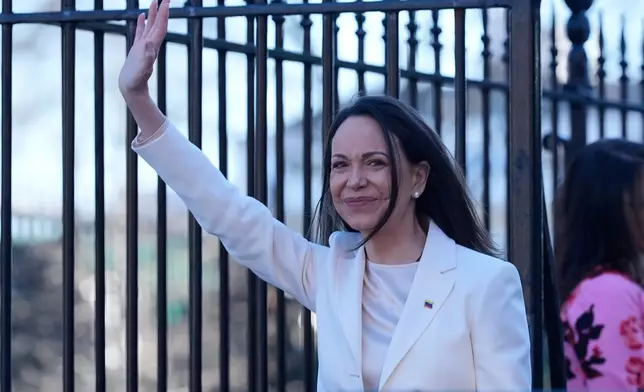
Venezuelan opposition leader María Corina Machado waves to supporters on Pennsylvania Avenue as she leaves the White House after meeting with President Donald Trump Thursday, Jan. 15, 2026, in Washington. (AP Photo/Pablo Martinez Monsivais)

Venezuelan opposition leader María Corina Machado waves to supporters on Pennsylvania Avenue as she leaves the White House after meeting with President Donald Trump Thursday, Jan. 15, 2026, in Washington. (AP Photo/Pablo Martinez Monsivais)

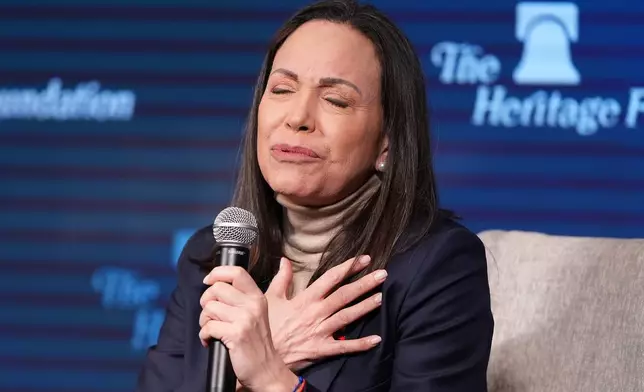
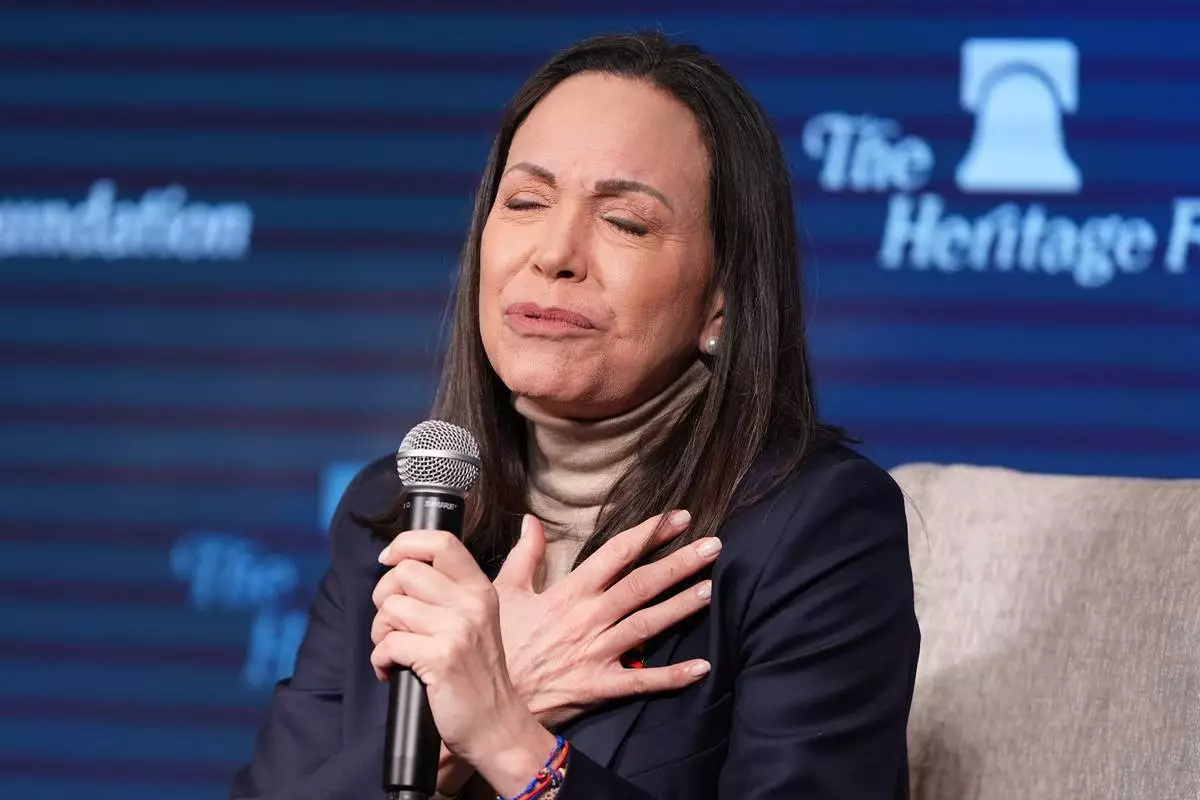
Venezuelan opposition leader Maria Corina Machado speaks at the Heritage Foundation, an influential conservative think tank, a day after meeting with President Donald Trump and members of Congress, on Capitol Hill in Washington, Friday, Jan. 16, 2026. (AP Photo/J. Scott Applewhite)

Venezuelan opposition leader Maria Corina Machado speaks at the Heritage Foundation, an influential conservative think tank, a day after meeting with President Donald Trump and members of Congress, on Capitol Hill in Washington, Friday, Jan. 16, 2026. (AP Photo/J. Scott Applewhite)

Venezuelan opposition leader Maria Corina Machado speaks at the Heritage Foundation, an influential conservative think tank, a day after meeting with President Donald Trump and members of Congress, on Capitol Hill in Washington, Friday, Jan. 16, 2026. (AP Photo/J. Scott Applewhite)

Venezuelan opposition leader Maria Corina Machado speaks at the Heritage Foundation, an influential conservative think tank, a day after meeting with President Donald Trump and members of Congress, on Capitol Hill in Washington, Friday, Jan. 16, 2026. (AP Photo/J. Scott Applewhite)

Her struggle to offer clear answers in Friday's news conference reflects how President Donald Trump’s endorsement of a Maduro loyalist to lead Venezuela for now has frozen out the nation’s Nobel Peace Prize -winning crusader for democracy.

With little choice but to put her faith in the U.S. and hope for an eventual transition, Machado has sought to cozy up to Trump, presenting her Nobel medal to him a day earlier at the White House.

As Machado was meeting with Trump, CIA Director John Ratcliffe was in Venezuela meeting with acting President Delcy Rodríguez, further confirmation that Maduro's longtime second in command was the woman that Washington preferred to see managing Venezuela at the moment.

Speaking to reporters at the Heritage Foundation, a conservative think tank in Washington, Machado said she was “profoundly, profoundly confident that we will have an orderly transition” to democracy that would also transform Venezuela's self-proclaimed socialist government long hostile to the U.S. into a strong U.S. ally.

She dismissed the perception that, in choosing to work with Rodríguez, Trump had snubbed her opposition movement, whose candidate was widely believed to have beaten Maduro in the 2024 presidential election.

“This has nothing to do with a tension or decision between Delcy Rodríguez and myself,” she said, but avoided elaborating in favor of more general assertions about her party's popular mandate and the government's dismal human rights record.

“The only thing they have is terror,” she said of Maduro's government.

Machado waved away the suggestion that her movement wouldn't be able to assert authority over security forces that remain loyal to Maduro and have long benefited from corruption under his government.

“There are not religious tensions within the Venezuelan society or racial or regional or political or social tensions,” she said.

But she also acknowledged “the difficulty of destroying a 27-year structure allied with the Russians and the Iranians.”

“We are facing challenging times ahead,” she said.

In apparent deference to Trump, she provided almost no details on Friday about what they discussed or even what she thought the U.S. should do in Venezuela, saying, “I think I don’t need to urge the president on specific things."

Trump has said little about his administration's plans for holding new elections in Venezuela and far more about its vision for reviving the nation's crumbling oil infrastructure. He's relying on a crippling oil blockade and threats of further military action to keep the interim government in line.

In a sign that the U.S. is exploring the restoration of relations with Venezuela, U.S. officials are considering reopening the U.S. Embassy in Caracas, which Trump closed during his first administration.

Machado traveled to Washington looking to rekindle the support for democracy in Venezuela that Trump showed during his first administration. She presented him with the prize she won last year, praising him for what she said was his commitment to Venezuela’s freedom. The Nobel Institute has been clear, however, that the prize cannot be shared or transferred.

Trump, who has actively campaigned to be awarded the prize, said Machado left the medal for him to keep. “And by the way, I think she’s a very fine woman,” he said. "And we’ll be talking again.”

That was of small comfort after Trump said it would be difficult for Machado to lead because she “doesn’t have the support within or the respect within the country.”

Machado crisscrossed Venezuela ahead of the 2024 presidential elections, rallying millions of voters looking to end 25 years of single party rule. When she was barred from the race, a previously unknown former diplomat, Edmundo Gonzalez, replaced her on the ballot. But election officials loyal to the ruling party declared Maduro the winner despite ample credible evidence to the contrary.

Machado, revered by millions in Venezuela, went into hiding but vowed to continue fighting until democracy was restored. She reemerged in December to pick up her Nobel Peace Prize in Norway, the first time in more than a decade that she had left Venezuela.

DeBre reported from Buenos Aires, Argentina. Darlene Superville in Washington and Meg Kinnard in Columbia, South Carolina, contributed.

Venezuelan opposition leader MarÌa Corina Machado greets supporters on Pennsylvania Avenue near the White House after meeting with President Donald Trump Thursday, Jan. 15, 2026, in Washington. (AP Photo/Pablo Martinez Monsivais)
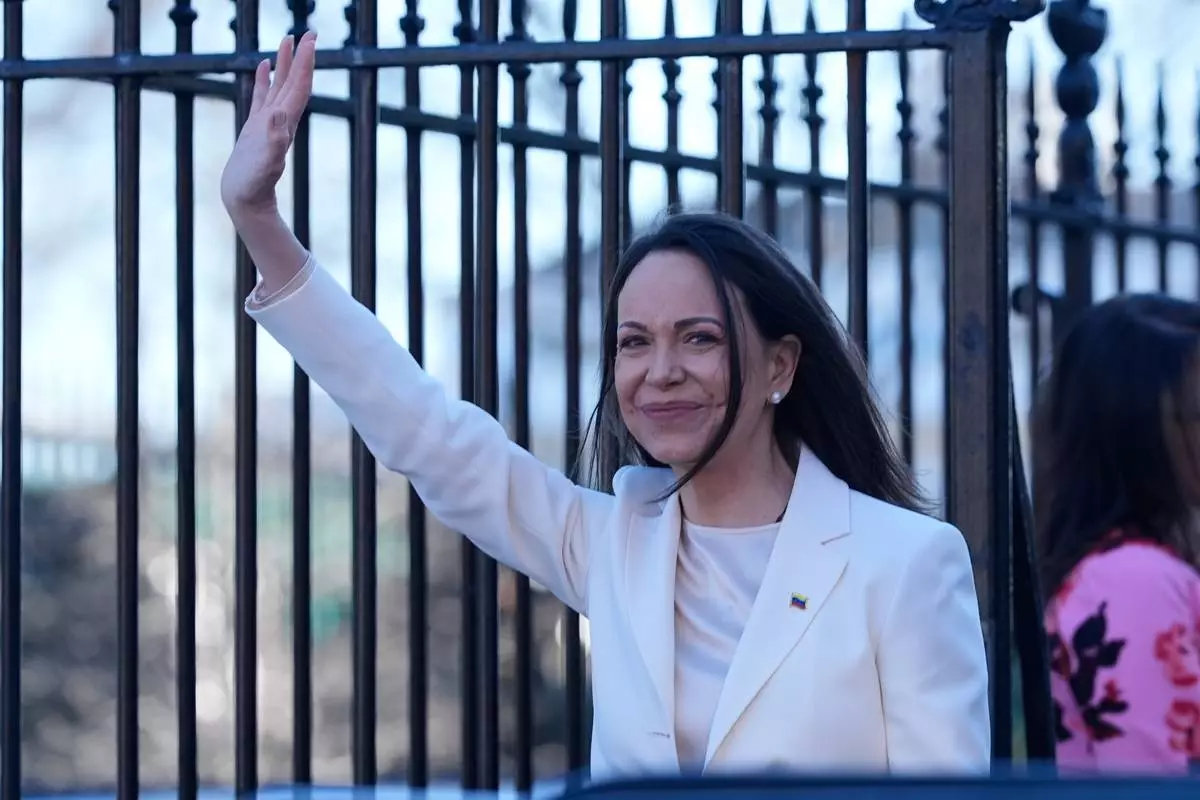
Venezuelan opposition leader MarÌa Corina Machado greets supporters on Pennsylvania Avenue near the White House after meeting with President Donald Trump Thursday, Jan. 15, 2026, in Washington. (AP Photo/Pablo Martinez Monsivais)
Venezuelan opposition leader María Corina Machado waves to supporters on Pennsylvania Avenue as she leaves the White House after meeting with President Donald Trump Thursday, Jan. 15, 2026, in Washington. (AP Photo/Pablo Martinez Monsivais)

Venezuelan opposition leader María Corina Machado waves to supporters on Pennsylvania Avenue as she leaves the White House after meeting with President Donald Trump Thursday, Jan. 15, 2026, in Washington. (AP Photo/Pablo Martinez Monsivais)

Venezuelan opposition leader Maria Corina Machado speaks at the Heritage Foundation, an influential conservative think tank, a day after meeting with President Donald Trump and members of Congress, on Capitol Hill in Washington, Friday, Jan. 16, 2026. (AP Photo/J. Scott Applewhite)
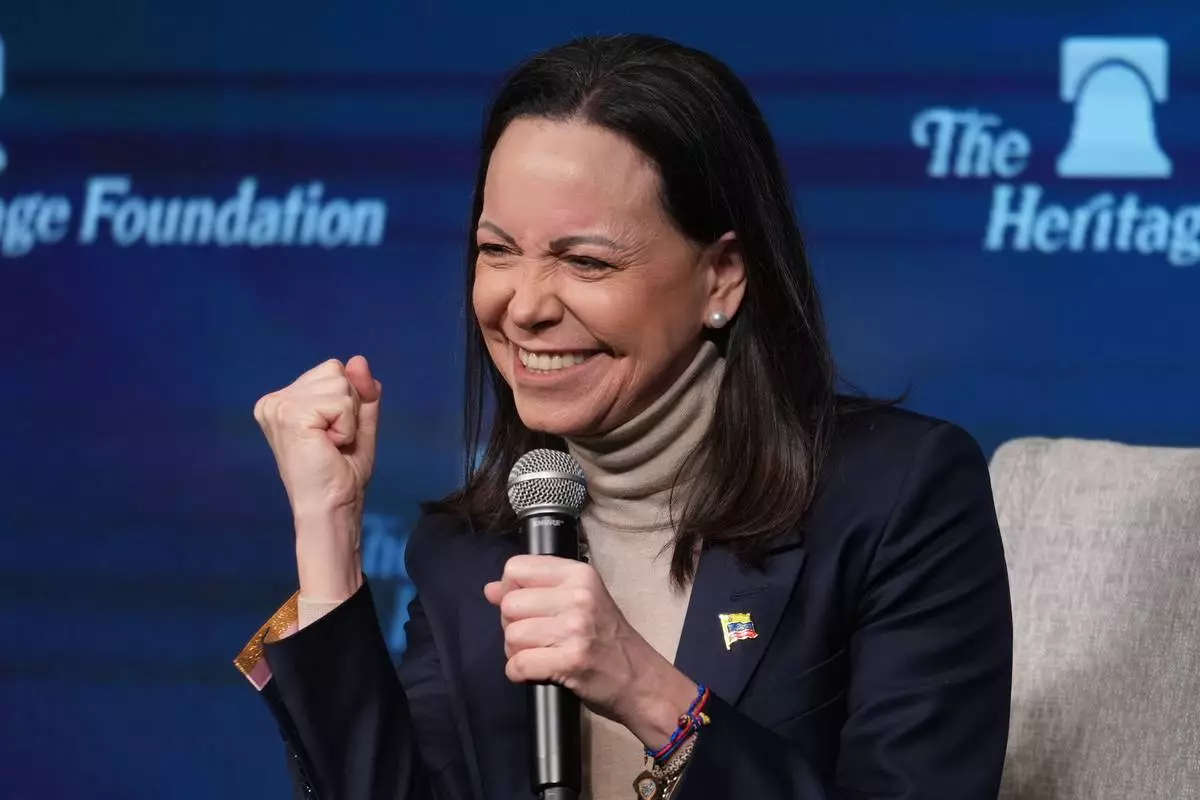
Venezuelan opposition leader Maria Corina Machado speaks at the Heritage Foundation, an influential conservative think tank, a day after meeting with President Donald Trump and members of Congress, on Capitol Hill in Washington, Friday, Jan. 16, 2026. (AP Photo/J. Scott Applewhite)
Venezuelan opposition leader Maria Corina Machado speaks at the Heritage Foundation, an influential conservative think tank, a day after meeting with President Donald Trump and members of Congress, on Capitol Hill in Washington, Friday, Jan. 16, 2026. (AP Photo/J. Scott Applewhite)
Venezuelan opposition leader Maria Corina Machado speaks at the Heritage Foundation, an influential conservative think tank, a day after meeting with President Donald Trump and members of Congress, on Capitol Hill in Washington, Friday, Jan. 16, 2026. (AP Photo/J. Scott Applewhite)
BEIRUT (AP) — Fatima Nazha slept on the street for two days after she and her family fled their home in Beirut's southern suburbs following an Israeli mass evacuation order.

All of the schools the government turned into shelters were full, and the family couldn’t afford a hotel or an apartment, so she and her husband eventually moved into a tent in the country's biggest stadium while their kids and grandchildren found shelter near the southern coastal city of Sidon.

In just 10 days, more than 800,000 people in Lebanon have been displaced by war, just over a year since the last conflict uprooted over a million Lebanese from their homes. That’s one in every seven people in the tiny country, according to humanitarian organization the Norwegian Refugee Council. Many don’t have a place to stay, and the cash-strapped government has only been able to accommodate roughly 120,000 people as it scrambles to open shelters and bring in more supplies.

Nazha, who uses a wheelchair, said being forced from her home has been far more difficult this time than when Israel and Hezbollah were last at war more than a year ago. The strikes targeting the Iran-backed militant group have been more intense and unpredictable, and Israel's evacuation order came abruptly, leaving her unable to gather all her belongings.

“The strikes used to target a specific area, but now they’re hitting all the areas,” she said, taking a drag off her cigarette. Lebanon’s Health Ministry said Friday that more than 700 people, including 103 children, have died in the war.

Israel ramped up its strikes on its northern neighbor after Hezbollah fired several rockets into Israel following the killing of Iran’s Supreme Leader Ali Khamenei at the start of the war.

Most Lebanese were hoping Hezbollah wouldn't respond to the attack on Iran, as the militant group's support for another Iran-backed group, Hamas, in 2023 led to Israeli attacks on Hezbollah in Lebanon. Resentment toward Hezbollah and its backers has surged in Lebanon, as internal tensions and divisions in the deeply divided country continue to simmer.

Fearing becoming a target, landlords have been hiking apartment rents to dissuade new tenants. Hotels, meanwhile, have been vetting guests more strictly since Israel struck two hotel rooms, saying it was targeting Iranian Revolutionary Guard members who were operating in Beirut.

Some who don’t have family and friends to stay with or can't afford an apartment or a hotel room have been sleeping on the streets or in their cars around central Beirut, trading comfort for safety. That sense of safety was shattered, though, after an overnight Israeli strike killed at least eight people and wounded more than 30 others in the capital’s Ramlet el-Bayda neighborhood, where many displaced people pitched tents by the sea or slept on mattresses on the boardwalk.

Humanitarian groups, saddled by years of underfunding, are struggling to keep up. They warn of a humanitarian crisis.

“The needs are escalating much faster than our capacity to respond,” Mathieu Luciano, the head of the International Organization for Migration in Lebanon, said during a recent press briefing.

The government, meanwhile, is using Lebanon's largest sports stadium as a makeshift shelter, where Nazha, her husband and more than 800 other people have been sleeping in the semiopen corridors under the stands. It has toilets and sinks, but no showers and only sporadic electricity.

“It’s not enough that they bring us food. … A tin of sardines or a loaf of bread or a gallon of water, that’s not enough,” Nazha said Thursday from her foldout bed.

In the parking lot of the stadium where Lebanon's national soccer team regularly plays in peacetime, children played a pickup game as an Israeli drone flew overhead, recognizable by its whirring. From there, one can see and hear the bombs that have been exploding daily in nearby neighborhoods.

Naji Hammoud, who oversees sporting facilities for the Lebanese Youth and Sports Ministry, said he didn't expect to have to take on such a heavy responsibility.

“It’s a race against time,” Hammoud said as aid workers and volunteers scrambled to pitch tents.

More than a million people were displaced in the last war, but that was toward the end of it after a year of limited fighting that gradually escalated. This time, what took months took days.

Hezbollah's initial rocket attack followed by Israel's swift bombardments overnight rattled Lebanon and the mass evacuation notices caught people off-guard. Israel first called on dozens of villages south of the Litani River to flee north. It later warned residents to evacuate Dahiyeh, an area of predominantly Shiite suburbs on Beirut's southern edge that is one of the country's most densely populated places.

All of the main roads leading to the capital from southern Lebanon were gridlocked as people scrambled to find somewhere safe to stay.

“We were on the road for two days until we found this place here that accepted us,” said Seganish Gogamo, a worker from Ethiopia who fled the southern city of Nabatieh and found shelter in a Beirut church hosting migrant workers from Asia and Africa. She fled in the middle of the night after intense airstrikes.

There is no end in sight to the fighting, as some 100,000 Israeli troops have amassed along the U.N.-mandated Blue Line which divides the two countries in an anticipated ground invasion. Many fear the Israel-Hezbollah conflict could continue beyond the Iran war.

Joe Sayyah was among dozens of residents who remained in their border village, Alma al-Shaab, during the first few days of the war, hoping they wouldn't have to leave. It's a Christian village, and Israel has mostly targeted Shiite communities where Hezbollah operates.

Sayyah and others appealed to the Vatican and the U.S., describing themselves as bystanders in the conflict, insisting there was no military presence or activity among them. They also spent days sheltering in a church.

But when his friend was killed in an Israeli drone strike while watering his plants, they knew it was time to leave. He and the others rang the church bell one last time before they left for the capital in a convoy escorted by United Nations peacekeepers.

After arriving at a church in the northern outskirts of Beirut to hold a funeral Mass for his friend, Sayyah said the sense of relief that came with reaching somewhere safe was quickly replaced by the grim realization that this war could be different from the last.

“This time around, there’s a huge possibility we may not be able to go back to our village,” he said.

Associated Press reporters Jamey Keaten in Geneva and Fadi Tawil in Beirut contributed to this story.

A displaced migrant woman, who among many others who fled Israeli strikes in southern and eastern Lebanon and Beirut's southern suburbs, sits with her children on mattresses at Saint Joseph Church, which has been turned into a shelter for displaced migrants, mostly from African nations, in Beirut, Wednesday, March 11, 2026. (AP Photo/Hussein Malla)

A displaced migrant woman, who among many others who fled Israeli strikes in southern and eastern Lebanon and Beirut's southern suburbs, sits with her children on mattresses at Saint Joseph Church, which has been turned into a shelter for displaced migrants, mostly from African nations, in Beirut, Wednesday, March 11, 2026. (AP Photo/Hussein Malla)

A displaced woman who fled Israeli airstrikes in southern Lebanon sleeps on the ground at the Bir Hassan Technical Institute, which has been turned into a shelter, in Beirut, Lebanon, Wednesday, March 11, 2026. (AP Photo/Bilal Hussein)

A displaced woman who fled Israeli airstrikes in southern Lebanon sleeps on the ground at the Bir Hassan Technical Institute, which has been turned into a shelter, in Beirut, Lebanon, Wednesday, March 11, 2026. (AP Photo/Bilal Hussein)

An elderly displaced woman who fled Israeli airstrikes with her family in southern Lebanon sits at the Bir Hassan Technical Institute, which has been turned into a shelter, in Beirut, Lebanon, Wednesday, March 11, 2026. (AP Photo/Bilal Hussein)

An elderly displaced woman who fled Israeli airstrikes with her family in southern Lebanon sits at the Bir Hassan Technical Institute, which has been turned into a shelter, in Beirut, Lebanon, Wednesday, March 11, 2026. (AP Photo/Bilal Hussein)

Displaced children run between tents set up inside the Camille Chamoun Sports City Stadium, which has been turned into a shelter for people displaced by Israeli airstrikes in southern Lebanon and Dahiyeh, Beirut's southern suburbs, in Beirut, Lebanon, Tuesday, March 10, 2026. (AP Photo/Hassan Ammar)

Displaced children run between tents set up inside the Camille Chamoun Sports City Stadium, which has been turned into a shelter for people displaced by Israeli airstrikes in southern Lebanon and Dahiyeh, Beirut's southern suburbs, in Beirut, Lebanon, Tuesday, March 10, 2026. (AP Photo/Hassan Ammar)

Displaced people fleeing Israeli airstrikes in southern Lebanon and Dahiyeh, Beirut's southern suburbs, settle at the Bir Hassan Technical Institute, which has been turned into a shelter, in Beirut, Lebanon, Wednesday, March 11, 2026. (AP Photo/Bilal Hussein)

Displaced people fleeing Israeli airstrikes in southern Lebanon and Dahiyeh, Beirut's southern suburbs, settle at the Bir Hassan Technical Institute, which has been turned into a shelter, in Beirut, Lebanon, Wednesday, March 11, 2026. (AP Photo/Bilal Hussein)

Recommended Articles