Skip to Content Facebook Feature Image

Order returns to normal at Colombia-Venezuela border

China

China

China

Order returns to normal at Colombia-Venezuela border

2026-01-17 02:49 Last Updated At:05:17

The situation at the Colombia–Venezuela border has returned to normal after U.S. strikes on Venezuela.

After the U.S. raid on Jan 3, the Colombian government announced a temporary closure of a bustling border port with Venezuela in the Colombian town of Cucuta. Traffic resumed a day later, even as authorities continued to strengthen the deployment of security forces.

According to media reports at the time, the Colombian government deployed 11,000 soldiers along the border.

Military forces have since completely withdrawn. The border on the Colombian side has returned to its pre-raid state, with traffic appearing normal on the border bridge.

Agricela Funez, a Venezuelan waitress who works at a restaurant near the border checkpoint in Cucuta, said the security situation has since eased.

"The security situation has changed. They (the soldiers) withdrew and everything returned to normal. The military forces were stationed here for only about a week; there were many soldiers, military vehicles, and journalists," said Funez.

Funez said she was extremely worried about the safety of her two daughters, who live in Caracas, Venezuela's capital, when the attacks occurred. She added that she believes the United States wants Venezuela's natural resources.

"I was scared because I have family in Caracas. At 01:00, I received a call from my family. I was sleeping. I burst into tears when I received the call. It (The U.S. attack on Venezuela) was wrong. Many people lost their lives. I think what they want is the natural resources and wealth that we, Venezuela, possess," said Funez.

Another Venezuelan immigrant living in Colombia also said he believes the U.S. wants Venezuela’s oil.

"To seize all of Venezuela's wealth, especially its oil," he said.
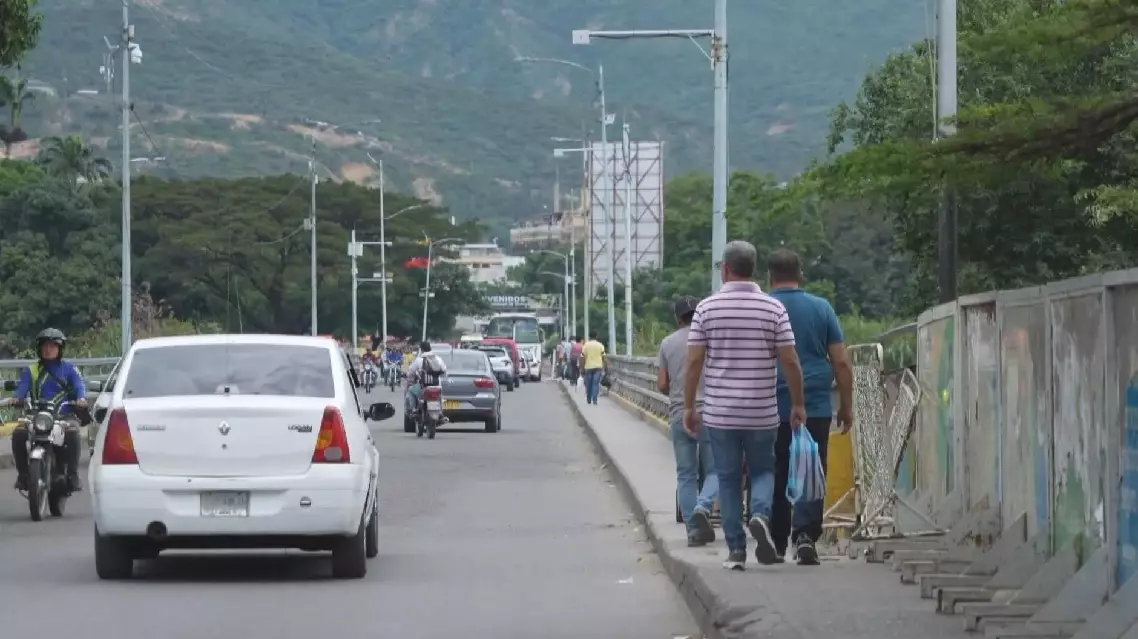
Order returns to normal at Colombia-Venezuela border

Order returns to normal at Colombia-Venezuela border

A growing number of Chinese energy companies are increasing their presence in the Persian Gulf as they get deeply involved in the region's energy transition.

As a highlight of China-Gulf cooperation, green energy projects carried out by Chinese companies in Gulf states gained spotlight at the 18th World Future Energy Summit, which took place from Wednesday to Thursday in Abu Dhabi, the United Arab Emirates (UAE).

A shining example is the Mohammed bin Rashid Al Maktoum Solar Park in Dubai. As one of the largest single-site solar parks in the world, the solar thermal plant is a key project to help Dubai achieve its carbon reduction goals and significantly increase the share of clean energy in the city's power mix.

"Upon completion in 2030, it will exceed 8,000 megawatts, and it will reduce 8.5 million tons of carbon emmissions on an annual basis. And it will raise Dubai's clean energy capacity up to 36 percent," said Ali Hayat, a senior engineer of the project.

In recent years, more and more Chinese energy product suppliers have transitioned to a new role as investors by building plants and regional offices in the Gulf region to deepen their participation in local energy transition.

"China has been absurdly in the lead in both ways -- in providing technologies that make the cost of solar panel to be affordable around the world, and also in an amazing increase of the share of renewable energy in the energy system," said Francesco La Camera, director-general of the International Renewable Energy Agency.

Chinese companies seek greater role in Gulf states' energy transition

Chinese companies seek greater role in Gulf states' energy transition

Recommended Articles