Beijing is experiencing its first citywide snowfall of 2026 as a cold wave sweeps across north China.
The heavy snow began on Saturday morning and is expected to end on Sunday afternoon. As of 21:00 Saturday, it had hit most parts of the city, with an average precipitation of 0.6 millimeters and the highest snow accumulation reaching six millimeters in Fangshan District.
The municipal meteorological observatory has issued yellow alerts for icy roads and persistent low temperatures, while the weather authorities in the districts of Shijingshan, Mentougou, Changping, Fengtai, Fangshan, Haidian, and Yanqing have all issued blue alerts for heavy snow.
China has a four-tier color-coded weather warning system, with red representing the most severe, followed by orange, yellow and blue.
The city has organized overnight operations to clear snow on roads, especially on highways.
"In response to this snowfall, we have deployed 31 equipment for snow removal operations, mainly sweeping rollers. If the snowfall strengthens and snow accumulates, we will use snow plows to ensure smooth traffic," said Wang Zemin, a manager of the Beijing Shoufa Highway Maintenance Engineering Company.
Meanwhile, the neighboring Tianjin Municipality also embraced its first snowfall of the year on Saturday, which has not significantly affected traffic in the urban area thanks to previously high road surface temperatures.
As the snowflakes fell, Tianjin presented a beautiful winter scenery, prompting many residents to take photos.
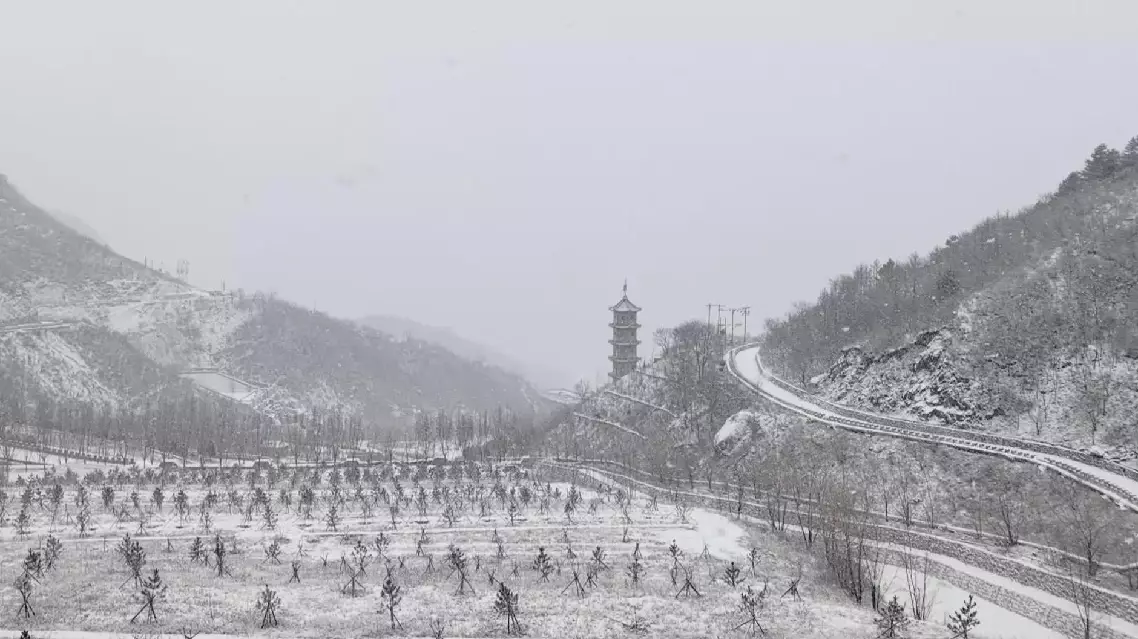
Heavy snow hits Beijing
Demonstrators from civil groups, labor unions and other communities in South Africa rallied outside the U.S. Consulate in Johannesburg on Friday, denouncing U.S. unilateral military actions against Venezuela and voicing solidarity with the Latin American nation.
They gathered along the street in front of the consulate, carrying banners that read "Hands Off Venezuela" and "Stop Imperialism," chanting slogans against U.S. hegemony and aggression.
"We are here to protest the U.S. threats to global peace, the abduction of President Nicolas Maduro Moros of Venezuela, which was done in violation of international law, in violation of territorial integrity of Venezuela, of course, in violation of national sovereignty of Venezuela," said Solly Afrika Mapaila, general secretary of the South African Communist Party.
In the early hours of Jan. 3, the United States carried out a military strike against Venezuela and captured President Nicolas Maduro and his wife, taking them to the United States.
Some protesters said the crisis in Venezuela shows how geopolitical struggles have direct and immediate effects on ordinary people's lives.
"Venezuela belongs to the people of Venezuela and nobody else. For American belligerent and colonial aggression, quite frankly, is not just something very distant. Never before have questions of geopolitics been of immediate and direct relevance and direct and immediate impacts on the day-to-day lives of ordinary people, as you are seeing today," said Mametlwe Sebei, president of the General Industries Workers Union of South Africa (GIWUSA).
Placards at the rally blended English and Spanish slogans, while some demonstrators sang liberation songs from South Africa's anti-apartheid era to express solidarity. Passing motorists slowed in front of the consulate, honking in support.
Defying the summer heat, the crowd remained spirited and resolute, their chants echoing along the street in a clear call for an end to foreign interference and respect for Venezuela's sovereignty.
South Africans rally in solidarity with Venezuela against U.S. aggression