Danish Prime Minister Mette Frederiksen said on Sunday that "Europe will not be blackmailed," following a series of emergency calls with European leaders after U.S. President Donald Trump's latest tariff threats over Greenland.
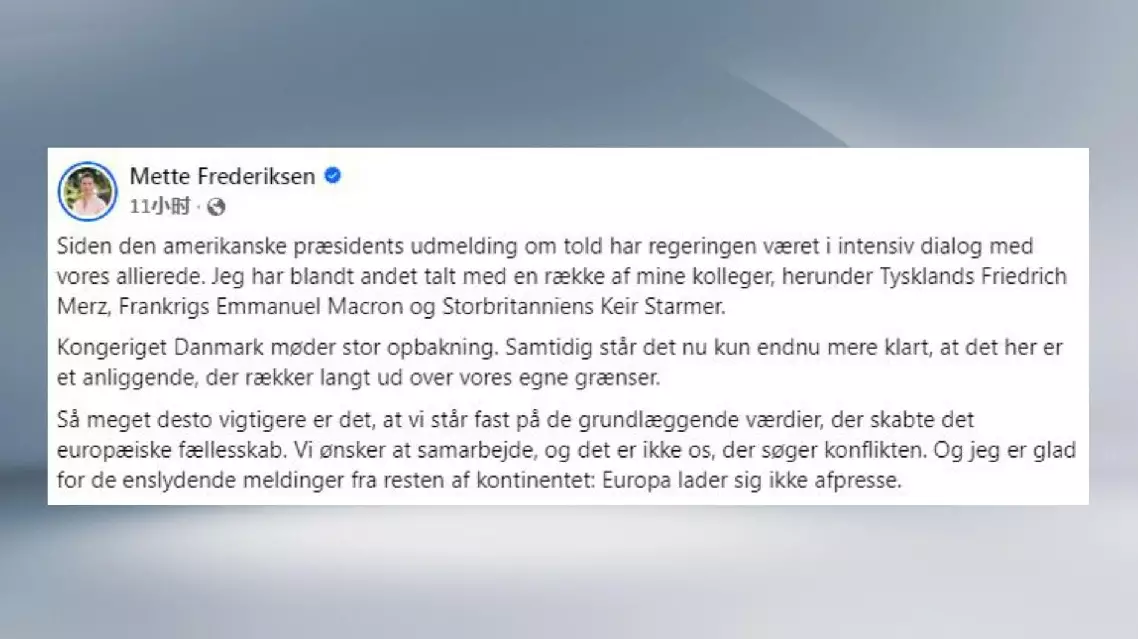
Frederiksen said she had spoken with German Chancellor Friedrich Merz, French President Emmanuel Macron, and British Prime Minister Keir Starmer.
In a post on her social media account, she said, "The Kingdom of Denmark is receiving great support. At the same time, it is now even clearer that this is an issue that reaches far beyond our own borders."
"It is all the more important that we stand firm on the fundamental values that created the European community," she said, adding, "We want cooperation, not conflict. I am pleased with the consistent messages from the rest of the continent: Europe will not be blackmailed."
The response comes after eight European countries, including Denmark, issued a joint statement expressing "full solidarity" with Denmark and Greenland and warning that the U.S. tariffs, imposed in retaliation for their stance on Greenland, risk triggering a "dangerous downward spiral" in transatlantic ties.
On the same day, Danish Foreign Minister Lars Lokke Rasmussen said that European countries are coordinating their response to the U.S. tariff threats over Greenland, and that he has no doubt about support from Europe.
Rasmussen made the remarks at a press conference in Oslo, capital of Norway, after meeting with his Norwegian counterpart Espen Barth Eide.
Rasmussen warned that although only eight countries were named in Trump's tariff threats, the economic fallout would ripple across the entire European Union. He noted that Denmark is among the largest European investors in the United States, and punitive tariffs would ultimately hurt American jobs and businesses.
Eide called the U.S. threat "unacceptable", affirming Norway's full respect for Danish sovereignty.
Rasmussen is also scheduled to visit Britain and Sweden to coordinate a unified European response.
Meanwhile, European leaders continued to denounce the U.S. move and vowed countermeasures.
French President Macron said he would push the European Union to activate the anti-coercion instrument, dubbed the "trade bazooka", which could include freezing U.S. market access or restricting investments. Such measures require approval by a qualified majority of EU member states.
German Vice Chancellor and Finance Minister Lars Klingbeil called the tariff threat "a line crossed", adding European nations are coordinating a firm response.
Dutch Foreign Minister David van Weel labeled the U.S. approach to acquire Greenland an act of "blackmail" and pledged to work within the EU to pressure Washington to rescind the planned tariffs, or it will face countermeasures.
Norwegian Prime Minister Jonas Gahr Store urged caution to avoid an uncontrolled trade conflict, saying that nobody benefits from a trade war.
Even European countries not targeted by the tariffs voiced strong criticism.
During a visit to South Korea, Italian Prime Minister Giorgia Meloni called the U.S. tariff threats "a mistake", saying she had raised the issue directly with Trump and NATO Secretary General Mark Rutte.
Ireland's Minister for Foreign Affairs and Trade, Helen McEntee, described the U.S. move as "completely unacceptable and deeply regrettable", while Croatia warned that the tariff threats would undermine transatlantic trade and damage the broader U.S.-EU partnership.
Trump announced on Saturday that the United States would impose a 10-percent tariff from Feb. 1 on goods from Denmark, Norway, Sweden, France, Germany, Britain, the Netherlands and Finland over Greenland, and raise the levy to 25 percent from the beginning of June unless a deal is reached for the United States to purchase the territory.
Greenland, the world's largest island, is a self-governing territory within the Kingdom of Denmark, with Copenhagen retaining control over defense and foreign policy. The United States maintains a military base on the island. Since returning to office in 2025, Trump has repeatedly expressed a desire to "obtain" Greenland.
Europe not to be blackmailed, Danish PM says after US tariff threats over Greenland

Europe not to be blackmailed, Danish PM says after US tariff threats over Greenland