Senegal leaving the field to protest referee decisions before winning the Africa Cup of Nations title amid shocking chaos was “unacceptable,” FIFA president Gianni Infantino said Monday.
Infantino criticized the Senegal coaches, players and some fans for their behavior at the end of regulation time against host nation Morocco that was astonishing for the final of an international competition.
Click to Gallery

Senegal's head coach Pape Thiaw holds the trophy after winning the Africa Cup of Nations final soccer match agaisnt Morocco, in Rabat, Morocco, Sunday, Jan. 18, 2026. (AP Photo/Mosa'ab Elshamy)

Players from both sides clash after a controversial penalty was awarded to Morocco late on during the Africa Cup of Nations final soccer match between Senegal and Morocco in Rabat, Morocco, Sunday, Jan. 18, 2026. (AP Photo/Youssef Loulidi)

Senegal's Idrissa Gueye calls players to walk off the ptich during the Africa Cup of Nations final soccer match between Senegal and Morocco, in Rabat, Morocco, Sunday, Jan. 18, 2026. (AP Photo/Mosa'ab Elshamy)

FIFA President Gianni Infantino present Morocco's Brahim Abdelkader Díaz with the trophy of the best scorer after the Africa Cup of Nations final soccer match between Senegal and Morocco, in Rabat, Morocco, Sunday, Jan. 18, 2026. (AP Photo/Mosa'ab Elshamy)

Senegal supporters are taken from the stadium by security officers after a controversial penalty was awarded to Morocco late on during the Africa Cup of Nations final soccer match between Senegal and Morocco in Rabat, Morocco, Sunday, Jan. 18, 2026. (AP Photo/Youssef Loulidi)
“The ugly scenes witnessed (Sunday) must be condemned and never repeated,” the FIFA leader posted on his Instagram account after attending the game in Rabat.
“I expect that the relevant disciplinary bodies at CAF (the Confederation of African Football) will take the appropriate measures,” Infantino wrote.
CAF also described the incidents as unacceptable in a later statement, and said it is “reviewing all footage and will refer the matter to competent bodies for appropriate action to be taken against those found guilty.”
That legal path was not enough for the Morocco soccer federation, which reacted to losing its home tournament — four years before it co-hosts the 2030 World Cup — with an unusual demand Monday.
The Moroccan federation said it would pursue legal action with CAF and FIFA about the Senegal players leaving the field in protest that forced a 15-minute stop in a game they would go on to win 1-0 in extra time.
Senegal coach Pape Thiaw faces severe sanctions for his part leading this players back to the locker room when Morocco was awarded a penalty in stoppage time at the end of regulation time. The spot-kick would eventually be missed in bizarre circumstances.
It is unclear if any ban imposed on Thiaw would apply just in future African competitions or at FIFA's World Cup in North America. Senegal starts its World Cup playing France on June 16 at MetLife Stadium near New York, where it also plays Norway six days later.
Senegal’s team and fans were angered by being denied what shaped as a title-winning goal early in stoppage time of a 0-0 draw when the referee called a foul to rule out the goal.
Minutes later, Morocco was awarded a penalty after a video review which judged star forward Brahim Diaz had been pulled to the ground by a Senegal defender when a corner was taken.
The controversial decision further fueled a feeling by Morocco’s opponents that the team was getting favorable decisions at a tournament which has been a showcase for co-hosting the 2030 World Cup for FIFA.
Thiaw encouraged his players to leave the field and so prevent Diaz taking the penalty kick that could decide the title. Senegal fans clashed with police at the other end of the stadium.
“It is unacceptable to leave the field of play in this manner, and equally, violence cannot be tolerated in our sport. It is simply not right,” Infantino wrote.
“We must always respect the decisions taken by the match officials on and off the field of play,” the FIFA president added. “Teams must compete on the pitch and within the Laws of the Game, because anything less puts the very essence of football at risk.”
Morocco coach Walid Regragui later called the incidents a “shameful” image of African soccer for the rest of the world to see.
When the players returned, and in the remarkable 24th minute of stoppage time, Diaz took one of the worst penalties in soccer history.
The Real Madrid forward's slow chip shot — known as a Panenka, after the Czech player who did it 50 years ago to win the European title against West Germany — was weak, low and easily saved by Senegal goalkeeper Édouard Mendy.
Diaz posted an apology to Morocco fans on social media Monday.
The game went into extra time and Senegal won it four minutes in with a powerful shot by Pape Gueye.
“My best wishes as well to Abdoulaye Fall, president of the Senegalese Football Association, and to everyone involved in this success,” Infantino wrote.
“It is also the responsibility of teams and players,” he said, “to act responsibly and set the right example for fans in the stadiums and millions watching around the world.”
The Morocco soccer federation — led by one of the most influential officials in world soccer, CAF first vice president and FIFA Council member Fouzi Lekjaa — asked those soccer bodies to rule on the Senegal team's walk off and the events surrounding it.
“This situation has had a significant impact on the normal flow of the match and on the players’ performance,” the federation said.
In sports law, decisions of the referee on the field of play typically stand and are not re-litigated later.
AP at the Africa Cup: https://apnews.com/hub/africa-cup-of-nations

Senegal's head coach Pape Thiaw holds the trophy after winning the Africa Cup of Nations final soccer match agaisnt Morocco, in Rabat, Morocco, Sunday, Jan. 18, 2026. (AP Photo/Mosa'ab Elshamy)

Players from both sides clash after a controversial penalty was awarded to Morocco late on during the Africa Cup of Nations final soccer match between Senegal and Morocco in Rabat, Morocco, Sunday, Jan. 18, 2026. (AP Photo/Youssef Loulidi)

Senegal's Idrissa Gueye calls players to walk off the ptich during the Africa Cup of Nations final soccer match between Senegal and Morocco, in Rabat, Morocco, Sunday, Jan. 18, 2026. (AP Photo/Mosa'ab Elshamy)

FIFA President Gianni Infantino present Morocco's Brahim Abdelkader Díaz with the trophy of the best scorer after the Africa Cup of Nations final soccer match between Senegal and Morocco, in Rabat, Morocco, Sunday, Jan. 18, 2026. (AP Photo/Mosa'ab Elshamy)
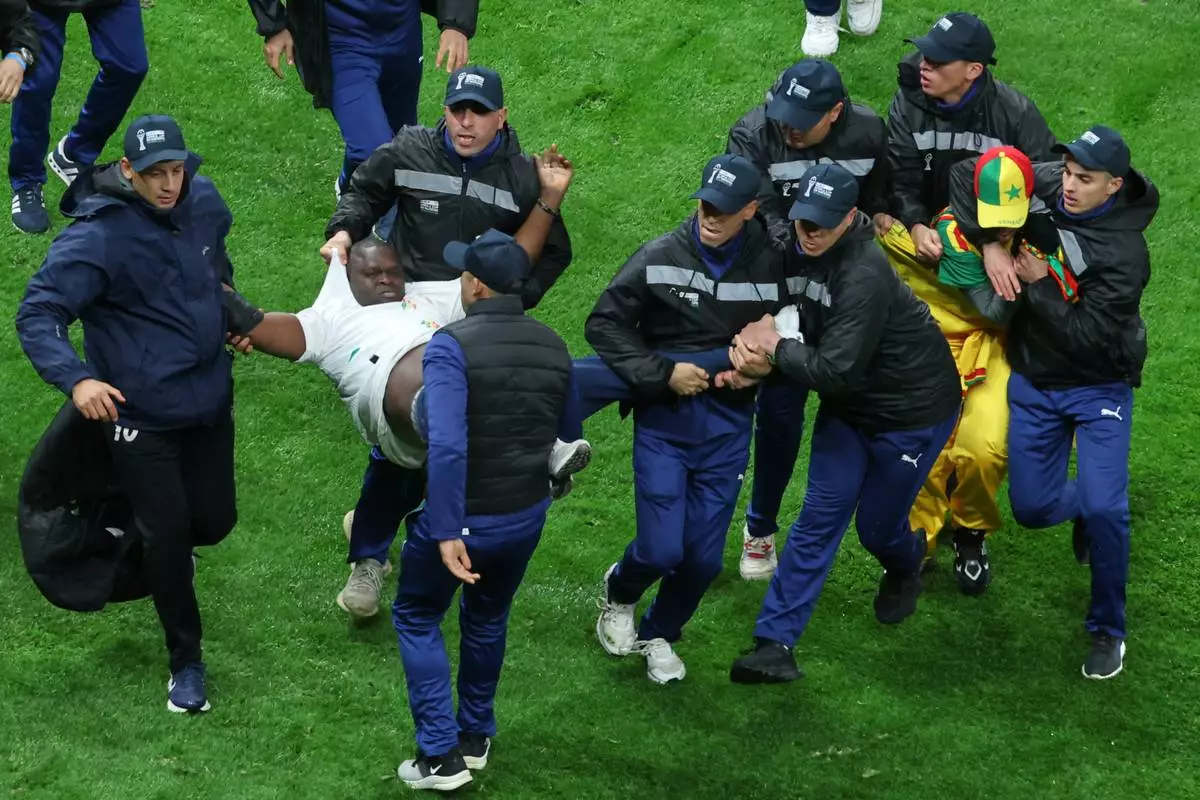
Senegal supporters are taken from the stadium by security officers after a controversial penalty was awarded to Morocco late on during the Africa Cup of Nations final soccer match between Senegal and Morocco in Rabat, Morocco, Sunday, Jan. 18, 2026. (AP Photo/Youssef Loulidi)