BEIRUT (AP) — Over the past decade, the religiously and ethnically mixed Syrian Democratic Forces had been the most effective force in the battle against the Islamic State group in Syria. The Kurdish-led force is now set to merge into the Syrian army after suffering major setbacks over the past weeks.
The SDF suffered a major defeat over the weekend when Syrian government forces captured wide areas in a territory under the group's control in the country's northeast following deadly clashes.
With SDF fighters cornered in the province of Hassakeh, the latest victory by interim President Ahmad al-Sharaa could mark the end of Syria’s Kurdish ambitions to set up an autonomous region in northeast Syria that they call Rojava, or Western Kurdistan. The fighters once ruled over nearly a quarter of Syria.
Kurds made up about 10% of Syria’s population of 23 million before the country's civil war began in 2011.
When it was founded in 2015 with U.S. backing, the SDF included ethnic Arab, Kurdish and Turkmen fighters in addition to the main Christian militia in northeast Syria known as the Syriac Military Council, which includes Assyrians.
However, the SDF was led by the main Kurdish fighting force in Syria, the People’s Protection Units, known as the YPG. The dominant role of Kurdish fighters in the alliance remained a concern for the majority Sunni Arab factions and their regional backers, and internal clashes broke out on several occasions.
Many of the Syrian rebel factions that were fighting former President Bashar Assad’s forces from 2011 until his ouster in December 2024 have always been opposed to the SDF, seeing them as a secessionist force that aims to break away from Syria.
Additionally, while Ankara has been a main backer of Syrian rebels during Assad's rule, it views the YPG as an extension of the Kurdish PKK, which has waged a long insurgency in Turkey.
After Assad’s fall in December 2024, relations between the country’s new rulers, led by al-Sharaa and the SDF remained cold, but a surprise came in March when SDF chief Mazloum Abdi arrived in Damascus and signed a deal with al-Sharaa.
The deal listed, among other things, that the SDF would merge into the Syrian army by the end of 2025. However, significant disagreements remained on how it would happen.
In October, Abdi told The Associated Press that the SDF had agreed in principle with the government on a plan to merge its fighters as a cohesive group into the national army.
Abdi visited Damascus in early January to discuss the merger. State media reported at the time that no “ tangible results ” had been achieved. Shortly afterward, deadly clashes broke out between government forces in the northern city of Aleppo, leading the SDF to evacuate three neighborhoods that it had controlled for years.
Soon after, the government launched an offensive to capture two towns east of Aleppo that later snowballed into a full-blown offensive that ended Sunday with the government in control of much of the critical northern province of Raqqa along the border with Turkey and the eastern oil-rich province of Deir el-Zour that borders Iraq.
On Sunday night, Syria’s government announced a ceasefire, marking the end of the latest round of fighting, with the SDF. The group now only controls Hassakeh, which has a large Kurdish community.
Later on Sunday, state-run news agency SANA showed al-Sharaa signing and holding the agreement. Abdi, who was scheduled to meet with the president in Damascus, was not seen, though his signature appeared on the document. Al-Sharaa told journalists that Abdi could not travel due to bad weather and was expected in the Syrian capital on Monday.
According to the new agreement, SDF fighters will merge into the national army and police forces as individuals rather than as a whole force, which is a blow to Abdi’s earlier plans.
The Kurdish-led force will also hand over names of commanders who will be given high military and managerial posts within the Syrian army and government.
Al-Sharaa issued a decree making Kurdish an official language in the country, along with Arabic, and adopting the Kurdish new year as a national holiday, a step viewed as an attempt to appease the Kurdish minority. The new ceasefire was announced two days later.
The SDF, which was once estimated to have about 40,000 fighters and had played a major role in the victory against IS in March 2019 when they captured the last sliver of land the extremists held, will most likely dissolve in the near future as al-Sharaa boosts his authority in Syria after taming Assad’s Alawite minority sect in deadly sectarian clashes in March.
A major mission that SDF continues to have is the control of prisons where some 9,000 IS members have been held for years without trial. The SDF also controls al-Hol and Roj camps in Hassakeh that are home to tens of thousands, mostly women and children linked to IS.
The group said in a statement Monday that gunmen were attacking the Shaddadeh prison “which holds thousands” of IS members. It later said that its fighters repelled several attacks adding that the prison it out of the control of its fighters.
Under the 14-point ceasefire, the authorities and protection forces that run the prisons and camps will merge into the government that will become “fully in charge” of the legal and security affairs of jails and camps. No deadline was set.
The Syrian government, the deal says, is committed to the fight against IS as Syria is now a member of the U.S.-led coalition fighting against the extremists.
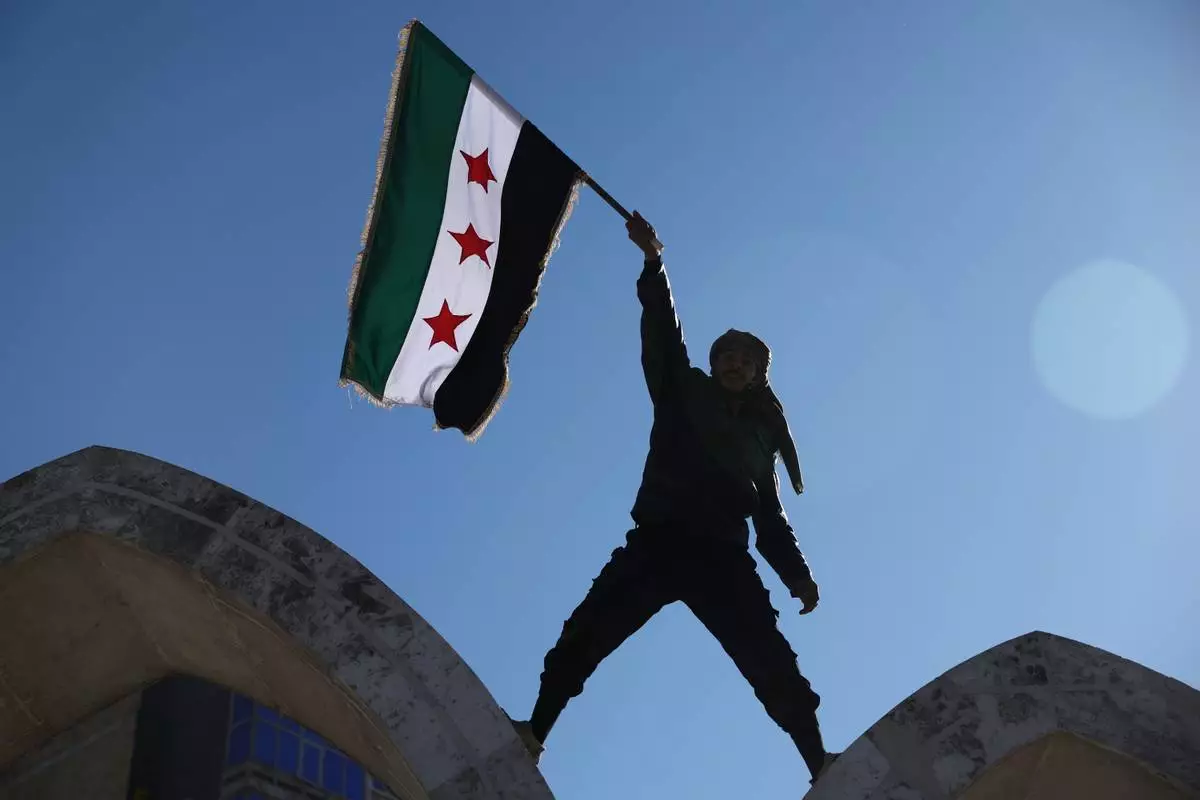
A soldier waves a Syrian flag amid celebrations a day after Syrian government troops took control of Raqqa from the Syrian Democratic Forces (SDF), at Al-Naeem roundabout in central Raqqa, northeastern Syria, Monday, Jan. 19, 2026. (AP Photo/Ghaith Alsayed)
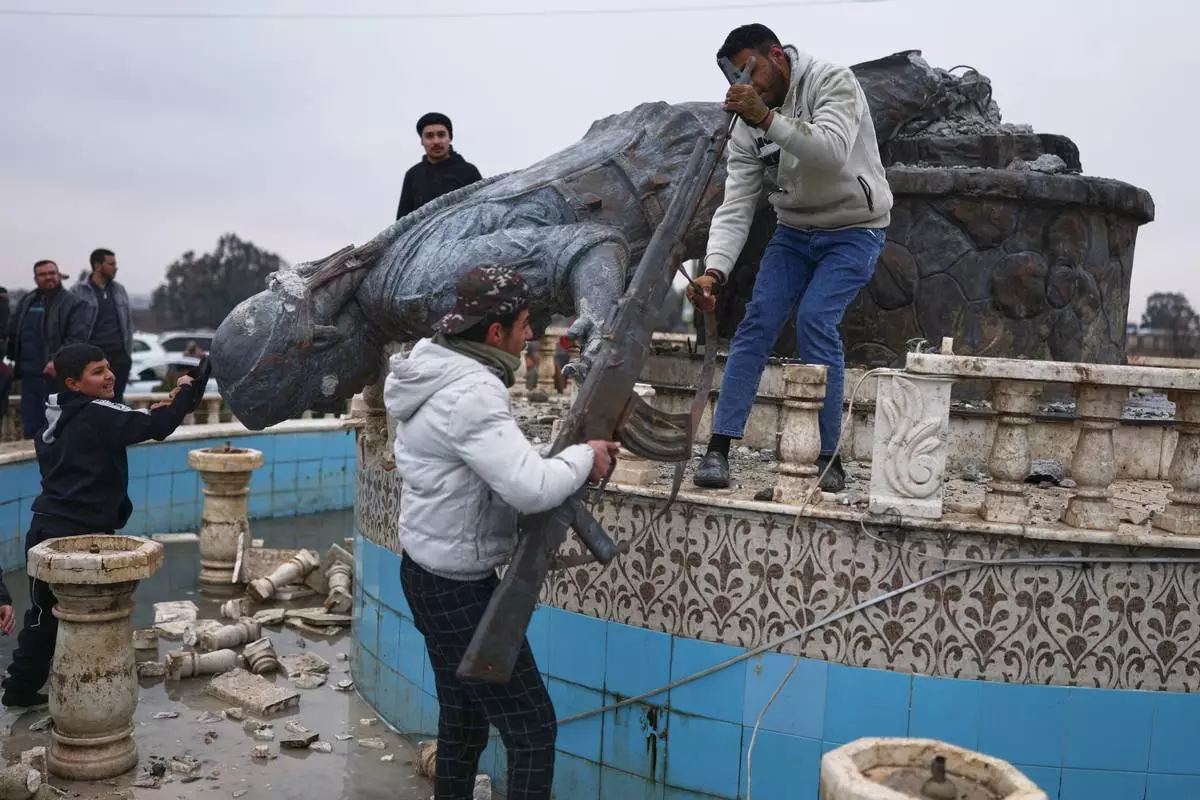
Residents topple a statue of a female Kurdish fighter after the takeover of the town by Syrian government forces from U.S.-backed Syrian Democratic Forces (SDF), in Tabqa, eastern Syria, Sunday, Jan. 18, 2026. (AP Photo/Ghaith Alsayed)
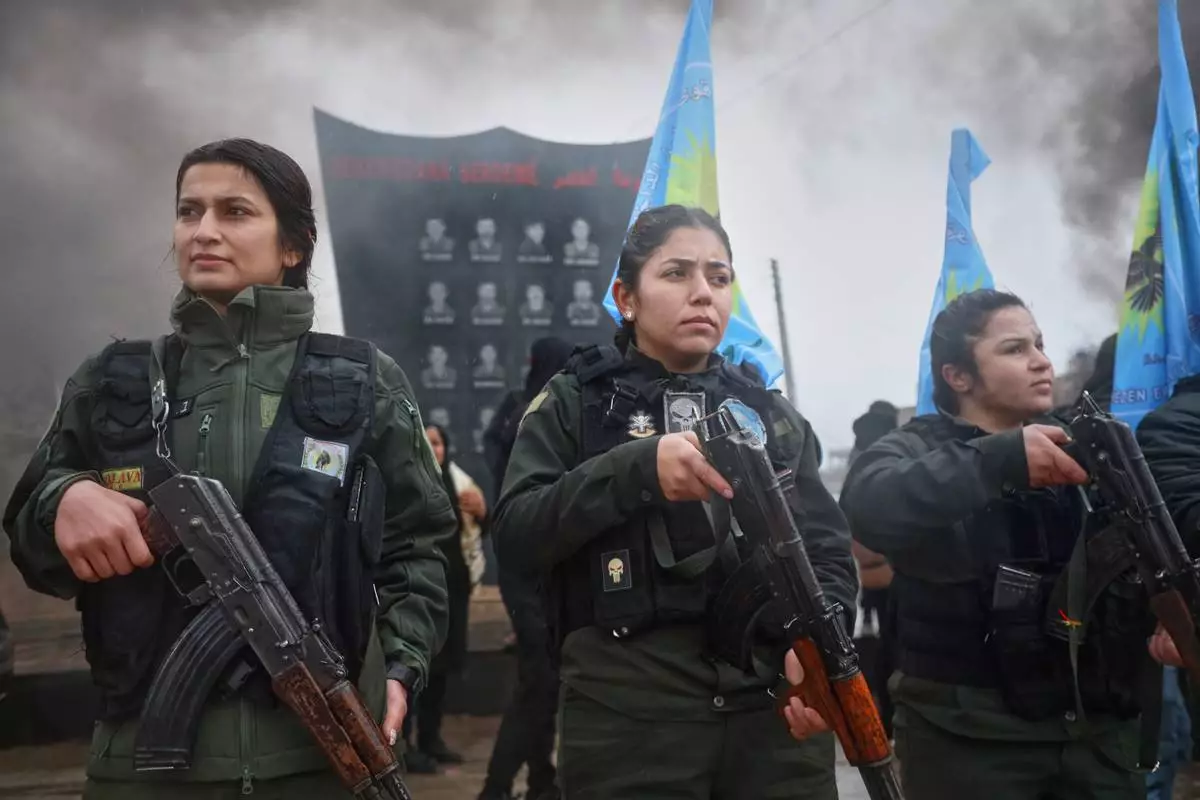
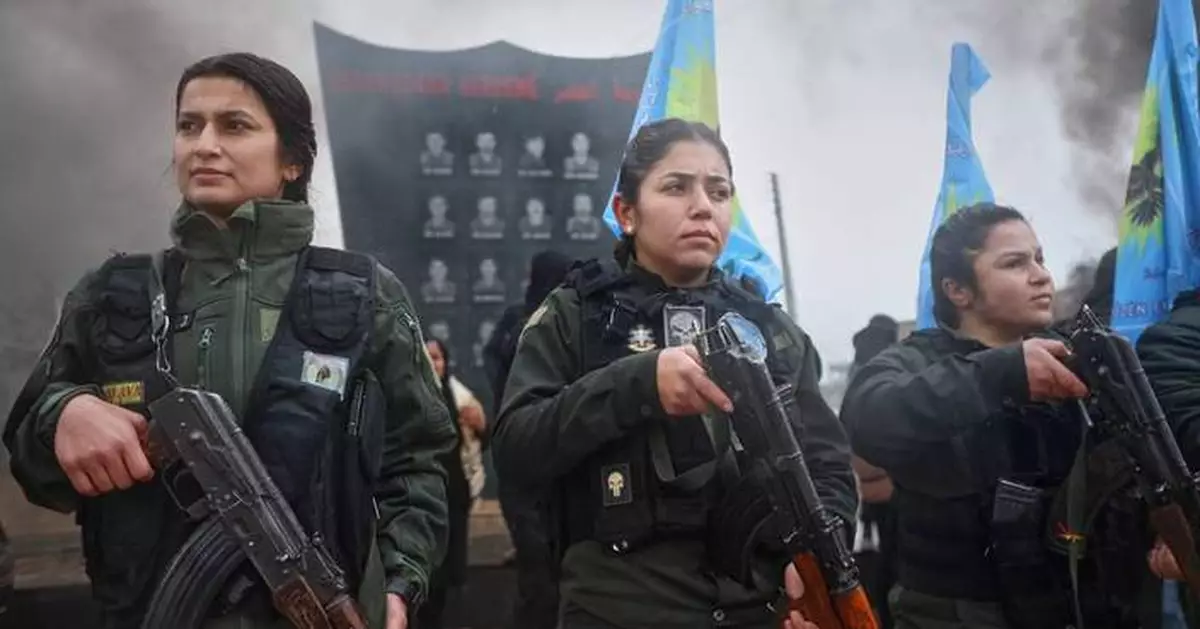
Female soldiers of the Kurdish-led, U.S.-backed Syrian Democratic Forces (SDF) march during a military parade in Qamishli, northeastern Syria, Sunday, Jan. 18, 2026. Syrian government forces have seized a strategic towns in eastern Syria, intensifying their push against Kurdish-led forces east of the Euphrates River.(AP Photo/Baderkhan Ahmad)
DAVOS, Switzerland (AP) — U.S. President Donald Trump insisted he wants to “get Greenland, including right, title and ownership,” but he said he wouldn’t employ force to achieve that — using his speech Wednesday at the World Economic Forum to repeatedly deride European allies and vow that NATO shouldn’t stand in the way of U.S. expansionism.
He urged NATO to allow the U.S. to take Greenland from Denmark and added an extraordinary warning, saying alliance members can say yes, “and we’ll be very appreciative. Or you can say, ‘No,’ and we will remember.”
Trump tried to focus on his efforts to tame inflation and spur the economy back home. But his more than 70-minute address focused more on his gripes with other countries.
European Commission President Ursula von der Leyen on Tuesday called Trump’s planned new tariffs on eight EU countries over Greenland a “mistake” and questioned Trump’s trustworthiness. French President Emmanuel Macron said the EU could retaliate by deploying one of its most powerful economic tools, known colloquially as a trade “bazooka.”
Here is the latest:
Trump told Swiss President Guy Parmelin that his country was “great” and “beautiful.”
“You do make great watches, too,” he said during a brief part of the meeting that was open to the media.
Trump also clarified that he’s meeting with Ukrainian President Volodymyr Zelenskyy on Thursday, not Wednesday, as he said during his address.
Zelenskyy was in Kyiv on Wednesday, his communications adviser Dmytro Lytvyn said.
Trump returned to the White House a year ago. He marked Tuesday’s anniversary by presiding over a meandering, nearly two-hour-long press briefing to recount his accomplishments, repeating many false claims he made throughout 2025.
▶ Read the AP’s latest Fact Focus
The president did not make any major news in the discussion, which lasted about 20 minutes. Trump then left the stage.
Asked about U.S. debt climbing toward $40 trillion — more than the size of the annual U.S. economy — Trump insisted that he can solve the problem with economic growth and eliminating fraud and excessive spending.
“I think we’re going to be paying off debt,” he boasted.
Trump made similar promises when he first ran for president in 2016 and again in 2024. He has added more to U.S. debt totals than any president.
He repeated claims about fraud in Minnesota, mentioning the figure $19 billion — a miniscule fraction of annual federal spending that is measured in trillions. Trump also said the U.S. is cutting spending, although he has exaggerated the effects of his government efficiency efforts.
He gave them until Jan. 20 to comply with his demand.
It was unclear how Trump could unilaterally cap credit card interest rates. White House Press Secretary Karoline Leavitt said previously that the president has “an expectation” that credit card companies will accede to his demand that they cap interest rates on credit cards at 10%.
There are a handful of bills introduced by Republicans and Democrats to cap credit card interest rates, but House Speaker Mike Johnson has been cold to the idea.
Banks are highly resistant to the idea of capping credit card rates. In an interview at Davos, JPMorgan’s Jamie Dimon said “it would be a disaster to the U.S. economy” to cap credit card rates, saying banks would close millions of credit card accounts in response.
It’s the first time he’s asked Congress to act on an issue that he demanded banks comply with only a couple weeks ago.
“Whatever happened to usury?” Trump said in his speech at the World Economic Forum in Davos, Switzerland.
Usury refers to the biblical prohibition to charge unreasonable interest on loans, and many states and countries had usury laws on the books up until the first half of the 20th Century.
Leaving vague exactly what kind of “culture” that he meant, Trump said the West has prospered because of a shared and “very special” one.
“This is the precious inheritance that America and Europe have in common,” Trump said. “We share it. But we have to keep it strong.”
Trump added that he wanted to “defend that culture” and “rediscover the spirit that lifted the West from the depths of the dark ages to the pinnacle of human achievement.”
Many Americans descend from Europeans, including settlers who came to the North American continent hundreds of years ago. But the Trump administration also has faced criticism at times for focusing on that side of U.S. culture when the country’s population is far more diverse.
“But equally importantly, we’re cracking down on more than $19 billion in fraud that was stolen by Somalian bandits,” Trump said, referring to ongoing fraud investigations in Minnesota that have focused on members of the diaspora. “Can you believe that— Somalia? They turned out to be higher IQ than we thought.”
It’s not the first time that Trump has gone after the community in sharp terms.
Last month, Trump said he did not want Somali immigrants in the U.S., saying residents of the war-ravaged eastern African country are too reliant on the U.S. social safety net and add little to the United States.
Somalis have been coming to Minnesota and other states, often as refugees, since the 1990s. The president made no distinction between citizens and non-citizens.
The president finished his speech by congratulating the people in the room for all their successes and declared that the U.S. is “back, bigger, stronger, better than ever before.”
“I’ll see you around,” he said.
He then sat down on a chair on stage for a question-and-answer session with World Economic Forum CEO Borge Brende, who was seated throughout Trump’s remarks.
He’s taken digs at French President Emmanuel Macron over Europe for selling pharmaceuticals to the U.S. at a premium. He ripped Denmark for a lack of appreciation for the U.S. protection of Greenland during World War II. And he’s blasted NATO for being too dependent on the United States.
“The United States is keeping the whole world afloat,” he said.
While speaking in Switzerland, Trump told a story about the country that he said “rubbed me the wrong way.”
He said Switzerland makes beautiful Rolex watches, but “were paying nothing to the United States” to export them. So, he set a tariff, which he said caused representatives from the country and the company to call and visit him and urge him to reverse it.
He brought down the tariff, but said he felt the country was “taking advantage” of the U.S.
“A majority of the money they make is because of us, because we never charge them anything,” he said.
Talking about the U.S. market, Trump threw a curveball, saying essentially that he didn’t want to simply expand housing supply because it could lower values for people who already own homes.
“If I want to really crush the housing market, I could do that so fast,” he said. But, “I don’t want to do anything to hurt” people who have built wealth through their home equity.
“I don’t want to do anything to hurt” existing homeowners, Trump said. He instead emphasized his desire to see lower interest rates, though that is a policy that, over time, would drive home prices up because it fuels demand.
Trump mocked French President Emmanuel Macron’s sunglasses to audience’s laughter.
“I watched him yesterday with those beautiful sunglasses. What the hell happened?” Trump said to the loudest laughter so far.
The French president has worn sunglasses indoors in recent days as he’s joked about a “completely harmless” eye condition.
▶ Read more about Macron
Trump says he’s meeting with Ukrainian President Volodymyr Zelenskyy on Wednesday.
The meeting was not on Trump’s publicly released calendar and it was not clear if he meant a virtual or in-person meeting.
Zelenskyy is not believed to be in Davos.
Trump asserted that Denmark promised to spend “over $200 million to strengthen Greenland’s defenses” and then insisted it has “spent less than 1% of that.”
He was referring to a 2019 commitment from the Danish government, made during Trump’s first presidency, when he first floated the idea of the U.S. taking control of the semiautonomous territory of Denmark.
Copenhagen has not disputed that the implementation of that commitment has been slow.
In recent weeks, with Trump pushing the U.S. takeover again, Denmark’s Defense Minister Troels Lund Poulsen unveiled an expanded defense plan with a $2 billion budget that includes three new ships, long-range drones and more satellite capacity.
Trump did not mention that latest commitment.
“We want a piece of ice for world protection, and they won’t give it,” Trump said in Davos speech.
“You can say yes and we will be very appreciative. Or you can say no and we will remember.”
Trump needled his northern neighbor after Canadian Prime Minister Mark Carney said Tuesday that the current phase of global diplomacy was a “rupture” and called for “middle powers” to “act together.”
Trump said Canada gets many “freebies” from the U.S. and “should be grateful.”
He said Carney’s Davos speech showed he “wasn’t so grateful.”
“Canada lives because of the United States,” Trump said. “Remember that, Mark, the next time you make your statements.”
Before the audience in Davos, Trump repeated a claim he’s said before that the Russian war on Ukraine “wouldn’t have started” if the 2020 U.S. presidential election “weren’t rigged.”
One thing is for certain: The 2020 election was not stolen. Biden earned 306 electoral votes to Trump’s 232. Trump’s allegations of massive voting fraud have been broadly refuted.
Trump, who has long been calling for prosecutions related to the 2020 election, added that “people will soon be prosecuted for what they did.” It wasn’t immediately clear what he meant.
Trump reiterated that he’s getting cooperation from Venezuelan officials following the ouster of Nicolás Maduro and predicted good times for the South American country’s economy.
“Every major oil company is coming in with us,” Trump said. ’It’s amazing.”
Earlier this month, at a White House meeting, Exxon Mobil CEO Darren Woods said the Venezuelan market is “un-investable” in its current state.
It is the first time Trump has ruled out using force, having previously been vague about how far he is willing to go in his push.
The president said the U.S. “probably won’t get anything” unless he decided to “use excessive strength and force” that he said would make the U.S. “frankly unstoppable.”
“But I won’t do that. Okay?” Trump said.
He added a minute later: “I don’t have to use force. I don’t want to use force. I won’t use force.”
Trump called for “immediate negotiations” for the U.S. to acquire Greenland from Denmark during his speech at Davos.
The president also lashed out at Denmark for being “ungrateful” for the U.S. protection of the Arctic island during World War II and continued to make his case that the U.S. needs to control the island for the sake of national security.
“This enormous unsecured island is actually part of North America,” Trump said. “That’s our territory.”
The president cited the difficulty of mining on the Arctic island.
“You got to go through hundreds of feet of ice,” he said. That’s not the reason we need it.”
Instead, he said the U.S. needs it for “strategic national security and international security.”
Windmills are “all over Europe” and are “losers” bought by “stupid people,” the U.S. president said.
He made it clear that it was European nations that were the “stupid people” buying windmills from China.
It’s part of his broad claims about energy. Trump is promoting oil and coal, traditional fossil fuels, and nuclear energy, while blasting newer, cleaner energy sources.
Calling windmills “those damn things,” he renewed his critiques that they “kill the birds” and “ruin the landscapes."
Trump mused that China owns the international windmill market but doesn’t use them within its borders.
Within 20 minutes of starting his speech, Trump had already criticized Europe several times.
He said he was European in heritage and wants to see it do well, but argued European countries are “destroying themselves.”
On windmills, immigration and trade, he tore into the continent, while many of its leaders were in his presence at the conference.
“Certain places in Europe are not even recognizable,” he said. “Here in Europe, we’ve seen the fate that the radical left tried to impose upon America.”
The president referenced a recent push by his administration to get tech companies to bid on contracts to build new power plants, so that data center operators, not regular consumers, pay for their own power needs.
“They’re building their own power plants, which when added up is more than any country anywhere in the world is doing,” Trump said.
The audience largely rewarded Trump’s one-liners with laughter.
“People are doing very well,” the U.S. president said to laughs inside the Congress Hall. They’re very happy with me.”
The overflow room also produced chuckles and giggles as attendees watched the speech on screens.
Distant protesters made their voices, though not their words, heard from the steps outside the Congress Center as Trump addressed the gathering of elites.
Their words were too faint to be discernible, but they clearly expressed angry opposition to Trump.
In the first part of his Davos speech, Trump touted America’s finances and living standards, which he said he achieved against expectations.
“Virtually all of the so-called experts predicted my plans to end this failed model would trigger a global recession and runaway inflation,” he said. “But we have proven them wrong.”
Trump said he wanted to spend the day discussing “how we have achieved this economic miracle” and suggested, as he did from the White House yesterday, that other countries in attendance could learn from his success.
Trump touted economic growth in the U.S., using many of his characteristic superlatives that exaggerate circumstances on the ground.
“The USA is the economic engine on the planet,” Trump said. “You all follow us down, and you follow us up.”
Trump credited his tariff policies, which allies have harshly criticized ahead of his arrival at Davos. The president has also repeated his false claims that he inherited record inflation and has completely eliminated it.
His economic framing is similar to how he reviewed his first year back in power in a lengthy White House press briefing Tuesday before he traveled to Europe.
The president echoed criticisms he had made of Europe in his United Nations address last year and his administration’s latest national security statements.
“I love Europe and I want to see Europe go good, but it’s not heading in the right direction,” he said.
The president opened his remarks by saying it was “great to be back in beautiful Davos Switzerland and to address so many respected business leaders, so many friends, a few enemies.”
His last line drew laughs.
Trump’s speech at Davos will coincide with arguments at the U.S. Supreme Court in Washington over the American president’s effort to oust Federal Reserve governor Lisa Cook.
It’s a politically charged case with the independence of the nation’s central bank at stake.
—
Follow live updates of the hearing here.
JPMorgan’s Jamie Dimon said the United States is now “less reliable” as a global geopolitical and economic partner under Trump.
Still, the Wall Street titan was noticeably reluctant to more forcefully criticize Trump as a person or his administration, prompting pushback during an interview at Davos with Zanny Minton Beddoes, editor-in-chief of The Economist.
“I am struck, I’m genuinely struck by the unwillingness of CEOs in America to say anything critical,” said Beddoes. “There is a climate of fear in your country. Would you agree with that? And what should be done about it?”
Dimon demurred on that question as well.
“What the hell else do you want me to say?” Dimon said, noting he’s generally pushed back on Trump’s tariff and immigration policies.
British Prime Minister Keir Starmer also said U.S. President Donald Trump’s criticism on Tuesday of the U.K.’s decision to hand sovereignty of the Chagos Islands to Mauritius was intended to pressure the British leader to change his stance on Greenland.
Previously, Trump had voiced support for the deal as a way to ensure the security of the American base on Diego Garcia, the largest island of the archipelago in the Indian Ocean.
Starmer is set to meet Danish Prime Minister Mette Frederiksen in London on Thursday.
The UK is among the eight countries threatened by Trump’s tariffs over their backing of Greenland.
Nvidia CEO Jensen Huang made his Davos debut, holding forth on the artificial intelligence boom that’s underpinned by his company’s advanced chips.
Sporting his signature black leather jacket, Huang told an audience that Europe should integrate AI with its strong industrial base to keep up with the global tech race dominated by the United States.
“This is your opportunity to now leap past the era of software. United States really led the era of software,” Huang said.
“Get in early now so that you can now fuse your industrial capability, your manufacturing capability with artificial intelligence,” he said, adding that physical AI in the form of robotics “is a once in a generation opportunity for the European nations.”
The halls of the Davos Congress Center rumbled with eager anticipation for Trump’s upcoming speech.
While many leaders and officials kept their opinions to themselves before the address, Czech Prime Minister Andrej Babis alluded to tensions between European countries and the U.S. over Greenland.
“Of course we are looking forward for the speech,” he said. “So, I hope we will find a nice solution among allies.”
Babis chuckled recalling his conversation with Finnish President Alexander Stubb, a Trump golfing buddy who is reputed to be one of his closest friends in Europe: The Finnish leader had “publicly invited Donald Trump to sauna, to relax and to speak between allies.”
Glad-handing and hugs abounded among old friends, political leaders, academics and activists. Personalities like former U.S. Vice President Al Gore, now a prominent environmental defender, also crisscrossed the maze of Davos hallways with the likes of President Karol Nawrocki of Poland and Israeli President Isaac Herzog.
Rutte, whose NATO alliance has been rattled by Trump’s threats over Greenland, waved to and hugged old acquaintances, but didn’t say whether he hoped to meet Trump.
Celebrities abound during winter in the Swiss Alps and the elite economic summit in Davos has not broken from that trend, from pop star Katy Perry watching a speech by her beau, former Canadian Prime Minister Justin Trudeau, to musician Jon Batiste on stage at the event’s opening concert.
Actor Matt Damon and musician Will.I.Am also were spotted.
Former soccer star David Beckham was in attendance in the wake of his son Brooklyn Beckham publicly acknowledging a feud with his family on social media. As he left a podcast recording Tuesday in Davos, David Beckham did not respond when asked whether he had a message for his son following the posts.
Egypt says it has accepted Trump’s invitation to join his Board of Peace and support the panel’s task in accordance with the U.N. Security Council mandate.
Prime Minister Benjamin Netanyahu of Israel also said he has agreed to join the board after his office earlier criticized the makeup of the executive committee.
The Egyptian statement came as el-Sissi is in Davos, where he is scheduled to meet with Trump. The Board of Peace is expected to be widely discussed at Davos.
AP World Economic Forum: https://apnews.com/hub/world-economic-forum
President Donald Trump speaks during the 56th annual meeting of the World Economic Forum, WEF, in Davos, Switzerland, Wednesday, Jan. 21, 2026. (Gian Ehrenzeller/Keystone via AP)
Alexander Stubb, President of Finland, attends a panel discussion during the 56th annual meeting of the World Economic Forum, in Davos, Switzerland, Wednesday, Jan. 21, 2026. (Gian Ehrenzeller/Keystone via AP)
Nvidia founder and CEO Jensen Huang speaks during the Annual Meeting of the World Economic Forum in Davos, Switzerland, Wednesday, Jan. 21, 2026. (AP Photo/Markus Schreiber)
Mark Rutte, Secretary-General, North Atlantic Treaty Organization (NATO), speaks during a panel discussion during the 56th annual meeting of the World Economic Forum, in Davos, Switzerland, Wednesday, Jan. 21, 2026. (Gian Ehrenzeller/Keystone via AP)
US rapper will.i.am speaks during the Annual Meeting of the World Economic Forum in Davos, Switzerland, Wednesday, Jan. 21, 2026. (AP Photo/Markus Schreiber)
Argentina's President Javier Milei, left, shakes hands with Switzerland's Federal President Guy Parmelin, right, prior to a bilateral meeting on the sideline of the 56th annual meeting of the World Economic Forum, WEF, in Davos, Switzerland, Wednesday, Jan. 21, 2026. (Laurent Gillieron/Keystone pool via AP)
Mark Rutte, left, Secretary-General, North Atlantic Treaty Organization (NATO), Karol Nawrocki, center, President of Poland, and Alexander Stubb, right, President of Finland, speak during a panel discussion during the 56th annual meeting of the World Economic Forum, in Davos, Switzerland, Wednesday, Jan. 21, 2026. (Gian Ehrenzeller/Keystone via AP)
President of Egypt Abdel Fattah El-Sisi speaks during the Annual Meeting of the World Economic Forum in Davos, Switzerland, Wednesday, Jan. 21, 2026. (AP Photo/Markus Schreiber)
Tim Cook, Apple CEO, makes a victory sign to the photographer in the corridors during the 56th annual meeting of the World Economic Forum, WEF, in Davos, Switzerland, Tuesday, Jan. 20, 2026. (Gian Ehrenzeller/Keystone via AP)
Canada's Prime Minister Mark Carney speaks during the Annual Meeting of the World Economic Forum in Davos, Switzerland, Tuesday, Jan. 20, 2026. (AP Photo/Markus Schreiber)
President of the European Commission Ursula von der Leyen talks during the Annual Meeting of the World Economic Forum in Davos, Switzerland, Tuesday, Jan. 20, 2026. (AP Photo/Markus Schreiber)
French President Emmanuel Macron talks with ECB President Christine Lagarde during the Annual Meeting of the World Economic Forum in Davos, Switzerland, Tuesday, Jan. 20, 2026. (AP Photo/Markus Schreiber)
President Donald Trump boards Air Force One for a trip to attend the World Economic Form in Davos, Tuesday, Jan. 20, 2026, at Joint Base Andrews, Md. (AP Photo/Evan Vucci)