DOHA, Qatar--(BUSINESS WIRE)--Jan 19, 2026--
In 2025, Qatar Foundation’s Doha Debates strengthened its role as a global platform for truth-seeking dialogue, bringing students and leading thinkers together to explore ideas shaping today’s most urgent questions––from freedom and justice to identity and belonging. Its reach continued to grow, surpassing 13.8 million video views and engaging nearly seven million followers across social platforms, including more than one million YouTube subscribers.
This press release features multimedia. View the full release here: https://www.businesswire.com/news/home/20260119796451/en/
A major milestone came with season four of The Negotiators, which earned international recognition, winning the Folio Award for Historical Reporting and the Shorty Award for News & Politics Podcast.
Alongside its live programming, Doha Debates released a new season of its flagship debates online, reaching global audiences with Majlis-style conversations on freedom, justice, identity and belonging.
Throughout the year, Doha Debates convened a series of international town halls that brought students into direct conversation with leading global thinkers. A sold-out event at the Bradford Literature Festival explored national identity and belonging, moderated by Malika Bilal and featuring Dr. Wael B. Hallaq, Dr. Shashi Tharoor and Dr. David Engels. The dialogue then expanded to Latin America with the organization’s first regional town hall in Buenos Aires, presented in partnership with Years of Culture, where students from Qatar, Argentina, and Chile debated the future of cities, alongside Guadalupe Granero Realini, Akel Ismail Kahera and Nicholas Boys Smith.
Doha Debates later returned to Doha, convening students with Dr. Omar Suleiman, Dr. Gregg Caruso and Professor Jeremy Koons to examine how science, faith and philosophy shape justice and moral responsibility. The year concluded at the Doha Forum with a live episode of The Negotiators, in partnership with Foreign Policy and the International Peace Institute, featuring Prince Zeid bin Ra’ad bin Zeid Al Hussein and Dr. Robert Malley, offering rare public insight into diplomacy and peacebuilding.
Youth engagement remained central throughout the year. Through town halls, Community of Practice training initiatives and the Doha Debates Ambassador Program, more than 400 young people from over 80 nations participated annually in dialogue-driven leadership development. Participation has grown from 30 participants in the program’s first year to a capacity of up to 200 ambassadors.
In 2026, Doha Debates builds on this momentum with a new Doha Debates Podcast season, opening with “Has disagreement become disinformation ?” featuring Glenn Greenwald, Renée DiResta and Siva Vaidhyanathan, alongside town halls, another flagship show season, and the continuing season of The Negotiators.
About Doha Debates
Doha Debates engages a vanguard of intellectually curious truth-seekers to constructively debate differences in order to build a better future. We emphasize unity over division, encouraging conversations that bring us together rather than drive us apart.
Learn more at DohaDebates.com
Source:AETOSWire

In 2026, Doha Debates addresses the world’s most pressing questions through global dialogue that engages diverse audiences, including youth. (Photo: AETOSWire)
SEOUL, South Korea (AP) — The U.S. military says a KC-135 refueling aircraft supporting operations against Iran crashed in western Iraq, killing at least four of its six crew members.
The U.S. Central Command, which oversees the Middle East, said the crash followed an unspecified incident involving two aircraft in “friendly airspace,” and that the other plane landed safely.
Here’s what is known so far about the tanker, which is the fourth publicly acknowledged U.S. aircraft to crash during the war against Iran:
The KC-135 Stratotanker is a U.S. Air Force aircraft used to refuel other planes in midair, allowing them to travel longer distances and maintain operations longer without landing. The plane is also used to transport wounded personnel during medical evacuations or conduct surveillance missions, according to military experts.
Based on the same design as the Boeing 707 passenger plane, the tanker has been in service for more than 60 years, supporting the U.S. Air Force, Navy and Marine Corps as well as allied aircraft, according to an Air Force description. The aging plane is set to be gradually phased out as more of the next-generation KC-46A Pegasus tankers enter service.
Despite upgrades over the years, the KC-135s' age has fueled concern about their reliability and durability.
“The last of these planes were produced in the 1960s,” said Yang Uk, a security expert at South Korea’s Asan Institute for Policy Studies. He added that the transition to the KC-46A has progressed more slowly than expected.
According to the Congressional Research Service, the Air Force last year had 376 KC-135s, including 151 on active duty, 163 in the Air National Guard and 62 in the Air Force Reserve.
A basic KC-135 crew has three people: a pilot, co-pilot and boom operator. Nurses and medical technicians are added in aeromedical evacuation missions.
Refueling typically happens at the back of the plane, where the boom operator is located. A fuel boom is lowered to connect with fighters, bombers or other aircraft. On many of the planes, the boom operator works lying face down while looking out of a window on the underside of the plane.
Some KC-135s can also refuel planes from pods on their wings. The tankers also have room to carry cargo or passengers if needed.
Refueling tankers could play an increasingly important role if the Iran war drags on, as U.S. aircraft may need to fly longer missions to pursue Iranian forces retreating deeper into the country, said Yang.
The U.S. Central Command said four of the six crewmembers on board the crashed KC-135 have been confirmed dead and that rescue efforts are continuing. It said the circumstances of the crash are under investigation but that the loss of the aircraft was “not due to hostile or friendly fire.”
A U.S. official, who also spoke on condition of anonymity to discuss the developing situation, said the other plane involved was also a KC-135. Yechiel Leiter, the Israeli ambassador to the U.S., wrote on X that the other plane landed safely in Israel.
Yang said it would be rare for a refueling tanker to be downed by enemy fire because such operations are usually conducted in the rear of combat zones.
The crash came after three U.S. F-15E fighter jets were mistakenly downed last week by friendly Kuwaiti fire.
KC-135s have previously been involved in several fatal accidents. The most recent occurred on May 3, 2013, when a KC-135R crashed after takeoff south of Chaldovar, Kyrgyzstan, while supporting the war in Afghanistan.
In that crash, the crew experienced problems with the plane’s rudder, according to a U.S. Air Force investigation. While they struggled to stabilize the plane, the tail section broke away and the plane exploded midair, killing all three crewmembers onboard.
The most serious mid-air collision involving the plane happened in 1966, when a B-52 bomber carrying nuclear bombs struck a tanker near Palomares, Spain.
The accident caused the tanker to crash, killing four onboard. The disaster led to an extensive decontamination effort to clean up nuclear material dispersed when conventional explosives in the hydrogen bombs detonated after hitting the ground.
Schreck reported from Bangkok. AP writers Ben Finley and Konstantin Toropin in Washington contributed.
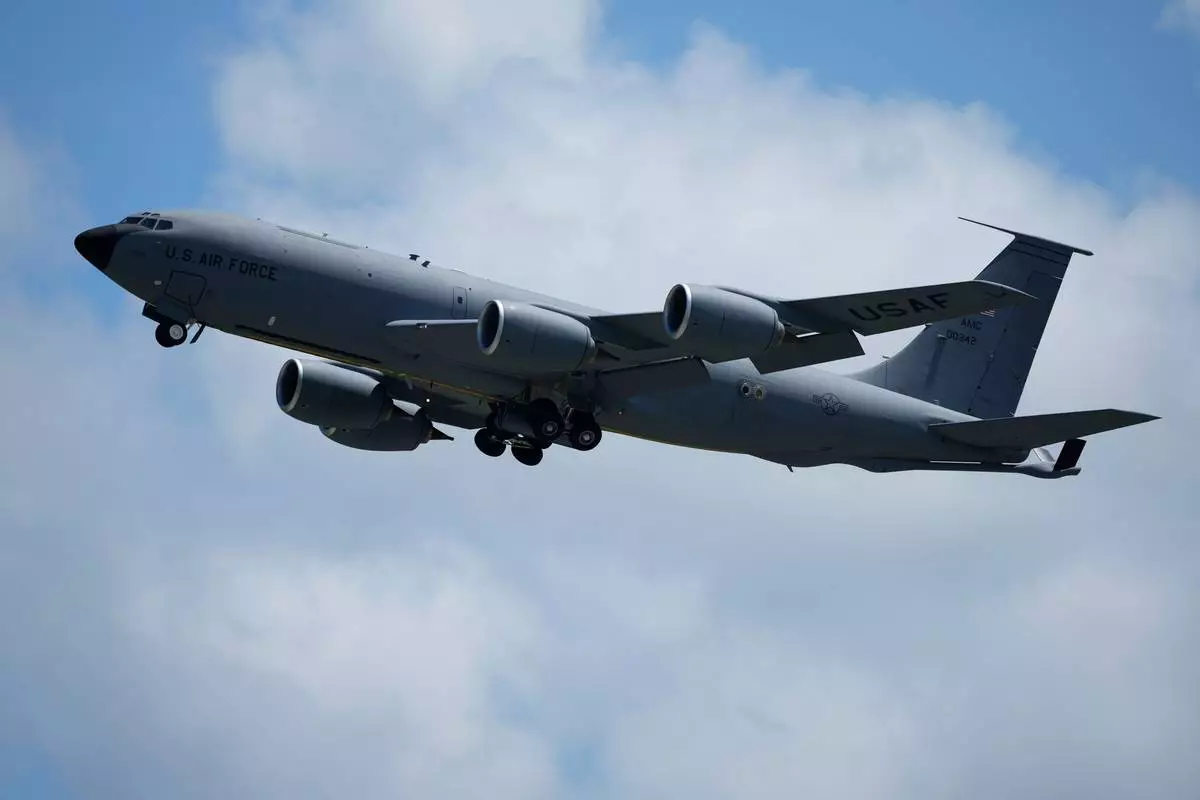
FILE - A U.S. Air Force KC-135 Stratotanker refueling tanker aircraft takes off from the Kadena Air Base airfield in Kadena town, west of Okinawa, southern Japan, Wednesday, Aug. 30, 2023. (AP Photo/Hiro Komae, File)
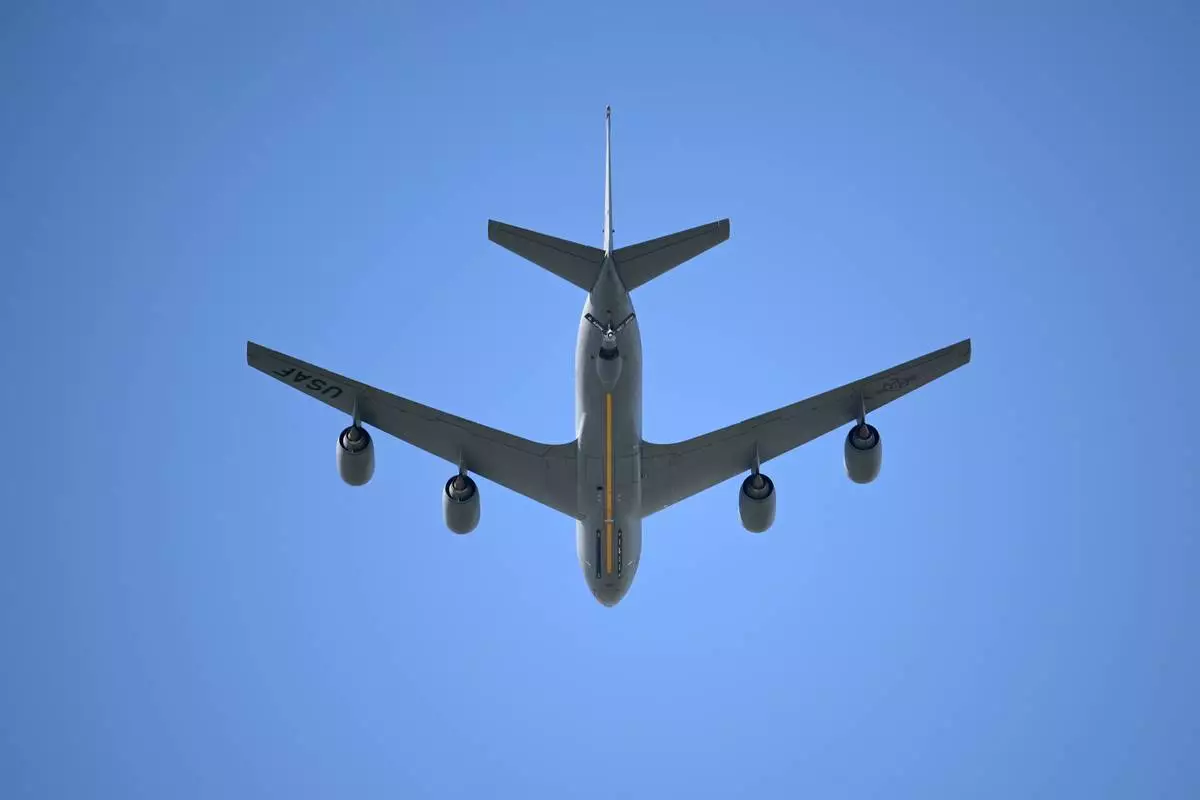
FILE - A U.S. Air Force KC-135 Stratotanker aerial refueling aircraft performs a flyover during the national anthem before an NCAA college football game between Central Florida and Georgia Tech, Sept. 24, 2022, in Orlando, Fla. (AP Photo/Phelan M. Ebenhack, File)