Humanoid robots are rapidly expanding into a growing range of applications in China, paving new paths for industrial growth and energizing high-tech manufacturing.
According to data released by the National Bureau of Statistics on Monday, in 2025, value-added output from high-tech manufacturing now accounts for 17.1 percent of total output from industrial enterprises above the designated size, which requires an annual main business revenue of at least 20 million yuan (about 2.84 million U.S. dollars). Specifically, production of industrial robots surged 28 percent year-on-year, marking the momentum of the emerging industry.
At Beijing's first robot 4S store, more than 35 models of humanoid robots are currently on sale, covering a wide range of functions. The store features demonstration areas such as simulated pharmacies and industrial assembly lines, allowing robots to showcase how they perform in different real-world settings.
"We have created six major application scenarios, covering industrial, medical and household use. Prices for humanoid robots range from tens of thousands to several hundred thousand yuan, and the store now attracts more than 5,000 visitors each month," said Zhou Xiang, marketing channel director of the Robot 4S Store in Beijing's high-tech cluster E-Town.
Humanoid robots are also gradually taking up positions on factory floors.
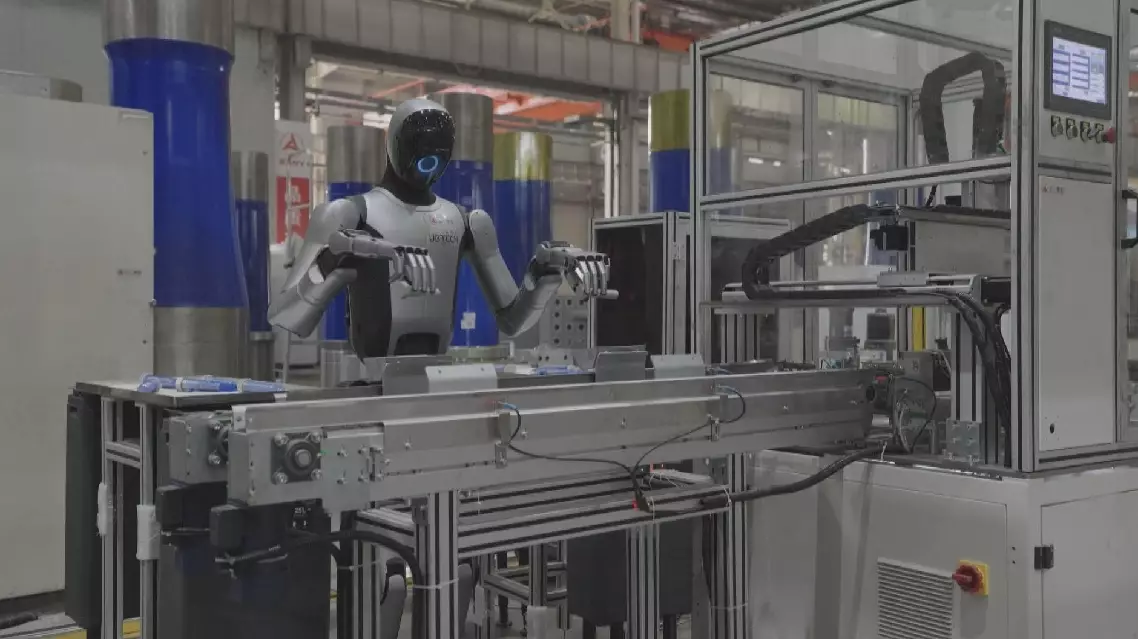
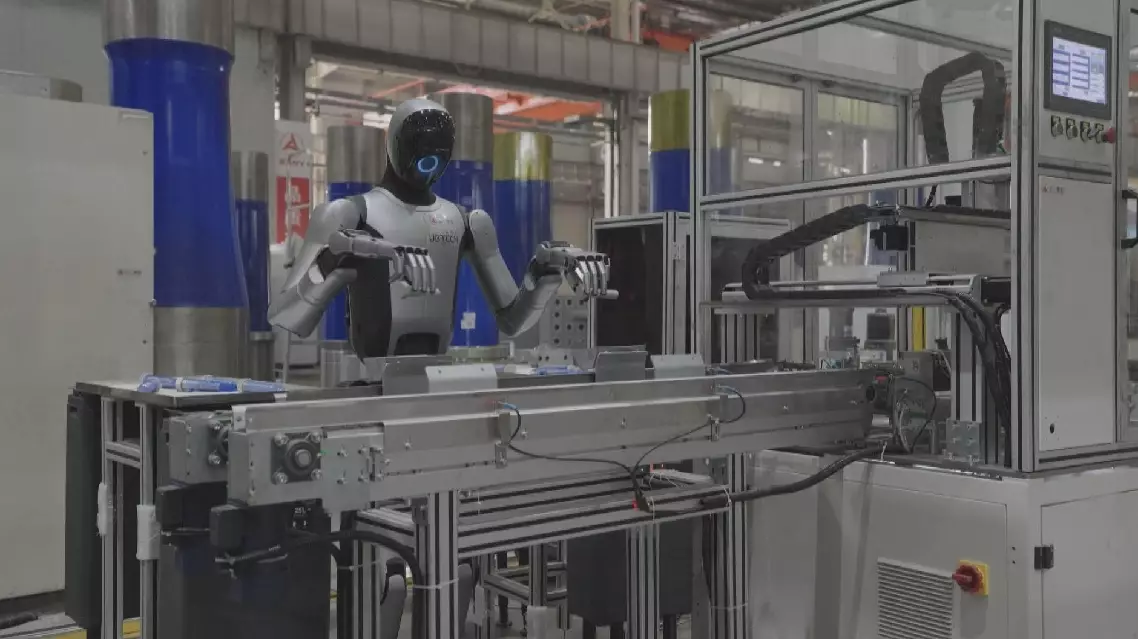
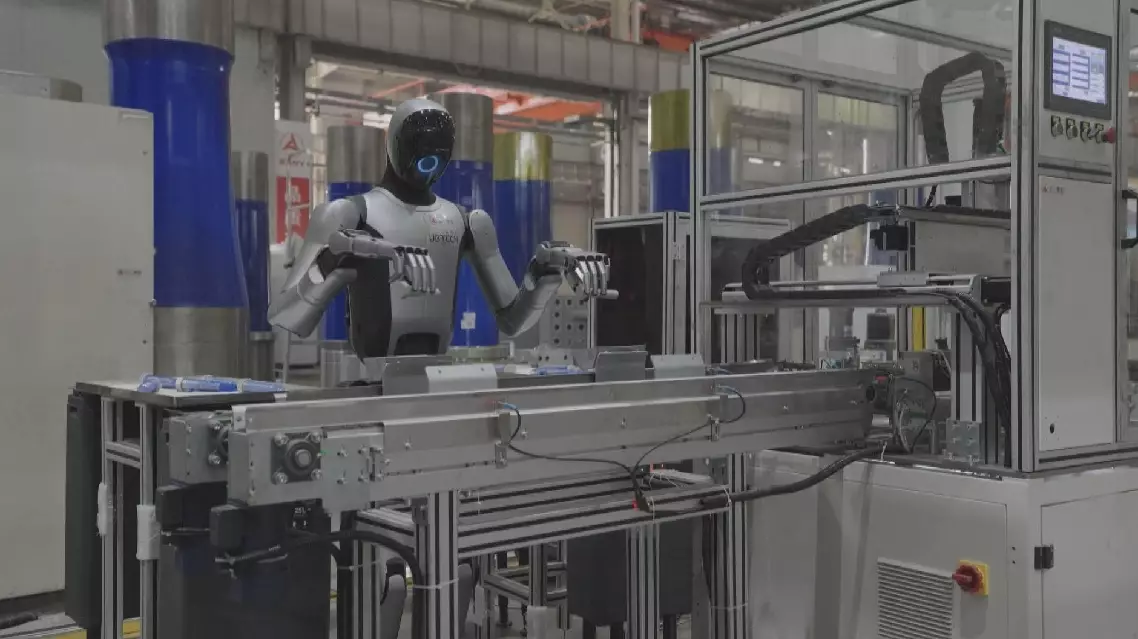
At SANY Heavy Energy's intelligent manufacturing plant in Beijing's Changping District, two "new colleagues" joined the workshop around three months ago. Standing 1.76 meters tall and equipped with 52 degrees of freedom, the full-size industrial humanoid robots work together to independently complete tasks.
One robot sorts out and picks up bolts, while the other receives signals after the bolts are processed, transfers the bolts to a nearby rack, and returns empty trays to their original positions. Powered by embodied intelligence technology, the robots can determine the most efficient way to carry out their work on their own.
"The robots use visual recognition to assess the difficulty of grasping each bolt, adjust them into more suitable positions, and then proceed with gripping. Their operational precision can reach three to five millimeters," said Xing Tengfei, director of the Intelligent Manufacturing Institute at SANY.
While these tasks may appear simple, robots can perform them repeatedly with a high success rate, effectively replacing human workers in high-intensity, repetitive jobs.
"Although it seems simple, such work is monotonous and physically demanding over time. The robots are not yet as flexible as humans, but they eliminate the need for manual labor," said Zhao Jianbo, an assembly worker at the workshop.
Xiong Jingchuang, head of humanoid robot delivery at UBTECH, the producer of the industrial humanoids, valued the quick evolution of the robots.
"Factory environments are complex. Our team builds one-to-one simulation platforms after data scanning to continuously optimize performance. We have made the first step toward integrating humanoid robots into industrial production," said Xiong.
"At present, the robots can grasp one bolt roughly every 30 seconds. If its efficiency improves to one bolt every 20 seconds, it would fully meet the factory's production capacity requirements," added Xing.
Beyond manufacturing, robots are increasingly being deployed in energy inspection, emergency response, and commercial services. Looking ahead, Xing said that humanoid robots are likely to take on tasks in extreme and harsh conditions.
The examples of robot applications reflect a robust high-tech market, in which China has taken the lead. According to estimates by China Center for Information Industry Development (CCID) and other research institutions, global shipments of humanoid robots are expected to reach about 15,000 units in 2025, with around 10,000 delivered from China. Over the next five years, average annual growth is projected at 95 percent.
Policy support is also accelerating adoption. In the recently launched "AI + Manufacturing" initiative proposed by the Ministry of Industry and Information Technology and other government agencies, authorities called for the development of benchmark humanoid robot production lines and the early deployment of robots in typical manufacturing scenarios.
Humanoids see expanding applications in China's hospitals, factories
Humanoids see expanding applications in China's hospitals, factories
Humanoids see expanding applications in China's hospitals, factories