WEST PALM BEACH, Fla.--(BUSINESS WIRE)--Jan 20, 2026--
Mesocore Modular Homes is redefining homeownership by delivering expandable, energy-efficient homes that let people truly own their home and land over time. As housing affordability challenges intensify nationwide, Mesocore is advancing a housing platform designed to restore flexibility, resilience, and attainable ownership for first-time buyers, downsizers, and communities seeking long-term solutions.
This press release features multimedia. View the full release here: https://www.businesswire.com/news/home/20260120658808/en/
Start Small. Grow Smart. Own Your Home.
Rising construction costs, restrictive zoning, and limited financing pathways have left many Americans with few viable housing options—often forcing them into condominiums with high HOA fees or continued renting. Mesocore’s expandable housing model offers an alternative that combines private land ownership, long-term adaptability, and flexible paths to ownership.
Designed for Flexibility, Resilience, and Real Living
At the core of Mesocore’s housing platform is a 420-square-foot, one-bedroom, one-bath modular core designed as a fully self-contained residence. Each core includes a full kitchen, dedicated living area, private bedroom, and built-in desk, providing the complete functionality of a conventional home in a compact footprint.
Mesocore homes are designed to meet the International Building Code (IBC) and include solar power with battery backup as a standard feature, reducing long-term energy costs while allowing the home to operate during grid outages—an important benefit for both everyday living and emergency situations.
“Homeownership shouldn’t require buying more house than you need, giving up control, or remaining locked out of the market,” said Joey Esposito, Jr., VP of Business Development at Mesocore Modular Homes. “Our goal is to make ownership attainable from day one, while giving people the ability to grow over time.”
Modular Deployment With Traditional Expansion
Mesocore’s housing platform combines the speed and predictability of modular construction with the long-term flexibility of traditional building methods. The initial modular core allows for faster deployment and consistent quality.
When homeowners are ready to expand, they can choose from multiple pre-engineered expansion plans that integrate seamlessly with the original core and are constructed using conventional, site-built construction methods. These expansions can be completed by local contractors and permitted and inspected through standard local building processes.
This hybrid approach ensures:
Expandable Homes With Flexible Paths to Ownership
Mesocore homes are designed to expand over time into two-, three-, or four-bedroom residences of up to approximately 1,500 square feet, without requiring homeowners to relocate.
To further lower barriers to entry, Mesocore is utilizing flexible financing options, including rent-to-own pathways, allowing households to transition from occupancy to ownership over time. This approach supports buyers who may not yet qualify for traditional financing while preserving a clear path to long-term homeownership.
Supporting State and Local Emergency Management — Without Being Temporary
While designed first and foremost as permanent homes, Mesocore’s expandable housing platform also offers meaningful benefits for state and local emergency management and recovery efforts. The ability to deploy compact, code-compliant homes quickly—and later expand them into permanent residences—helps communities respond to displacement without relying on short-term, disposable housing solutions.
Exhibiting at the Resilient City Expo in Miami
Mesocore Modular Homes will be exhibiting at the Resilient City Expo in Miami on March 4 and 5, where the company will engage with city leaders, planners, emergency management professionals, and resilience experts focused on addressing climate-driven risks and housing challenges.
Florida Pilot Demonstrates Real-World Application
Mesocore plans to launch its first pilot subdivision in Gainesville, Florida, with construction expected to begin later this year. The pilot will demonstrate how expandable homes, small-lot development, and flexible ownership models can deliver attainable housing while supporting resilience in a rapidly growing state.
Florida Pilot and Future Development Opportunities
Mesocore Modular Homes is advancing its expandable housing platform through active development efforts in Florida, including an initial pilot project planned to break ground later this year. Building on this momentum, Mesocore is actively seeking development partners for future projects across Florida and other growth markets.
The company is engaging with developers, landowners, and municipalities interested in delivering expandable, small-lot housing that supports affordability, resilience, and long-term homeownership.
“Expandable housing works best when it’s deployed at scale and in partnership with local stakeholders,” said Joey Esposito, Jr., VP of Business Development. “We’re looking to collaborate with developers who want to rethink how housing is built, financed, and grown over time.”
A Scalable Housing Platform for a Changing Market
As housing costs continue to outpace incomes and communities seek smarter ways to grow, Mesocore Modular Homes is working with developers, municipalities, and partners to deploy expandable housing at scale. By combining modular efficiency, traditional expansion, and flexible financing, Mesocore aims to restore a practical, attainable path to homeownership across generations.
About Mesocore Modular Homes
Mesocore Modular Homes designs and builds expandable, energy-efficient modular housing focused on affordability, flexibility, and long-term livability. With IBC-compliant, solar-powered homes that start small, grow over time, and support flexible ownership pathways—including rent-to-own—Mesocore is redefining modern homeownership.
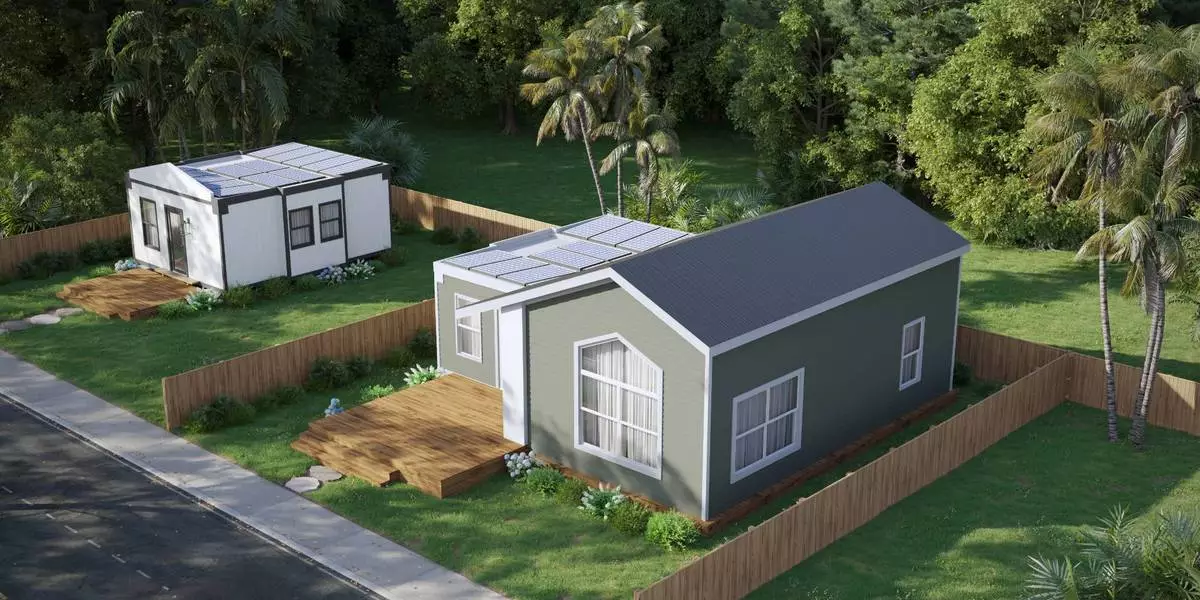
A Mesocore expandable home shown side by side as a 420-square-foot modular core and an expanded multi-bedroom residence, illustrating how homeowners can start small and grow over time.

DAVOS, Switzerland (AP) — The European Union’s top official on Tuesday described U.S. President Donald Trump’s planned new tariffs over Greenland as a “mistake” between long-standing allies and called into question Trump's trustworthiness, while French President Emmanuel Macron said the situation could push the EU to deploy one of the its most powerful tools of retaliation.
While the furor over Trump's desire for control of the vast Arctic island was a focus of an elite annual meeting in Switzerland, Greenland's leader insisted on respect for its territorial integrity and said that respect for international law is “not a game.”
European Commission President Ursula von der Leyen pushed back against Trump's announcement that starting February, a 10% import tax will be imposed on goods from eight European nations that have rallied around Denmark in the wake of his escalating calls for the United States to take over Greenland. The Arctic island is a semiautonomous territory of NATO ally Denmark.
“The European Union and the United States have agreed to a trade deal last July,” von der Leyen said at the World Economic Forum in Davos, Switzerland. “And in politics as in business – a deal is a deal. And when friends shake hands, it must mean something.”
“We consider the people of the United States not just our allies, but our friends. And plunging us into a downward spiral would only aid the very adversaries we are both so committed to keeping out of the strategic landscape,” she added.
She vowed that the EU’s response “will be unflinching, united and proportional.”
Trump, who will speak in Davos on Wednesday and said on social media that he had agreed to “a meeting of the various parties” there, has insisted the U.S. needs the territory for security reasons against possible threats from China and Russia.
Earlier Tuesday, U.S. Treasury Secretary Scott Bessent said America’s relations with Europe remain strong and urged trading partners to “take a deep breath” and let tensions driven the new tariff threats over Greenland “play out.”
“I think our relations have never been closer,” he said.
But Danish Prime Minister Mette Frederiksen, speaking in the Danish parliament, said that “the worst may still be ahead of us.” She said that “we have never sought conflict. We have consistently sought cooperation.”
Greenland's Prime Minister Jens-Frederik Nielsen insisted at a news conference in the island's capital, Nuuk, that “we need to have respect for international law and territorial integrity.” He said those principles should unite Western democratic countries, and said he was grateful for support from EU allies.
“International law, it's not a game,” he said. “We have been a close and loyal ally to the United States, to NATO, through many, many, many years. We can do lots more in that framework. We are willing to cooperate much more, but of course in mutual respect, and if we cannot see that, it will be very difficult to have a good and reliable partnership.”
The American leader’s threats have sparked outrage and a flurry of diplomatic activity across Europe, as leaders consider possible countermeasures, including retaliatory tariffs and the first-ever use of the European Union’s anti-coercion instrument.
Unofficially known as the “trade bazooka,” the anti-coercion instrument could sanction individuals or institutions found to be putting undue pressure on the EU. In addition, the EU has two other major economic tools it could use to pressure Washington: new tariffs, or a suspension of the U.S.-EU trade deal.
Macron warned in Davos that the additional tariffs could force the EU to use its anti-coercion mechanism “for the very first time” against the United States.
“Can you imagine that?” he said, arguing that allied countries should be focusing on bringing peace to Ukraine. “This is crazy.”
In general, he said, the mechanism “is a powerful instrument and we should not hesitate to deploy it in today’s tough environment.”
Trump earlier posted a text message from Macron in which the French president suggested a meeting of members of the Group of Seven industrialized democracies in Paris after the Davos gathering. An official close to Macron, who spoke anonymously in line with the French presidency's customary practices, confirmed the message shared by Trump is genuine.
In his latest threat of tariffs, Trump indicated that the import taxes would be retaliation for last week’s deployment of symbolic numbers of troops from the European countries to Greenland — though he also suggested that he was using the tariffs as leverage to negotiate with Denmark.
Speaking on the sidelines of Davos, California Gov. Gavin Newsom slammed Europe’s response to Trump's tariff threats as “pathetic” and “embarrassing,” and urged European leaders to unite and stand up to the United States.
“It is time to get serious, and stop being complicit,” Newsom told reporters. “It’s time to stand tall and firm, have a backbone.”
On Monday night, Greenland’s European backers looked at establishing a more permanent military presence in the High North to help guarantee security in the Arctic region, a key demand of the United States, Swedish Defense Minister Pål Jonson said.
Jonson said after talks with his counterparts from Denmark, Greenland and Norway that European members of NATO are currently “doing what’s called a reconnaissance tour in order to identify what kind of needs there are when it comes to infrastructure and exercises and so forth.”
In Moscow, Russian Foreign Minister Sergey Lavrov strongly denied any intention by Russia and China to threaten Greenland, while also describing Greenland as a “colonial gain” for Denmark. At a news conference, he said that “in principle, Greenland isn’t a natural part of Denmark.”
In another sign of tension between allies, the British government on Tuesday defended its decision to hand sovereignty of the Chagos Islands to Mauritius after Trump attacked the plan, which his administration previously supported.
Trump said that relinquishing the remote Indian Ocean archipelago, home to a strategically important American naval and bomber base, was an act of stupidity that shows why he needs to take over Greenland.
In a speech to lawmakers at Britain's Parliament on Tuesday, U.S. House of Representatives Speaker Mike Johnson said he hoped to “calm the waters” as Trump roils the trans-Atlantic relationship with his desire to take over Greenland.
Johnson said the U.S. and the U.K. “have always been able to work through our differences calmly, as friends. We will continue to do that.”
Emma Burrows reported from Nuuk, Greenland. AP writers Sylvie Corbet in Paris, Jill Lawless in London and Lorne Cook in Brussels contributed to this report.
French President Emmanuel Macron is seen during the Annual Meeting of the World Economic Forum in Davos, Switzerland, Tuesday, Jan. 20, 2026. (AP Photo/Markus Schreiber)
President Donald Trump speaks with reporters after arriving at Palm Beach International Airport, Monday, Jan. 19, 2026, in West Palm Beach, Fla. (AP Photo/Julia Demaree Nikhinson)
People walk at the Promenade in front of the Congress Center where the Annual Meeting of the World Economy Forum take place in Davos, Switzerland, Monday, Jan. 19, 2026. (AP Photo/Markus Schreiber)
President of the European Commission Ursula von der Leyen talks during the Annual Meeting of the World Economic Forum in Davos, Switzerland, Tuesday, Jan. 20, 2026. (AP Photo/Markus Schreiber)
Danish soldiers land at Nuuk airport, Monday, Jan. 19, 2026. (Mads Claus Rasmussen/Ritzau Scanpix via AP)
President of the European Commission Ursula von der Leyen talks during the Annual Meeting of the World Economic Forum in Davos, Switzerland, Tuesday, Jan. 20, 2026. (AP Photo/Markus Schreiber)
Riot police clash with protesters after a rally against the World Economic Forum in Davos and the visit of US President Donald Trump, on Monday, in Zurich, Switzerland, Jan. 19, 2026. (Michael Buholzer/Keystone via AP)
A fisherman navigates past ice in the sea off the coast of Nuuk, Greenland, Monday, Jan. 19, 2026. (AP Photo/Evgeniy Maloletka)
European Union foreign policy chief Kaja Kallas, center, greets Minister for Foreign Affairs and Research of Greenland Vivian Motzfeldt, right, and Denmark's Defense Minister Troels Lund Poulsen, left, prior to a meeting at EU headquarters in Brussels, Monday, Jan. 19, 2026. (AP Photo/Geert Vanden Wijngaert)
People protest against Trump's policy towards Greenland in front of the US consulate in Nuuk, Greenland, Saturday, Jan. 17, 2026. (AP Photo/Evgeniy Maloletka)
Scott Bessent, US Secretary of the Treasury, holds a speech at the USA House during the Annual Meeting of the World Economic Forum in Davos, Switzerland, Tuesday, Jan. 20, 2026. (AP Photo/Markus Schreiber)