ATLANTA (AP) — Georgia Lt. Gov. Burt Jones, a Republican gubernatorial candidate, is attacking his primary opponent Secretary of State Brad Raffensperger over the 2020 election again, this time wielding his legislative powers.
State senators on Thursday slammed Raffensperger for not complying with a U.S. Department of Justice request for detailed voter data that includes names, dates of birth, residential addresses, driver’s license numbers and partial Social Security numbers. Raffensperger has said that would violate state law and infringe on Georgians’ privacy. He did not attend the meeting, citing active litigation. Georgia is among 23 states the Justice Department has sued to get that information.
But Jones emphasized an incorrect claim that there were 315,000 wrongly certified Fulton County ballots from 2020 when he demanded Raffensperger appear at the Senate Ethics Committee meeting. That appeared to be an attempt to galvanize Jones' right-wing supporters. Jones is a close ally of President Donald Trump, who has repeatedly and falsely claimed the 2020 election was stolen from him.
Spotlighting the 2020 election baffled some Republicans who say most Georgians have moved on.
Ricky Hess, chair of north Georgia’s Paulding County Republicans, said in a text that voters care about election transparency but are “ready to move on from relitigating 2020” and are more worried about affordability, education and public safety.
“Candidates who make 2020 the centerpiece risk sounding stuck,” Hess wrote. “Candidates who talk about practical steps that build confidence and then focus on today’s issues will connect with more people.”
In a January 2021 phone call, the president pressured Raffensperger to help “find” enough votes to overturn Democrat Joe Biden’s win in the state’s 2020 presidential election.
Jones already has Trump’s endorsement and the support of election skeptics, said Jason Shepherd, a Republican in Georgia who resigned from party office over disagreements with Trump supporters. It’s the rest of the voters he needs to win over, and Shepherd said most trust that Georgia’s elections are secure.
Jones was one of 16 Georgia Republicans who declared themselves electors in 2020 even though Biden had won the state. He also backed a call for a special session to declare Trump the winner. Raffensperger and Attorney General Chris Carr, Jones’ top rivals for the Republican nomination, spurned Trump’s efforts. Raffensperger and Carr will appeal to more moderate Republicans, but Raffensperger is expected to pull ahead of Carr.
Outcry over the false claim that the Fulton County ballots were wrongly certified went viral in right-wing media last year. In announcing the Ethics Committee meeting, Jones said Fulton County admitted that “315,000 ballots were not properly signed by poll workers." Ballots in Georgia are never signed. It was the tabulator tapes from scanners used to count votes during early in-person voting for the 2020 general election that poll workers failed to sign, Ann Brumbaugh, an attorney for the county, acknowledged during a State Election Board meeting last month.
She added the county has new leadership overseeing elections and implemented new training and procedures for checking tabulator tapes.
Raffensperger called what happened a “clerical error.” The Brennan Center’s director of elections and security Gowri Ramachandran agreed with that assessment. Signing tabulation tapes is not how votes get counted, and the error doesn’t invalidate election results, she said.
“There is nothing in the election code overturning it for not following a procedural rule, especially invalidating every single early vote cast in Georgia’s largest county,” said a spokesperson for Raffensperger.
Jones said in the announcement that Raffensperger’s office needs oversight.
“I will not allow the Secretary and his allies in the press to let him escape accountability by downplaying this utter failure as a mere ‘clerical error,’” Jones said.
During his campaign, Raffensperger has said Georgia’s elections are nationally recognized as secure. In a letter to the Ethics Committee's chairman, Raffensperger's office said they provided the DOJ with Georgia's voter list and complied to the extent that Georgia law allows. His office filed a motion to dismiss the lawsuit Wednesday.
“If you and your colleagues wish to weaken the legal protections for Georgia voters’ private information and make millions of Georgians vulnerable to identity theft, you can certainly change the law, but that is not something that the Secretary of State’s office would support,” the letter says.
At the meeting, Republican state Sen. Randy Roberston, who filed the resolution, argued Raffensperger could legally share the information.
“He continuously fails to show up and answer the questions and that is the absolute truth,” said Robertson.
Since Trump often laments the 2020 election with a focus on Fulton County, where he was indicted over attempts to overturn the results, it’s not surprising that Jones wants to keep it on voters’ radar, said Georgia State University political science professor Dr. Jennifer McCoy. However, Jones will have to appeal to a broad swath of voters in the general election.
State GOP Chairman Josh McKoon said election security is a “key concern” among Republican primary voters and candidates will continue to talk about it.
Shepherd said he’s surprised that a “bureaucratic error” is galvanizing the party’s MAGA wing as much as it is. Garland Favorito, a conservative activist known for espousing conspiracy theories and challenging the state’s 2020 results, said Fulton County’s error is just one example of what he describes as Raffensperger’s lack of transparency.
Republicans like Jones “think that if they can win all the straw polls at the Republican Party barbecues, they’ll probably win the nomination, when typically speaking, it’s the opposite,” said Shepherd.
Associated Press writer Kate Brumback in Atlanta contributed to this report.
Kramon is a corps member for The Associated Press/Report for America Statehouse News Initiative. Report for America is a nonprofit national service program that places journalists in local newsrooms to report on undercovered issues.

FILE - Georgia Lt. Gov. Burt Jones speaks about Republican presidential nominee former President Donald Trump at a campaign event at the Cobb Energy Performing Arts Centre, Oct. 15, 2024, in Atlanta. (AP Photo/Alex Brandon, File)

FILE - Georgia Secretary of State Brad Raffensperger participates in an election forum, Sept. 19, 2024, in Ann Arbor, Mich. (AP Photo/Carlos Osorio, File)
NASA's launch team has loaded more than 700,000 gallons of fuel into the 32-story Space Launch System rocket, setting the stage for the Artemis II mission crew members to board.
The mission is NASA’s planned lunar fly-around by four astronauts that will be the first moon trip in 53 years.
The Space Launch System rocket is poised to blast off Wednesday evening with a two-hour launch window beginning at 6:24 p.m. EDT at Kennedy Space Center in Florida.
Artemis astronauts Reid Wiseman, Victor Glover, Christina Koch and Jeremy Hansen will be on board. They’ll hurtle several thousand miles beyond the moon, hang a U-turn and then come straight back. No circling around the moon, no stopping for a moonwalk — just a quick out-and-back lasting less than 10 days. NASA promises more boot prints in the gray lunar dust, but not before a couple practice missions.
Unlike the Apollo missions that sent astronauts to the moonfrom 1968 through 1972, Artemis’ debut crew includes a woman, a person of color and a Canadian citizen.
Artemis II is the opening shot of NASA’s grand plans for a permanent moon base. The space program is aiming for a moon landing near the lunar south pole in 2028.
The Latest:
Wiseman, Glover, Koch and Hansen have left the Neil Armstrong Operations and Checkout Building and are on their way to launch pad 39B.
Waving to family, colleagues and news photographers, the crew boarded the so-called astrovan for the 9-mile ride to the launch pad and their awaiting SLS rocket.
Before their highly anticipated walkout, commander Reid Wiseman and his crew played a quick card game with NASA’s chief astronaut Scott Tingle. It’s a preflight tradition since the space shuttle era.
Losing is good: It means the astronaut has gotten rid of all bad luck before launching.
The four thanked the suit techs and posed for photos, keeping a safe distance from many of the bystanders to avoid germs. They then went down the elevator at the Neil Armstrong Operations & Checkout Building and walk out to a barrage of cameras and cheers.
They’ll take a custom-designed astrovan for the ride to the launch pad
House Speaker Mike Johnson posted on the social media site X ahead of the planned Artemis II launch.
“Praying for the safety and success of the Artemis II crew and @NASA as they undertake a mission that will carry humanity farther into space than we have gone in over half a century. I had the privilege of hosting these courageous pioneers at the State of the Union earlier this year. Americans are watching proudly as our Golden Age reaches new heights!” Johnson wrote.
Wiseman, 50, a retired Navy captain from Baltimore, was serving as NASA’s chief astronaut when asked three years ago to lead humanity’s first lunar trip since 1972.
His wife Carroll’s death from cancer in 2020 gave him pause.
His two teenage daughters, especially the older one, had “zero interest” in him launching again after a 2014 trip to the International Space Station.
“We talked about it and I said, ’Look, of all the people on planet Earth right now, there are four people that are in a position to go fly around the moon,” he said. “I cannot say no to that opportunity.”
The next day, homemade moon cupcakes awaited him, along with his daughters’ support.
Artemis is the twin sister of Apollo in Greek mythology. They are the children of Zeus and Leto. Artemis has long been associated with the moon.
While the Artemis name builds on the Apollo program and pays homage to it, “there is no way we could be that same mission or ever hope to even be,” said NASA astronaut Christina Koch, part of the Artemis II crew.
The Apollo program was all about beating the Russians to the moon and planting the U.S. flag. NASA sent 24 astronauts to the moon between 1968 and 1972, including 12 moonwalkers. Now China is the competition.
NASA is striving for a long-term lunar presence under Artemis, with Mars to follow.
The Artemis II astronauts are now in their orange Orion spacesuits that they will wear for launch and reentry. Testing these new suits is one of the main goals of the mission.
The four are expected to emerge for their trip to the pad sometime before 2pm.
NASA created bright orange custom spacesuits for launch and reentry. Astronauts will also use them in case of a depressurization or some other emergency.
They can survive up to six days in the suits, inserting a straw into the helmet to sip water or protein shakes and relying on undergarment bags and bladders as a built-in toilet.
Future Artemis crews to the lunar surface will wear white moonwalking suits designed by Axiom Space.
During the Apollo era, astronauts wore the same white bulky spacesuits for launch and return as well as for moonwalks because there wasn’t enough storage on board for different outfits.
“We should have done Artemis 50 years ago,” said John Tribe, a propulsion engineer during the Apollo era.
The launch team has loaded more than 700,000 gallons of fuel into the 32-story Space Launch System rocket, setting the stage for the Artemis II crew to board.
The wind is picking up at Cape Canaveral, more clouds are appearing and rain is expected in about two hours. But there is no lightning threat, NASA says, and there’s still an 80% chance the weather will be good enough to launch.
L-minus tracks the overall time to liftoff, counting down the days, hours and minutes away before the planned blastoff. It doesn’t include built-in holds, or pauses — that’s T-minus time.
The T-minus countdown in the final 10 minutes is where nerves tense up and hearts start pounding. Automated software kicks off a series of highly choreographed milestones. During this period, the clock can be stopped if a problem is spotted and restarted if it’s fixed in time.
T-0 is the moment of liftoff — zero — when the boosters ignite and the rocket begins its journey.
NASA has a narrow time frame each month to fly to the moon.
The Earth and moon must be aligned just so to achieve the proper trajectory for the mission. In any given month, there’s only about a week when Artemis II astronauts can lift off.
The Orion capsule needs to get a check of its life-support and other systems in near-Earth orbit. If that goes well, Orion will fire its main engine to hurtle toward the moon, taking advantage of the moon and Earth’s gravity to get there and back in a slingshot maneuver that requires little if any fuel.
Orion also needs sunlight for power and can’t be in darkness for more than 90 minutes at a time. Plus NASA wants to minimize heating during reentry at flight’s end.
The latest launch window runs through April 6. The next opportunity opens on April 30.
The hydrogen tank of the rocket’s core stage is 100% filled. NASA said no significant leaks have been observed so far in fueling. It was hydrogen leaks that prevented the rocket from flying in February.
The alarm clocks just went off in Kennedy Space Center’s crew quarters.
That means it’s rise and shine for the three Americans and one Canadian who are about to become the first lunar visitors in more than 53 years.
They have a long day ahead of them, whether they launch or not.
After breakfast, they’ll start suiting up. NASA’s launch window opens at 6:24 p.m. and lasts a full two hours.
Launch director Charlie Blackwell-Thompson is wearing green as are many of the controllers alongside her in the firing room.
Green represents “go” for NASA, a color symbolizing good luck.
The team is monitoring the fueling of the 322-foot moon rocket, set to blast off Wednesday evening.
A plush toy named Rise will ride with the Artemis II astronauts around the moon, carrying the names of more than 5.6 million people.
Rise is what’s known as a zero gravity indicator, which gives the astronauts a visual cue of when they reach space.
The design was inspired by the iconic “Earthrise” photo during Apollo 8, showing the planet as a shadowed blue marble from space in 1968.
Rise was selected from more than 2,600 contest submissions. It was designed by Lucas Ye of California.
Commander Reid Wiseman and his crew tucked a small memory card into Rise before the toy was loaded into the Orion capsule. The card bears the names of all those who signed up with NASA to vicariously tag along on the nearly 10-day journey.
“Zipping that little pocket on the bottom of Rise was kind of the moment that put it all together for me,” Wiseman said. “We are going for all and by all. It’s time to fly.”
NASA is fueling the new rocket that will send four astronauts to the moon.
Launch teams have begun pumping more than 700,000 gallons (2.6 million liters) of liquid hydrogen and liquid oxygen into the Space Launch System rocket at Kennedy Space Center in Florida.
It’s the latest milestone in the two-day countdown that kicked off on Monday when launch controllers reported to duty.
It will take at least four hours to fully load the rocket before astronauts climb aboard for humanity’s first flight to the moon since Apollo 17 in 1972.
The two-hour launch window opens at 6:24 p.m. EDT.
▶ Read more about Apollo vs. Artemis
The Americans who blazed the trail to the moon more than half a century ago were white men chosen for their military test pilot experience.
The Artemis II crew includes a woman, a person of color and a Canadian, products of a more diversified astronaut corps.
▶ Read more about Christina Koch, Victor Glover, Jeremy Hansen and Reid Wiseman
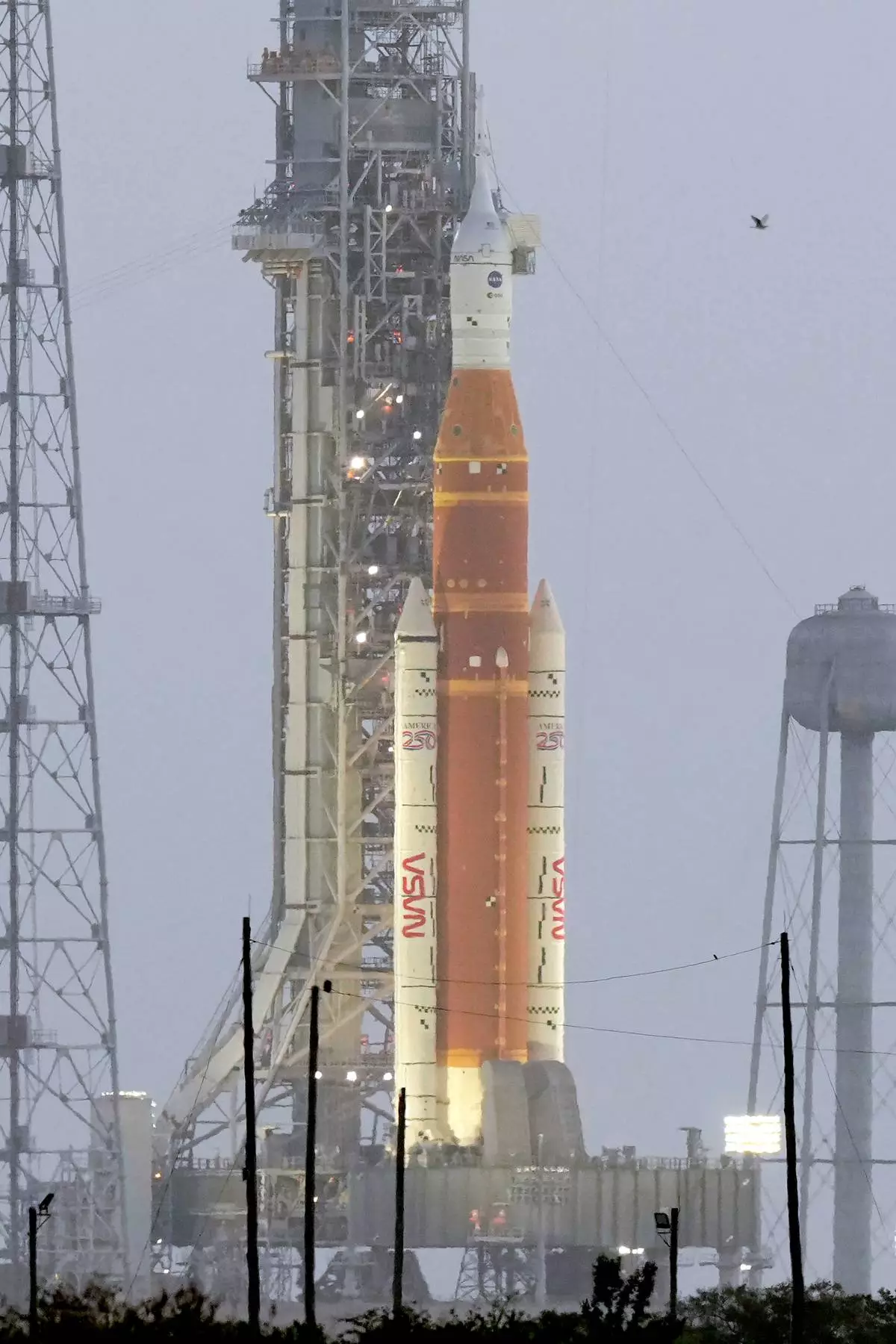
NASA's Artermis II moon rocket sits on Launch Pad 39-B at the Kennedy Space Center hours ahead of planned liftoff Wednesday, April 1, 2026, in Cape Canaveral, Fla. (AP Photo/Chris O'Meara)
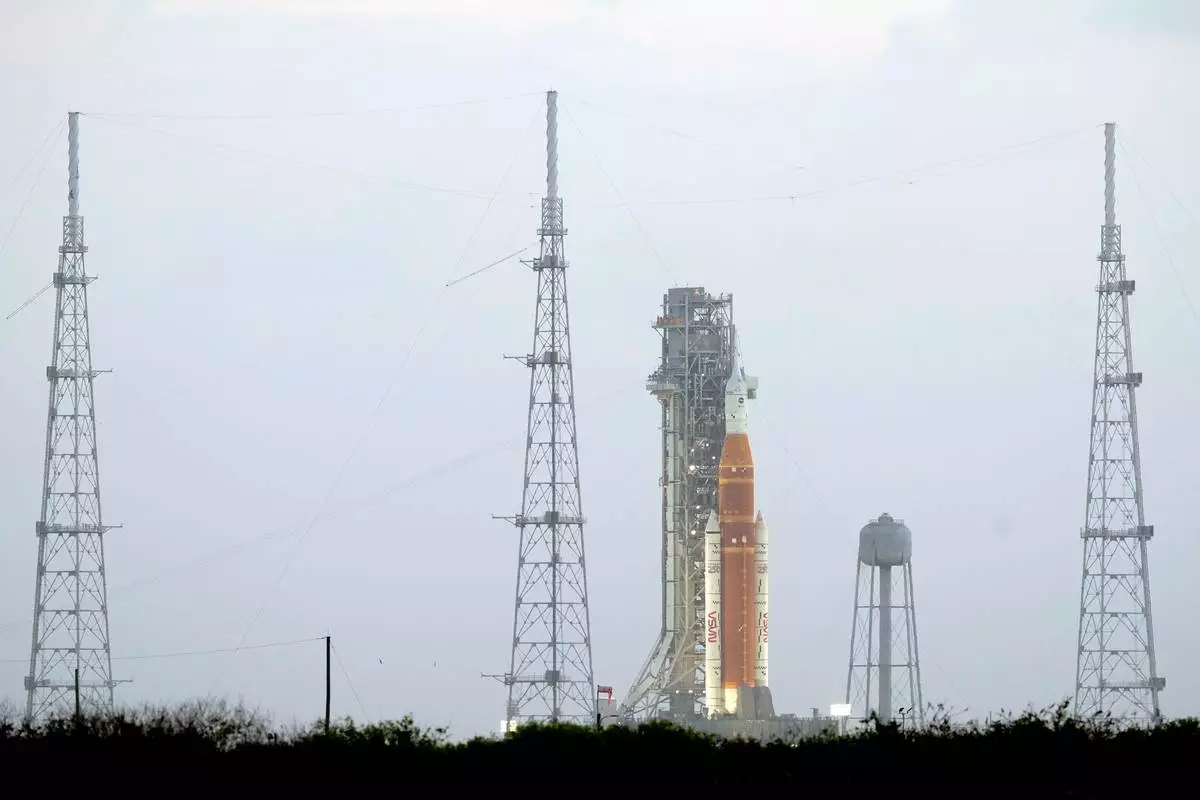
NASA's Artermis II moon rocket sits on Launch Pad 39-B at the Kennedy Space Center hours ahead of a planned launch attempt Wednesday, April 1, 2026, in Cape Canaveral, Fla. (AP Photo/Chris O'Meara)
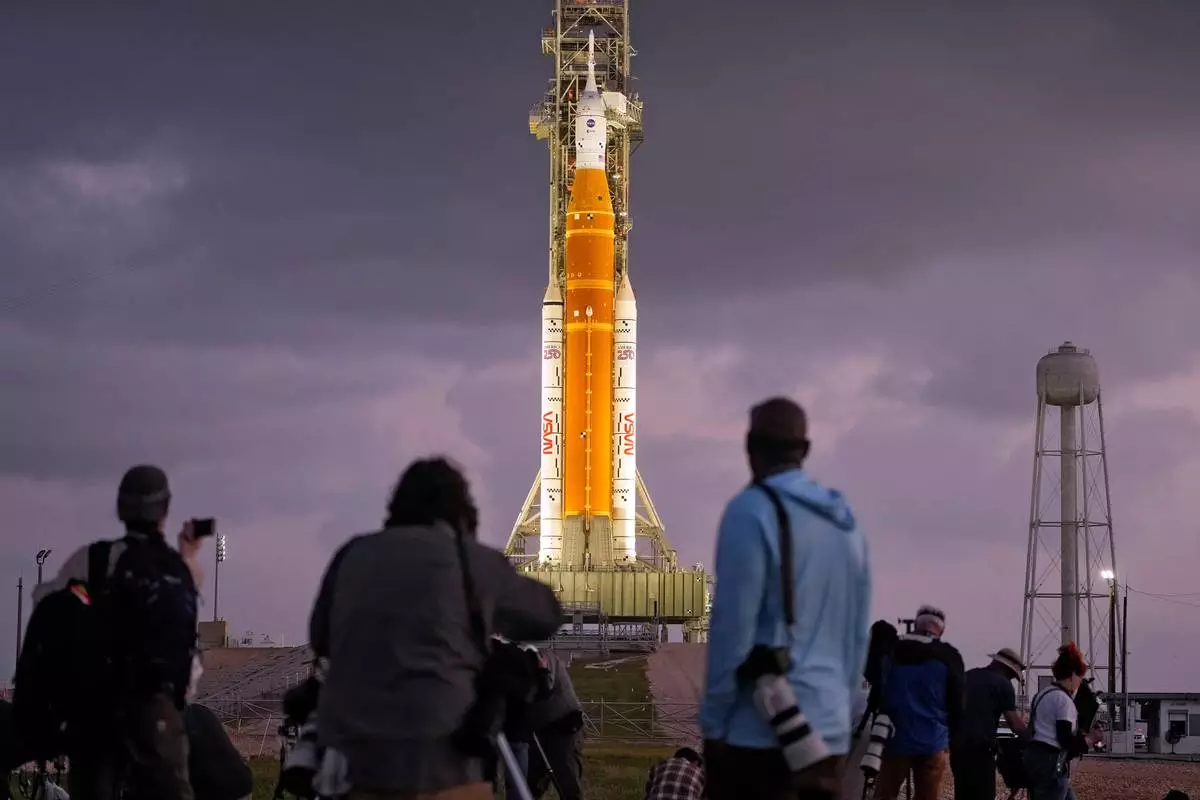
Photographers set up remote cameras near NASA's Artermis II moon rocket on Launch Pad 39-B just before sunrise at the Kennedy Space Center Tuesday, March 31, 2026, in Cape Canaveral, Fla. (AP Photo/Chris O'Meara)