The ongoing American-Israeli war with Iran, for all its complexity and global effects, boils down to a single question: Who can take the pain the longest? A surge in oil prices points to what may be Iran’s most effective weapon and the United States’ biggest vulnerability in continuing the campaign: Damaging the world economy.
Wednesday’s major developments include Iranian attacks against commercial ships — setting a Thai cargo ship ablaze in the Strait of Hormuz — and drones targeting Dubai International Airport, escalating a campaign of squeezing the oil-rich region as global energy concerns mount.
The U.S. campaign of airstrikes in Iran is now in its 12th day with no end in sight after hitting more than 5,500 targets. The Israeli military is striking across Iran as well as in Lebanon, where Israel says it's targeting the Iran-backed militant group Hezbollah. An Israeli intelligence assessment also indicates that Iran’s new supreme leader, Ayatollah Mojtaba Khamenei, was wounded at the start of the war.
The war has killed at least 1,230 people in Iran, at least 570 in Lebanon and 12 in Israel, according to officials in those countries. The Pentagon said Tuesday that about 140 U.S. service members have been wounded, eight of them severely, and seven killed.
Here is the latest:
U.N. Ambassador Mike Waltz told an emergency meeting of the U.N. Security Council that the United States supports the Lebanese government’s decision to prohibit Hezbollah’s military and security activities, and the government’s order for the group to immediately disarm.
The U.S. also welcomes Lebanon’s ban on all activities of Iran’s Islamic Revolutionary Guard Corps, he said.
“The world must come together now in supporting Lebanon’s efforts to exercise its sovereignty across every inch of Lebanese territory,” Waltz said.
He said the U.S. is responding to Hezbollah’s “recklessness” by providing humanitarian aid to hundreds of thousands of displaced Lebanese.
The retiring North Carolina senator told reporters Wednesday that he still wants to see the outcome of an investigation into who was responsible for a strike near a school in Iran that killed more than 165 people, mostly kids.
But he added that “the worst thing we can do, if, in fact, it was a horrible outcome from an American strike, is to try to pretend that it didn’t happen.”
“We shouldn’t gloss over it if we made a mistake,” Tillis said. “We should admit it and move on.”
Tillis added, however, that Iran bore responsibility for the school’s location, which was next to a Revolutionary Guard base and close to barracks for a naval unit.
Ninety-one children — nearly one in seven dead — were among the 634 people killed by Israeli fire since fighting broke out last week, Lebanon’s Health Ministry said. At least 47 women have been killed and more than 1,500 people wounded.
That’s up from 570 people the ministry reported killed as of Tuesday.
More than 800,000 people have been displaced, mostly from southern Lebanon and the capital’s southern suburbs, according to the Lebanese government, which is strapped for cash and has struggled to secure adequate shelter and aid for evacuees.
Israel’s widespread strikes in Lebanon are intensifying, while Iran-backed Hezbollah vows to keep firing missiles and drones into Israel and refuses to disarm.
Some 2,733 of these “trajectories” came from Israel along with 323 air attacks, while 1,387 came from Lebanon, United Nations peacekeeping chief Jean-Pierre Lacroix told the U.N. Security Council.
Each of those approximately 4,120 firings from both Israel and Hezbollah could represent multiple projectiles, he added.
Lacroix noted several incidents jeopardizing the safety and security of UNIFIL positions and peacekeepers, including serious injuries to a Ghanaian soldier.
The International Energy Agency’s decision to prop up the world’s oil supply sends “a clear signal aimed at lowering global prices,” French President Emmanuel Macron said after a video meeting by the Group of Seven leaders on the economic impact of the Iran war.
“We will take all necessary measures to encourage maximum production from all producers during this period,” he added.
Paris currently holds the rotating presidency of the G7 — France, the United States, Canada, Germany, Italy, Japan and the United Kingdom — a group of wealthy democracies with large, advanced economies.
U.N. humanitarian chief Tom Fletcher called this “a moment of grave peril for Lebanon and for the region,” as the conflict disrupts markets, supply chains and aid operations.
Speaking Wednesday at an emergency U.N. Security Council meeting, he said disruptions to sea routes like the Strait of Hormuz are driving up costs and delaying humanitarian supplies by as much as six months.
“And when that happens,” he said “the most vulnerable people in Lebanon and across the region are hit first — and hardest,”
When asked Wednesday if a preliminary determination has been made into responsibility for the strike that killed more than 165 people, mostly children, White House press secretary Karoline Leavitt responded that “the investigation is still ongoing.”
Trump was later asked as he left the White House about a report in The New York Times that a preliminary military probe had found the U.S. was responsible for striking the school because of a targeting mistake.
When asked if he took responsibility for the airstrike as the commander-in-chief of U.S. forces, Trump responded by saying, “I don’t know about it.”
He didn’t say anything more.
“I think they should,” the president told reporters when asked if he’d spoken to oil companies, as he left the White House for a trip to Ohio and Kentucky.
He added of Iran, “We took out just about all of their mines” and that U.S. forces had also destroyed “just about all of their mine ships in one night.”
The waterway off Iran’s coast is vital for oil and gas but has been effectively closed amid the war.
Iranian forces can target ships using the strait with missiles, drones and mines — and U.S. attempts to limit Iran’s mine-laying capabilities is among Washington’s efforts to try and make the waterway safer to use.
Witnesses in Tehran said they heard loud airstrikes, explosions and heavy fire by anti-aircraft batteries, which sent people running for shelters. They could also hear the buzzing of drones overhead. They spoke on condition of anonymity to avoid reprisal.
In a video posted on Tuesday, he said Iranian players would not be safe in the United States.
“Due to the wicked acts they have done against Iran — they have imposed two wars on us over just eight or nine months and have killed and martyred thousands of our people – definitely it’s not possible for us to take part in the World Cup” Sports Minister Ahmad Donyamali told Iranian state TV.
The State Department said it had invited nearly 9,000 Americans and their family members for such flights from the United Arab Emirates on Wednesday. It said that 300 seats had been available but the flights departed with seats still open after all those who wanted to fly had boarded.
At least one charter flight in the UAE over the weekend was cancelled after no one showed up for it, officials said.
Many of those declining charter flight seats have opted to make their own travel plans or elected to stay in the Middle East. More than 43,000 Americans have returned to the U.S., most of them commercially, since the start of the war with Iran on Feb. 28.
The European Union has given Lebanon 100 million euros ($115 million) in humanitarian support, said European Commission President Ursula von der Leyen in a call with Lebanon’s president.
“Yesterday, we delivered over 40 tonnes of supplies and we plan to organise more humanitarian flights,” she said in a post on social media, without providing details on the aid.
The EU is tracking a potential migration crisis in Lebanon and Iran because of the war, and has scrambled to safety return European citizens from the Middle East. Drone attacks in EU-member Cyprus, an island in the Eastern Mediterranean, have drawn statements of support and collective defense from across Europe.
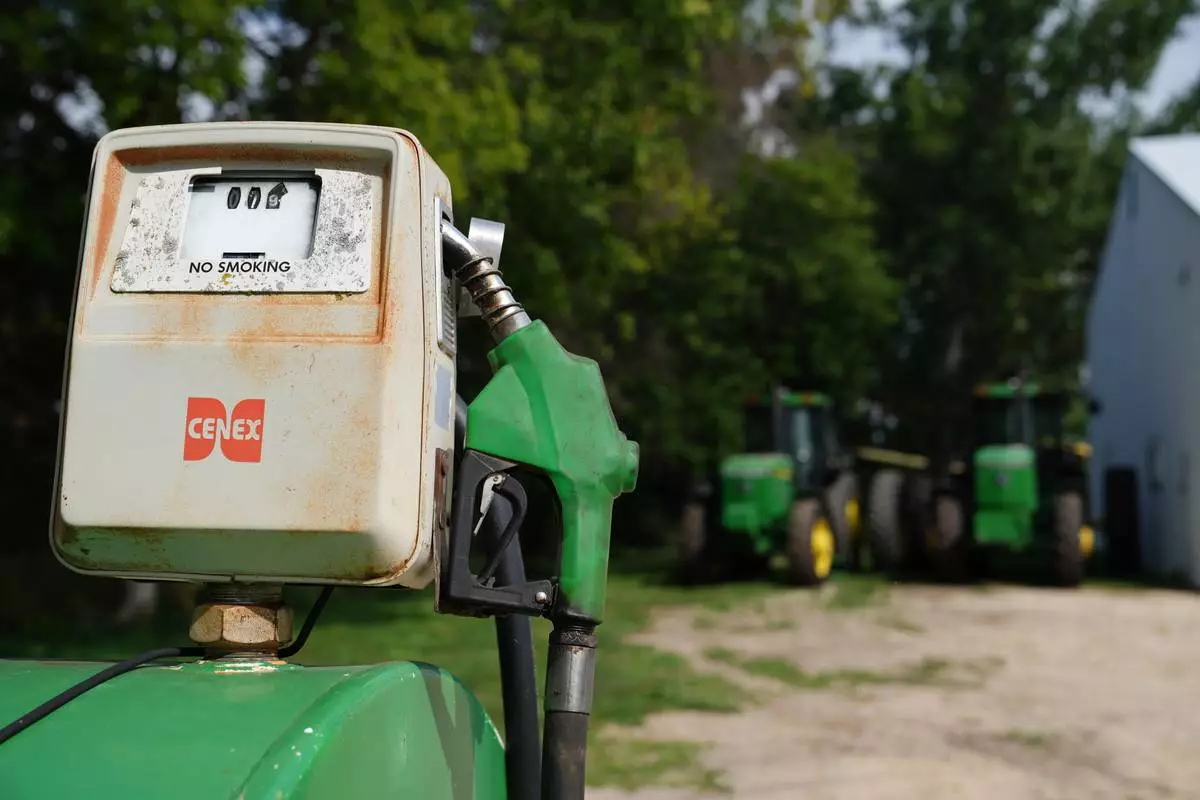
The state-run Litro Gas Lanka announced the cooking gas price increase — the first in 18 months — a day after the government increased fuel prices by 8%.
A former chief economist at the International Monetary Fund said rising fuel costs could lead to significant food shortages in many countries. “The effects are going to be most devastating in low-income countries where agricultural productivity may already be challenged,” said Maurice Obstfeld, now a senior fellow at the Peterson Institute for International Economics.
There were no deaths or injuries reported after a U.S. Embassy operations center at Baghdad’s airport was hit by a drone launched by Iraq-based Iranian proxies, a State Department official said.
The official, speaking on condition of anonymity because an investigation into the attack is still ongoing, said Wednesday that the Baghdad Diplomatic Support Center “was targeted by Iran-backed terrorist militias overnight.” The actual U.S. Embassy compound in Baghdad was not struck in the attack.
The official condemned the strike and said the U.S. was in close contact with Iraqi authorities “regarding steps to protect U.S. personnel and facilities.”
“In such challenging times,” Thailand’s Foreign Ministry said Wednesday, “respect for the Charter of the United Nations and principles of international law, such as the protection of civilians and civilian infrastructure, becomes imperative.” The ministry’s statement also called for immediate de-escalation of tensions and negotiations among all parties.
Authorities were searching for three missing crew members from the Thai cargo ship, which was set ablaze off the coast of Oman, after 20 others were rescued by the Omani navy, according to Thailand’s Marine Department.
At least 12 incidents have been confirmed involving vessels in and around the Strait of Hormuz since the war began, according to two global trackers. The International Maritime Organization says at least seven mariners have been killed.
U.N. political chief Rosemary DiCarlo urged stronger international support for Lebanon and its armed forces after the government banned Hezbollah’s military activities and ordered the group to hand over its weapons.
At an emergency Security Council meeting, DiCarlo said the U.N. is pressing to end the current conflict sparked by Hezbollah’s attacks on Israel after the killing of Iran’s supreme leader and Israel’s retaliation.
She warned the violence has “largely erased the progress” since a November 2024 ceasefire and is fueling fears of sectarian tensions in Lebanon.
U.S. Interior Secretary Doug Burgum, speaking ahead of the International Energy Agency announcement, told Fox News that it's appropriate for countries to release oil from their strategic reserves because the challenges in the Strait of Hormuz after the start of the war with Iran pose a “temporary transit problem.”
The White House did not immediately comment when asked if the U.S. would draw down from its own strategic stockpile, but Burgum expressed comfort with other nations doing so.
“We’ve got a transit problem which is temporary,” Burgum said on “Fox & Friends.” “When you have a temporary transit problem that we’re resolving militarily and diplomatically, which we can resolve and will resolve, this is the perfect time to think about releasing some of those to take some pressure off the global price.”
Families in southern Lebanon have fled Israeli airstrikes targeting Hezbollah, taking shelter in places like sports stadiums and schools in Beirut.
Lebanon’s minister of social affairs, Haneen Sayed, told reporters Wednesday that the war has displaced 780,000 people in Lebanon so far, and that 120,000 of them are staying in shelters.
▶ This is a photo gallery curated by AP photo editors.
The International Energy Agency agreed Wednesday to release the largest volume of emergency oil reserves in its history.
The Paris-based organization said it will make 400 million barrels of oil available from its members’ emergency reserves. That’s more than twice the 182.7 million barrels released in 2022 by the IEA’s 32 member countries in response to Russia’s full-scale invasion of Ukraine.
These countries currently hold over 1.2 billion barrels of public emergency oil stocks, and 600 million barrels of industry stocks under government obligation.
Germany, Austria and Japan said earlier Wednesday that they would release parts of their oil reserves following the IEA’s request to mitigate energy price spikes due to the war.
Adm. Brad Cooper, commander of U.S. Central Command, said that as a result of the U.S. strikes, including one on a “large ballistic missile manufacturing facility,” Iran’s ballistic missile and drone attacks have “dropped drastically.” The targets have included more than 60 ships, he said in a video posted to social media Wednesday.
Cooper also confirmed that the military was using “advanced AI tools” to “sift through vast amounts of data in seconds.” He said these tools are enabling leaders to make smarter decisions faster but stressed that “humans will always make final decisions on what to shoot and what not to shoot and when to shoot.”
Ambassador Danny Danon said Israel always prefers diplomacy and talks with the Lebanese government will continue, “but now they have to choose to actually confront Hezbollah — they have to stop Hezbollah.”
“They have to choose — either they confront Hezbollah or they let us do it,” he said. “There is no other option.”
Danon was asked by U.N. reporters ahead of an emergency meeting of the U.N. Security Council meeting on Lebanon how long its military operation would last.
“As long as there will be a threat against us, we will operate,” he replied.
Lebanon’s cash-strapped military, backed by the U.S. and other governments, has been deploying in recent months across southern Lebanon where Hezbollah has a strong military presence, but it’s unclear if they are able or willing to disarm the Iran-backed militant group.
The Strait of Hormuz, a narrow waterway off Iran’s coast now effectively closed by the war, is so vital for the global economy that governments are working on blueprints to speedily reopen it to oil tankers and other shipping when the shooting stops.
Former naval officers who are intimately familiar with the narrow Hormuz passage say vessels would be sitting ducks if military forces tried to reopen the waterway before hostilities cease.
“In today’s context, sending warships or civilian vessels into the Strait of Hormuz would be suicidal,” French navy retired Vice Adm. Pascal Ausseur said in an interview with The Associated Press.
A ceasefire agreement with Iran “would make the situation shift from suicidal to dangerous. At that point, military ships could be deployed. And then escort operations could begin,” he said.
Imad Darwish of Biddya — a northern West Bank town of more than 10,000 people — told The Associated Press that his two nieces panicked as the debris tore through concrete, sparking a small fire fueled by rocket propellant.
“Thankfully there were no injuries, only minor panic,” Darwish said. He had been at nightly Ramadan prayers at the time.
The Israeli-occupied West Bank does not have the same siren and shelter system Israelis rely on, although warning sirens from nearby Israeli settlements can often be heard. No Palestinians have been killed by Iranian missiles or falling debris from Israeli interceptions, but large fragments have hit multiple homes.
Palestinian Civil Defense crews arrived to remove the debris from the Darwish’s ceiling and extinguish the fire.
Facing jittery global markets and drooping poll numbers since attacking Iran, Trump has cycled from calls for “unconditional surrender” to sounding amenable to an end state in which Iran trades one hard-line ayatollah for another.
Shifting comments from the Republican president and his top aides are adding to the precariousness of the 12-day-old conflict, which is impacting nearly every corner of the Middle East and causing economic tremors around the globe. With neither side budging, the war is now on an unpredictable path — one in which a credible endgame is still unclear.
▶ Read more
Michael Eisenberg, general partner of the Aleph venture capital fund, told The Associated Press Wednesday that he hopes Iranians will seize this opportunity to claim their freedom, as it’s currently the only option on the table. He said the war’s goals include enabling the Iranian people to take hold of their future in what he called a once-in-a-generation opportunity.
He acknowledged that people could risk death if they rise up, but said “freedom has a price. People pay. Sometimes with their life.”
“What Israel and the United States have done together is reduce the cost of freedom for the Iranian people,” he said. “It’s time to leave this evil death cult regime behind.”
When asked in the interview if there’s a plan B if that doesn’t transpire, Eisenberg said: “Plan B is not on the table right now.”
A man, left, carries the body of his son, Kassem Younis, who was killed in an Israeli airstrike, during his funeral procession in the southern village of Chehabiyeh, Lebanon, Wednesday, March 11, 2026. (AP Photo/Mohammed Zaatari)
This image released by the Royal Thai Navy shows Thai cargo ship, Mayuree Naree, that was struck and set ablaze in the Strait of Hormuz Wednesday, March 11, 2026. (Royal Thai Navy via AP)
Mourners attend the funeral procession for senior Iranian military officials and some civilians killed during the U.S.-Israel campaign, in Tehran, Iran, Wednesday, March 11, 2026. (AP Photo/Vahid Salemi)
Flames rise from an Israeli airstrike in Dahiyeh, Beirut's southern suburbs, Wednesday, March 11, 2026. (AP Photo/Hassan Ammar)
People take cover in an underground bomb shelter as air raid sirens warn of incoming Iranian missile strike, in Ramat Gan, Israel, Wednesday, March 11, 2026. (AP Photo/Oded Balilty)
Rescue workers gather at the site where Israeli airstrikes hit apartments in Beirut, Lebanon, Wednesday, March 11, 2026. (AP Photo/Hussein Malla)
A man waves an Iranian flag as a crowd attends the funeral procession for senior Iranian military officials and civilians killed during the U.S.-Israel campaign in Tehran, Iran, Wednesday, March 11, 2026. (AP Photo/Vahid Salemi)
Flames rise from an Israeli airstrike in Dahiyeh, Beirut's southern suburbs, Wednesday, March 11, 2026. (AP Photo/Hassan Ammar)
Oil tankers and cargo ships line up in the Strait of Hormuz as seen from Khor Fakkan, United Arab Emirates, Wednesday, March 11, 2026. (AP Photo/Altaf Qadri)
A boy runs inside cement pipe turned into a bomb shelter as air raid sirens warn of incoming Iranian missile strike in Michmoret, Israel, Tuesday, March 10, 2026. (AP Photo/Ariel Schalit)
A man passes in front of a destroyed building that housed a branch of Al-Qard Al-Hassan, a non-bank financial institution run by Hezbollah, which was hit by an Israeli airstrike in Dahiyeh, Beirut's southern suburbs, Lebanon, Tuesday, March 10, 2026. (AP Photo/Hussein Malla)
Protesters wave Iranian flags and hold a portrait of the late Iran's Supreme Leader Ayatollah Ali Khamenei and his son Ayatollah Mojtaba Khamenei to support his selection as the new Iran's Supreme Leader in Baghdad, Monday, March 9, 2026. (AP Photo/Hadi Mizban)
A displaced woman holds a child as another stands beside her between rows of tents at the Camille Chamoun Sports City Stadium, which has been turned into a shelter for people displaced by Israeli airstrikes in southern Lebanon and Dahiyeh, Beirut's southern suburbs, in Beirut, Lebanon, Tuesday, March 10, 2026. (AP Photo/Hassan Ammar)
Smoke rise from an Israeli airstrike in Dahiyeh, Beirut's southern suburbs, Lebanon, Tuesday, March 10, 2026. (AP Photo/Bilal Hussein)