DUBAI, United Arab Emirates (AP) — The commander of Iran’s paramilitary Revolutionary Guard, which was key in putting down recent nationwide protests in a crackdown that left thousands dead, warned that his force is “more ready than ever, finger on the trigger,” as U.S. warships headed toward the Middle East.
Nournews, a news outlet close to Iran’s Supreme National Security Council, reported on its Telegram channel that the commander, Gen. Mohammad Pakpour, warned the United States and Israel “to avoid any miscalculation.”
“The Islamic Revolutionary Guard and dear Iran stand more ready than ever, finger on the trigger, to execute the orders and directives of the Commander-in-Chief,” Nournews quoted Pakpour as saying.
Tension remains high between Iran and the U.S. in the wake of a bloody crackdown on protests that began on Dec. 28, triggered by the collapse of Iran’s currency, the rial, and swept the country for about two weeks.
Meanwhile, the number of people reported by activists as having been arrested jumped to more than 40,000, as fears grow some could face the death penalty.
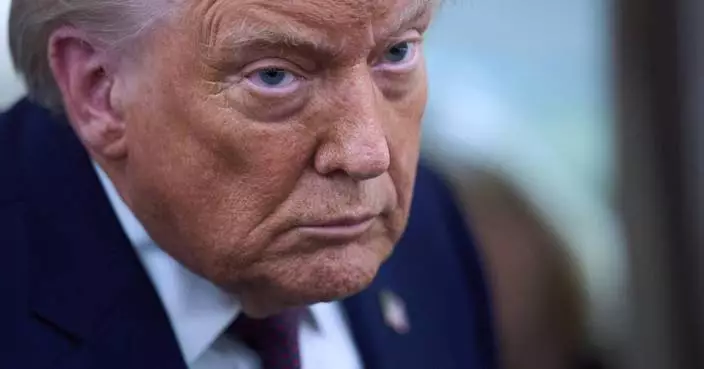
U.S. President Donald Trump has repeatedly warned Tehran, setting two red lines for the use of military force: the killing of peaceful demonstrators and the mass execution of people arrested in the protests.
Trump has repeatedly said Iran halted the execution of 800 people detained in the protests. He has not elaborated on the source of the claim, which Iran’s top prosecutor, Mohammad Movahedi, strongly denied Friday in comments carried by the judiciary’s Mizan news agency.
On Thursday, Trump said aboard Air Force One that the U.S. was moving warships toward Iran “just in case” he wants to take action.
“We have a massive fleet heading in that direction and maybe we won’t have to use it,” Trump said.
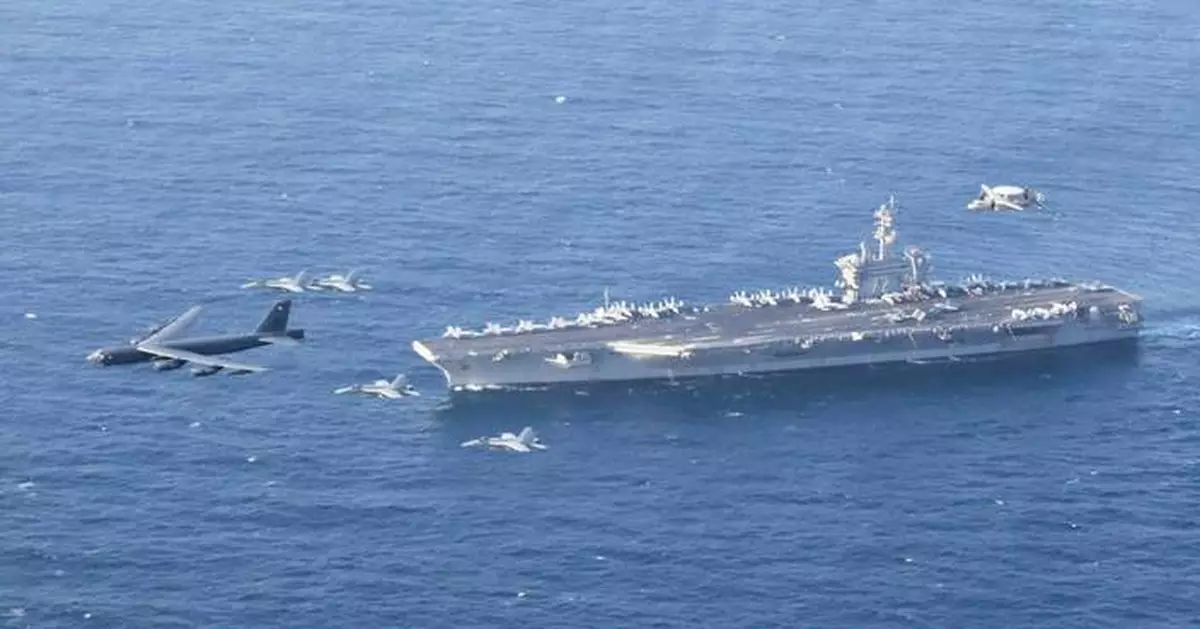
A U.S. Navy official, who spoke on condition of anonymity to discuss military movements, said Thursday that the aircraft carrier USS Abraham Lincoln and other warships traveling with it were in the Indian Ocean.
Trump also mentioned the multiple rounds of talks American officials had with Iran over its nuclear program before Israel launched a 12-day war against the Islamic Republic in June, which also saw U.S. warplanes bomb Iranian nuclear sites. He threatened Iran with military action that would make earlier U.S. strikes against Iranian uranium enrichment sites “look like peanuts.”
The tension has led at least two European airlines to suspend some flights to the wider region.
Air France canceled two return flights from Paris to Dubai over the weekend. The airline said it was "closely following developments in the Middle East in real time and continuously monitors the geopolitical situation in the territories served and overflown by its aircraft in order to ensure the highest level of flight safety and security.” It said it would resume its service to Dubai later Saturday.
Luxair said it had postponed its Saturday flight from Luxembourg to Dubai by 24 hours “in light of ongoing tensions and insecurity affecting the region’s airspace, and in line with measures taken by several other airlines.”
It told the AP it was closely monitoring the situation “and a decision on whether the flight will operate tomorrow will be taken based on the ongoing assessment.”
Arrivals information at Dubai’s international airport also showed the cancellation of Saturday flights from Amsterdam by Dutch carriers KLM and Transavia. The airlines did not immediately respond to requests for comment.
Some KLM flights to Tel Aviv in Israel were also canceled on Friday and Saturday, according to online flight trackers.
Although there have been no further demonstrations in Iran for days, the death toll reported by activists has continued to rise as information trickles out despite the most comprehensive internet blackout in Iran’s history, which has now lasted more than two weeks.
The U.S.-based Human Rights Activists News Agency on Saturday put the death toll at 5,200, with the number expected to increase. The group’s figures have been accurate in previous unrest and rely on a network of activists in Iran to verify deaths. That death toll exceeds that of any other round of protest or unrest there in decades, and recalls the chaos surrounding Iran’s 1979 Islamic Revolution.
Iran’s government offered its first death toll on Wednesday, saying 3,117 people were killed. It said 2,427 were civilians and security forces, and labeled the rest as “terrorists.” In the past, Iran’s theocracy has undercounted or not reported fatalities from unrest.
The activist agency on Saturday also increased the total number of people arrested to 40,879 — a significant jump from the more than 27,700 people in its previous update.
There have been fears Iran could apply the death penalty to arrested protesters, as it has done in the past.
Iranian judiciary officials have called some of those being held “mohareb” — or “enemies of God” — a charge that carries the death penalty. It had been used along with other charges to carry out mass executions in 1988 that reportedly killed at least 5,000 people.
At a U.N. Human Rights Council special session on Iran held in Geneva Friday, Volker Türk, the U.N.’s high commissioner for human rights, expressed concern over “contradictory statements from the Iranian authorities about whether those detained in connection with the protests may be executed.”
He said Iran “remains among the top executioner states in the world,” with at least 1,500 people reportedly executed last year — a 50% increase over 2024.
Associated Press writers Jon Gambrell in Dubai, Samuel Petrequin in Paris, Melanie Lidman in Tel Aviv, Israel, and Konstantin Toropin and Aamer Madhani in Washington contributed to this report.
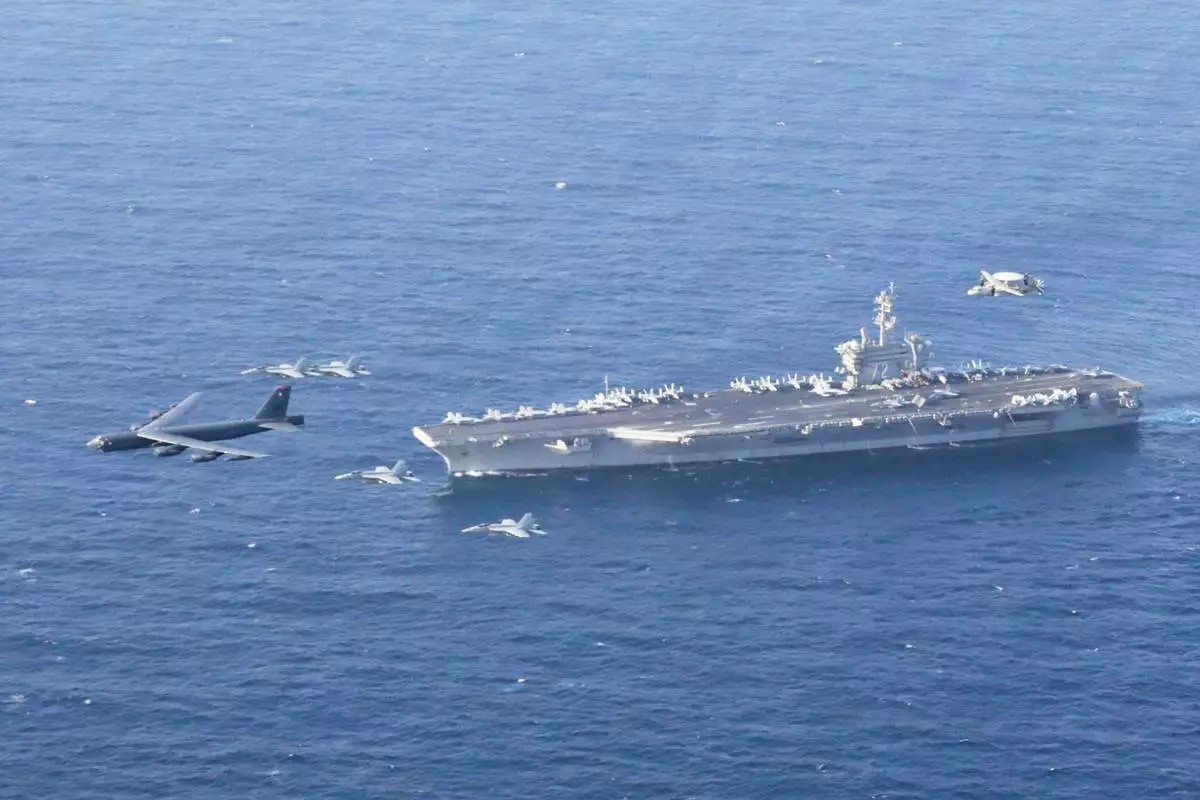
FILE - The USS Abraham Lincoln carrier and a U.S. Air Force B-52H Stratofortress, conduct joint exercises in the U.S. Central Command area of responsibility in Arabian Sea June 1, 2019. (Mass Communication Specialist 1st Class Brian M. Wilbur/U.S. Navy via AP, File)
CAIRO (AP) — American officials met with Prime Minister Benjamin Netanyahu on Saturday, urging Israel to move into the second phase of the ceasefire that stopped the war in Gaza.
Netanyahu met with President Donald Trump’s envoy Steve Witkoff and Jared Kushner, Trump’s son-in-law and Middle East adviser, according to the Prime Minister's Office.
The U.S. is anxious to keep the Trump-brokered deal moving, but Netanyahu is facing pressure from within Israel not to progress to the second phase until Hamas returns the body of the last hostage it is holding in Gaza. The Rafah border crossing is both a symbolic and logistical step that is the biggest signal of the commencement of second phase, and many outside Israel are eager to see it open.
Ali Shaath, the head of a new, future technocratic government in Gaza that is expected to run the day-to-day affairs, announced on Thursday that the Rafah border crossing will open in both directions this coming week. There was no confirmation from Israel, which said only that it would consider the matter next week. The Gaza side of the crossing, which runs between Gaza and Egypt, is currently under Israeli military control.
The family of Ran Gvili, the hostage whose body is being held in Gaza, urged the pressure to be focused on Hamas. “President Trump himself stated this week in Davos that Hamas knows exactly where our son is being held," the family said on Saturday. “Hamas is deceiving the international community and refusing to return our son, the last remaining hostage, in what constitutes a clear violation of the agreement it signed.”
Egypt’s top diplomat pressed for an immediate opening of the crossing with the director of Trump’s Board of Peace in Gaza, the Egyptian Foreign Ministry said Saturday, including the ability of Palestinians to enter and exit Gaza.
Foreign Minister Bader Abdelatty spoke by phone with Bulgarian diplomat Nickolay Mladenov, the high representative for Gaza, the ministry said in a statement. They discussed the implementation of the second phase of the October ceasefire that stopped the war, including the deployment of an international monitoring force, the opening of the Rafah crossing, and the withdrawal of Israeli forces from the strip, the statement said.
The Egyptian minister said that implementing the second phase is a “key entry point” to launch Gaza’s reconstruction.
The statement didn’t say when the crossing, a crucial part of the ceasefire deal, will open for travelers and the evacuation of sick and wounded.
An official associated with the Board of Peace, Trump’s coalition of international leaders who will oversee the Gaza ceasefire, said that he was “hopeful” the last issues concerning the opening of the Rafah crossing could be overcome in the coming days. The official spoke on the condition of anonymity because he was not authorized to speak to the media. “The idea is to move on with the next phase of the ceasefire, which includes this,” he said.
Israel did not comment on Shaath's declaration but is expected to discuss opening the Rafah crossing during the Cabinet meeting on Sunday.
Also on Saturday, an Israeli strike killed two Palestinian children in the Gaza Strip, according to hospital authorities.
The children, aged 13 and 15, were searching for firewood, according to Shifa Hospital in Gaza City, which received the bodies.
The children were cousins and killed in the area where the Israeli military has said is safe for Palestinians, about 500 meters (yards) away the Yellow Line, which separates the Israeli-controlled areas in eastern Gaza from the rest of the strip, said their uncle Arafat al-Zawara.
“They were targeted directly, not through any fault of their own,” he told The Associated Press outside the hospital morgue.
The Israeli military said it had targeted several militants that crossed the Yellow Line and planted explosives, threatening troops. It denied that those killed were children.
Yusuf Zawara, covered in blood, desperately begged for his son, Mohamed, to wake up. “No, he is not dead,” he said as he hugged his body. “Mohamed, oh Mohamed, come on, get up.”
“They hit you with a missile. You couldn’t escape? Run, people, run! Why didn’t you run away?” he sobbed, bending over his son's lifeless body.
Arafat al-Zawara, the uncle of the second boy who was killed, tried to wipe the blood from his nephew's face, pleaded with him to get up so they could go get some grilled chicken wings.
The desperate search for firewood is forcing many Palestinians to approach areas close to the Israeli withdrawal line, as they search for anything that can be burned, including garbage and plastic, in order to cook and warm themselves. There’s been no central electricity in Gaza since the first few days of the war, and fuel for generators is scarce.
Hundreds of thousands of people are living in tent camps and war-damaged buildings in Gaza as temperatures drop below 10 degrees Celsius (50 degrees Fahrenheit) at night and storms blow in from the Mediterranean. At least nine children have died of severe cold in the past weeks, according to the Gaza Health Ministry.
Shurafa reported from Deir Al-Balah, Gaza Strip, and Lidman reported from Tel Aviv, Israel.
Find more of AP’s coverage at https://apnews.com/hub/israel-hamas-war
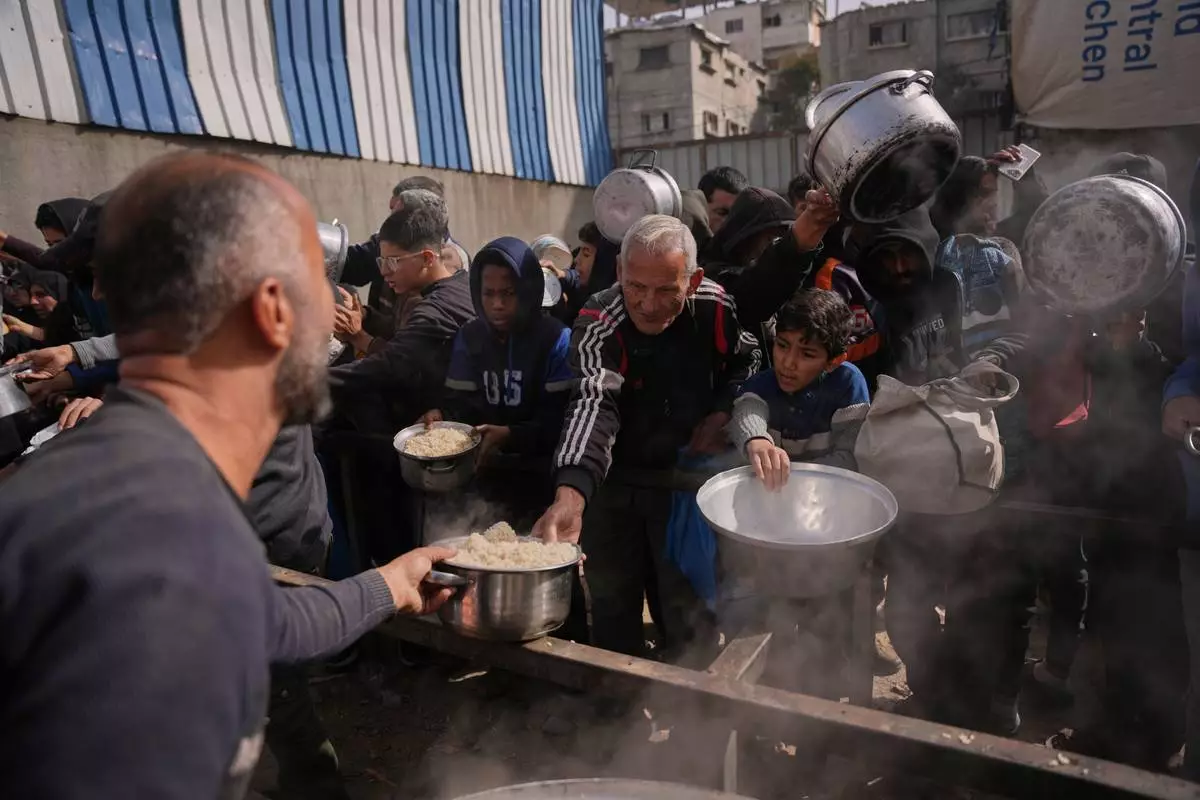
Palestinians receive donated food at a community kitchen in Nuseirat, in central Gaza Strip, Saturday, Jan. 24, 2026. (AP Photo/Abdel Kareem Hana)
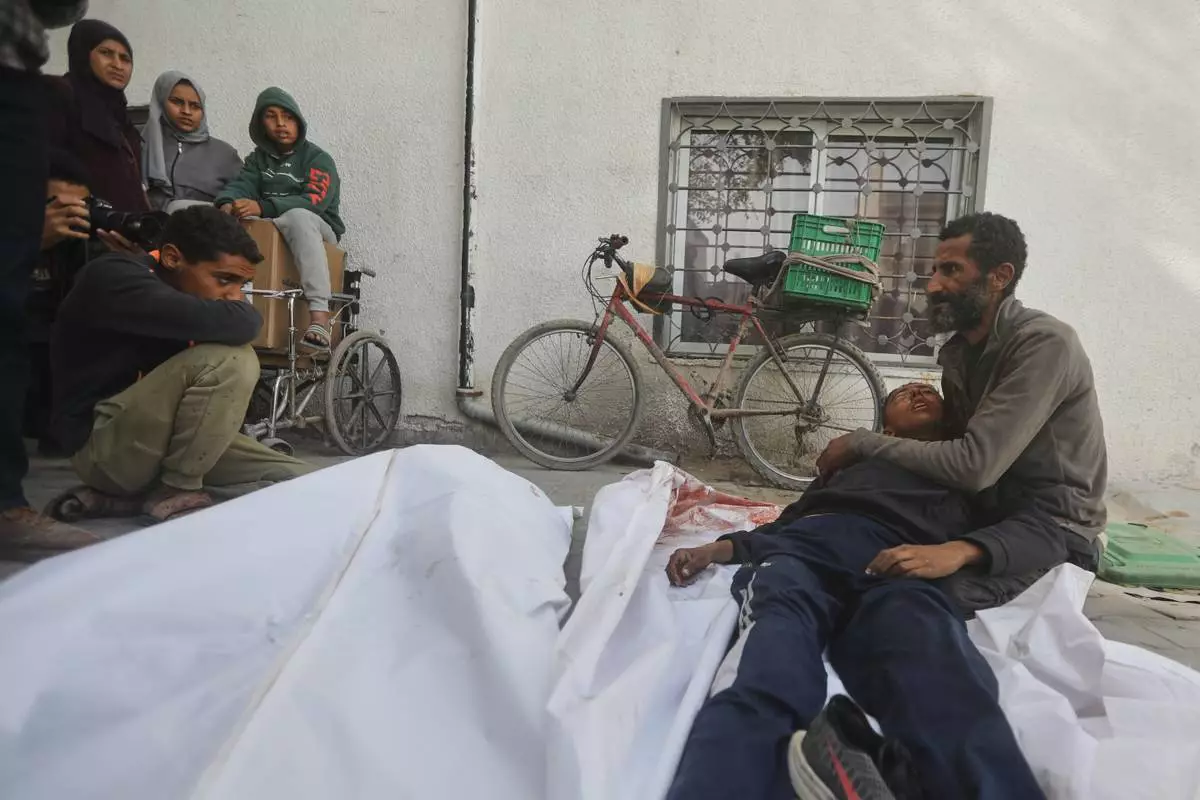
EDS NOTE: GRAPHIC CONTENT - Yusuf Zawara mourns over the body of his son, Mohammad Zawara, 15, who was killed along with his cousin Sulaiman Zawara, 13, left, in an Israeli strike, according to health officials, at Shifa Hospital, Gaza City, Saturday, Jan. 24, 2026. (AP Photo/Yousef Al Zanoun)
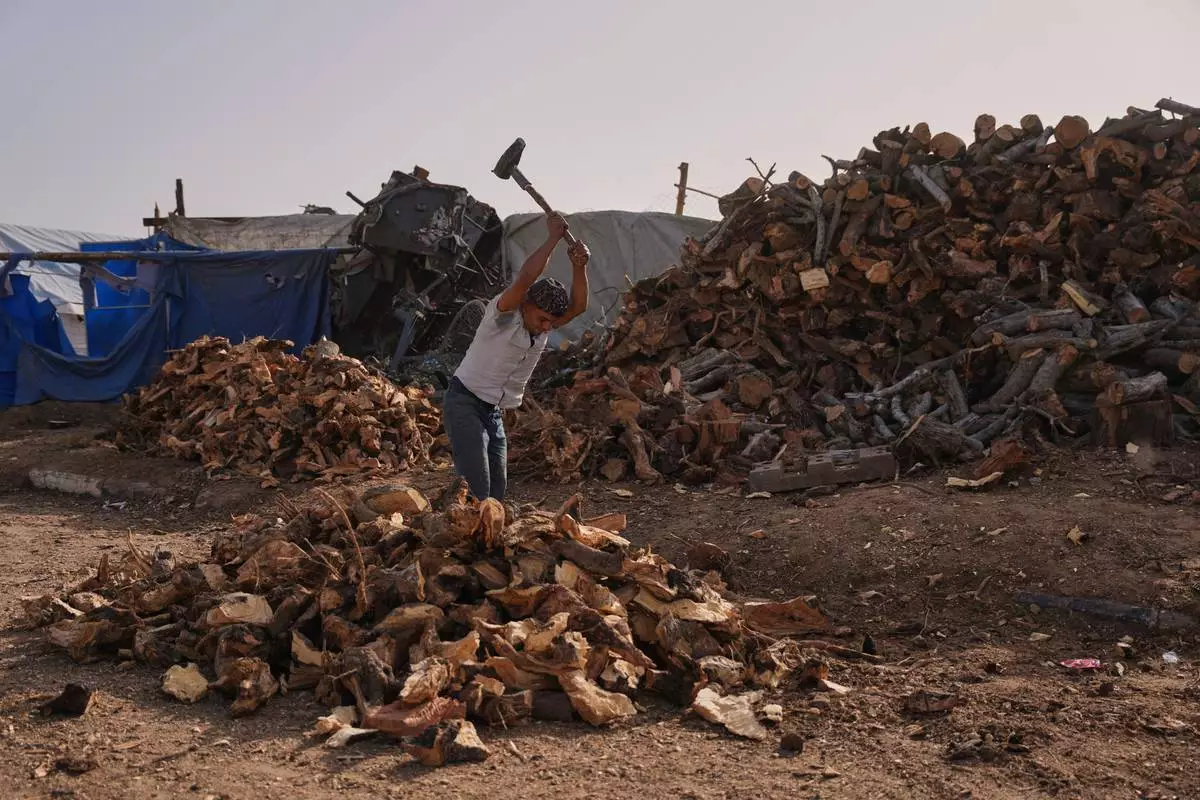
Palestinian Mohanad Eslem, 22, cuts firewood for sale in front of his shop on Salah al-Din Street near al-Bureij camp, central Gaza Strip, Saturday, Jan. 24, 2026. (AP Photo/Abdel Kareem Hana)
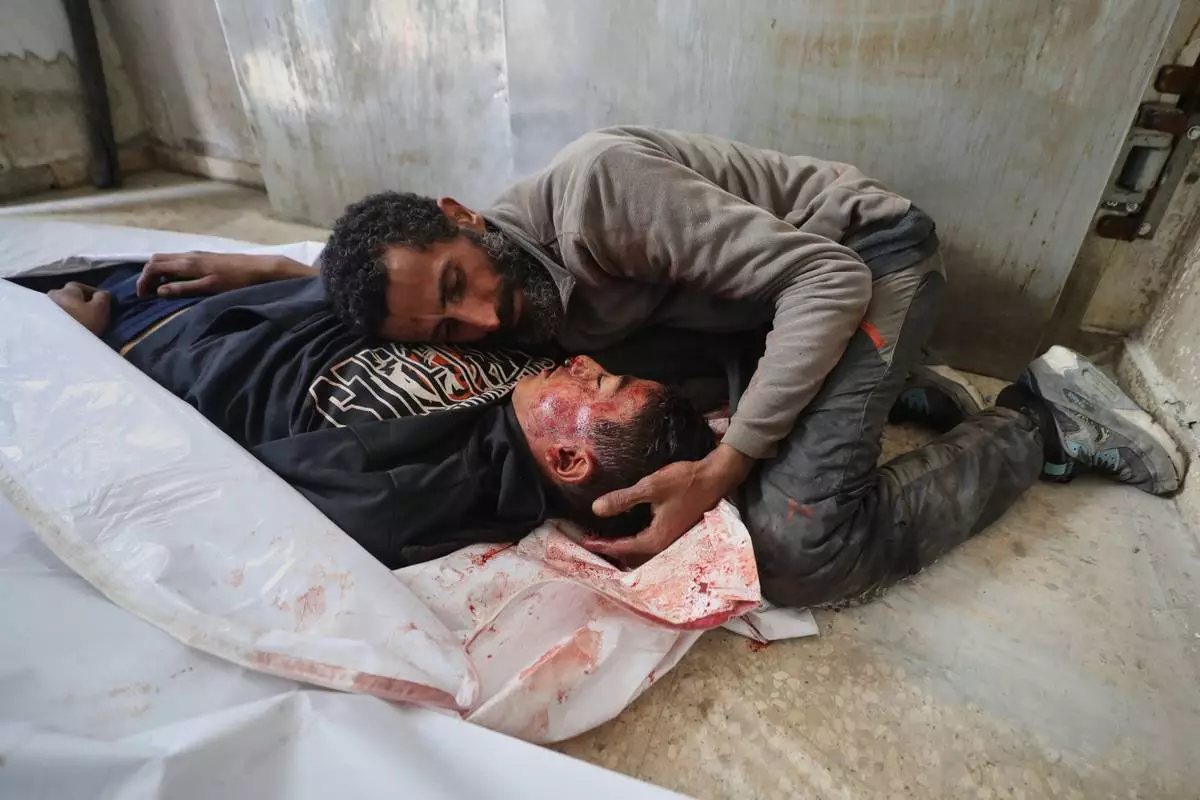
EDS NOTE: GRAPHIC CONTENT - Yusuf Zawara mourns over the body of his son, Mohammad Zawara, 15, who was killed in an Israeli strike, according to health officials, at Shifa Hospital, Gaza City, Saturday, Jan. 24, 2026. (AP Photo/Yousef Al Zanoun)
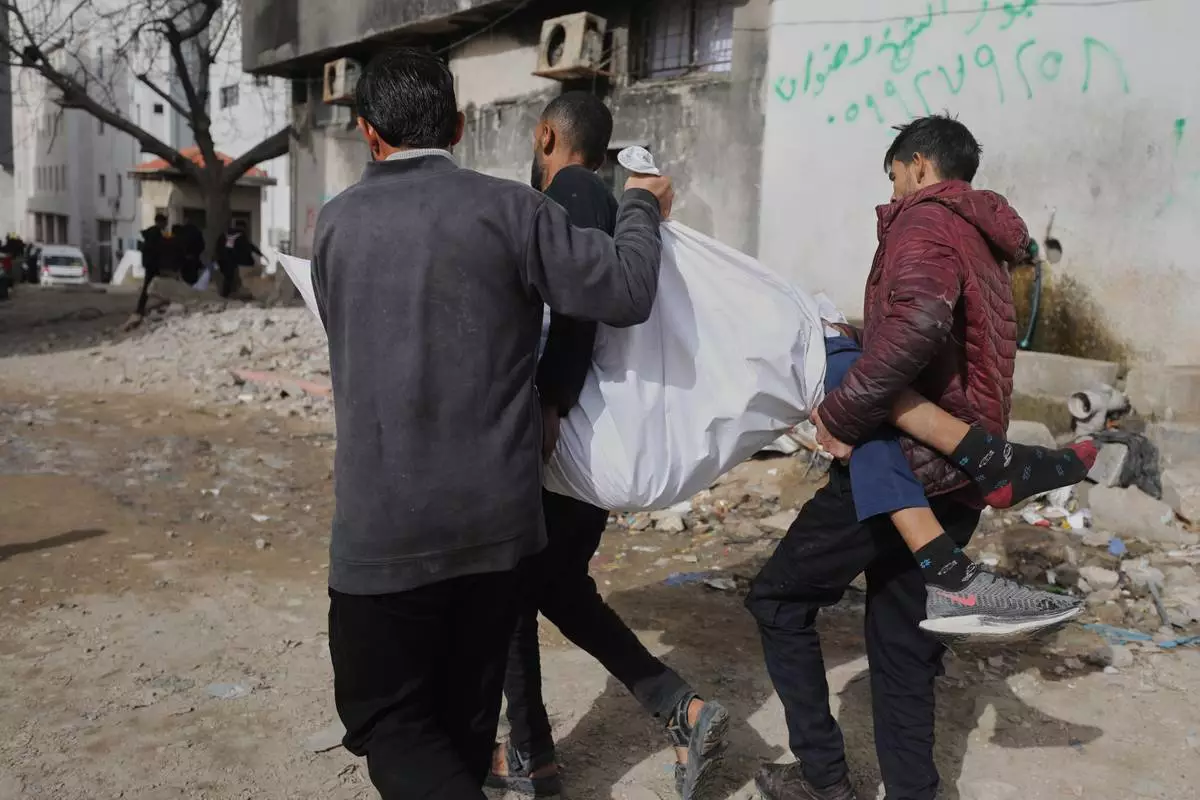
Palestinians carry the body of Mohammad Zawara, 15, who was killed in an Israeli strike, according to health officials, as they arrive at Shifa Hospital, Gaza City, Saturday, Jan. 24, 2026. (AP Photo/Yousef Al Zanoun)