World Economic Forum (WEF) President Borge Brende stressed the need for international collaboration to tackle global challenges, warning that decoupling carries high economic costs.
Speaking in an interview with China Central Television (CCTV) ahead of the WEF's 2026 annual meeting, Brende highlighted the imperative for nations to work together on shared interests, particularly in addressing transnational problems.
"So we still need to be able to collaborate on the areas where we have common interests. So if a challenge is global, you cannot solve it only locally. Look at, for example, if we are faced as we are with cybercrime, 3, 4, 5 trillion U.S. dollars every year are stolen, I think we all can agree that this is not a good thing. So nations have to collaborate on this. That's something else, and for example, collaboration on rules and regulations in areas that are legitimate. We are saying that it is more difficult to agree on traffic rules for artificial intelligence, but that I can understand," he said.
Reflecting on the WEF's role, Brende described the organization as a facilitator rather than a direct problem-solver.
"I still think there are areas where we could collaborate better, but in the World Economic Forum we are more a platform and an enabler. We are like not an organization that fixes things. We can bring the horses to the well, but we cannot force the horses to drink the water," he added.
Brende advocated for globalization in an integrated global economy, rather than decoupling.
"I think also countries are finding out that they have more in common than they maybe thought. It is in an integrated global economy, not so easy to decouple. And if you want to decouple, it will come also with a high economic price. And we are also, in addition, of course, seeing that nations are preparing for a different world, you are then inclined to nations that you think are your friends, and you also diversify your trade," he said.
The 2026 annual meeting of the WEF was held in the Swiss Alpine town of Davos from Jan 19 to 23, under the theme "A Spirit of Dialogue."
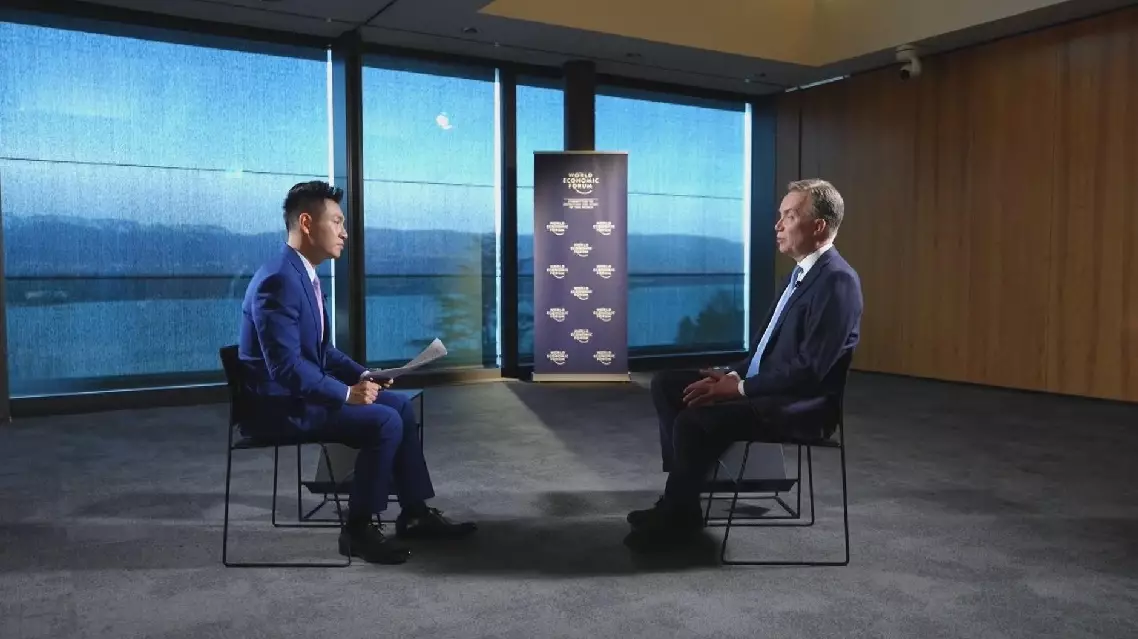
WEF president advocates for int'l collaboration to tackle global challenges
U.S. President Donald Trump said Thursday that the United States has a "massive" naval force heading toward Iran, while suggesting it may not be used as tensions remain high amid Iran's unrest.
"We have a lot of ships going that direction just in case. We have a big flotilla going in that direction. And we'll see what happens," Trump told reporters on Air Force One as he returned from the World Economic Forum in Davos, Switzerland.
"We have an armada. We have a massive fleet heading in that direction, and maybe we won't have to use it. We'll see," Trump added.
The USS Abraham Lincoln, along with three destroyers, was spotted making its way to the Middle East from Asia, according to Tuesday's ship-tracking data.
The USS George H.W. Bush has left Virginia and is at sea in the Atlantic, bound for Europe, said a New York Post report.
Trump reiterated that he prefers to avoid conflict, saying, "I'd rather not see anything happen, but we're watching them very closely."
The president said a planned 25-percent tariff on countries doing business with Iran would take effect "very soon."
Despite his tough rhetoric, including a recent call for regime change in Iran, Trump said he remains open to negotiations.
"Iran does want to talk, and we'll talk," Trump said during his stay in Davos.
Mohammad Pakpour, chief commander of Iran's Islamic Revolution Guards Corps (IRGC), said on Thursday that the U.S. and Israel should "draw lessons from historical experiences" and "refrain from any miscalculation" to avoid a "more painful and regret-inducing fate."
In an opinion article published Tuesday in the Wall Street Journal, Iranian Foreign Minister Seyed Abbas Araghchi said that while Iran "will always choose peace over war," if the country faced new attacks, "our powerful armed forces have no qualms about firing back with everything we have," citing a contrast with the "restraint" Iran showed in June 2025.
According to a Reuters report on Friday citing a senior Iranian official, Iran had noticed the U.S. deployment of additional troops to the Middle East.
The official said the Iranian military is prepared for the worst-case scenario, and that the nation is on high alert. Iran would regard any form of attack as all-out war against Iran and would respond with the strongest possible measures.
Trump touts "massive" U.S. forces heading toward Iran