SANTA ANA, Calif. (AP) — A former Canadian Olympic snowboarder turned top FBI fugitive is expected to appear in federal court Monday on charges he allegedly ran a billion-dollar multinational drug trafficking ring and orchestrated multiple killings.
Ryan Wedding, 44, turned himself in at the U.S. Embassy in Mexico City last week and was flown to Southern California after a yearlong effort by authorities in the United States, Mexico, Canada, Colombia and the Dominican Republic to arrest him.
Wedding is scheduled to make an initial appearance in federal court in Santa Ana, California. No attorney was listed for him on the court docket Monday morning.
U.S. authorities believe the former Olympian, who competed in a single event for his home country in the 2002 Winter Olympics in Salt Lake City, had been hiding in Mexico for more than a decade. He was added to the FBI’s Ten Most Wanted Fugitives list last March when authorities offered a $15 million reward for information leading to his arrest and conviction.
Authorities say Wedding moved as much as 60 tons of cocaine between Colombia, Mexico, Canada and Southern California and believe he was working under the protection of the Sinaloa Cartel, one of Mexico’s most powerful drug rings.
He was indicted in 2024 on federal charges of running a criminal enterprise, murder, conspiring to distribute cocaine and other crimes.
The murder charges accuse Wedding of directing the 2023 killings of two members of a Canadian family in retaliation for a stolen drug shipment, and for ordering a killing over a drug debt in 2024. Last year, Wedding was indicted on new charges of orchestrating the killing of a witness in Colombia to help him avoid extradition to the U.S.
Wedding was previously convicted in the U.S. of conspiracy to distribute cocaine and sentenced to prison in 2010. Online records show he was released from Bureau of Prisons custody in 2011.
In Canada, Wedding faces separate drug charges dating back to 2015.
The 2024 indictment says Wedding ran a billion-dollar drug trafficking group that was the largest supplier of cocaine to Canada. The group obtained cocaine from Colombia and worked with Mexican cartels to move drugs by boat and plane to Mexico and then into the U.S. using semitrucks, the indictment said. It said the group stored cocaine in Southern California before sending it to Canada and other U.S. states.

FILE - An image of former Canadian Olympic snowboarder Ryan Wedding, who is a fugitive and been charged with allegedly running and participating in a transnational drug trafficking operation, is displayed on a video monitor along with bricks of cocaine, foreground, during a news conference at the FBI offices in Los Angeles, Oct. 17, 2024. (AP Photo/Damian Dovarganes, File)
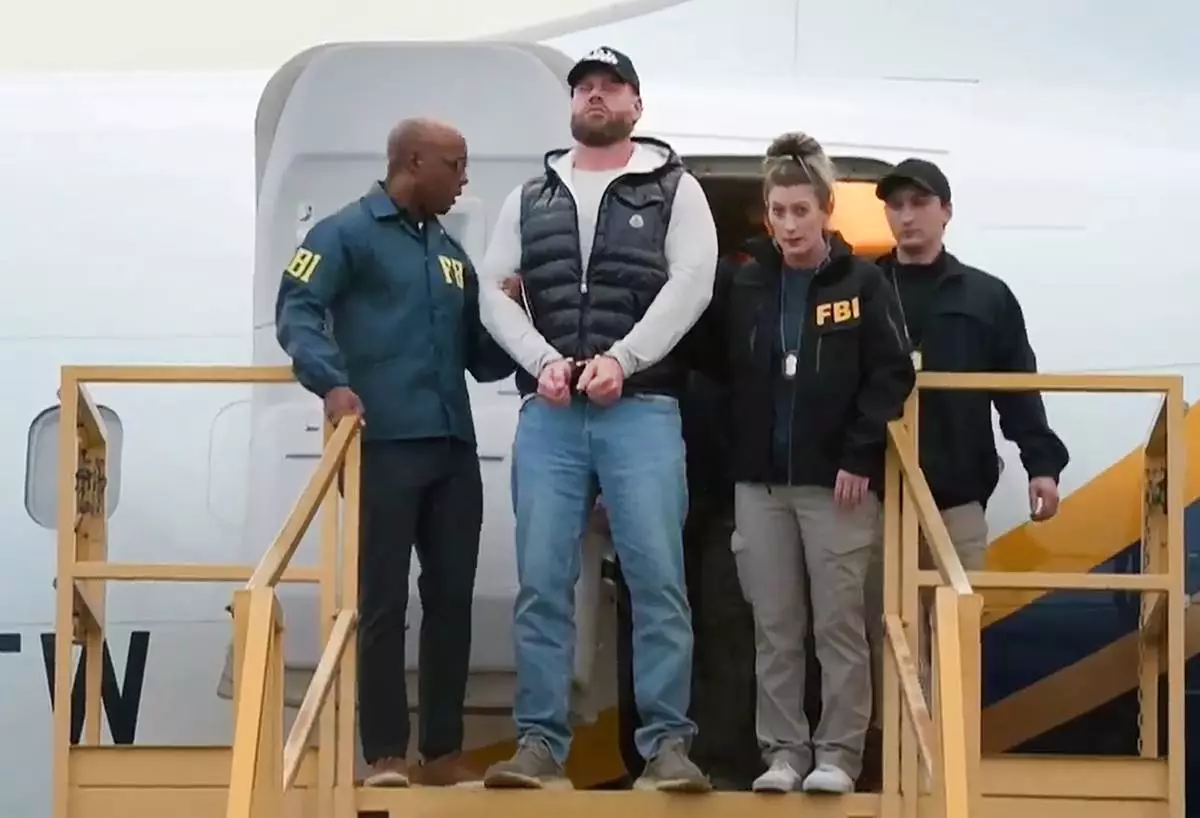
This still photo taken from video and provided by the FBI shows Ryan Wedding a former Canadian Olympic snowboarder facing charges related to drug trafficking and the killing of a federal witness is taken off a plane at Ontario International Airport in Ontario, Calif. on Friday, Jan. 23, 2026. (FBI via AP)
Many in the U.S. faced another night of below-freezing temperatures and no electricity after a colossal winter storm heaped more snow Monday on the Northeast and kept parts of the South coated in ice. At least 26 deaths were reported in states afflicted with severe cold.
Deep snow — over a foot (30 centimeters) extending in a 1,300-mile (2,100-kilometer) swath from Arkansas to New England — halted traffic, canceled flights and triggered wide school closures Monday. The National Weather Service said areas north of Pittsburgh got up to 20 inches (50 centimeters) of snow and faced wind chills as low as minus 25 degrees Fahrenheit (minus 31 degrees Celsius) late Monday into Tuesday.
The bitter cold afflicting two-thirds of the U.S. wasn't going away. The weather service said Monday that a fresh influx of artic air is expected to sustain freezing temperatures in places already covered in snow and ice. And forecasters said it's possible another winter storm could hit parts of the East Coast this weekend.
A rising death toll included two people run over by snowplows in Massachusetts and Ohio, fatal sledding accidents in Arkansas and Texas, and a woman whose body was found covered in snow by police with bloodhounds after she was last seen leaving a Kansas bar. In New York City, officials said eight people were found dead outdoors in the course of the frigid weekend.
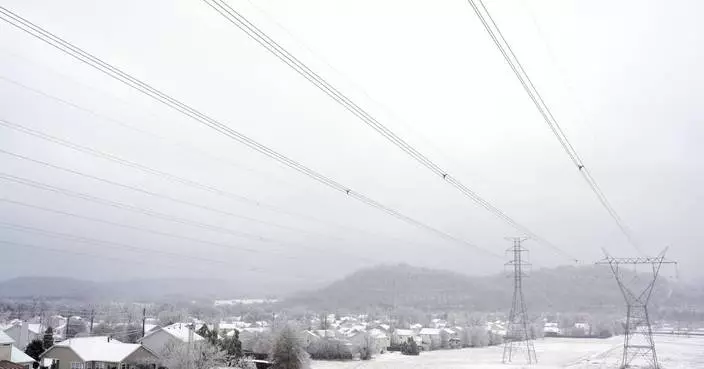
There were still more than 690,000 power outages in the nation Monday afternoon, according to poweroutage.com. Most of them were in the South, where weekend blasts of freezing rain caused tree limbs and power lines to snap, inflicting crippling outages on northern Mississippi and parts of Tennessee.
Parts of Mississippi were reeling in the aftermath of the state's worst ice storm since 1994. Officials scrambled Monday to get cots, blankets, bottled water and generators to warming stations in hard-hit areas.
The University of Mississippi, where most students hunkered down without power Monday, canceled classes for the entire week as its Oxford campus remained coated in treacherous ice. Oxford Mayor Robyn Tannehill said on social media that so many trees, limbs and power lines had fallen that “it looks like a tornado went down every street.”
A pair of burly, falling tree branches damaged real estate agent Tim Phillips' new garage, broke a window and cut off power to his home in Oxford. He said half of his neighbors had homes or vehicles damaged.
“It’s just one of those things that you try to prepare for,” Phillips said, “but this one was just unreal.”
The U.S. had more than 8,000 flight delays and cancellations nationwide Monday, according to flight tracker flightaware.com. On Sunday, 45% of U.S. flights got cancelled, making it the highest day for cancellations since the COVID-19 pandemic, according to aviation analytics firm Cirium.
More light to moderate snow was forecast in New England through Monday evening.
New York City saw its snowiest day in years, with neighborhoods recording 8 to 15 inches (20 to 38 cm) of snow. Though public schools shut down, roughly 500,000 students were told to log in for online lessons Monday. Snow days off from school melted away in New York, the nation's largest public school system, after remote learning gained traction during the coronavirus pandemic.
Meanwhile, bitter cold followed in the storm's wake. Communities across the Midwest, South, and Northeast awakened Monday to subzero weather. The entire Lower 48 states were forecast to have their coldest average low temperature of minus 9.8 F (minus 12.3 C) since January 2014.
In the Nashville, Tennessee, area, electricity returned for thousands of homes and businesses Monday, while more than 170,000 others awoke bundled up in powerless homes after subfreezing temperatures overnight. Many hotels were sold out overnight to residents escaping dark and frigid homes.
Alex Murray booked a Nashville hotel room for his family to ensure they had a working freezer to preserve pumped breast milk to feed their 6-month-old daughter. Anticipating a long wait until power gets restored at his home, Murray planned to extend their hotel stay through Wednesday.
“I know there’s many people that may not be able to find a place or pay for a place or anything like that, or even travel,” Murray said Monday. “So, we were really fortunate.”
In New York City, Mayor Zohran Mamdani's office said at least eight people were found dead outside as temperatures plunged between Saturday and Monday morning, though the cause of their deaths remained under investigation.
In Emporia, Kansas, police searching with bloodhounds found a 28-year-old teacher dead and covered in snow. Police said she had was last seen leaving a bar without her coat and phone.
Police said snowplows backed into two people who died in Norwood, Massachusetts, and Dayton, Ohio. And authorities said two teenagers, one in Arkansas and another in Texas, were killed in sledding accidents.
Officials reported four deaths in Tennessee, three deaths apiece in Louisiana and Pennsylvania; two deaths in Mississippi; and one in New Jersey.
Kramon reported from Atlanta. Bynum reported from Savannah, Georgia. AP journalists Jeff Amy in Atlanta; Kim Chandler in Montgomery, Alabama; Sophie Bates in Jackson, Mississippi; Jonathan Mattise in Nashville, Tennessee; Kathy McCormack in Concord, New Hampshire; Jennifer Peltz in in New York; Julie Carr Smyth in Columbus, Ohio; Sara Cline in Baton Rouge, Louisiana sand Heather Hollingsworth in Mission, Kansas, contributed to this story.
.
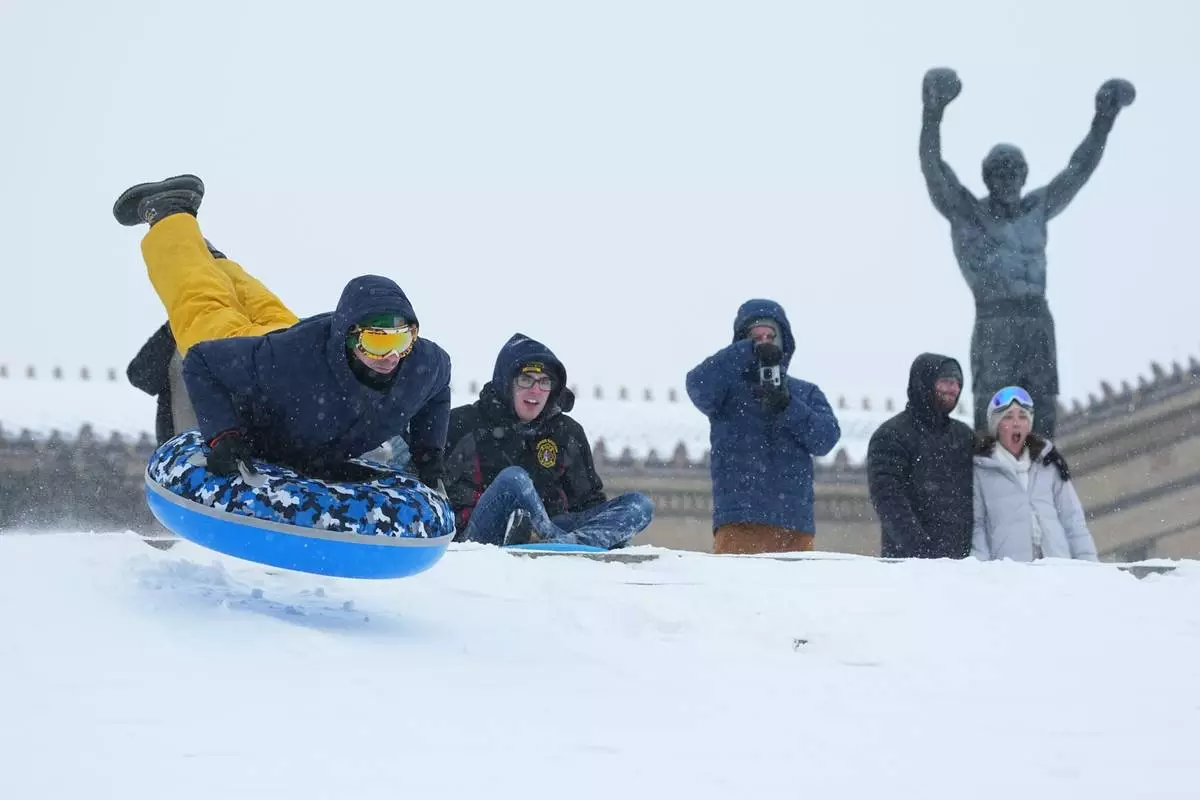
People sled at Philadelphia Art Museum steps by the Rocky statue during a winter storm in Philadelphia, Sunday, Jan. 25, 2026. (AP Photo/Matt Rourke)
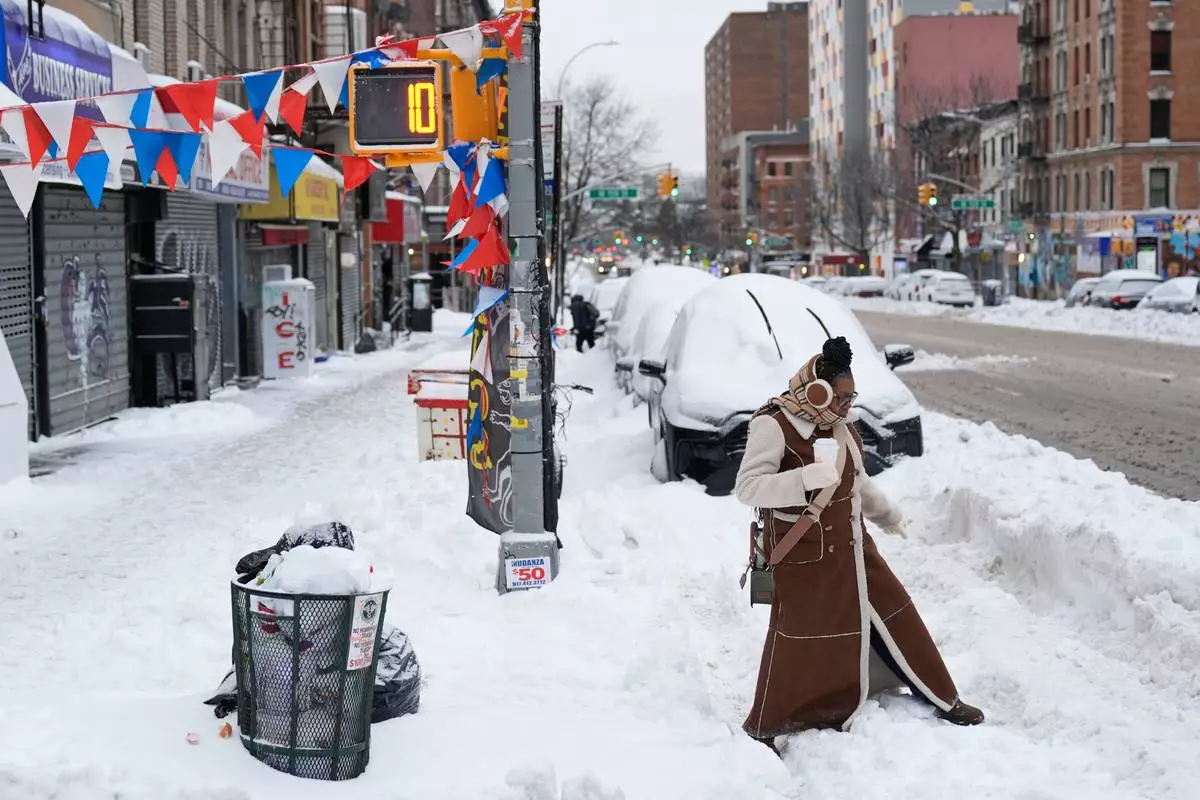
Carrie Hampton tries to navigate a snowy intersection without spilling her coffee in New York, Monday, Jan. 26, 2026. (AP Photo/Seth Wenig)
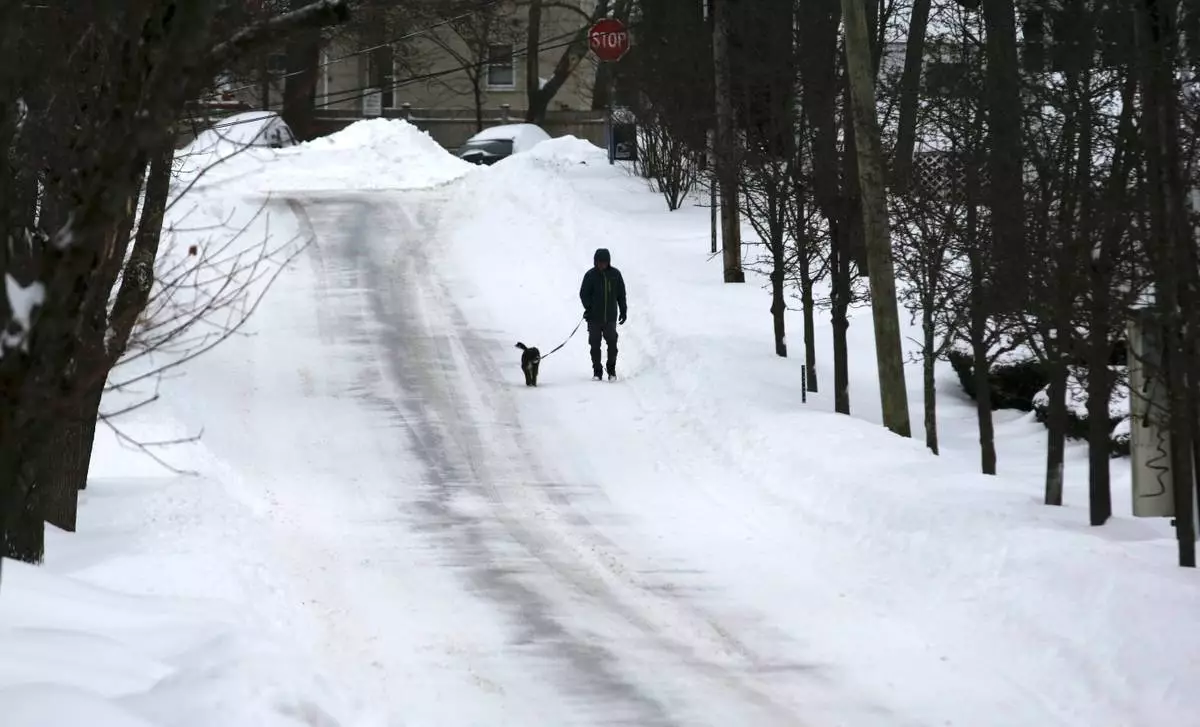
A person walks their dog in the snow after a storm in Portsmouth, N.H., Monday, Jan. 26, 2026. (AP Photo/Caleb Jones)
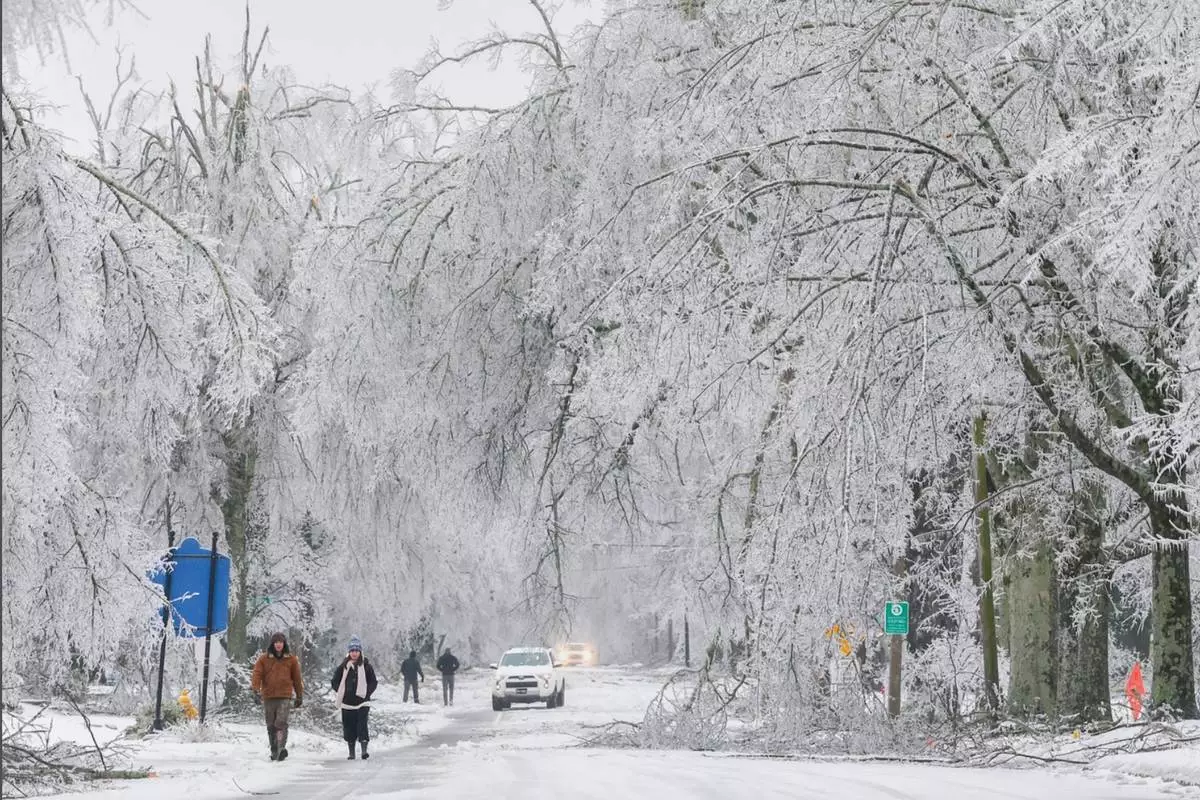
In this image provided by the City of Oxford, Miss., snow and ice cover trees and streets as a winter storm passes through, Sunday, Jan. 25, 2026, in Oxford, Miss. (Josh McCoy/City of Oxford, Miss. via AP)
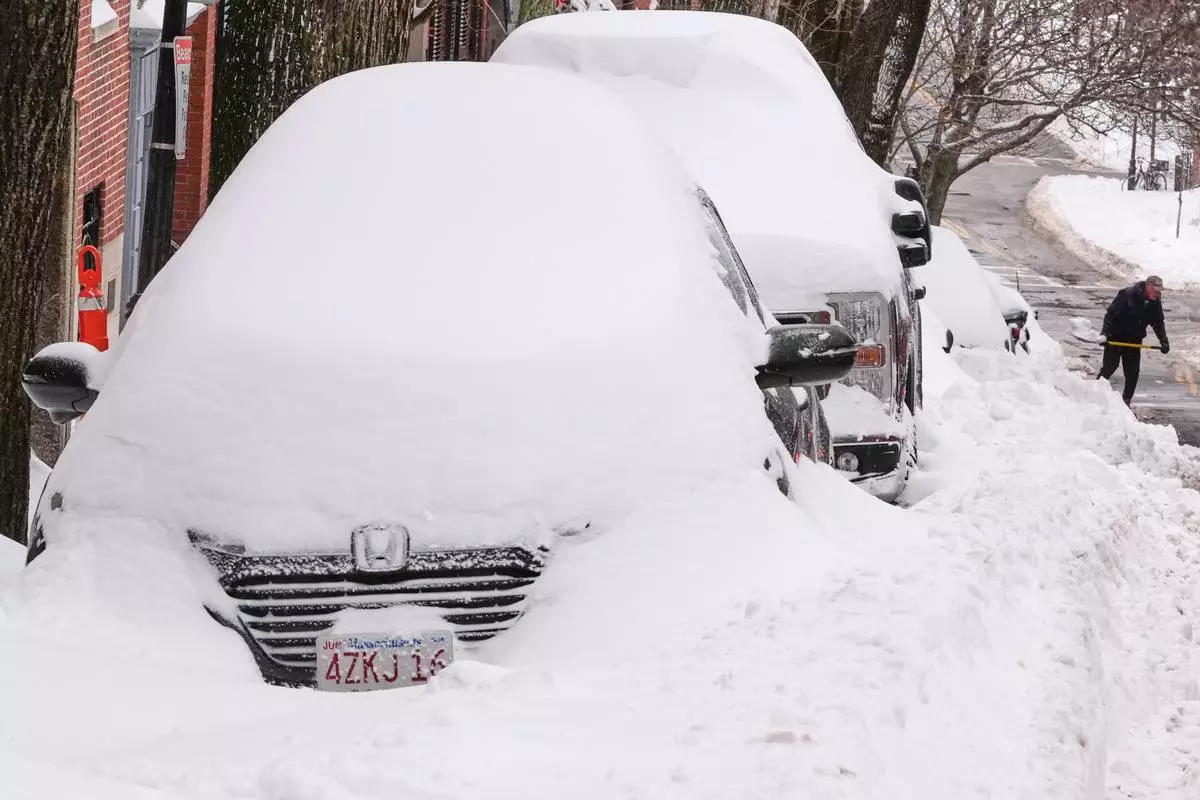
A man digs a car out of the snow on Beacon Hill following a winter storm that dumped more than a foot of snow across the region, Monday, Jan. 26, 2026, in Boston. (AP Photo/Charles Krupa)
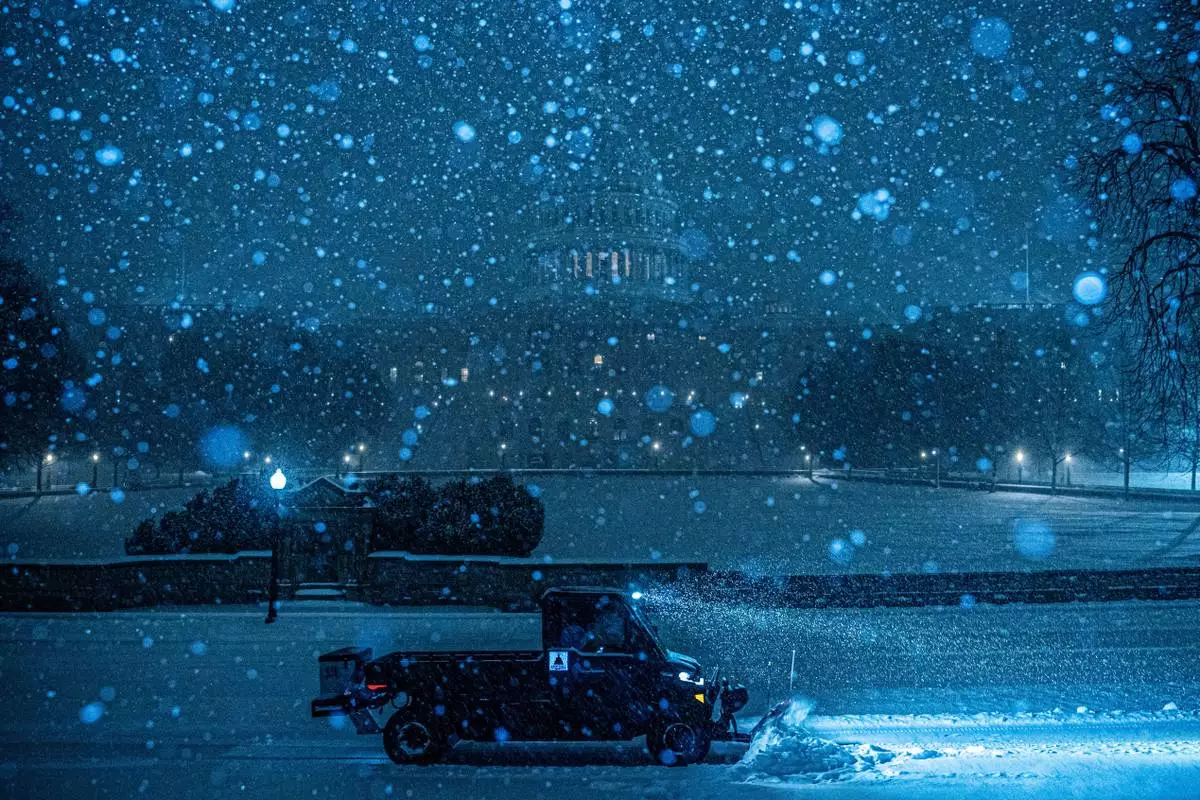
A plow clears snow in front of the U.S. Capitol, Sunday, Jan. 25, 2026, in Washington. (AP Photo/Julia Demaree Nikhinson)
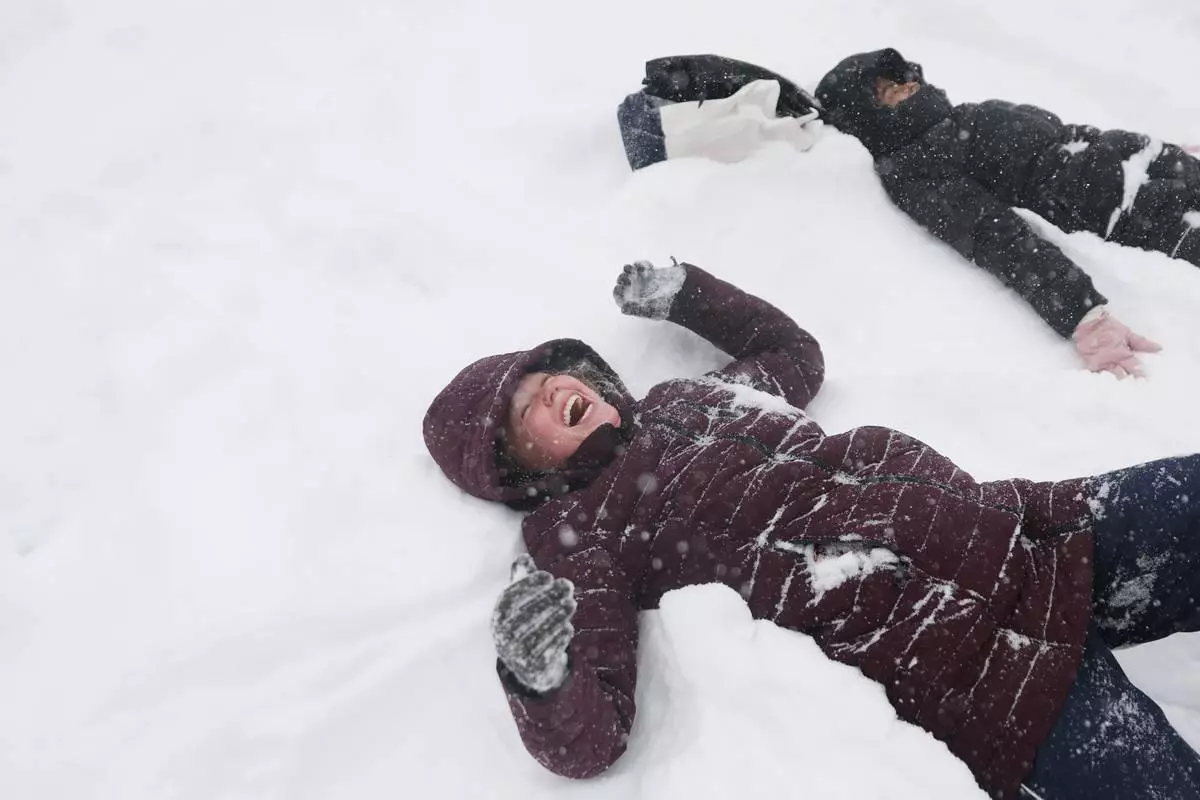
Sadie Eidson, left, laughs while playing in the snow in Central Park during a winter storm, Sunday, Jan. 25, 2026, in New York. (AP Photo/Heather Khalifa)
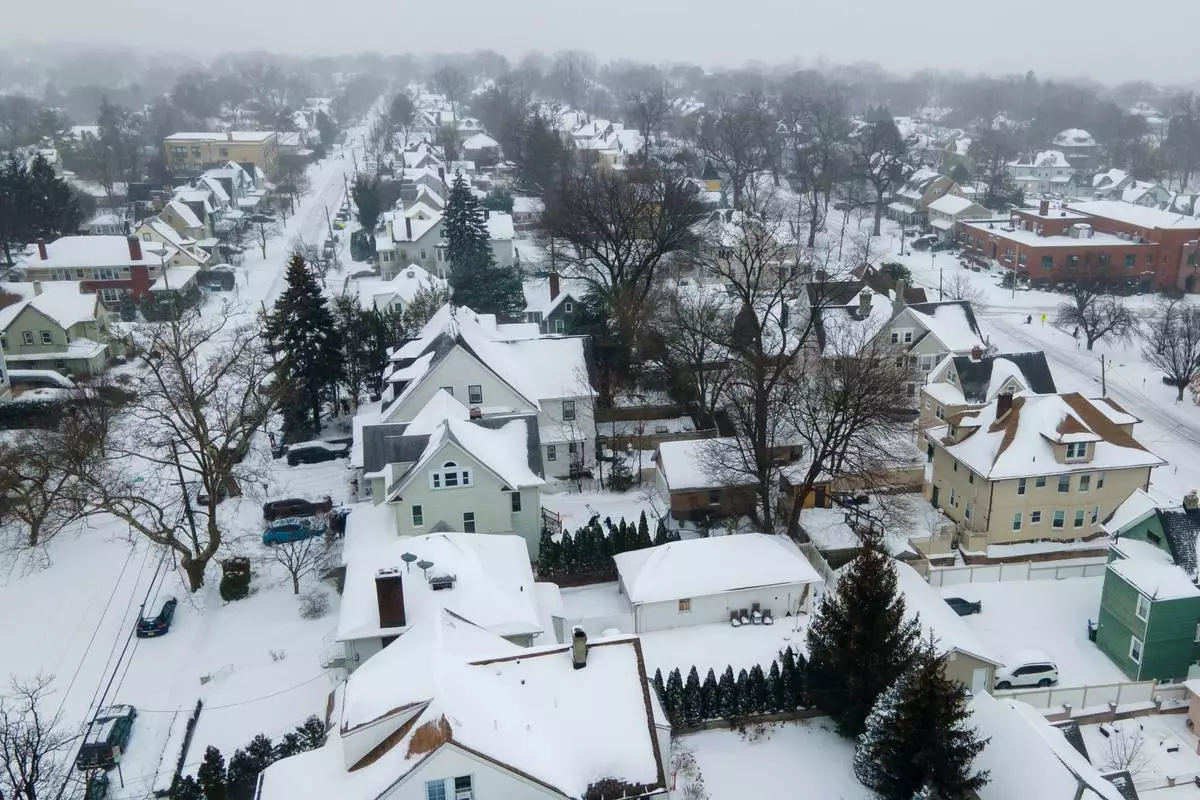
Snow covers houses in Rutherford, N.J., on Sunday, Jan. 25, 2026. (AP Photo/Ted Shaffrey)
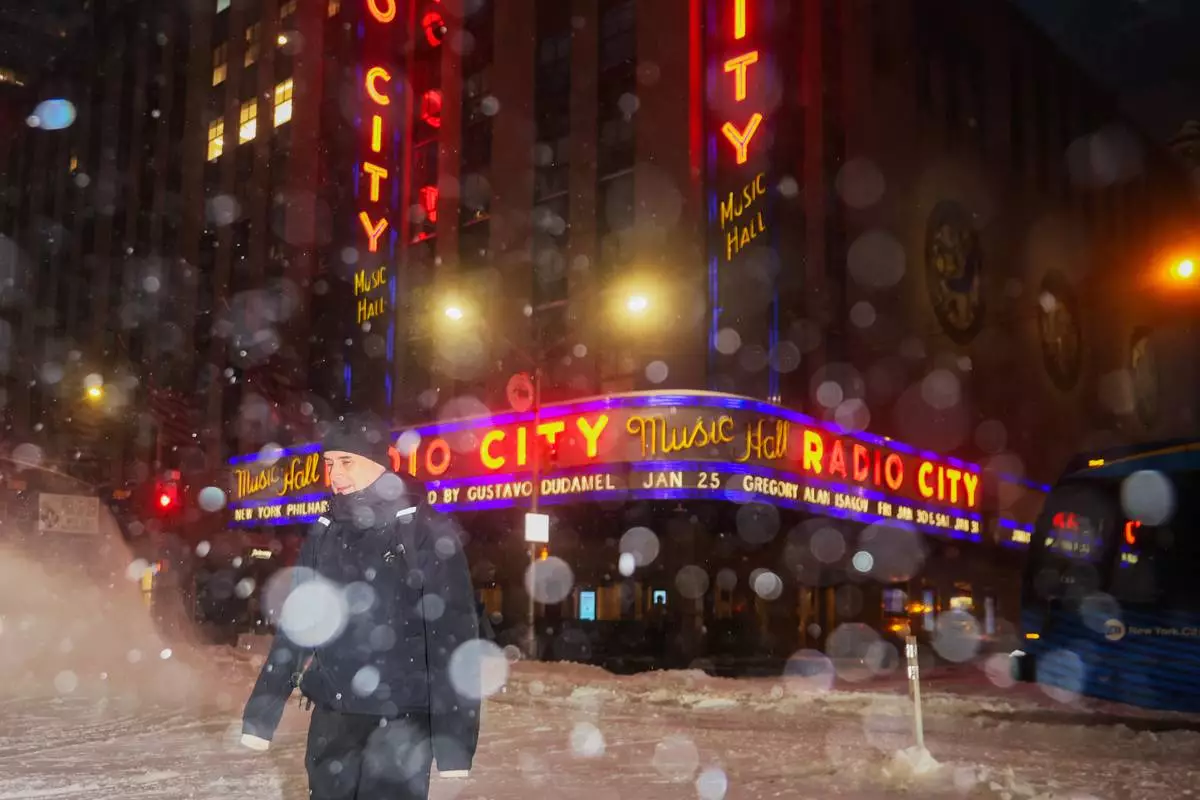
A pedestrian crosses the street near Radio City Music Hall during a winter storm, Sunday, Jan. 25, 2026, in New York. (AP Photo/Heather Khalifa)
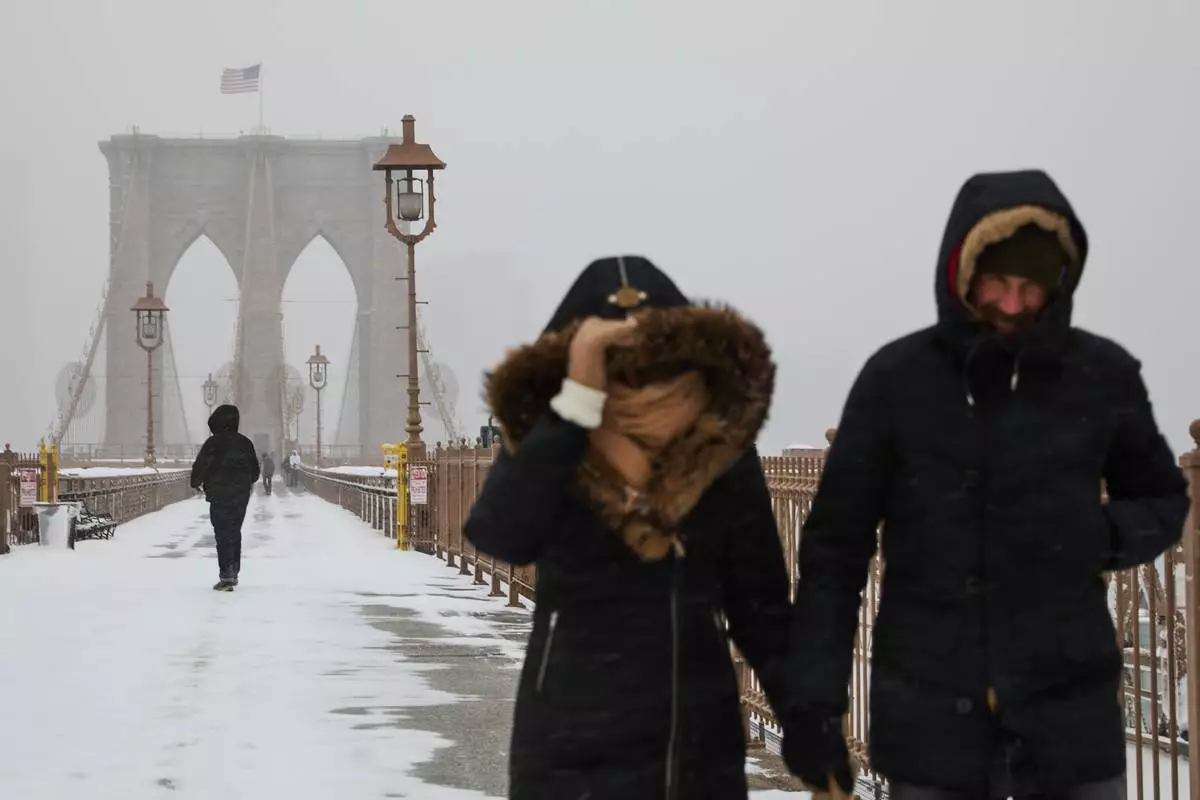
People walk across the Brooklyn Bridge during a winter storm, Sunday, Jan. 25, 2026, in New York. (AP Photo/Sydney Schaefer)
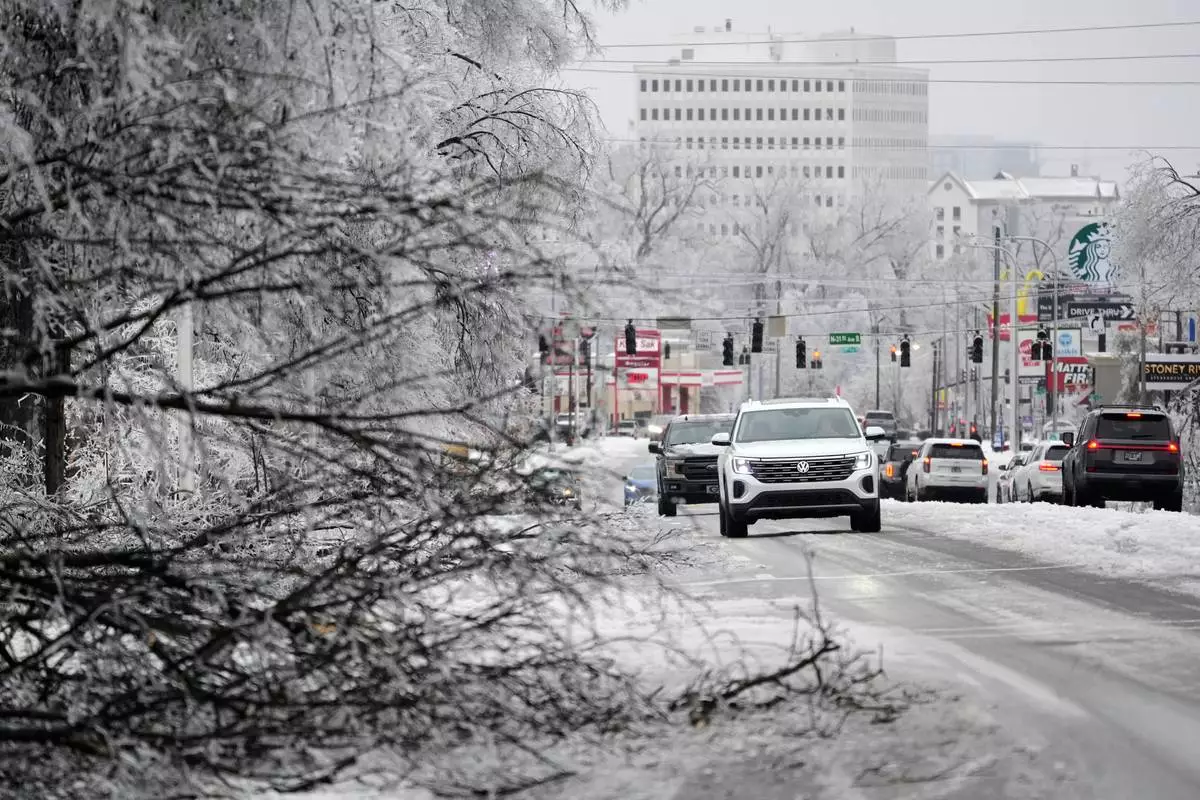
A motorist passes an ice covered tree limb blocking a lane along West End Ave. during a winter storm Sunday, Jan. 25, 2026, in Nashville, Tenn. (AP Photo/George Walker IV)
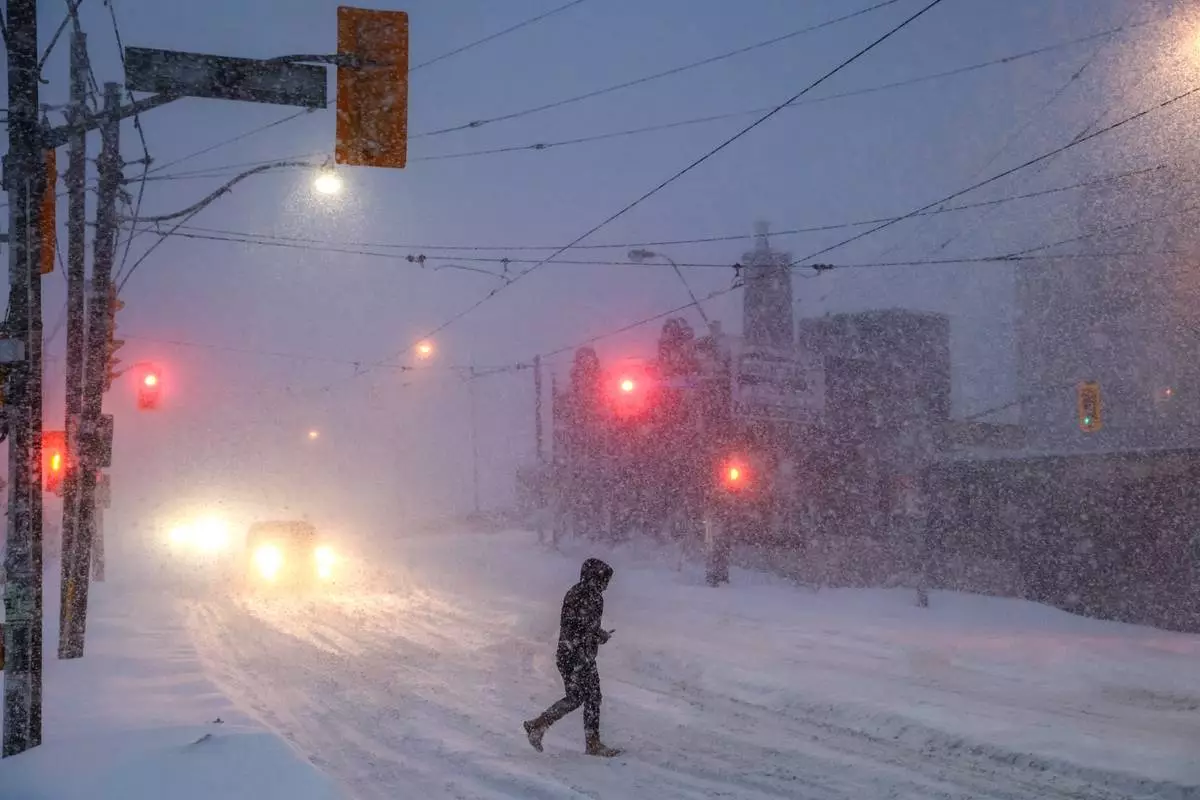
People walk through downtown Toronto as a winter storm moves through the region, Sunday, Jan. 25, 2026. (Cole Burston/The Canadian Press via AP)