A 5.5-magnitude earthquake struck northwest China's Gansu Province on Monday afternoon, prompting a swift emergency response and the relocation of hundreds of residents.
The quake jolted Tebo County of the Gannan Tibetan Autonomous Prefecture at 14:56 Beijing Time on Monday, at a depth of 10 kilometers, according to the China Earthquake Networks Center (CENC).
Local authorities reported no casualties, though cracks have been observed in several buildings.
More than 20,000 residents were temporarily evacuated to safety, while 280 people have been resettled in temporary shelters.
Key infrastructure, including water, electricity, transportation, and communications, remains operational.
Immediately after the quake, the office of the State Council earthquake relief headquarters and the Ministry of Emergency Management activated a Level-IV emergency response. A work group was dispatched to the affected area to support rescue and relief efforts, while provincial rescue teams rushed to the scene.
The Gannan detachment of the People's Armed Police Force activated its emergency plan, deploying 15 officers with 40 sets of rescue equipment to the disaster area to assess damage and eliminate potential hazards.
By late evening, temperatures in Mari Village had dropped below freezing. Despite the cold and limited lighting, armed police officers continued their work, erecting tents for displaced residents.
"We are working efficiently to set up tents as quickly as possible so that the affected people can have a warm place to stay tonight," said Hu Yubin from the Gannan detachment of Gansu Corps of the People's Armed Police Force.
Grateful residents expressed their appreciation to the officers.
"Thank you to the armed police officers for building tents for us. We're really grateful," one villager said.
By 23:50 on Monday, the armed police had assisted local authorities in clearing three collapsed road sections, assessing risks for 34 homes in two villages and erecting 20 tents.
At the epicenter in Waqiong Village, Dianga Town, the earthquake caused wall cracks in multiple houses. More than 50 tents were set up to shelter 195 displaced villagers.
Inside, the tents are equipped with makeshift beds, bedding, and a stove. Emergency supplies such as instant noodles, ham sausages, and bottled water were provided by the government. Local authorities also coordinated with charitable restaurants to provide hot meals, ensuring relocated residents had access to adequate food. Electricity, medical care, and communications remain fully operational at the relocation sites.
Tebo County initiated a level-III emergency response after the earthquake. By 22:00 Monday, over 3,600 personnel, including government officials, police, firefighters, armed police officers, medical staff, had mobilized for a comprehensive search and rescue operation.
All essential living and heating supplies have been secured, and further relief work is underway.
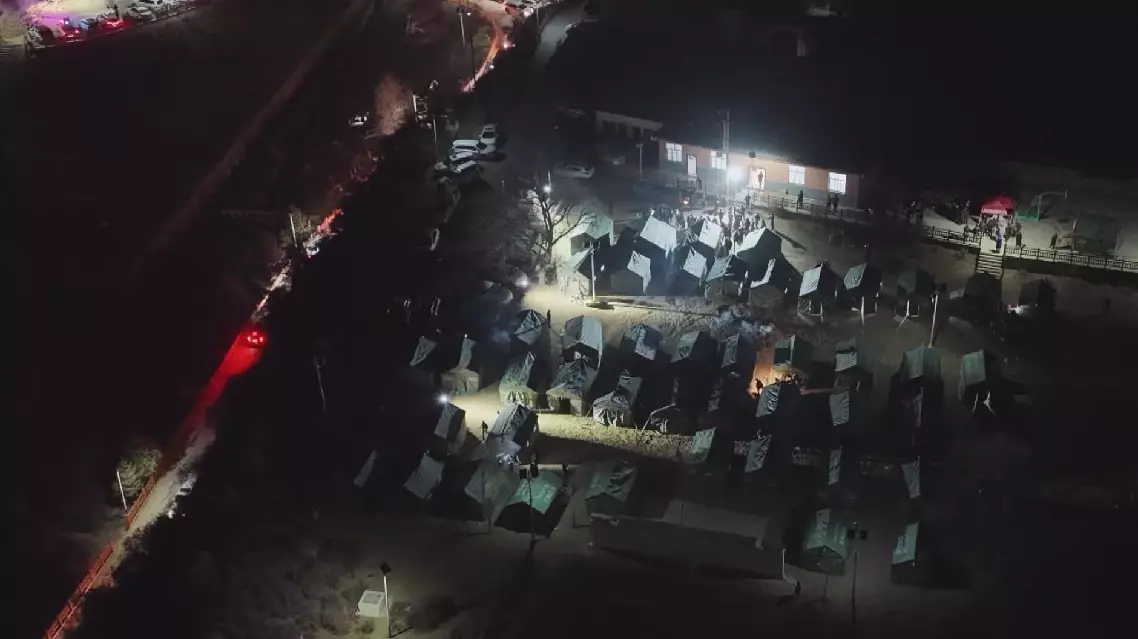
280 people relocated following 5.5-magnitude earthquake in Gansu
Chinese researchers have successfully developed an all-superconducting user magnet with a central magnetic field strength of 35.6 teslas -- more than 700,000 times that of Earth's magnetic field -- setting a new world record for all-superconducting user magnets.
The breakthrough marks China's attainment of internationally advanced capabilities in high-temperature superconducting applications and is expected to provide strong technical support for research in materials science, life sciences and nuclear fusion, among other fields.
The all-superconducting user magnet, which uses a high-temperature superconducting insert magnet as its core, has a bore diameter of 35 millimeters. It first achieved a magnetic field of 30 teslas in 2023 and has since been opened to domestic and international users.
Following continuous upgrades to materials, structure and manufacturing processes, the research team has recently raised the maximum magnetic field to 35.6 teslas, while keeping the bore size unchanged.
With this achievement, the system has become the world’s only all-superconducting user magnet capable of providing magnetic fields above 30 teslas for materials science research, significantly enhancing China’s strength in strong-magnetic-field studies.
According to the research team, the magnet was designed and manufactured by the Institute of Electrical Engineering under the Chinese Academy of Sciences (CAS), while the Institute of Physics under CAS addressed challenges such as system health monitoring. The facility will support frontier research conducted by scientific teams from China and abroad. Going forward, the team plans to further enhance the magnet’s overall performance and develop all-superconducting user magnets with even higher magnetic field strengths.
"Under extreme high magnetic fields, we can obtain the most fundamental structural and functional information of matter. As the magnetic field strength increases, we are able to study larger molecular structures and probe deeper into the internal structure and functions of materials. In this sense, 35 teslas represents a technological leap. Our next goal is to reach 40 teslas,” said a CAS academician of Wang Qiuliang, also a fellow from the Institute of Electrical Engineering under the CAS.
"With stronger magnetic fields, nuclear magnetic resonance can achieve higher resolution, allowing us to observe biological details more clearly. In plasma confinement, strong magnetic fields offer an effective solution. High-temperature superconductors can generate even stronger magnetic fields, providing better confinement and technological support for future magnetic confinement in nuclear fusion research," said Luo Jianlin, a fellow from the Institute of Physics under the CAS.
The fully superconducting user magnet system is housed at the Comprehensive Research Facility for Extreme Conditions, a major national scientific infrastructure in Huairou Science City, Beijing. The facility, which integrates extreme experimental conditions including ultra-low temperatures, strong magnetic fields, ultra-high pressure, and ultrafast optical fields, passed national acceptance in February 2025.
Working in coordination with other extreme-condition research platforms at the facility, the 35.6-tesla fully superconducting user magnet will provide technical support for scientists on microscopy research.
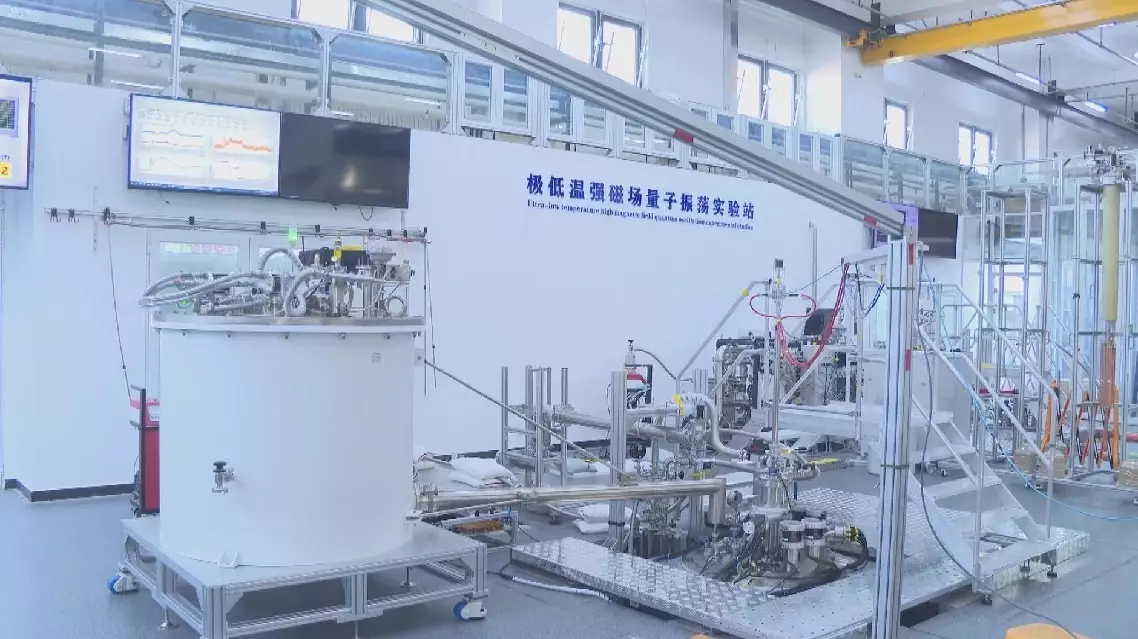
China sets new world record with 35.6-tesla all-superconducting user magnet