NEW YORK (AP) — Amazon said it's closing all of its Amazon Go and Amazon Fresh locations, as the online behemoth focuses on its grocery delivery, Whole Foods Market and a new “supersized” store concept.
The Seattle-based online retailer said Tuesday in a blog post that it plans to convert some of those soon-to-be shuttered locations into Whole Foods Market stores. The company operates 57 Amazon Fresh stores and 15 Amazon Go stores.
“While we’ve seen encouraging signals in our Amazon-branded physical grocery stores, we haven’t yet created a truly distinctive customer experience with the right economic model needed for large-scale expansion,” the company said in the post.
Amazon noted that customers can continue to shop Amazon Fresh online in available areas for “fast and convenient delivery.”
The last day of operation for Amazon Fresh and Amazon Go stores is Feb. 1, with the exception of its California locations, which will remain open longer to comply with state requirements, Amazon said.
Since Amazon's purchase of Whole Foods Market in 2017, it's seen more than 40% sales growth and expansion to more than 550 locations, it said. It now plans to open more than 100 new Whole Foods Market stores over the next few years.
At the same time, shoppers are turning to online delivery for everyday essentials and fresh food, Amazon said.
The online retailer is now delivering groceries to 5,000 U.S. cities and towns, including thousands served by same-day delivery where customers can shop produce and other perishables along with staples. Based on strong customer feedback, it said it plans to expand its same-day delivery service of fresh groceries to more areas this year.
Still, Amazon pledges to continue to experiment with new physical store formats.
The company revealed on Tuesday its plans to open a “new supercenter” physical retail concept designed for customers to shop Amazon’s broad selection across fresh groceries, household essentials, and general merchandise. The company didn’t provide any other details including the timing of the opening.
Amazon also is testing a new in-store format called Amazon Grocery, which it launched alongside Whole Foods Market in Chicago. This concept at Whole Foods Market in Plymouth Meeting, Pennsylvania, lets customer also shop for groceries and household essentials from Amazon
Amazon opened its first Amazon Go concept in 2018 in Seattle, letting shoppers take milk, potato chips or ready-to-eat salads off its shelves and just walk out. Amazon’s technology charges customers after they leave.
It said that it's gathered valuable insights along the way.
For example, its Amazon Go locations served as “innovation hubs” where it developed “just walk out” technology—now a checkout solution operating in more than 360 third-party locations across five countries.
Amazon said it is expanding its “just walk out” technology to Amazon’s own operations, with more than 40 North American fulfillment centers using it in breakrooms, helping employees grab meals without checkout delays. More are planned this year.
Amazon introduced its first Amazon Fresh physical store in 2020. The stores feature an assortment of national brands, produce, meat and seafood.
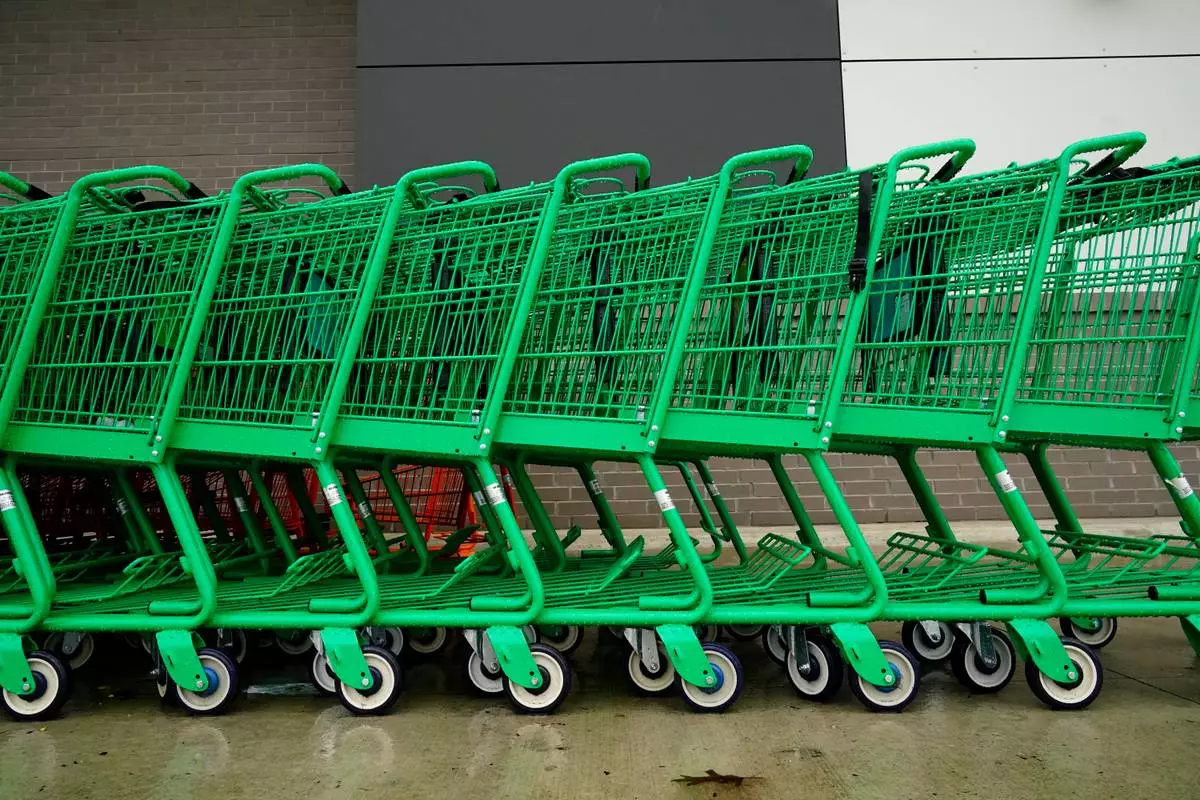
FILE - Shopping carts are positioned outside an Amazon Fresh grocery store in Warrington, Pa., Feb. 4, 2022. (AP Photo/Matt Rourke, File)

FILE - People walk out of an Amazon Go store in Seattle, March 4, 2020. (AP Photo/Ted S. Warren, File)

KYIV, Ukraine (AP) — A new report warns that the number of soldiers killed, injured or missing on both sides of Russia's war on Ukraine could hit 2 million by the spring, with Russia suffering the largest number of troop deaths recorded for any major power in any conflict since World War II.
The report from the Center for Strategic and International Studies came less than a month before the fourth anniversary of Moscow's full-scale invasion of Ukraine on Feb. 24.
The CSIS report, released Tuesday, said Russia suffered 1.2 million casualties, including up to 325,000 troop deaths, between February 2022 and December 2025.
“Despite claims of battlefield momentum in Ukraine, the data shows that Russia is paying an extraordinary price for minimal gains and is in decline as a major power,” the report said. “No major power has suffered anywhere near these numbers of casualties or fatalities in any war since World War II."
It estimated that Ukraine, with its smaller army and population, had suffered between 500,000 to 600,000 military casualties, including up to 140,000 deaths.
Neither Moscow nor Kyiv gives timely data on military losses, and each side seeks to amplify the other side’s casualties.
Commenting on the report, Kremlin spokesperson Dmitry Peskov said Wednesday that the research could not be considered “reliable information” and that only Russia’s Ministry of Defense was authorized to provide information on military losses.
The ministry’s last statement on battlefield deaths was in September 2022, when it said that just under 6,000 Russian soldiers had been killed. It has not released any updated figures since then.
There was no immediate comment from the Ukrainian government.
In an interview with NBC in February 2025, Ukrainian President Volodymyr Zelenskyy said that more than 46,000 Ukrainian soldiers had been killed since the war began.
The report estimated that at current rates, combined Russian and Ukrainian casualties may be as high as 1.8 million and could reach 2 million by spring.
The figures from the CSIS were compiled using the Washington, D.C.-based think tank’s own analysis, data published by independent Russian news site Mediazona with the BBC, estimates by the British government and interviews with state officials.
Reports about military losses have been repressed in Russian media, activists and independent journalists say.
Mediazona, together with the BBC and a team of volunteers, has so far collected the names of over 160,000 troops killed by scouring news reports, social media and government websites.
The report also said that Russian forces were advancing at a sluggish pace since it seized the initiative on the battlefield in 2024, despite its much larger size.
Russia’s advance in Ukraine has largely settled into a grinding war of attrition, and analysts say that Russian President Vladimir Putin is in no rush to find a settlement, despite his army’s difficulties on the roughly 1,000-kilometer (600-mile) front line.
The report said Russian forces have advanced at an average rate of between 15 and 70 meters (49 to 230 feet) per day in their most prominent offensives.
That is “slower than almost any major offensive campaign in any war in the last century,” the report said.
Putin told his annual news conference last month that 700,000 Russian troops are fighting in Ukraine. He gave the same number in 2024, and a slightly lower figure — 617,000 — in December 2023. It was not possible to verify those figures.
Officials said Wednesday that two people were killed near the Ukrainian capital and at least nine others were injured in attacks across Ukraine.
A man and a woman died in an overnight attack in the Bilohorodka area on the outskirts of Kyiv, according to Mykola Kalashnyk, head of the regional military administration.
Officials in the Ukrainian cities of Odesa and Kryvyi Rih, as well as the Zaporizhzhia region, also reported Russian strikes overnight, wounding at least nine people and damaging infrastructure.
Ukraine's air force said that Russia attacked overnight with one ballistic missile and 146 strike drones, 103 of which were shot down or destroyed using electronic warfare.
Meanwhile, Russia's Ministry of Defense said its air defenses destroyed 75 Ukrainian drones overnight. Twenty-four were shot down over Russia’s southwestern Krasnodar region, with 23 more shot down over the Crimean Peninsula, which Russia illegally annexed in 2016.
Two drones were reportedly shot down over Russia's Voronezh region, where Ukraine's General Staff said Wednesday that it had struck the Khokholskaya oil depot. Regional Gov. Alexander Gusev wrote on Telegram that falling drone debris sparked a fire involving oil products, but did not give further details.
This photo provided by the Ukrainian Emergency Service, shows a burned car after Russian attack in Zaporizhzhia, Ukraine, Wednesday, Jan. 28, 2026. (Ukrainian Emergency Service via AP Photo)
Rescuers carry the coffin of their fellow Oleksandr Zibrov, 36, who was killed in a secondary Russian drone strike on a residential building, at a fire station in Kyiv, Ukraine, Wednesday, Jan. 28, 2026. (AP Photo/Efrem Lukatsky)
Relatives and colleagues attend the funeral of rescuer Oleksandr Zibrov, 36, who was killed in a secondary Russian drone strike on a residential building, at a fire station in Kyiv, Ukraine, Wednesday, Jan. 28, 2026. (AP Photo/Efrem Lukatsky)
A local resident clears up debris from his broken balcony after a Russian attack in Zaporizhzhia, Ukraine, Wednesday, Jan. 28, 2026. (AP Photo/Kateryna Klochko)
People pass by damaged cars near an apartment building after a Russian attack in Zaporizhzhia, Ukraine, Wednesday, Jan. 28, 2026. (AP Photo/Kateryna Klochko)
People pass a crater and damaged cars near an apartment building after a Russian attack in Zaporizhzhia, Ukraine, Wednesday, Jan. 28, 2026. (AP Photo/Kateryna Klochko)