NEW YORK (AP) — A man on trial for bludgeoning four men to death with a metal bar as they slept on the New York City streets had been diagnosed with schizophrenia when he left jail months earlier and was hearing voices telling him he needed to kill 40 people or he would die too, his lawyer told jurors on Tuesday.
Randy Santos, 31, is asserting an insanity defense at his trial in state court in Manhattan. Through his lawyers, he has acknowledged committing the 2019 Chinatown rampage. But, they argue, he is not criminally responsible because mental illness has polluted his mind with irrational thoughts and left him prone to violence.
If they succeed, Santos could be sent to a psychiatric treatment facility instead of prison.
“He needed the voices to stop. He needed to save his own life," Santos’ lawyer, Marnie Zien, said in an opening statement. “He saw no other way out.”
Santos, 31, has pleaded not guilty to charges including first-degree murder in the deaths of Florencio Moran, Nazario Vásquez Villegas, Anthony Manson and Chuen Kok and attempted murder charges for assaults that left two other men severely injured. They were among 319 killings in New York City in 2019, including 52 in Manhattan.
Surveillance video captured Santos “repeatedly lifting the bar up over his head and bringing it down on the head” of one victim, Assistant District Attorney Alfred Peterson told jurors.
A couple out on a date on Manhattan’s Bowery street saw him beating another man with the same weapon, Peterson said. Police found Santos carrying the bar, which was covered with blood and hair. Testing showed it had his DNA on one end and blood from some of his victims on the other, the prosecutor said.
If the jury convicts Santos, rejecting his insanity defense, he could be sentenced to life in prison. Otherwise, he could be involuntarily committed to treatment for as long as necessary.
Peterson urged jurors to look past Santos' mental health claims and find him guilty on all charges, telling them that evidence will show that Santos “knew exactly what he was doing and the consequences of what he was doing — that he was killing these men," the prosecutor said.
Santos looked up and down the street and “saw the coast was clear” before starting the attack, Peterson said. He then paused to let a pedestrian — and potential witness — leave the area before wailing on another man, Peterson said. He knew “it was legally and morally wrong,” the prosecutor said.
Santos even recognized himself in surveillance video of the attack, Peterson said. Shown the footage after his arrest, he told police: “Yea, that’s me.”
Santos, a native of the Dominican Republic who moved to New York as a child, attacked five men between 1:30 a.m. and 2 a.m. on Oct. 5, 2019, bashing their heads repeatedly with a 4-foot (1.2 meter) bar he found on the street, Peterson said. The victims ranged in age from 39 to 83.
The lone survivor, critically injured 49-year-old David Hernandez, staggered to a nearby street where police officers were trying to revive another Santos victim.
Peterson said Santos had done a “trial run” about a week earlier, badly hurting another man by bashing his head with a wooden stick in a different Manhattan neighborhood.
Santos, who has gone back and forth from jail to psychiatric treatment facilities since his arrest, wore an untucked white button-down shirt and a tie as he sat between his lawyers at the defense table. He listened to Zien’s opening statement through a Spanish interpreter, but moved his headphones off his ear as Peterson spoke.
Prevailing with an insanity defense can be particularly tough in New York. Santos’ lawyers must convince the jury that he didn’t understand the consequences of his actions and didn’t know right from wrong. The strategy has had mixed results.
In 2022, a man who killed a young tourist when he drove his car through crowds of people in Times Square was cleared of responsibility and sent to a mental health facility instead of prison after a jury found he was so psychologically disturbed he didn’t know what he was doing.
But in 2018, a Manhattan nanny was convicted of killing two children in her care while their parents were away after a jury rejected her lawyer's claims that she had an undiagnosed mental illness, heard voices and saw hallucinations, snapped and didn’t know what she was doing.
Zien said Santos knew that attacking the men was legally wrong, but — in his mind — he had to do it to save his own life.
The ambush, she said, was the last in a line of increasingly violent episodes that began with a clash with his grandfather.
He has at least six prior arrests, police said, including allegations that he punched a tourist he thought was laughing at him on a subway train, choked a man at an employment agency and punched a homeless man inside a Brooklyn shelter.
During his last jail stint before the killings, Santos was diagnosed with schizophrenia, Zein said. He was released in August 2019 and given referrals for treatment and prescriptions for medication but never used them, Zein said.
Santos was previously diagnosed with schitzophreniform, a shorter-term mental health condition, and turned up at a hospital complaining that he was hearing voices in his head, Zein said.
He was asked about drug use but didn't get the treatment he needed, she said.

FILE - New York Police Department officers investigate the scene of an attack in Manhattan's Chinatown neighborhood, Oct. 5, 2019, in New York. (AP Photo/Jeenah Moon, File)
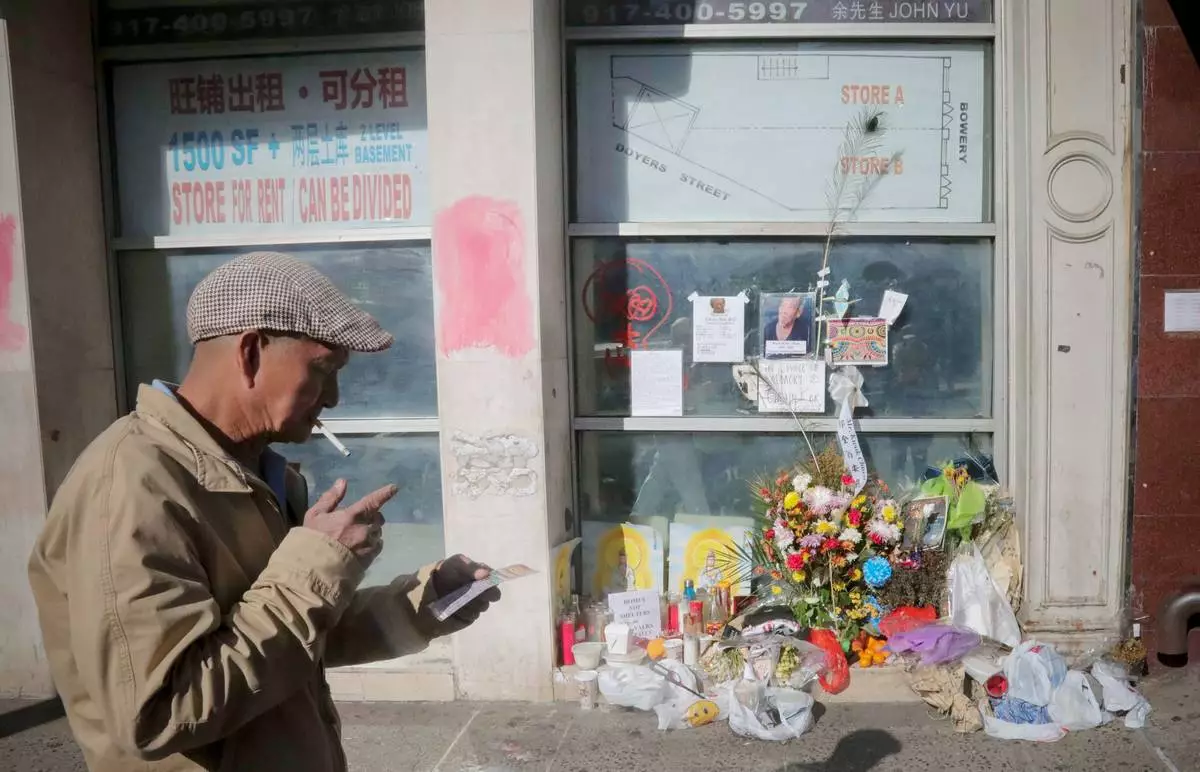
FILE - A man walks past a makeshift memorial made for Chuen Kok, Oct. 18, 2019, in New York. (AP Photo/Bebeto Matthews, File)

FILE - Randy Santos, center, is arraigned in criminal court for the murder of four homeless men, Oct. 6, 2019, in New York. (Rashid Umar Abbasi/New York Post via AP, Pool)
BARCELONA, Spain (AP) — Spain's government announced Tuesday it will grant legal status to potentially hundreds of thousands of immigrants living and working in the country without authorization, the latest way the country has bucked a trend toward increasingly harsh immigration policies imposed in the United States and much of Europe.
The extraordinary measure will be implemented by expediting a decree to amend immigration laws, according to Spanish Minister of Migration Elma Saiz, bypassing a similar bill that has stalled in parliament. Eligible immigrants will be granted up to one year of legal residency as well as permission to work.
In contrast to other nations that have moved to restrict immigration and asylum, many emboldened by the Trump administration’s policies, Spain has moved in the opposite direction with Prime Minister Pedro Sánchez and his ministers often extolling the benefits of legal migration to the country's economy and aging workforce.
Spain “will not look the other way,” Saiz told journalists during a press conference. The government is “dignifying and recognizing people who are already in our country," she said.
The measure could benefit an estimated 500,000 people living in Spain without authorization, Saiz said. Other organizations have estimated up to 800,000 people live in the shadows of Spanish society. Many are immigrants from Latin American or African countries working in the agricultural, tourism or service sectors, backbones of Spain's booming economy.
Foreigners who arrived in Spain before Dec. 31, 2025 and can prove they have been living in the country for at least five months will be eligible. They must also prove they have no criminal record.
Saiz said she expects those eligible will be able to start applying for their legal status from April until the end of June. She added that resources would be in place to process them smoothly and efficiently after a union representing Spain’s national police officers, responsible for processing applications, warned of a possible collapse.
The Spanish government's move came as a surprise to many after a last-minute deal between the ruling Socialist Party and the leftist Podemos party in exchange for parliamentary support to Sánchez's wobbly government.
Irene Montero, a European Parliament lawmaker with Podemos who first announced the deal Monday, contrasted Spain’s move with immigration enforcement in the U.S., where the Trump administration has come under intense criticism for its operations, particularly in Minnesota.
“If they kidnap children, murder and terrorize people, we give them papers," she said during a rally alongside migrant rights activists.
The news was celebrated by hundreds of migrant rights groups and prominent Catholic associations who had campaigned and obtained 700,000 signatures for a similar initiative.
“We are not used to these victories,” said Silvana Cabrera, a spokesperson for the migrant campaigning group RegularizaciónYa, or RegularizationNow in English, as she held back tears. The movement was born in the COVID-19 pandemic when many vulnerable immigrants worked essential jobs with little to no rights or protections.
In a statement Tuesday, the Spanish Episcopal Conference called the move an “act of social justice and recognition of so many migrants who, through their work, have long contributed to the development of" Spain.
“At a time when a hostile environment against migrants is spreading on both sides of the Atlantic, this move shows both humanity and common sense,” said Laetitia Van der Vennet, senior advocacy officer at PICUM, a European network of migrant rights organizations.
It's not the first time Spain has granted amnesty to immigrants who are in the country illegally: It has done so six times between 1986 and 2005.
“There was a strong impact on the workforce, not only legalizing the status of workers but creating formal jobs,” said Anna Terrón Cusi, a senior fellow at the Migration Policy Institute think tank who previously worked on immigration policy for multiple Spanish governments, including Sánchez’s.
The measure will allow Spain to “reset the counter” ahead of the implementation in June of the new European migration and asylum pact which relies heavily on deportations as a solution to irregular migration, she said. Terrón added that by granting legal status to migrants in the country irregularly, Sánchez is giving rights and protections to undocumented workers while also benefiting the Spanish economy.
“In the end, telling people that immigration is bad may appeal to them, but deporting the woman who cleans their house is a different story,” she said.
Center-right and far-right parties criticized the government's announcement.
Alberto Núñez Feijóo, leader of the conservative Popular Party, accused Sánchez of trying to distract from a deadly train crash earlier this month that left 46 dead. Meanwhile, Santiago Abascal, leader of the anti-immigration, far-right party Vox, wrote on social media that Sánchez “hated” Spaniards and was “accelerating an invasion,” echoing a racist conspiracy theory often used by right-wing extremists.
The Iberian nation — which saw millions of its citizens leave during and after its civil war — has taken in millions of people from South America and Africa in recent years. The vast majority entered the country legally.
Saiz said Spain will remain a “beacon” in the fight against the global wave of anti-immigration politics led by the far right.
“We will do everything in our power to stop it,” she said. "I believe that today is a great day for our country.”
Follow AP’s global migration coverage at https://apnews.com/hub/migration

FILE - Migrants sit together with their belongings after being evicted by police from an abandoned school where they had been living in Badalona, near Barcelona, Spain, Wednesday, Dec. 17, 2025. (AP Photo/Emilio Morenatti, File)

FILE - A migrant carries his belongings at an abandoned school building where hundreds of mostly undocumented migrants had been living, in Badalona, near Barcelona, Spain, Wednesday, Dec. 17, 2025. (AP Photo/Emilio Morenatti, File)
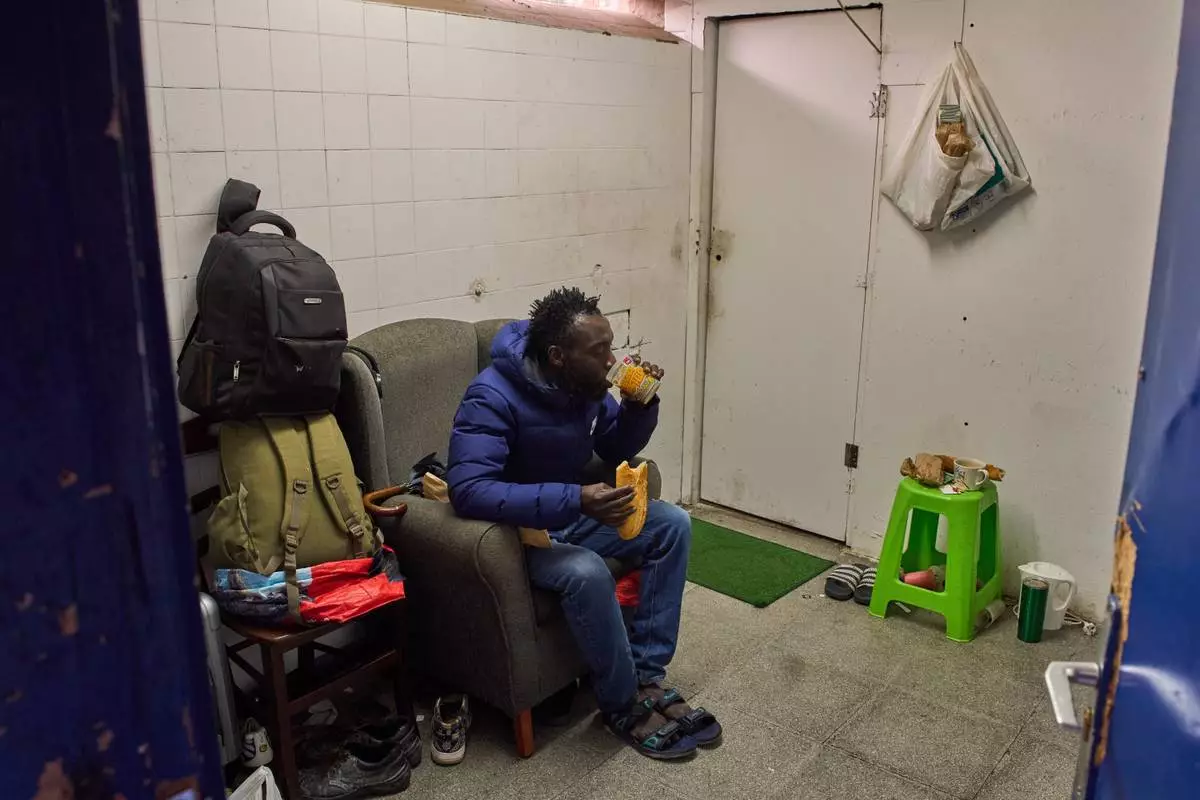
FILE - Yankuba Touray, from Gambia, eats his breakfast inside an abandoned school in Badalona, near Barcelona, Spain, Tuesday, Dec. 16, 2025. (AP Photo/Emilio Morenatti, File)