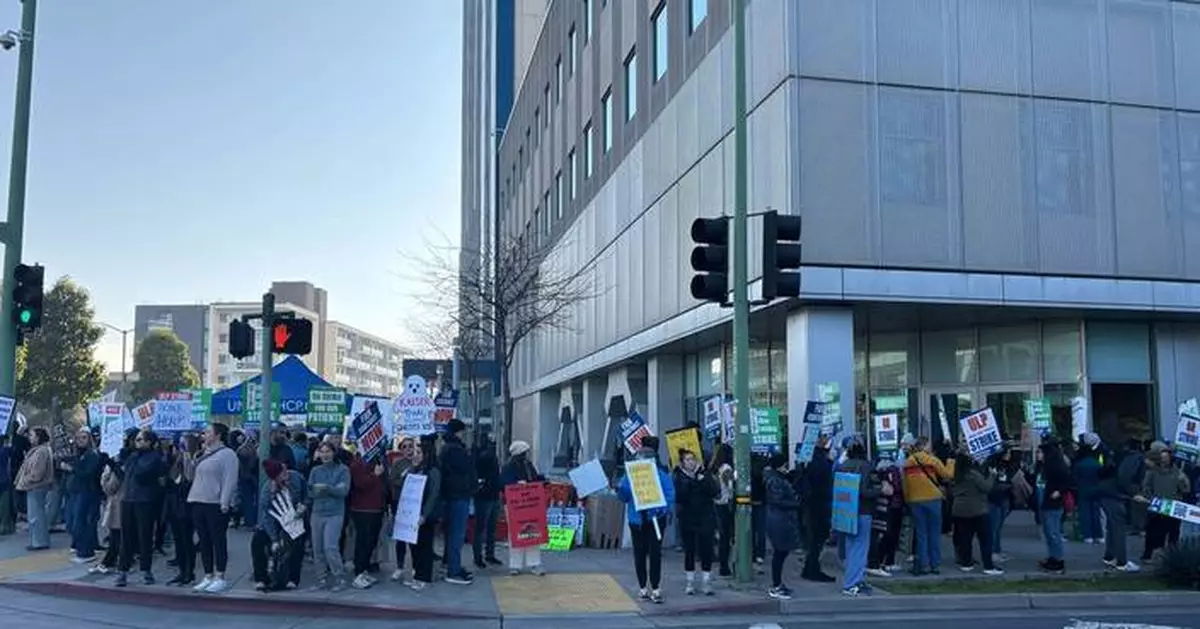
OAKLAND, Calif. (AP) — An estimated 31,000 registered nurses and other front-line Kaiser Permanente health care workers launched an open-ended strike this week in California and Hawaii to demand better wages and staffing from the health care giant.
The picketing that began Monday marked the second major walkout in recent months by employees represented by the United Nurses Associations of California/Union of Health Care Professionals. A five-day strike in October ended with negotiations resuming, but talks broke down in December.
This week the union accused Kaiser of refusing to return to national bargaining discussions.
“We will continue to push Kaiser to stop their egregious unfair labor practices against the frontline workers who deliver the best care for their patients and billions in profit to do the right thing, and come back to the table to bargain in good faith,” the union bargaining committee said in a statement.
Kaiser said Sunday that the union had agreed to return to local bargaining, even as workers moved forward with the strike. The company said it paused national bargaining last month after what it described as a threatening incident involving a union official.
“Illegal threats are a line that cannot be crossed,” Greg Holmes, Kaiser’s chief human resources officer, said in a statement. “This union official’s actions have compromised the national bargaining process and undermined both parties’ ability to continue good-faith bargaining.”
Those on strike, including pharmacists, midwives and rehab therapists, say wages have not kept pace with inflation and there is not enough staffing to keep up with patient demand.
They are asking for a 25% wage increase over four years to make up for wages they say are at least 7% behind their peers.
Kaiser Permanente had countered with a 21.5% increase over four years. The company says that represented employees earn, on average, 16% more than their peers, and it would have to charge customers more to meet strikers' pay demand.
Arezou Mansourian, a physician assistant on the bargaining team, told the San Francisco Chronicle that Kaiser has been unable to retain and recruit providers, which is impacting patient care. Medical staff have been leaving Kaiser for higher-paying jobs at other local hospitals, Mansourian said.
She said the union’s fight for better working conditions will ultimately help patients as well.
“We know it’s a pain right now, but it’s so that we can take care of you better in the future,” Mansourian told the Chronicle.
The company said health clinics and hospitals will remain open during the strike, with some in-person appointments shifted to virtual appointments, and some elective surgeries and procedures being rescheduled.
Kaiser Permanente is one of the nation’s largest not-for-profit health plans, serving 12.6 million members at 600 medical offices and 40 hospitals in largely western U.S. states. It is based in Oakland, California.
In New York City, about 15,000 nurses who walked off the job headed back to the bargaining table earlier this month. The New York State Nurses Association said contract negotiations resumed with officials at the three private hospital systems impacted by the strike: Montefiore, Mount Sinai and New York-Presbyterian.
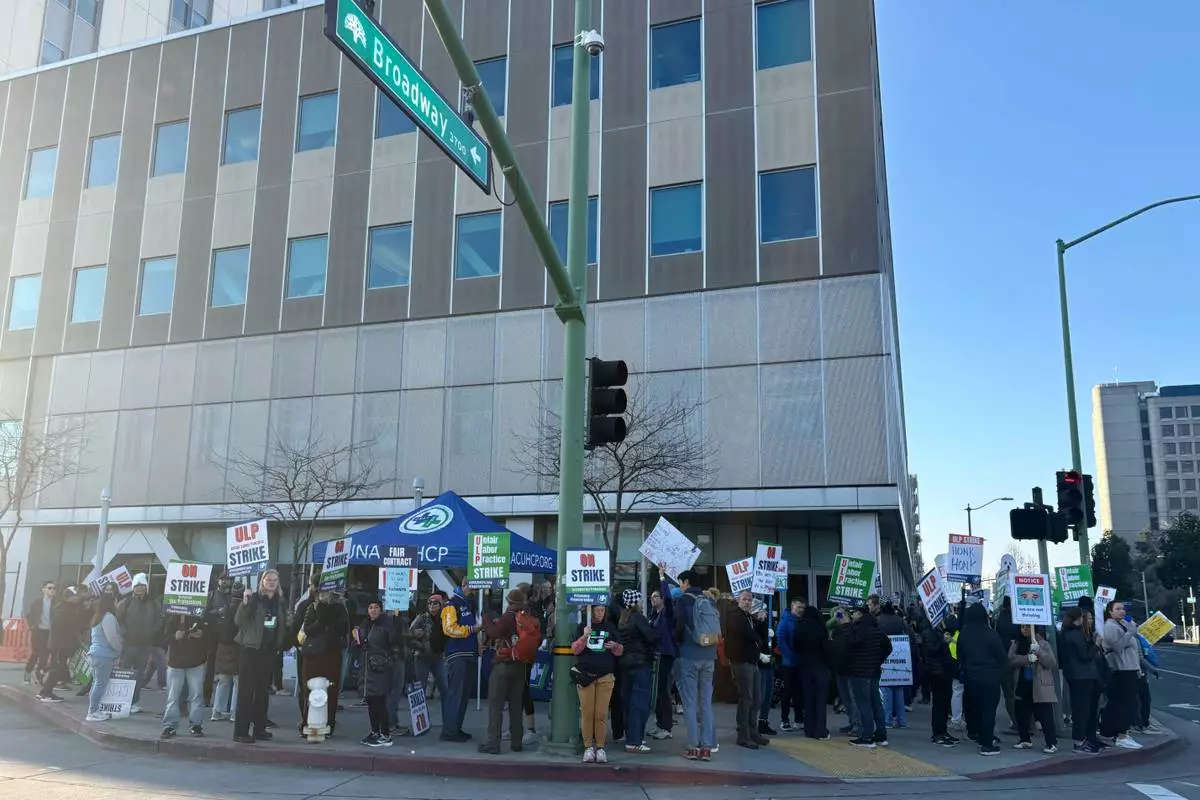
Kaiser Permanente nurses and health workers represented by the United Nurses Associations of California/Union of Health Care Professionals picket outside Kaiser's Oakland Medical Center on the first day of an open-ended strike Monday, Jan. 26, 2026. (Jessica Flores/San Francisco Chronicle via AP)
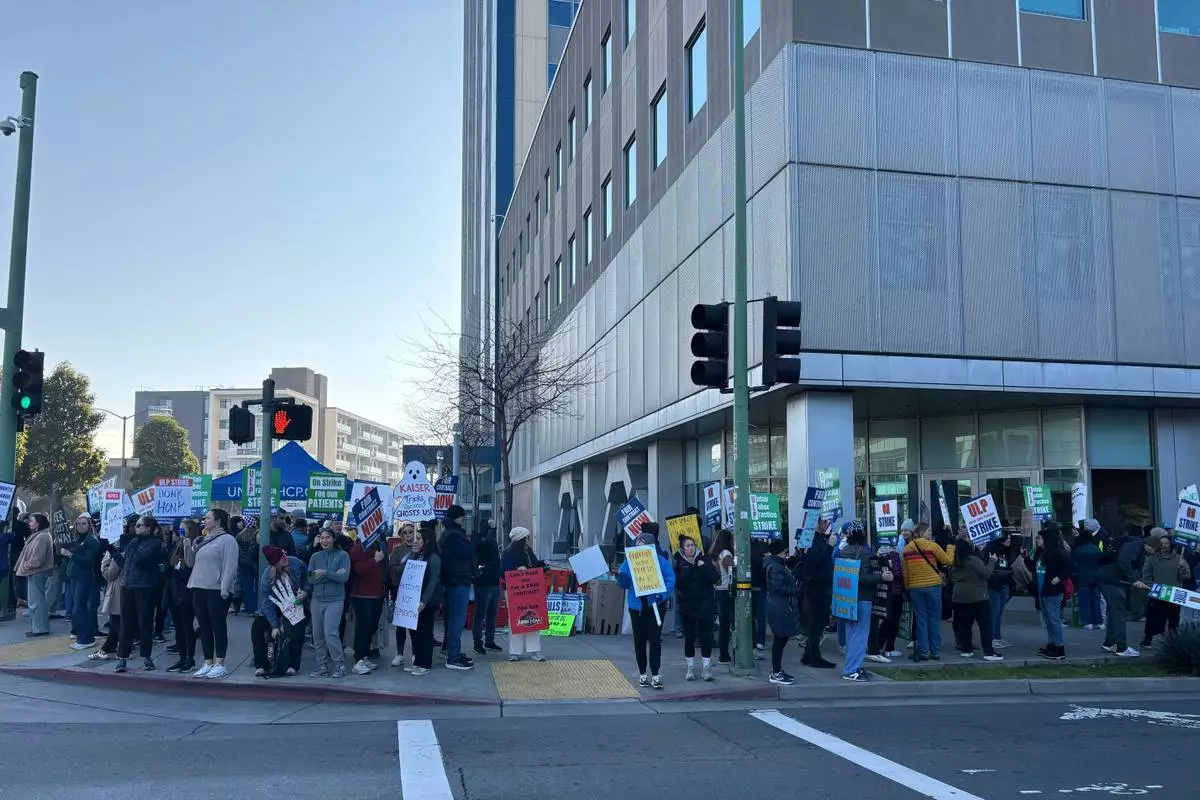
Kaiser Permanente nurses and health workers represented by the United Nurses Associations of California/Union of Health Care Professionals picket outside Kaiser's Oakland Medical Center on the first day of an open-ended strike Monday, Jan. 26, 2026, in Oakland, Calif. (Jessica Flores/San Francisco Chronicle via AP)
OKLAHOMA CITY (AP) — Shai Gilgeous-Alexander isn't scoring the way he usually does, but the Oklahoma City Thunder are still winning the way they normally do.
Gilgeous-Alexander, the reigning NBA MVP, averaged 31.1 points during the regular season. In the Western Conference semifinals against the Los Angeles Lakers, he is averaging 20 points and taking only 14 shots per game.
Oklahoma City has still won the first two games by an average of 18 points. Gilgeous-Alexander and Chet Holmgren each scored 22 points, and the defending champion Thunder beat the Lakers 125-107 on Thursday night.
Ajay Mitchell, starting in place of injured Jalen Williams, is averaging 19 points on 50% shooting in the series for Oklahoma City.
“I think the coaching staff does a good job at just getting all of us ready,” said Mitchell, a second-year guard. "And we have a lot of competitors. Like, everyone’s a competitor on our team. So every time the lights are bright, everyone’s ready to go.”
Holmgren is the leading scorer for the Thunder in the best-of-seven series with 23 points per game. The 2026 All-Star also is averaging 10.5 rebounds and 2.5 blocks.
Jared McCain, a midseason acquisition from the Philadelphia 76ers, barely played in the first round against Phoenix but has averaged 15 points and made 8 of 10 3-pointers in the series.
“He goes in there, stays in character, stays aggressive," Thunder coach Mark Daigneault said. "He’s going to shoot the next shot. He makes the right plays, plays inside the team. He competes defensively, has had good defensive possessions for us. And he was huge tonight. You need that in a playoff series.”
The Lakers again were without scoring champion Luka Doncic, who is out indefinitely with a strained left hamstring. They also were missing forward Jarred Vanderbilt, the reserve forward who dislocated the pinkie on his right hand during the second quarter of Game 1. The Lakers had three players finish with five fouls, limiting their aggressiveness late in the game.
Los Angeles guard Austin Reaves, who struggled with his shot in Game 1, scored 31 points on 10-for-16 shooting in Game 2. LeBron James, coming off a 27-point effort in Game 1, followed that up with 23.
With the Lakers up 63-61 early in the third quarter, Gilgeous-Alexander got tied up with Reaves and was called for his fourth foul. Upon review, it was upgraded to a flagrant 1 for Gilgeous-Alexander's follow through. Oklahoma City's Alex Caruso was called for a technical foul as the situation was being sorted out.
Gilgeous-Alexander left the game with the Lakers up 65-61, but the Thunder rallied and took control without him. On a fast break, Holmgren found a trailing Jaylin Williams, who hit a 3-pointer and was fouled. His free throw put the Thunder up 85-74.
The Thunder outscored the Lakers 32-15 while Gilgeous-Alexander was out in the third quarter to take a 93-80 lead into the fourth.
“It was amazing," Gilgeous-Alexander said. “They strung together stops, they’re playing the right way offensively and things are going their way. Full confidence in those guys. They know how to win basketball games. And we've proven that. They’ve proven that no matter who’s on the floor, they know how to get the job done. And they just did it again tonight."
The Lakers cut Oklahoma City's lead to five in the fourth quarter before the Thunder pulled away again.
Los Angeles will host Game 3 on Saturday.
“We just stuck with it,” Holmgren said. “It’s the game of basketball. It’s not always going to go your way. It’s about how you respond. And this team has proven many times that we know how to respond. And we did so tonight.”
This story has been corrected to show that Shai Gilgeous-Alexander is averaging 20, not 19, points per game against the Lakers.
AP NBA: https://apnews.com/hub/NBA
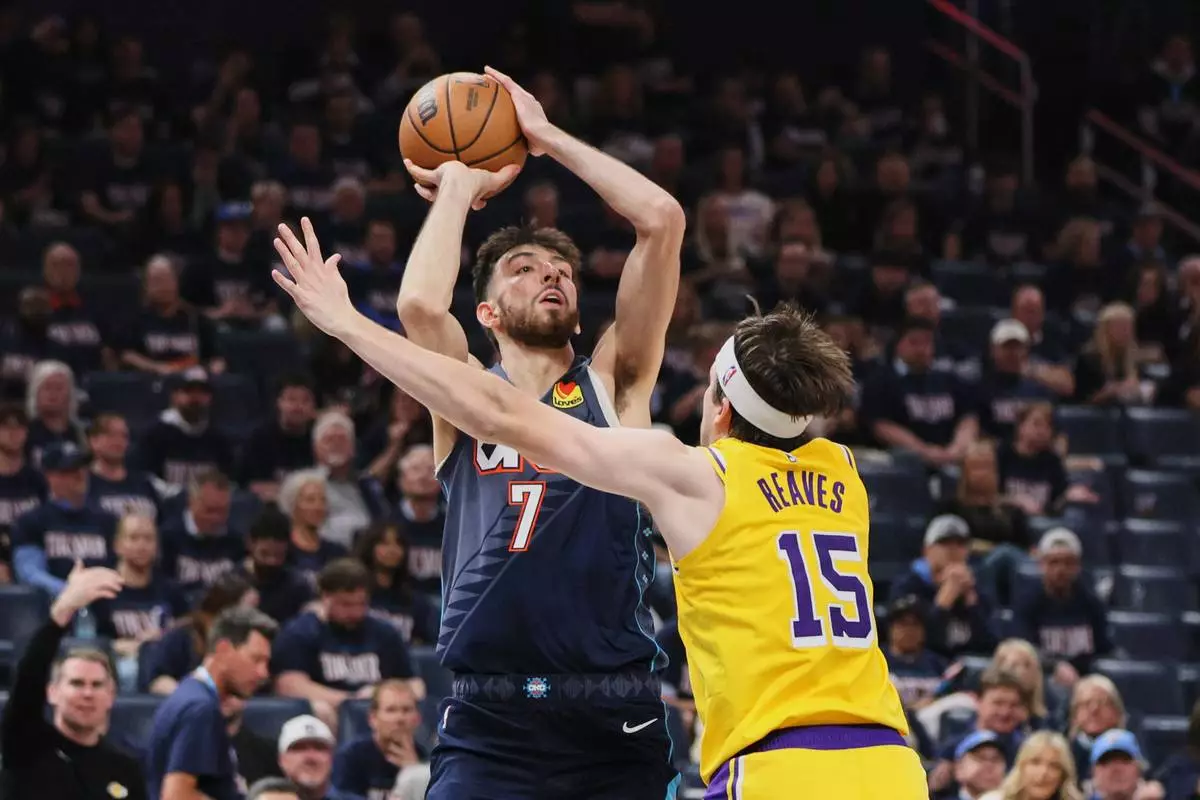
Oklahoma City Thunder's Chet Holmgren (7) shoots over Los Angeles Lakers' Austin Reaves (15) in the second half of Game 2 in a second-round NBA basketball playoffs series Thursday, May 7, 2026, in Oklahoma City. (AP Photo/Nate Billings)
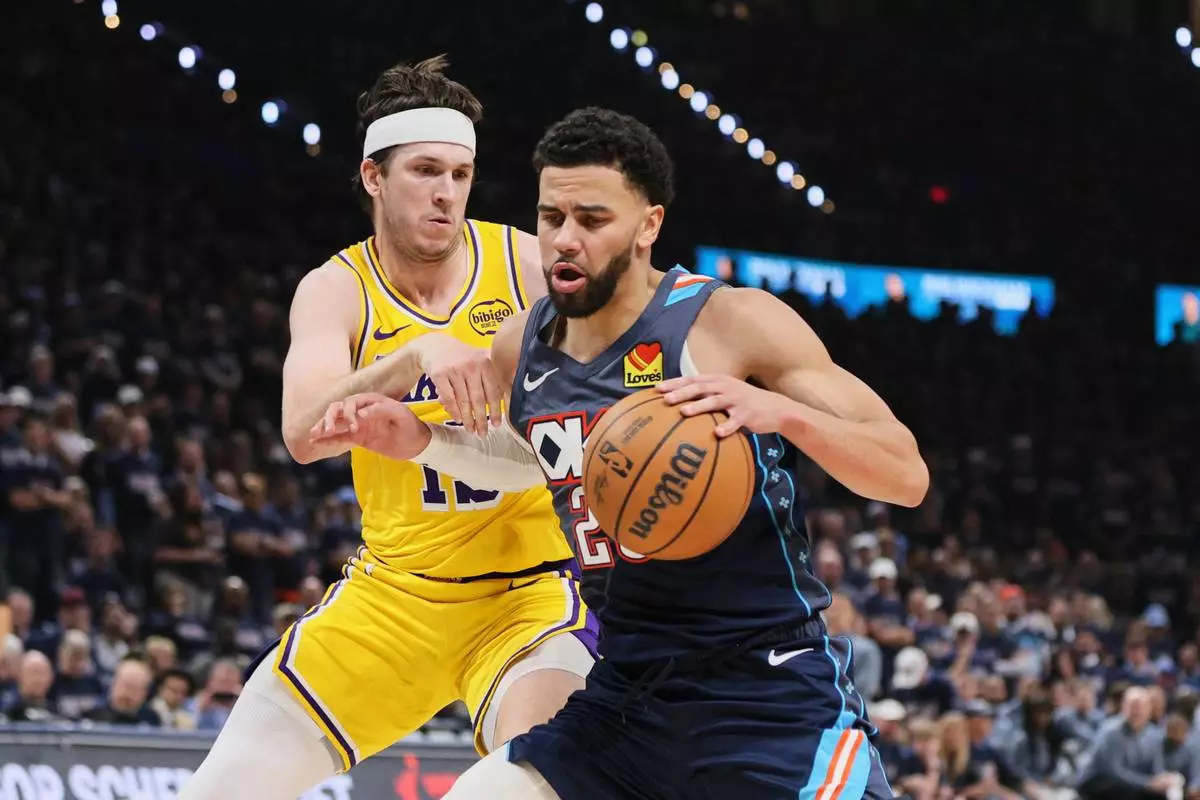
Oklahoma City Thunder guard Ajay Mitchell, front, works for a shot as Los Angeles Lakers' Austin Reaves, rear, defends in the second half of Game 2 in a second-round NBA basketball playoffs series Thursday, May 7, 2026, in Oklahoma City. (AP Photo/Nate Billings)
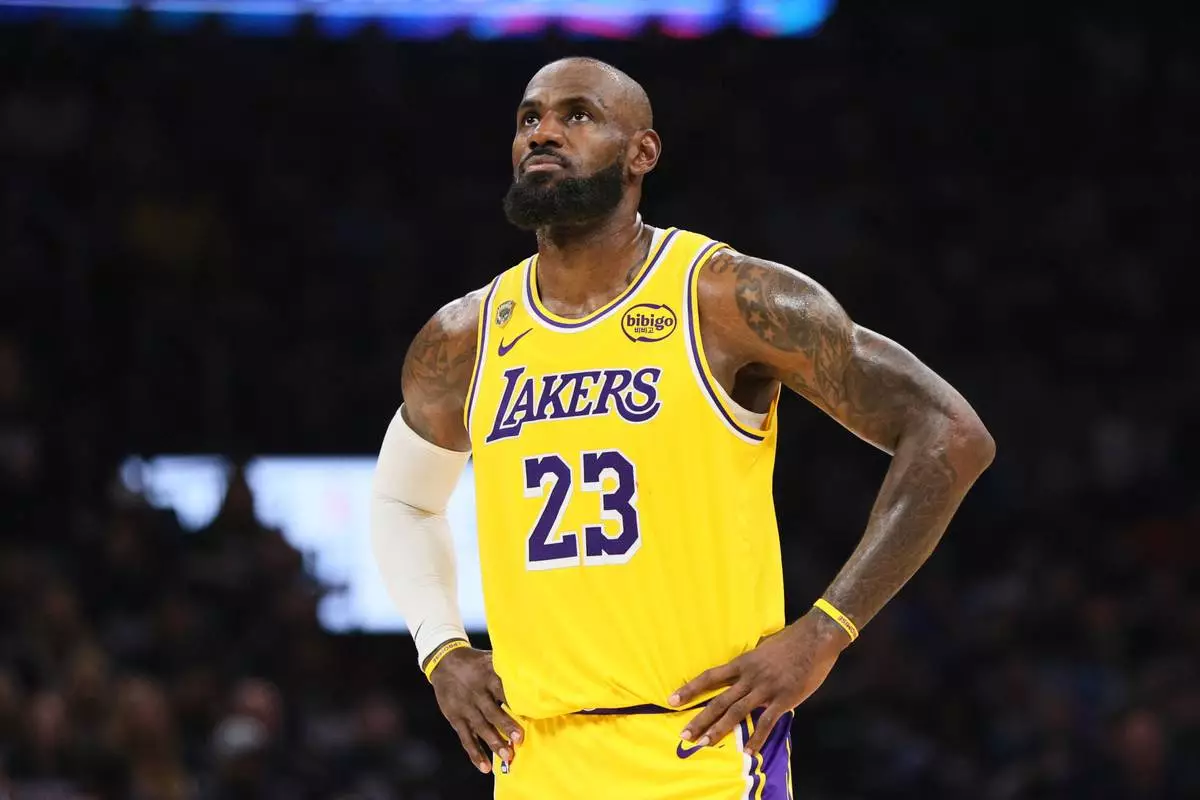
Los Angeles Lakers' LeBron James stands on the court in the second half of Game 2 in a second-round NBA basketball playoffs series against the Oklahoma City Thunder Thursday, May 7, 2026, in Oklahoma City. (AP Photo/Nate Billings)
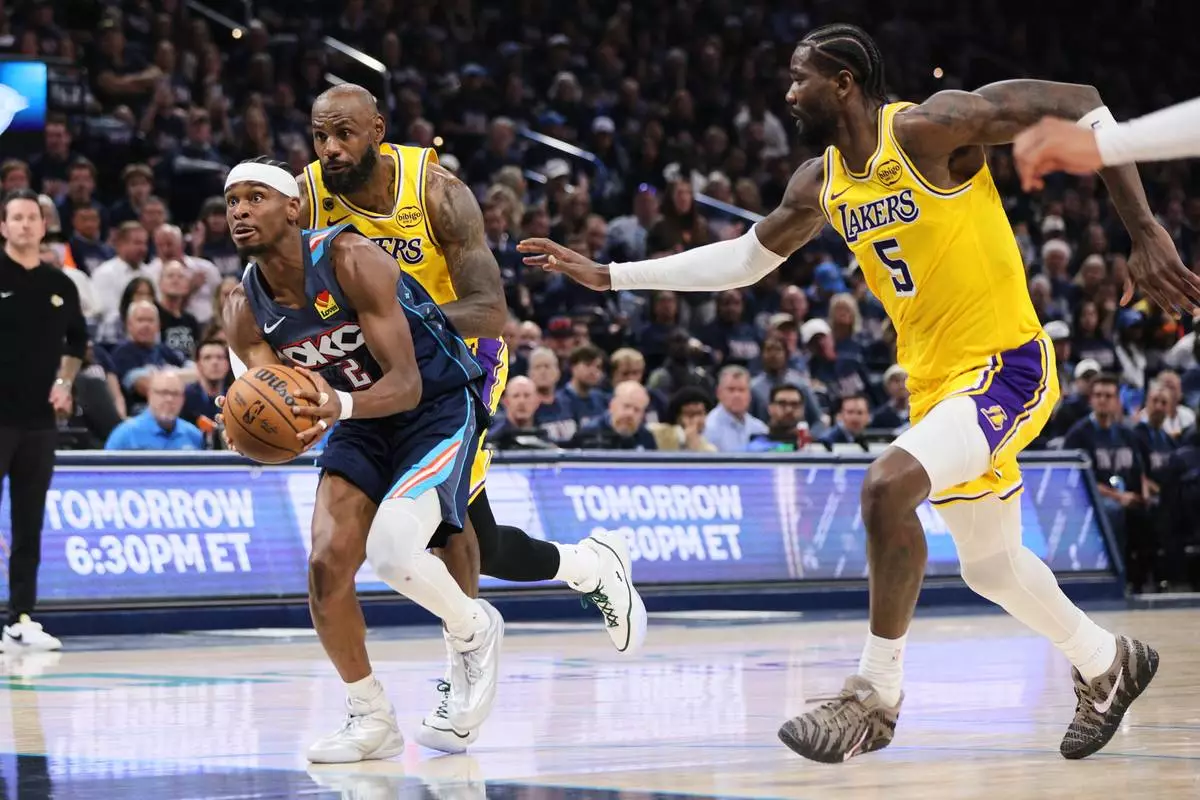
Oklahoma City Thunder guard Shai Gilgeous-Alexander (2) drives to the basket past Los Angeles Lakers' Deandre Ayton (5) and LeBron James, rear, in the second half of Game 2 in a second-round NBA basketball playoffs series Thursday, May 7, 2026, in Oklahoma City. (AP Photo/Nate Billings)
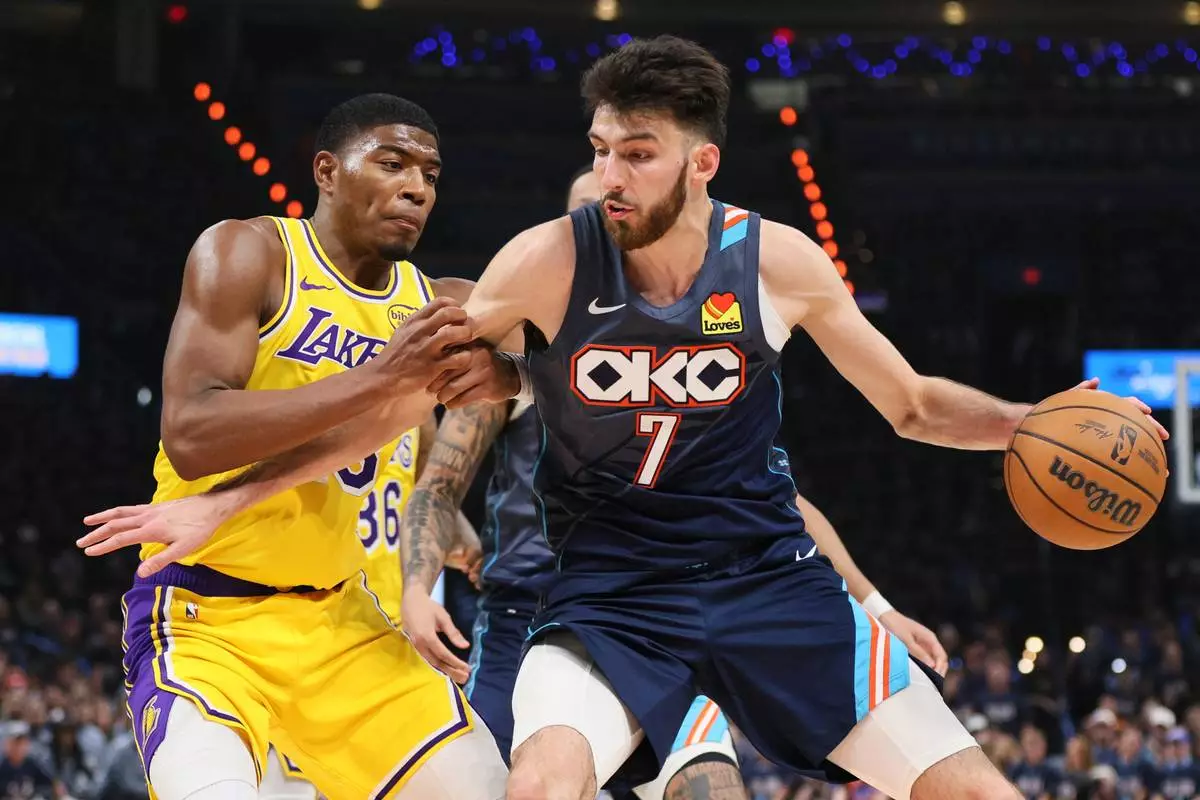
Oklahoma City Thunder center Chet Holmgren (7) works to the basket against Los Angeles Lakers forward Rui Hachimura (28) in the second half of Game 2 in a second-round NBA basketball playoffs series Thursday, May 7, 2026, in Oklahoma City. (AP Photo/Nate Billings)