Associated Press (AP) — A Nicaraguan man who died at a troubled Texas detention camp days after he was detained by immigration agents in Minnesota appeared to have died by suicide, according to a 911 call and records released Wednesday.
Victor Manuel Diaz, 36, was found by guards on Jan. 14 in a room at Camp East Montana in El Paso, Texas, after he tried to die by suicide, a camp official reported on a 911 call obtained by The Associated Press through a public information request.
“They were doing rounds and they just found him with his pants tied up to his neck, I believe,” said the caller, who identified himself as a health administrator named Luis Gonzalez.
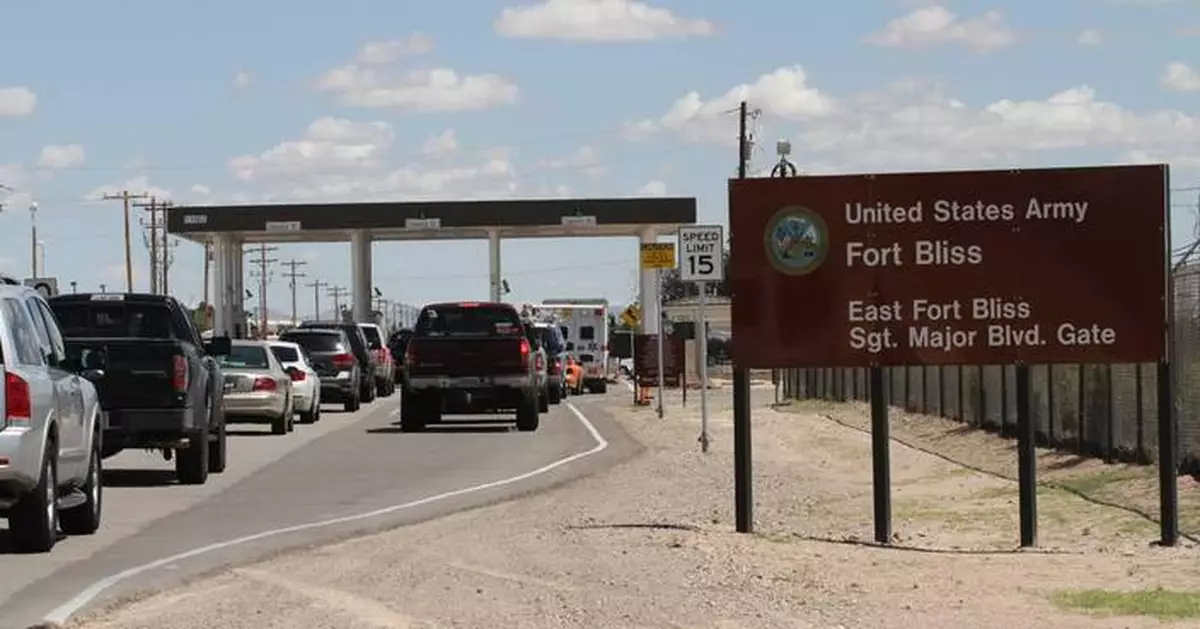
Diaz’s death was at least the third of a detainee housed at Camp East Montana, which opened last year at Fort Bliss to hold 5,000 detainees in the desert near the U.S.-Mexico border. Advocates for detainees have alleged a pattern of violence, abuse and neglect at the camp. One earlier death has been ruled a homicide.
Randall Kallinen, an attorney for Diaz's family, said they are suspicious of the claim that his death was a suicide because he was not depressed and would have been reunited with his mother, two sons and siblings in Nicaragua if he had been deported.
“Even if it is suicide, was there something that happened to him that drove him to suicide?” Kallinen asked. “There still has to be an investigation.”
Messages seeking comment were left with ICE on Wednesday.
Gonzalez did not witness Diaz's suicide attempt. A separate report by emergency medical services that was released Wednesday said Diaz was suspected of hanging himself with a bed sheet. Federal authorities have not released the findings of an autopsy, but have said the death was a “presumed suicide.”
U.S. Immigration and Customs Enforcement picked up Diaz on Jan. 6 as agents fanned out across Minneapolis looking for people who may be in the country illegally. He was then sent to the sprawling Texas tent complex.
Diaz crossed the U.S.-Mexico border in 2024, requested asylum and was released. A judge later ordered his removal after he didn’t show up for an immigration hearing, according to ICE.
Relatives in Nicaragua lost contact with Diaz after he went to work at a suburban restaurant on Jan. 6 and later learned he'd been detained. They received a call on Jan. 15 from ICE saying Diaz was dead. Family members “were in disbelief,” said Carlos Morales, board president of Texas Nicaraguan Community, a nonprofit that helped the family raise money to repatriate Diaz's remains to Nicaragua.
A coalition of groups and a Democratic congresswoman who represents El Paso have called for Camp East Montana to be closed.
Some of those calls came after the Jan. 3 death of 55-year-old Cuba native Geraldo Lunas Campos. A medical examiner has ruled that a homicide, citing physical restraint by guards.
A witness has described guards pinning Lunas Campos to the ground in handcuffs, with one restraining him in a chokehold until he could no longer breathe. ICE has said the guards intervened to try to help Lunas Campos after he attempted suicide, and that he resisted them. A camp official initially told police it was a suicide.
Lawyers for the family of Lunas Campos have asked a judge for an emergency order to prevent ICE from deporting detainees who witnessed the struggle.
ICE, which oversees the camp, announced Diaz’s death on Jan. 18, saying security staff “found Diaz unconscious and unresponsive in his room.” The agency said he “died of a presumed suicide” but that the cause was still under investigation.
In addition to Lunas Campos and Diaz, ICE announced that on Dec. 3 an immigrant from Guatemala held in Camp East Montana died after being transferred to a El Paso hospital for care. The agency said Francisco Gaspar-Andres, 48, was suspected to have died of liver and kidney failure.
Unlike with the two prior deaths, Diaz’s body wasn’t sent to the county medical examiner in El Paso for an autopsy. Kallinen said an Armed Forces pathologist conducted the autopsy at Fort Bliss, and that he's been told it could take months for findings to be released.
The 911 caller in the case told the dispatcher that a team of doctors and nurses were working to try to revive Diaz after his suicide attempt and they needed an ambulance.
Paramedics found him laying on his back in a hospital bed without a heartbeat, according to an El Paso Fire Department incident report.
AP reporter Michael Biesecker contributed from Washington.
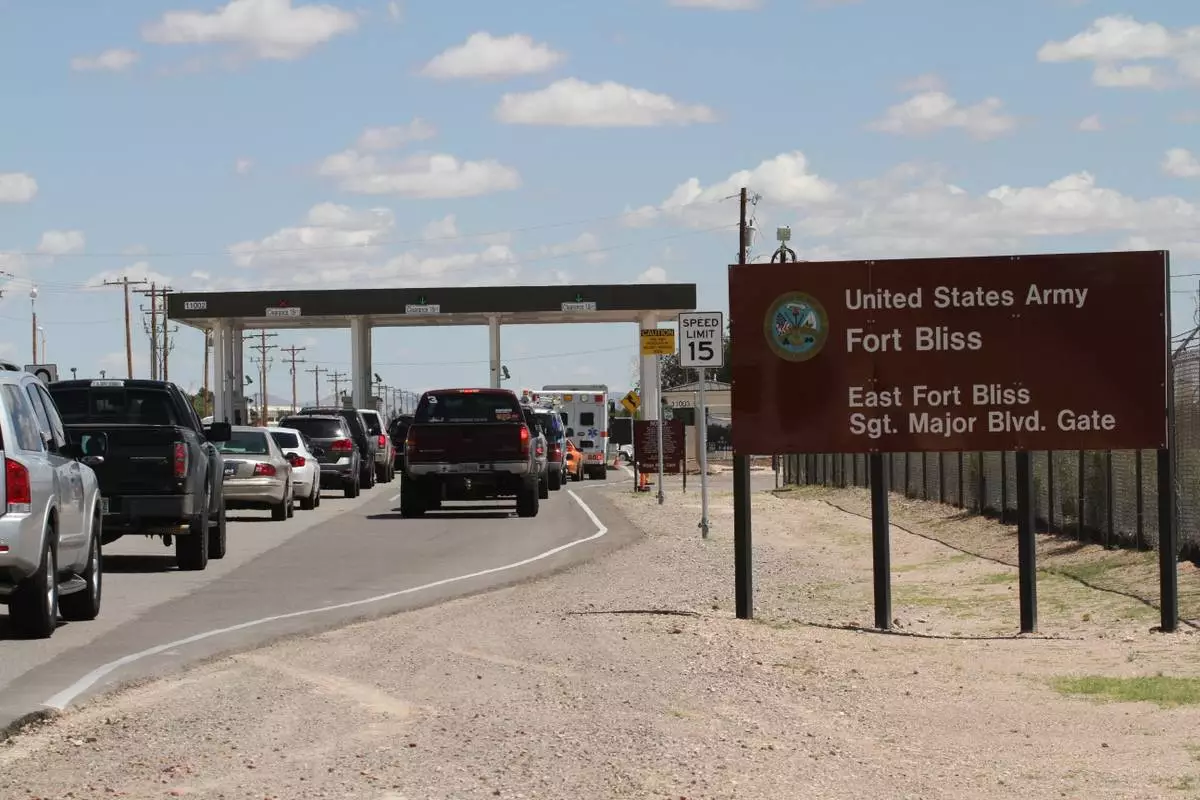
FILE - Cars wait to enter Fort Bliss in El Paso, Texas, Sept. 9, 2014. (AP Photo/Juan Carlos Llorca, File)
WASHINGTON (AP) — The midterm elections are looming and the first hurricane of the Atlantic Season is menacing the Gulf Coast.
But President Donald Trump is really, really hoping the weather doesn’t stop him from going to another big college football game — this one in Alabama on Saturday night.
“Well, hurricane and football? I love Alabama. I gotta go to the game. It’d be awfully hard,” Trump said Wednesday, when asked if Hurricane Isaias — and a forecast track which has parts of Alabama, Mississippi and Florida bracing for significant impacts — might alter his plans.
Trump had been set to visit Bryant-Denny Stadium in Tuscaloosa when Alabama hosts Georgia in a Top 10 matchup, following an afternoon rally in Tennessee.
Officials are still discussing how the storm might affect the game. But if it happens and Trump is there, it would be the 10th college football game he’s attended as president since 2017 — including the late September game in Knoxville when Texas topped Tennessee 20-17.
Trump told reporters on Wednesday “if there’s a hurricane, I don’t want to do anything" to take the focus of first responders and law enforcement away from the storm, saying he wanted people to be safe.
“We'll have to see," he said.
A president trying to give his party a midterm boost typically wouldn't even contemplate going to two college football games so close to Election Day. But Trump's longtime love of sports — and big crowds — are often key factors in his travel schedule.
Live sports — especially big games that attract casual fans nationwide — are one of the few televised programs that can still draw large, real-time audiences. But mixing sports and politics can be tricky: Trump received cheers but also boos when he was shown on Tennessee's jumbotron, despite being in a deep red state.
“I think what they’re trying to do is get this broad cast: trying to raise enthusiasm, particularly among young men,” said University of Richmond political scientist Dan Palazzolo, who has researched, written and taught about the intersection of politics and sports.
Tennessee and Alabama are “safe turf,” Palazzolo said, and Trump “clearly sees sports as a kind of way to connect with a certain part of the base.”
While presidents usually visit key swing states leading up to elections, Trump's sinking approval ratings mean some GOP candidates may be looking to distance themselves from the increasingly unpopular Iran war and the higher gasoline prices it's caused.
The White House says Trump attending football games — even in reliably Republican states — can energize his core supporters around the country. White House spokesperson Taylor Rogers described the president as “the greatest champion of college sports in American history" and said that Trump has used his executive powers and championed congressional efforts to try to overhaul how the sport is governed.
Trump is now a week into what he said would be 32 days of travel ahead of Election Day on Nov. 3 — including a visit last week to Alabama and other stops in Texas, Oklahoma, Ohio and Nebraska. Swings in coming weeks will take him to Georgia, North Carolina, Michigan, Kansas and Alaska, among other places.
Richard Nixon publicly leaned into his fierce love of football to ”make a difference politically by capturing the Midwest, working class values," Palazzolo said. His successor, Gerald Ford, was a standout University of Michigan center and used his playing days as a key component of his folksy personal style when campaigning.
But Trump has made sporting events a big part of his second term. A onetime owner of the USFL's New Jersey Generals, Trump recently attended the Presidents Cup and flew to his golf course for the Irish Open.
He was at the World Cup final, the NBA finals and the NCAA football championship game, while marking his 80th birthday with a UFC extravaganza on the White House lawn.
In 2025 alone, Trump went to the Super Bowl, the Daytona 500, the Ryder Cup, a New York Yankees game and the U.S. Open men's final, as well as UFC fights and the NCAA wrestling championships.
“I think it helps the brand more than anything else. Because, I think his brand is ‘Sports Guy,’" said Dave Mowery, an Alabama-based consultant who has worked on campaigns for both parties.
“I know everything is political," Mowery said. “But it almost puts him above politics and into that type of guy that is seen in the box with the people.”
Mowery, a Georgia fan who plans to attend Saturday’s game against Alabama, said a presidential visit means fans have to cope with additional security and arriving early to sit in the stands long before the game begins.
He said not everyone there will support Trump, though few will be frustrated enough about the disruptions to vote for Democrats on that issue alone. Seeing the president flash on the scoreboard, or wave to the crowd from a private box, probably won't win him votes from the crowd, either, Mowery said.
Palazzolo said he thinks it’s a “time-drain” for a president to go to a football game when there's no evidence it can sway voter behavior — and he said it risks backlash, especially in parts of the country where football remains bipartisan with “conservatives and liberals finding common ground at the ballpark."
Mowery said the difference between attending a big game in the South versus other parts of the country is that college football is the top attraction. That's in contrast to NFL games, which might be bigger draws in other, more northern battleground states.
He also said it's no accident that Trump has stuck to attending marquee college matchups.
“If ‘Sports Guy’ helps drive the brand, then you want to be at the top of that food chain," Mowery said. “He wants to go to the best game on the board. He wants to go to the top of the pops."
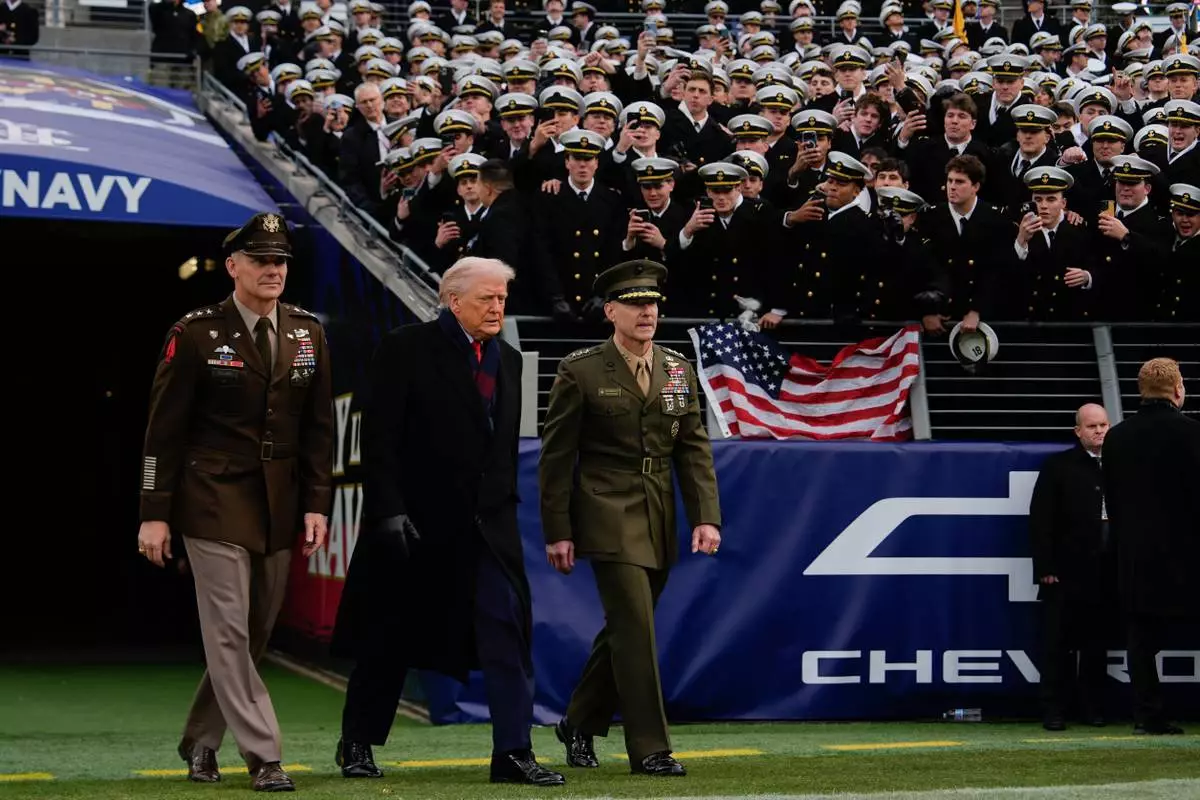
FILE - President Donald Trump walks onto the field with Lt. Gen. Steven Gilland, Superintendent of the U.S. Military Academy at West Point, left, and Lt. Gen. Michael Borgschulte, Superintendent of the U.S. Naval Academy, right, before the start of the 126th Army-Navy NCAA college football game at M&T Bank Stadium, Dec. 13, 2025, in Baltimore. (AP Photo/Julia Demaree Nikhinson, File)
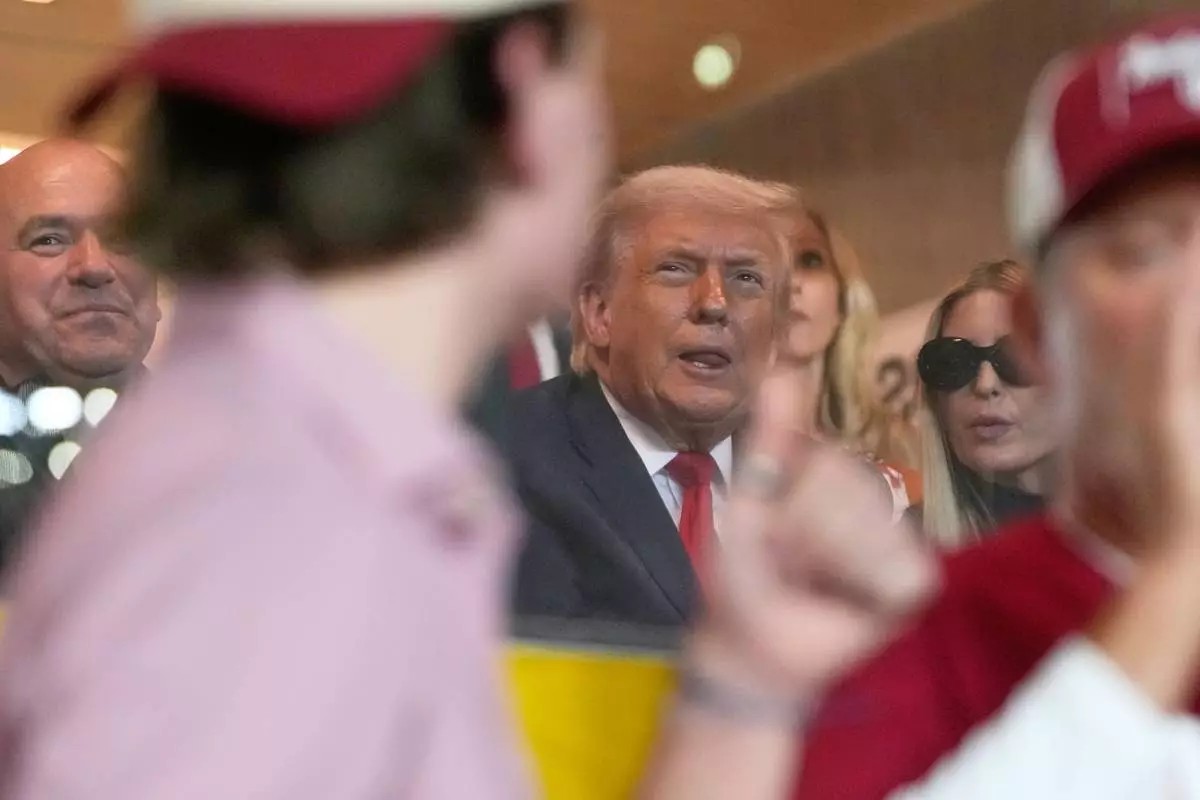
FILE - President Donald Trump watches first half of the College Football Playoff national championship game between Miami and Indiana, Jan. 19, 2026, in Miami Gardens, Fla., with Dana White and Ivanka Trump. (AP Photo/Julia Demaree Nikhinson, File)
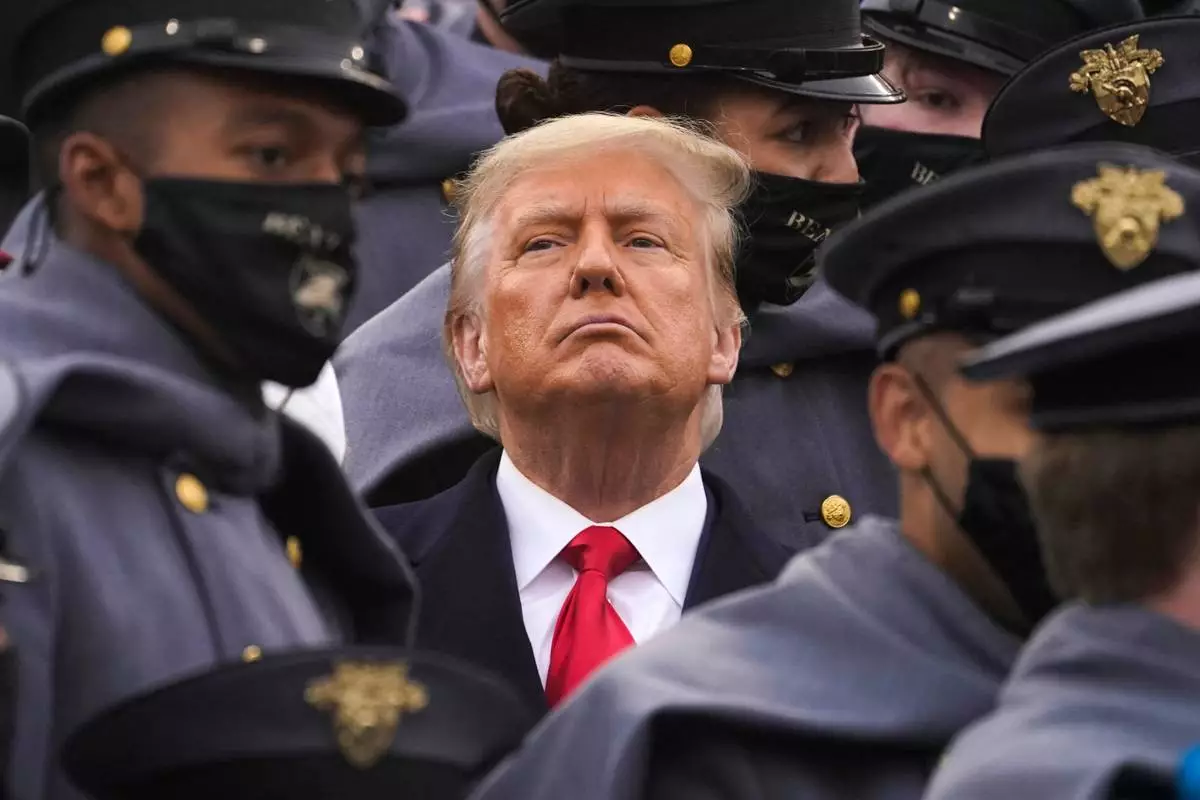
FILE - Surrounded by Army cadets, President Donald Trump watches the first half of the 121st Army-Navy Football Game, Dec. 12, 2020, in West Point, N.Y. (AP Photo/Andrew Harnik, File)
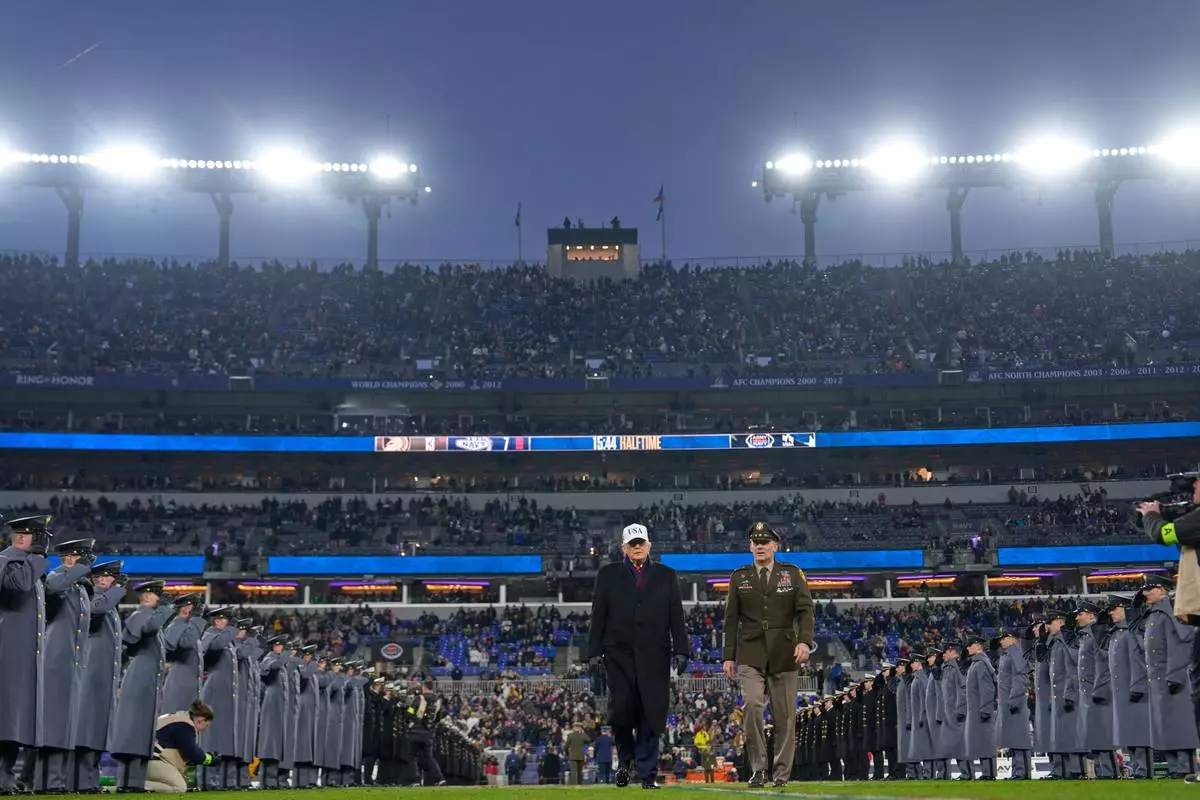
FILE - President Donald Trump walks from the Navy to the Army side of the field with Lt. Gen. Steven Gilland, superintendent of the U.S. Military Academy at West Point, during halftime of the 126th Army-Navy NCAA college football game at M&T Bank Stadium, Dec. 13, 2025, in Baltimore. (AP Photo/Julia Demaree Nikhinson, File)
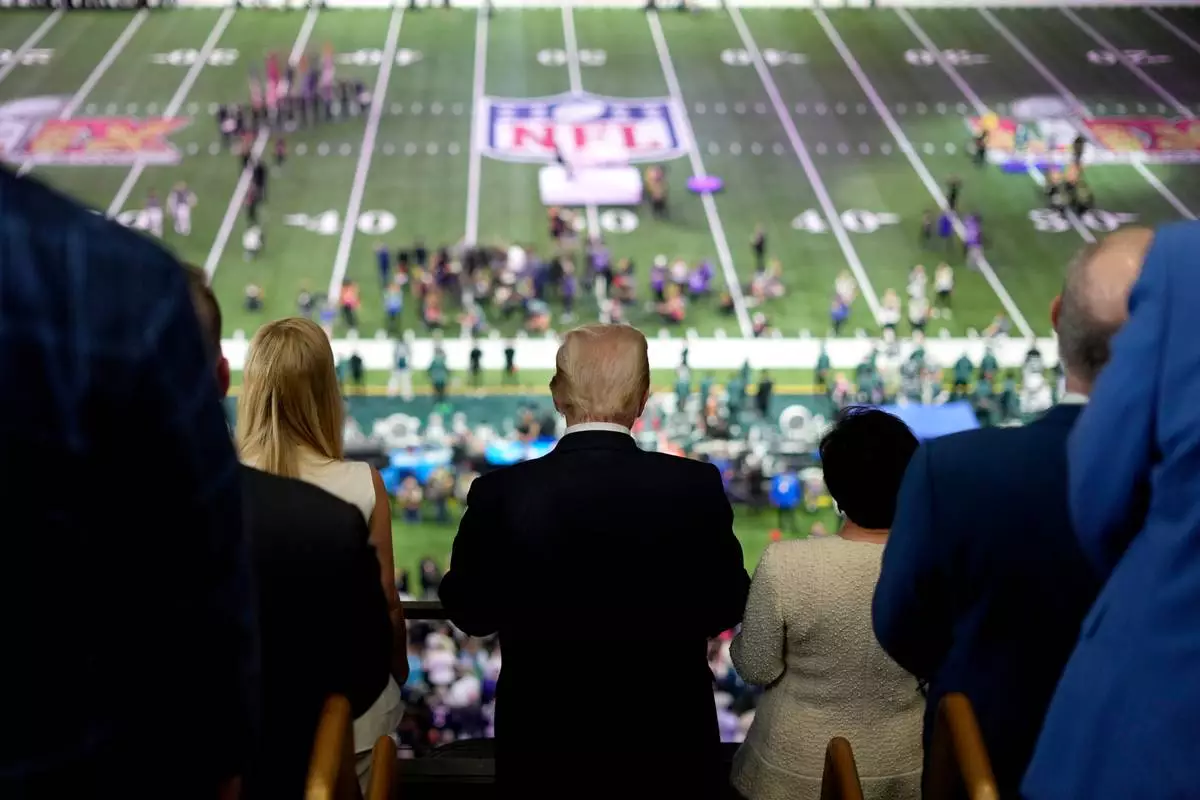
FILE - President Donald Trump, center, attends the NFL Super Bowl 59 football game between the Philadelphia Eagles and the Kansas City Chiefs, Feb. 9, 2025, in New Orleans. (AP Photo/Ben Curtis, File)
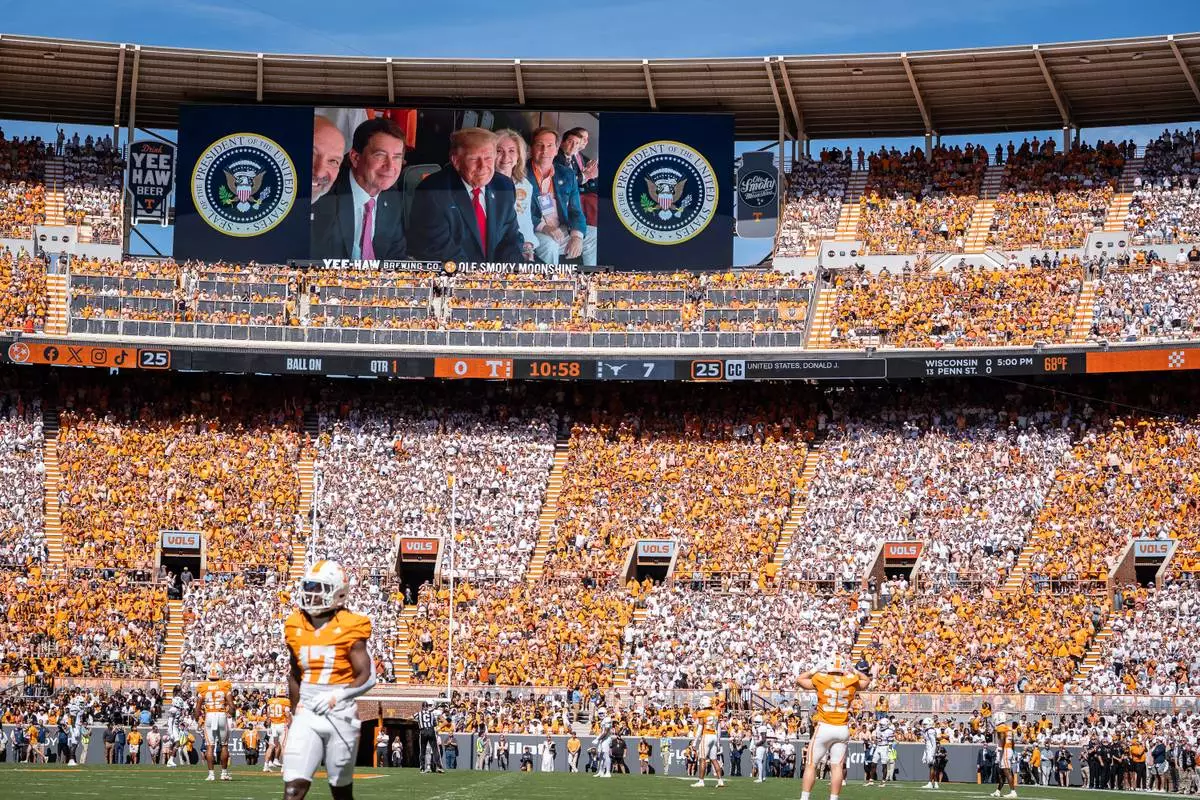
President Donald Trump is displayed on the scoreboard as he attends the Tennessee-Texas NCAA college football game in Knoxville, Tenn., Saturday, Sept. 26, 2026. (Sara Diggins/The San Antonio Express-News via AP)