A Chinese research team has constructed an intercity quantum detection network, significantly enhancing the precision of searching for elusive dark matter and lighting a new path toward unraveling one of the universe's greatest mysteries.
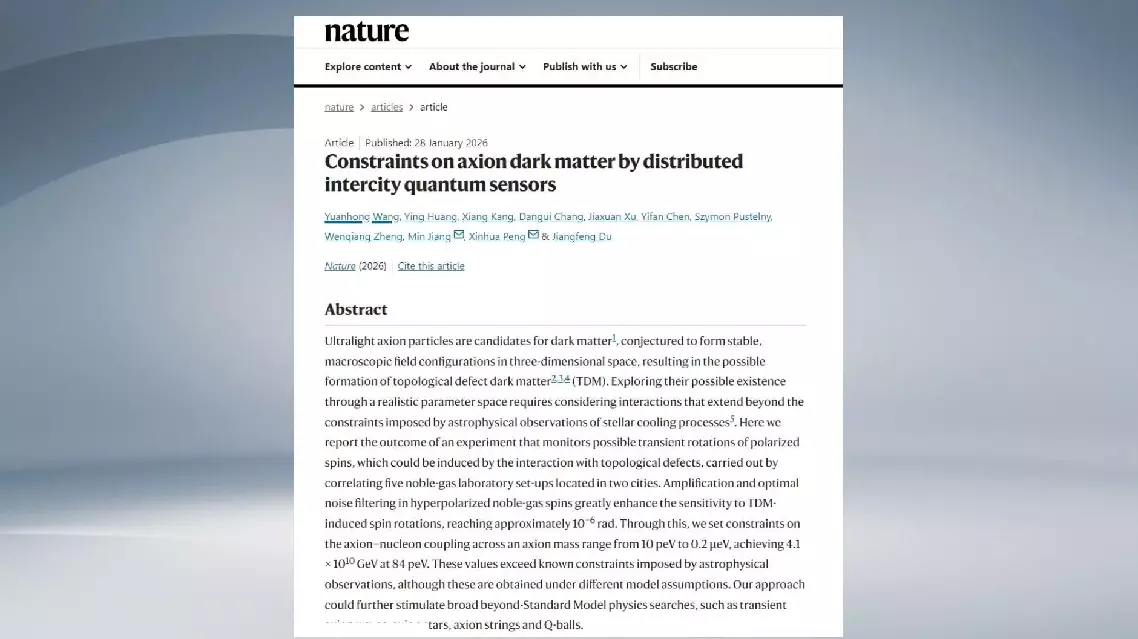
The team has published the paper, titled "Constraints on axion dark matter by distributed intercity quantum sensors," in the international academic journal Nature on Thursday.
While stars and planets constitute only about 4.9 percent of the universe's mass, dark matter, which does not emit, absorb, or reflect light, makes up an estimated 26.8 percent. This "invisible neighbor" reveals itself only through gravitational effects on galaxies, making its direct detection a monumental scientific challenge.
To address this, the team built a network of five ultra-sensitive quantum sensors located in east China’s Hefei City and Hangzhou City. The sensors are synchronized via satellite timing, forming a coordinated "listening network" dedicated to cosmic signals. By applying self-developed quantum amplification technology, the research team is able to amplify extremely faint signals a hundredfold. When integrated with advanced network signal discrimination techniques, the system achieves unprecedented levels of detection sensitivity.
"By advancing this technology, we have the potential to discover traces of dark matter. This could help solve fundamental scientific questions, such as what the universe is made of and how it evolved," explained Peng Xinhua, a professor at the University of Science and Technology of China in Hefei and corresponding author of the paper.
The findings establish stricter bounds on how hypothetical axion particles, a leading candidate for dark matter, could interact with ordinary matter. This method also paves the way for wider exploration of physics beyond the Standard Model, such as the search for transient axion waves and other exotic cosmic phenomena.
Chinese scientists build quantum network to enhance search for dark matter