Skip to Content Facebook Feature Image

Expert hails China-Europe freight train as champion project for free trade

China

China

China

Expert hails China-Europe freight train as champion project for free trade

2026-01-31 17:03 Last Updated At:19:07

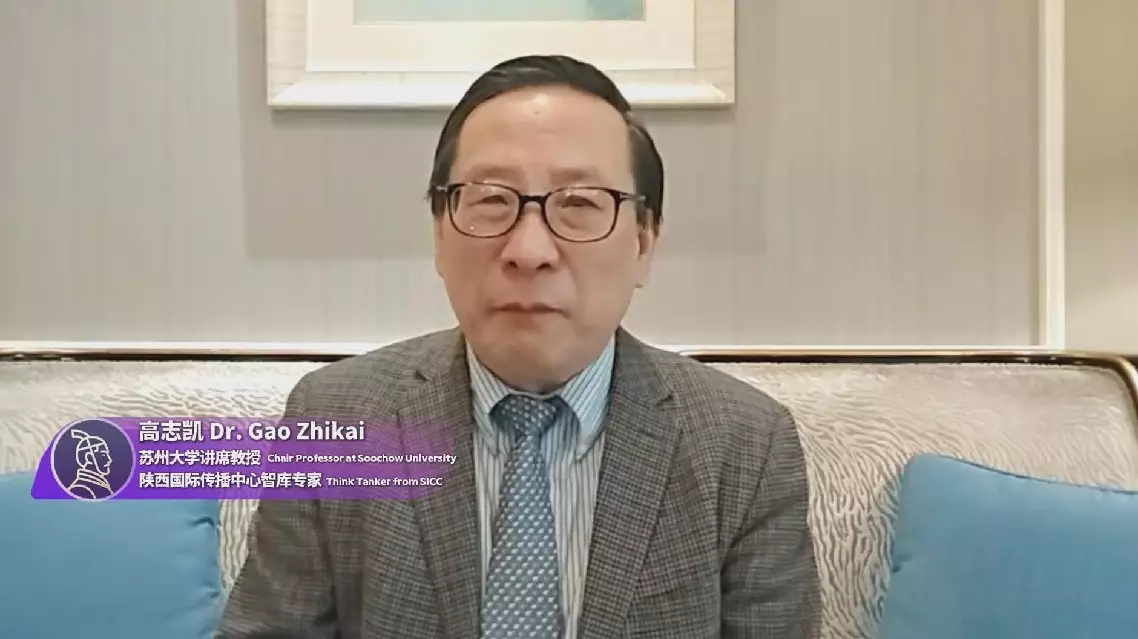
China champions free trade and market-oriented practices, as exemplified by the China-Europe freight train service, which enhances Eurasian connectivity and promotes win-win development, according to Victor Gao Zhikai, vice president of Center for China and Globalization.

"China is unique in the sense that it is really the champion of defending free trade and defending market practice, and also promotes the win-win paradigm of development. Because China believes if we are serious in engaging in trade with each other, both of us and all of us will be better off," Gao said in an exclusive interview with Shaanxi Broadcasting Group.

"Allow me to emphasize especially for the benefit of the European countries, without free trade, there will be no fair trade. So, free trade is the precondition for any fair trade you want to expect. And we are living in such a fast-changing world today that it is critically important for us to decide what is the principle we cannot afford not to defend, and that is free trade, that is free market, that is respect for each other's sovereignty, and territorial integrity and independence of each country, rather than, for example, pointing a gun at the head of other countries and then try to bully other countries, or even seize the land, and the wealth, and the riches of other countries," Gao said.

The China-Europe freight train service is a good example of connectivity. As of October 2025, the service had expanded its operational network to 232 cities in 26 European countries and over 100 cities across 11 Asian countries.

At the heart of this monumental initiative is Xi'an in northwest China's Shaanxi Province, an ancient capital that served as the starting point of the ancient Silk Road for more than 1,000 years. Today, that trade legacy is reborn in the cross-continent rail network dubbed the modern "steel camel caravans".

Gao praised the rail service for promoting free trade, facilitating economic activities, and enhancing people-to-people exchanges.

"I think the railway connectivity originating from Xi'an, westward all the way linking central Asia and Europe at large, is one of the champion projects calling for free trade and economic engagement and people-to-people exchanges. And this is the highway and the better way for all the countries to learn about and to enjoy," said Gao.
Expert hails China-Europe freight train as champion project for free trade
Expert hails China-Europe freight train as champion project for free trade
A new generation of Chinese professionals is reshaping the meaning of work by trading rigid office hours for digital flexibility, mobile offices, and career paths rooted in innovation.

In today's fast-paced world, the traditional 9-to-5 workday is no longer the dominant path to success, especially in cities like Hangzhou, one of China's leading e-commerce and digital innovation hubs. Here, a new wave of professionals is choosing when and where to work, creating value on their own terms.

From livestream studios to factory floors, these workers are embracing flexible hours, mobile offices, and a broader definition of expertise and impact. "My classmates followed the traditional path: labs, hospitals, classrooms. My path looks different. But it's still a path of expertise. Here in my stream, I break down the science behind a product, to build trust with an audience. My degree isn't just a title, here, it's credibility," said Lou Han, who holds a PhD in Pharmacology and now works as a livestream host at Yowant Technology.

Beyond credentials, freedom and flexibility are prized in this new work culture.

"I mean it's good to have clear shifts: day, night, with clear boundaries. But for me I would always want more freedom, to avoid rush hour, and work when my energy and creativity peak. It's not about a better path. It's that we finally have more choices of paths," Lou said.

With new paths come new offices, ones that go far beyond four walls.

Cao Difan, head of Livestream Business at Yowant Technology, said he studied TV production and spent years working in traditional media, starting out as a director for reality shows at a local television station. However, by 2015, the rise of new media in China felt like a revolution to him, an opportunity he was eager to be part of.

Cao left behind broadcast studios in Changsha to join Hangzhou's digital boom, and he never looked back.

"My workday usually starts in the afternoon, when I head to the studio. The first thing I do is check the live stream to ensure everything is running smoothly. Then, I'll dive into performance data, all of this is easy to do when everyone is in the same space. We can talk and analyze things instantly," Cao said.

"In this bustling hub of digital innovation, I hope to tap into the future of the industry and create something new. So are so many others who are drawn to our industry because they want to be a part of the digital transformation. Gone are the days when people would sit in front of a TV screen. Now, everyone's watching on their phones, and that shift in behavior has changed the way people approach their careers. However, the trade-off is also real behind mobile workspaces and hugely increased income means a much more intense workload," he said.

The impact of digital labor doesn't stop at the camera lens.

"Before we fully committed to live-streaming as our main sales channel, we had only three production lines. Our first major livestream brought in 40 million yuan (5.75 million U.S. dollars ) in sales. Within six months, we expanded to 20 lines. Our team grew from 30 people to over 600," said Wu Yue, co-founder of Duowei.

But Wu said it's not just about faster scaling, it's about smarter systems.

"This new model is far more efficient than the traditional path. From the beginning, we built this brand for the new retail era, starting with livestreams, driving online sales, then expanding to physical stores. The old model relied on distributors, wholesalers, and retailers before reaching the customer. Feedback was slow. Now, our data analysts capture real-time reactions straight from the live chat. That raw input goes directly to our research and development team to improve products. The entire cycle, from feedback to upgrade, is faster and far more precise," Wu said.

From a single stream to millions in sales, and from the factory floor to the home office, this new digital economy is unlocking a world of possibilities.

Digital shift redefines work for young Chinese

Digital shift redefines work for young Chinese

Recommended Articles