LAGOS, Nigeria (AP) — Victor Ahansu was barely awake with his wife and baby twins before the grinding sound of bulldozers woke them. It was all the warning the family had, he said, before fleeing mass evictions in their historic community of Makoko in Lagos. Their house was demolished on Jan. 11, one of thousands taken down by the ongoing operation.
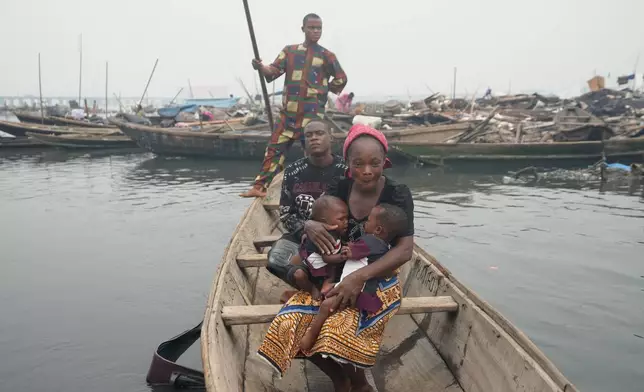
Now the 5-month-old twins and their parents live in a wooden canoe, with a woven plastic sack for shelter from the rain. The thump of hammers fills the air as other residents of Nigeria ’s largest city break down homes and salvage what they can.
Click to Gallery
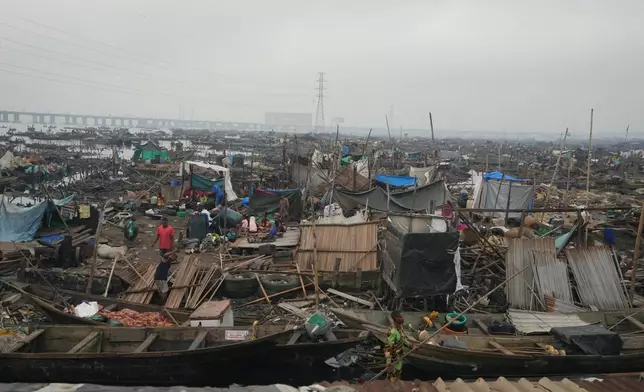
People stand on the ruins of their demolished stilts houses by authorities at Makoko slum in Lagos, Nigeria, Wednesday, Jan. 14, 2026. (AP Photo/Sunday Alamba)
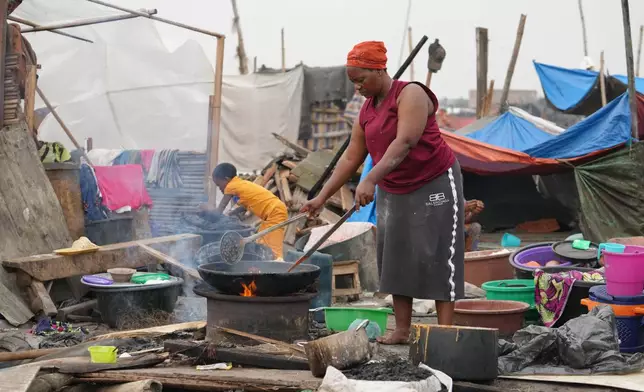
Kpetosi Basra , fried a dough to sell at the ruins of her demolished stills house in Makoko slum in Lagos, Nigeria, Wednesday, Jan. 14, 2026. (AP Photo/Sunday Alamba)
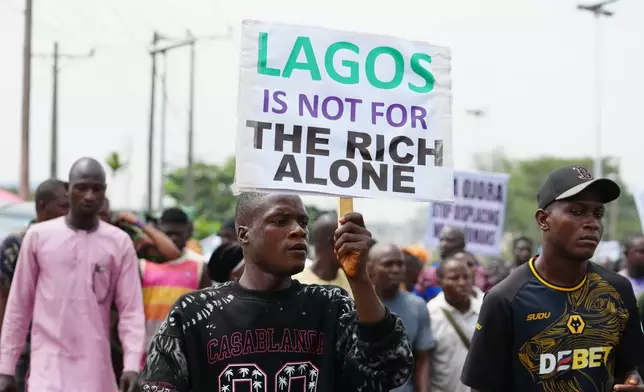
Victor Ahansu, center, protests the recent mass evictions and demolition of homes in Makoko and other communities, in Lagos, Nigeria, Wednesday, Jan. 28, 2026. (AP Photo/Sunday Alamba)
Victor Ahansu, center, and his wife Josianua Agbokpasu, front, ride with their twins inside a canoe in Makoko in Lagos, Nigeria, Friday, Jan.30, 2026. (AP Photo/Sunday Alamba)
Josianua Agbokpasu poses with her twins at their demolished stilts house in Makoko Lagos, Nigeria, Friday, Jan.30, 2026. (AP Photo/Sunday Alamba)
“I have not even been able to go to work to make money, because I don’t want to leave my wife and children, and the government comes again,” Ahansu, a fisherman, told The Associated Press.
For decades, tens of thousands of people have lived in homes on stilts above the lagoon in Makoko, one of Africa’s oldest and largest waterfront communities.
To many Nigerians, Makoko has long been distinctive. To nonprofit organizations, it has been a testing ground for ideas like floating schools. But to some developers and authorities, it's valuable waterfront property in the hands of some of the megacity’s poorest people.
More than 3,000 homes have been torn down and 10,000 people displaced in this latest wave of demolitions that began in late December, according to a coalition of local advocacy groups. Makoko’s residents have lived here legally, but Nigeria’s Land Law allows the government to take any land it deems fit for public purpose.
There is a long history of such mass evictions in the rapidly developing city of an estimated 20 million people on the Gulf of Guinea. Advocacy groups estimate that hundreds of thousands of people have lost their homes since 2023, when the current state government took office.
On Wednesday, hundreds of people protested the mass evictions across Lagos. Police dispersed them with tear gas.
As Lagos' population increases, people in low-income communities like Makoko have been caught in the line of fire amid government efforts to develop the megacity.
Residents told the AP that the Lagos state government in this case asked people to move 100 meters from an electricity line, but then the demolitions just kept going.
Officials at the state’s Ministry of Physical Planning and Urban Development declined to answer questions about the Makoko demolitions and residents’ allegations that there had been little or no warning before they began on Dec. 23.
The officials, however, pointed to recent comments by Lagos Gov. Babajide Sanwo-Olu, who defended the evictions and cited safety risks, saying communities had spread close to critical infrastructure.
Residents say that space in the Makoko area had been allotted to a private construction company, one of many in a city where waterfront space is often prized for luxury and other properties. The AP couldn't verify that allegation.
“I think that when (the government) is looking for centrally located land and since other places are filled up, there is the idea that you can come and clear away communities because they are less privileged and you can come up with some justification,” said Megan Chapman, co-director for the Justice and Empowerment Initiatives, an advocacy group for displaced communities in Lagos.
Makoko, established in the 19th century, has survived past attempts at demolition, usually when there's a public outcry. Life meanders through narrow streets and waterways in the community nicknamed the “Venice of Africa” by outsiders. There are few public services like electricity or waste management.
Those being displaced say they have few options. Lagos has some of Africa’s highest rents. A room in a tenement house where dozens of people share bathrooms can go for 700 thousand naira annually (around $500) in a city where the minimum wage is 77,000 naira ($55).
Basirat Kpetosi sat atop the ruins of her waterfront home in Makoko, frying dough in sizzling oil for sale. She was resigned to her loss.
Kpetosi said that she woke to the sound of bulldozers on Jan. 9, when her house was torn down. Now she and her five children are left with no shelter.
Kpetosi, from a family of fishermen, said that she built the home on the lagoon — two rooms on stilts made of bamboo and aluminium sheets — last year.
She said they received no compensation for its destruction, and the government is making no plans for their resettlement, even though the law requires it. In a 2017 ruling by the Lagos High Court seen by the AP, the judge ruled that mass eviction without resettlement violated the “fundamental right to protection from cruel and degrading treatment.”
"We sleep in the open,” Kpetosi said. “When it rained, it rained on my children and me.”
For more on Africa and development: https://apnews.com/hub/africa-pulse
The Associated Press receives financial support for global health and development coverage in Africa from the Gates Foundation. The AP is solely responsible for all content. Find AP’s standards for working with philanthropies, a list of supporters and funded coverage areas at AP.org.
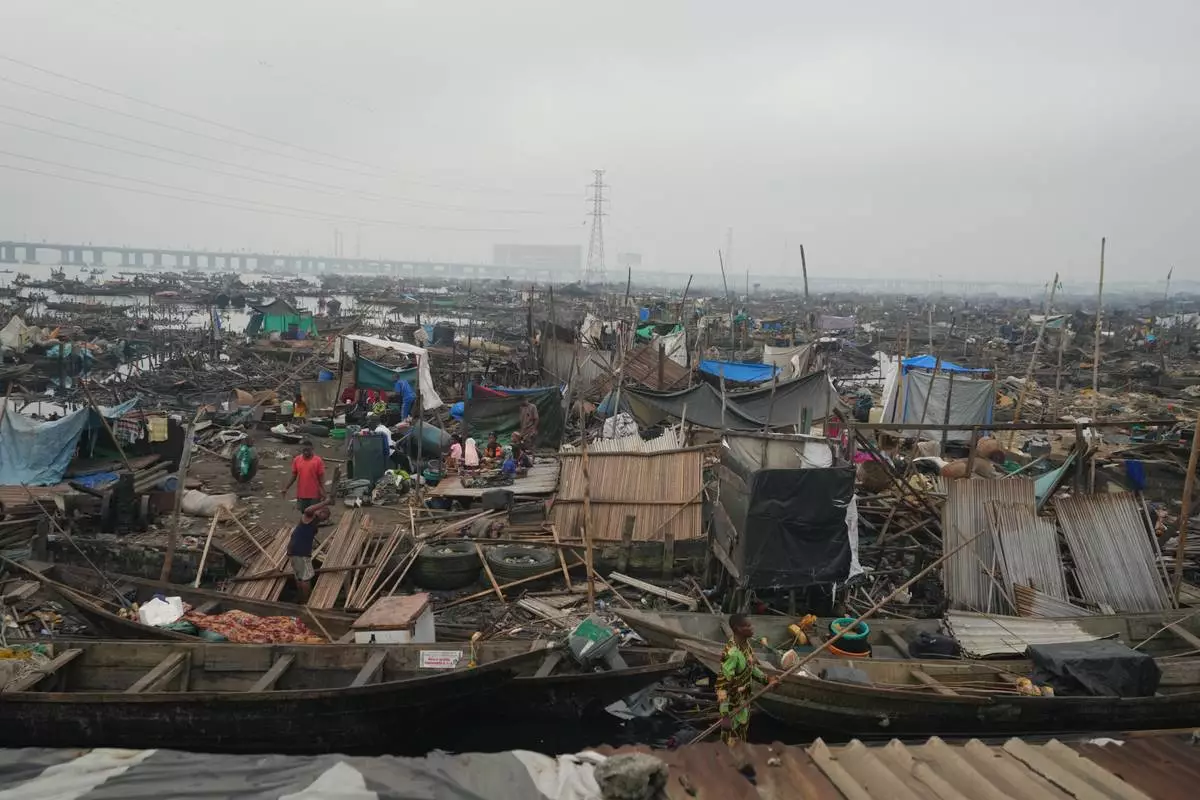
People stand on the ruins of their demolished stilts houses by authorities at Makoko slum in Lagos, Nigeria, Wednesday, Jan. 14, 2026. (AP Photo/Sunday Alamba)
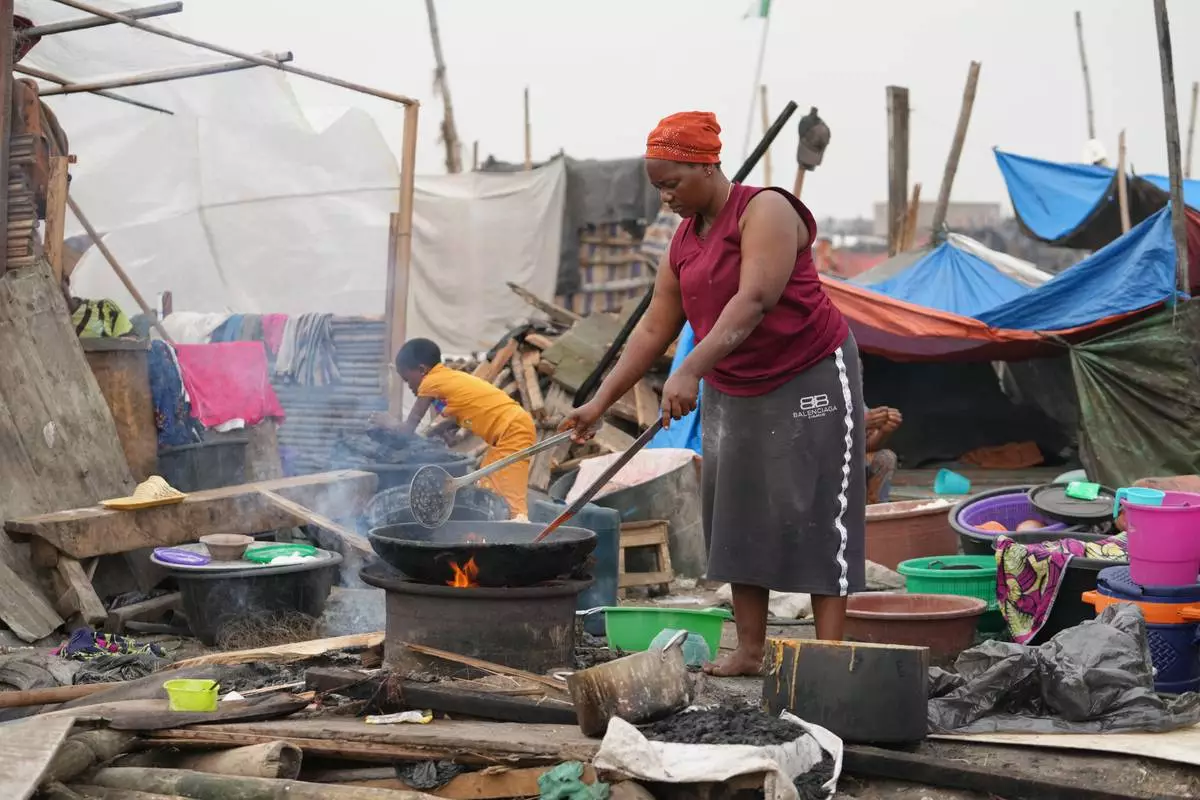
Kpetosi Basra , fried a dough to sell at the ruins of her demolished stills house in Makoko slum in Lagos, Nigeria, Wednesday, Jan. 14, 2026. (AP Photo/Sunday Alamba)

Victor Ahansu, center, protests the recent mass evictions and demolition of homes in Makoko and other communities, in Lagos, Nigeria, Wednesday, Jan. 28, 2026. (AP Photo/Sunday Alamba)

Victor Ahansu, center, and his wife Josianua Agbokpasu, front, ride with their twins inside a canoe in Makoko in Lagos, Nigeria, Friday, Jan.30, 2026. (AP Photo/Sunday Alamba)

Josianua Agbokpasu poses with her twins at their demolished stilts house in Makoko Lagos, Nigeria, Friday, Jan.30, 2026. (AP Photo/Sunday Alamba)
BRUSSELS (AP) — European allies and Canada are pouring billions of dollars into helping Ukraine, and they have pledged to massively boost their budgets to defend their territories.
But despite those efforts, NATO’s credibility as a unified force under U.S. leadership has taken a huge hit over the past year as trust within the 32-nation military organization dissolved.
The rift has been most glaring over U.S. President Donald Trump's repeated threats to seize Greenland, a semiautonomous territory of NATO ally Denmark. More recently, Trump's disparaging remarks about his NATO allies' troops in Afghanistan drew another outcry.
While the heat on Greenland has subsided for now, the infighting has seriously undercut the ability of the world’s biggest security alliance to deter adversaries, analysts say.
“The episode matters because it crossed a line that cannot be uncrossed,” Sophia Besch from the Carnegie Europe think tank said in a report on the Greenland crisis. “Even without force or sanctions, that breach weakens the alliance in a lasting way.”
The tensions haven’t gone unnoticed in Russia, NATO’s biggest threat.
Any deterrence of Russia relies on ensuring that President Vladimir Putin is convinced that NATO will retaliate should he expand his war beyond Ukraine. Right now, that does not seem to be the case.
“It’s a major upheaval for Europe, and we are watching it,” Russian Foreign Minister Sergey Lavrov noted last week.
Criticized by U.S. leaders for decades over low defense spending, and lashed relentlessly under Trump, European allies and Canada agreed in July to significantly up their game and start investing 5% of their gross domestic product on defense.
The pledge was aimed at taking the whip out of Trump's hand. The allies would spend as much of their economic output on core defense as the United States — around 3.5% of GDP — by 2035, plus a further 1.5% on security-related projects like upgrading bridges, air and seaports.
NATO Secretary-General Mark Rutte has hailed those pledges as a sign of NATO’s robust health and military might. He recently said that “fundamentally thanks to Donald J. Trump, NATO is stronger than it ever was.”
Though a big part of his job is to ensure that Trump does not pull the U.S. out of NATO, as Trump has occasionally threatened, his flattery of the American leader has sometimes raised concern. Rutte has pointedly refused to speak about the rift over Greenland.
The North Atlantic Treaty Organization was formed in 1949 to counter the security threat posed by the Soviet Union during the Cold War, and its deterrence is underpinned by a strong American troop presence in Europe.
The alliance is built on the political pledge that an attack on one ally must be met with a response from them all — the collective security guarantee enshrined in Article 5 of its rule book.
It hinges on the belief that the territories of all 32 allies must remain inviolate. Trump’s designs on Greenland attack that very principle, even though Article 5 does not apply in internal disputes because it can only be triggered unanimously.
“Instead of strengthening our alliances, threats against Greenland and NATO are undermining America’s own interests,” two U.S. senators, Democrat Jeanne Shaheen and Republican Lisa Murkowski, wrote in a New York Times op-ed.
“Suggestions that the United States would seize or coerce allies to sell territory do not project strength. They signal unpredictability, weaken deterrence and hand our adversaries exactly what they want: proof that democratic alliances are fragile and unreliable,” they said.
Even before Trump escalated his threats to seize control of Greenland, his European allies were never entirely convinced that he would defend them should they come under attack.
Trump has said that he doesn’t believe the allies would help him either, and he recently drew more anger when he questioned the role of European and Canadian troops who fought and died alongside Americans in Afghanistan. The president later partially reversed his remarks.
In testimony to the Senate Foreign Relations Committee, U.S. Secretary of State Marco Rubio dismissed criticism that Trump has undermined the alliance.
“The stronger our partners are in NATO, the more flexibility the United States will have to secure our interests in different parts of the world,” he said. “That’s not an abandonment of NATO. That is a reality of the 21st century and a world that’s changing now.”
Despite NATO’s talk of increased spending, Moscow seems undeterred. The EU's foreign policy chief, Kaja Kallas, said this week that “it has become painfully clear that Russia will remain a major security threat for the long term.”
“We are fending off cyberattacks, sabotage against critical infrastructure, foreign interference and information manipulation, military intimidation, territorial threats and political meddling,” she said Wednesday.
Officials across Europe have reported acts of sabotage and mysterious drone flights over airports and military bases. Identifying the culprits is difficult, and Russia denies responsibility.
In a year-end address, Rutte warned that Europe is at imminent risk.
“Russia has brought war back to Europe, and we must be prepared for the scale of war our grandparents or great-grandparents endured,” he said.
Meanwhile in Russia, Lavrov said the dispute over Greenland heralded a “deep crisis” for NATO.
“It was hard to imagine before that such a thing could happen,” Lavrov told reporters, as he contemplated the possibility that “one NATO member is going to attack another NATO member.”
Russian state media mocked Europe's “impotent rage” over Trump's designs on Greenland, and Putin's presidential envoy declared that “trans-Atlantic unity is over.”
U.S. Defense Secretary Pete Hegseth is due to meet with his counterparts at NATO on Feb. 12. A year ago, he startled the allies by warning that America’s security priorities lie elsewhere and that Europe must look after itself now.
Security in the Arctic region, where Greenland lies, will be high on the agenda. It’s unclear whether Hegseth will announce a new drawdown of U.S. troops in Europe, who are central to NATO’s deterrence.
Lack of clarity about this has also fueled doubt about the U.S. commitment to its allies. In October, NATO learned that up to 1,500 American troops would be withdrawn from an area bordering Ukraine, angering ally Romania.
A report from the European Union Institute for Security Studies warned last week that although U.S. troops are unlikely to vanish overnight, doubts about U.S. commitment to European security means “the deterrence edifice becomes shakier.”
“Europe is being forced to confront a harsher reality,” wrote the authors, Veronica Anghel and Giuseppe Spatafora. “Adversaries start believing they can probe, sabotage and escalate without triggering a unified response."

FILE - President Donald Trump speaks in the Oval Office of the White House on May 20, 2025, in Washington. (AP Photo/Alex Brandon, File)
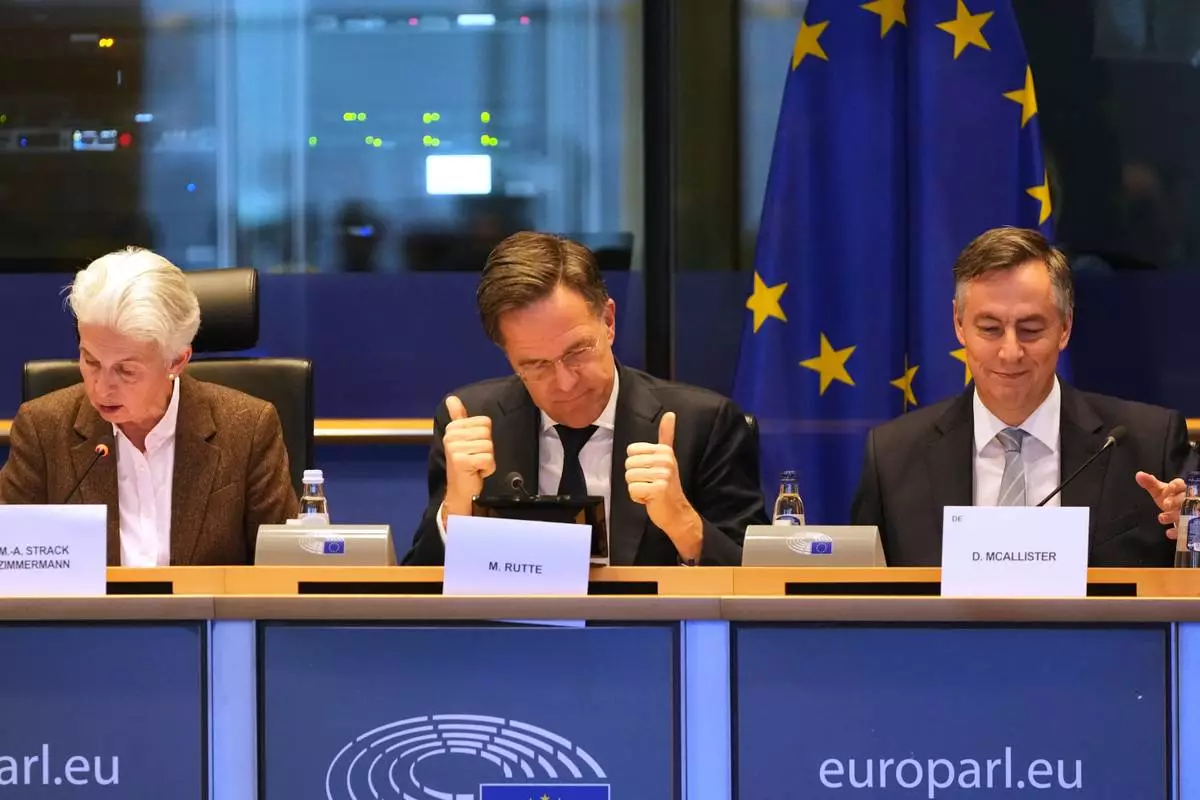
NATO Secretary General Mark Rutte, center, addresses the Security and Defence Committee at the European Parliament in Brussels, Monday, Jan. 26, 2026. (AP Photo/Virginia Mayo)
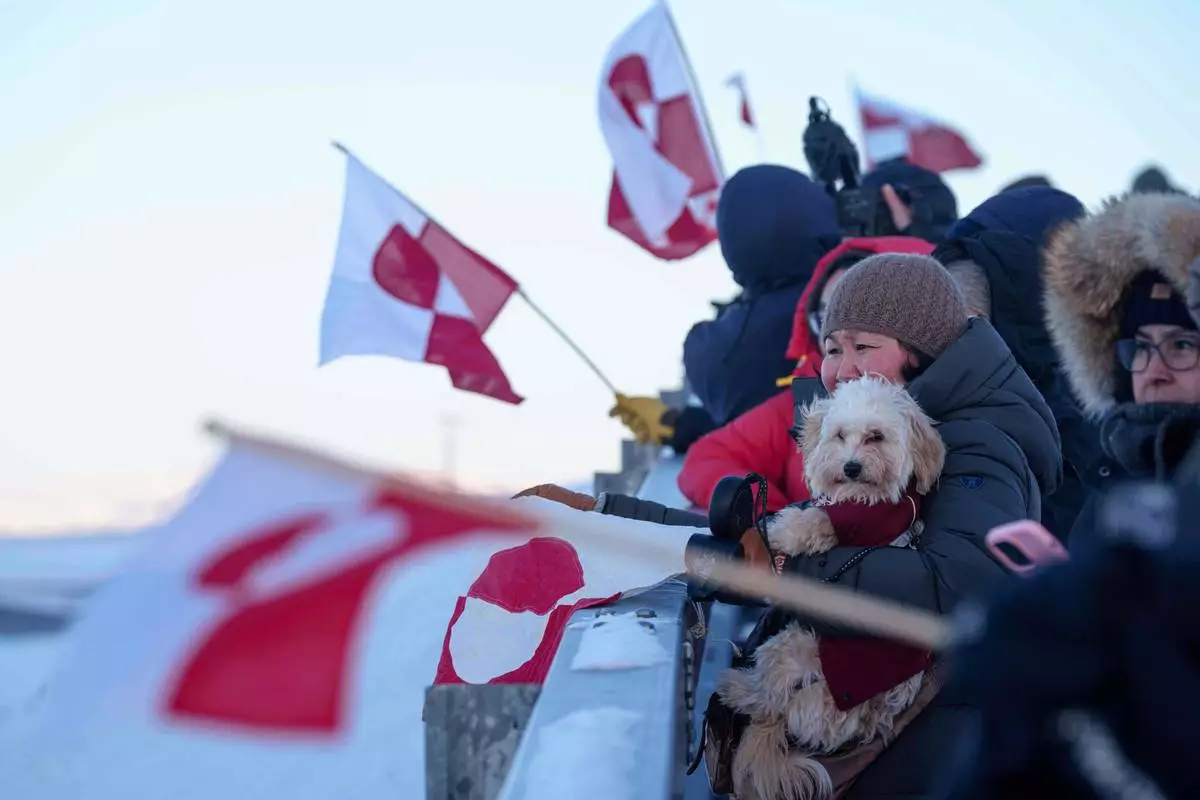
People wave national flags for Greenland Minister for Foreign Affairs and Research Vivian Motzfeldt as she arrives at the airport in Nuuk, Greenland, on Tuesday, Jan. 20, 2026. (AP Photo/Evgeniy Maloletka)

A woman aims a rifle aboard a naval vessel during a public day in Nuuk, Greenland, on Saturday, Jan. 24, 2026. (AP Photo/Evgeniy Maloletka)
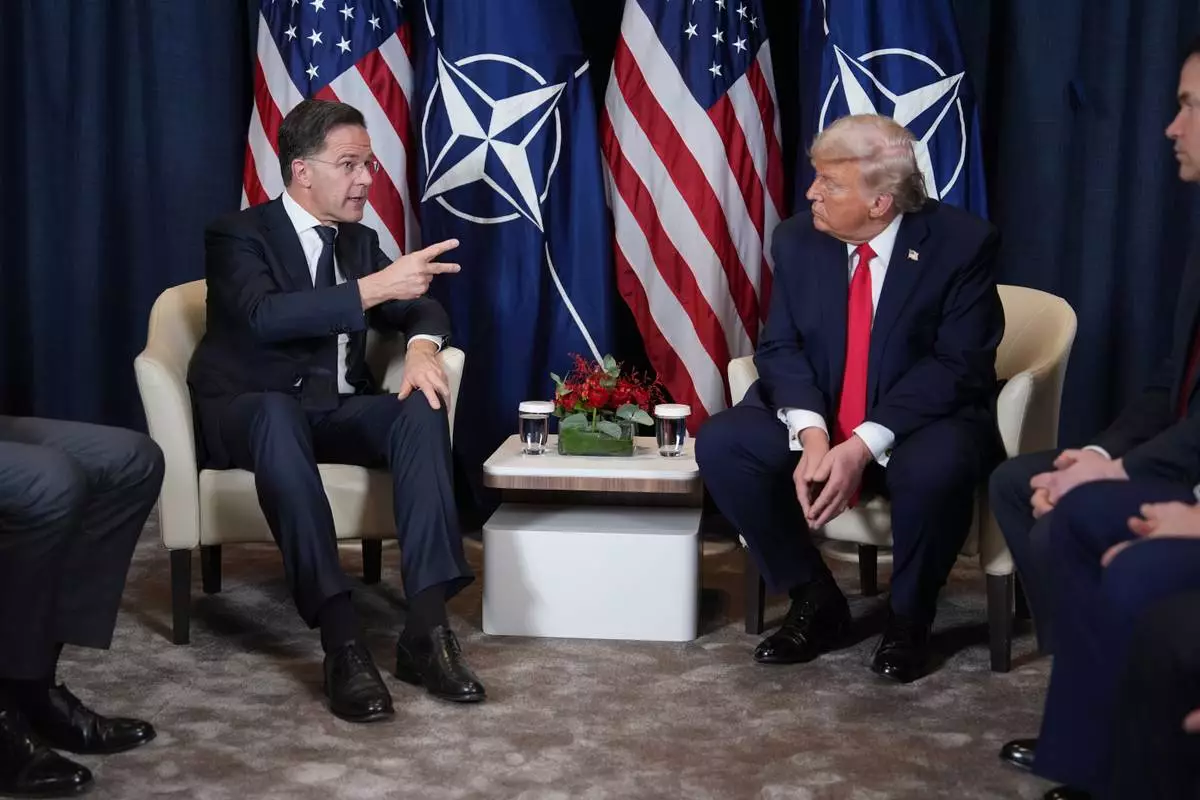
President Donald Trump, right, meets with NATO Secretary General Mark Rutte during a meeting on the sidelines of the Annual Meeting of the World Economic Forum in Davos, Switzerland, Wednesday, Jan. 21, 2026. (AP Photo/Evan Vucci)