Severe fog blanketed large swathes of north China's Hebei Province since Saturday night, reducing visibility to below 50 meters and prompting widespread expressway closures until Sunday noon.
The Hebei Provincial Meteorological Observatory issued an orange fog alert on Saturday afternoon, the second-highest alert level. Starting that night, heavy fog engulfed central and southern parts of Hebei, including the provincial capital Shijiazhuang and cities of Baoding, Langfang, and Handan.
Visibility dropped drastically, falling to below 200 meters in many areas. Places like Feixiang District and Guangping County of Handan even reported visibility of less than 50 meters.
The dense fog created hazardous conditions for road travel, prompting large-scale highway closures across the affected region. Beginning at around 04:00 on Sunday morning, toll stations along more than ten major expressways in central and southern Hebei, including the Beijing-Shanghai, Beijing-Taipei, and Beijing-Hong Kong-Macao routes, were temporarily shut down.
By midday, as the fog gradually dissipated, the meteorological alert was lifted and expressway access points were reopened, allowing traffic to return to normal.
China has a four-tier weather warning system, with red representing the most severe warning, followed by orange, yellow and blue.
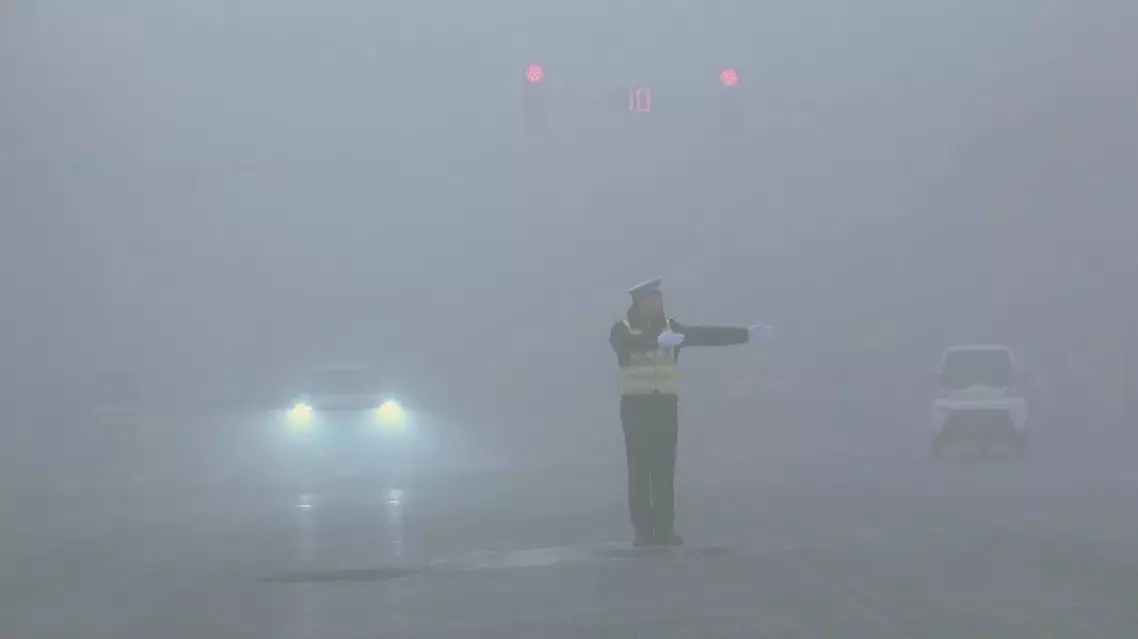
Dense fog disrupts road traffic in parts of north China

China has increased transportation capacity in its air, highway and railway systems to handle a busier 40-day Spring Festival travel rush, which is set to begin on Monday and expected to see 9.5 billion cross-regional passenger trips.
Each year during the period, millions of people working, studying, or living away from their hometowns return for the Spring Festival, China's most important traditional holiday, forming the world's largest annual human migration.
The railway network in China has geared up to meet the growing travel demand. It is capable of scheduling over 14,000 passenger trains per day during the peak period of the travel rush, representing a year-on-year increase of 5.3 percent in transportation capacity.
"By analyzing data flows, we are now capable of tracking passengers' demands and dynamically managing transportation capacity in areas such as ticket purchasing, waitlist management, and transportation capacity adjustments so that the transportation resources will be used more effectively to meet passengers' travel needs," said Zhang Zhiqiang, head of the operation support department at the China Railway 12306 Technology Center.
During the travel rush, China's civil aviation sector is expected to schedule an average of 19,400 flights per day, increasing by 5 percent year on year.
Helping meet capacity, a new terminal was put into test operation at Sanya Phoenix International Airport on Sunday to facilitate smooth travel in the island province of Hainan, which is a popular tourism destination for people from home and abroad during the Spring Festival holiday.
The country is also expected to handle record-high daily self-driving trips and highway traffic volume during the travel rush period.
The Spring Festival, or the Chinese New Year, falls on February 17 this year. The official holiday lasts nine days, with the travel rush running through March 13.
China increases transportation capacity to handle busier Spring Festival travel rush