Skip to Content Facebook Feature Image

China's Silk Road Maritime network ships over 26 mln TEUs

China

China

China

China's Silk Road Maritime network ships over 26 mln TEUs

2026-02-03 16:34 Last Updated At:02-04 13:02

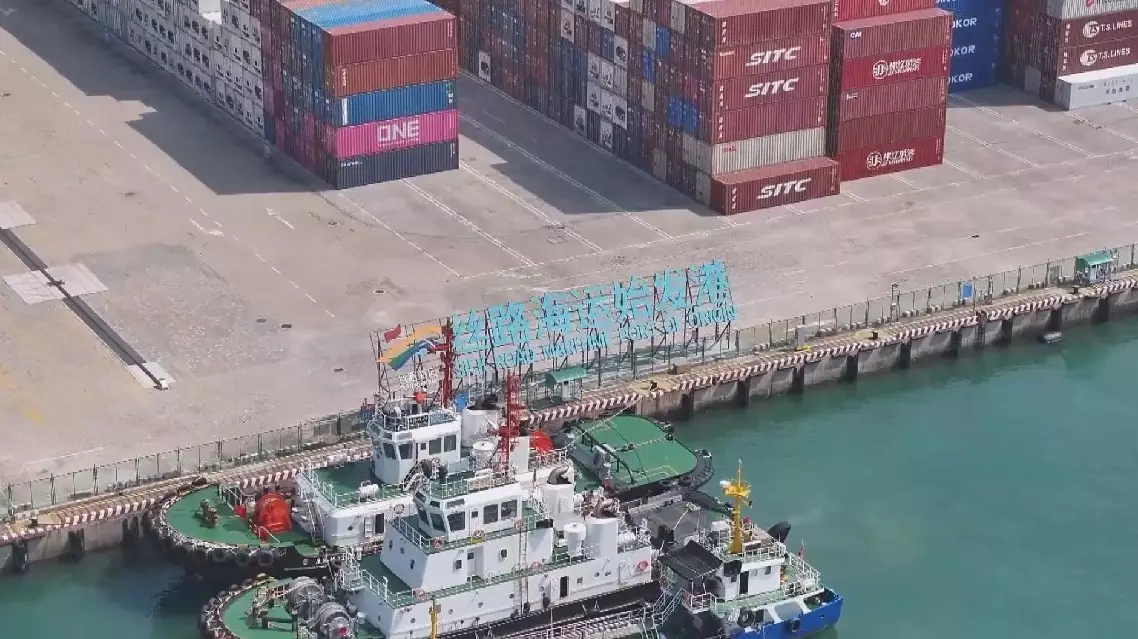
The Silk Road Maritime network, China's first international maritime logistics platform serving the Belt and Road Initiative (BRI), has continued to grow rapidly, shipping 26 million twenty-foot equivalent units (TEUs) of container cargo since its launch.

According to the latest statistics, the container throughput on the Silk Road Maritime routes exceeded 5.4 million TEUs in 2025, marking a year-on-year increase of 9.11 percent. Bulk and general cargo shipments exceeded 12.27 million tons, up 26.4 percent from the previous year.

As a major project under China's 14th Five-Year Plan (2021–2025), the network plays a vital role in promoting the high-quality development of the BRI. Since the inaugural route was launched in east China's Xiamen in 2018, the network has so far handled over 26 million TEUs of container cargo and more than 34 million tons of bulk and general cargo in total.

The network has expanded from just 16 routes at inception to 148 international routes, covering 150 ports in 48 countries and regions, including Southeast Asia, South Asia, the Middle East, and Europe.

According to Zhang Tao, deputy director of the port supervision department of the General Administration of Customs, China is intensifying its efforts to advance the development of multimodal transport systems.

"We are promoting the deep integration of Silk Road Maritime network with the China-Europe Railway Express and the Western Land-Sea New Corridor. This will create a multidimensional, multimodal logistics network to reduce cross-border logistics costs and improve customs clearance efficiency, thereby injecting fresh momentum into the high-quality development of the BRI," he said.
China's Silk Road Maritime network ships over 26 mln TEUs


China's Silk Road Maritime network ships over 26 mln TEUs
Global food commodity prices climbed for a second consecutive month in March, driven mainly by higher energy costs linked to escalating conflict in the Middle East, the Food and Agriculture Organization of the United Nations (FAO) said in report released on Friday.

The FAO Food Price Index, which tracks monthly changes in the international prices of a basket of globally traded food commodities, averaged 128.5 points in March, up 2.4 percent from February and 1.0 percent above its level a year ago.

According to the report, the FAO Vegetable Oil Index and Sugar Price Index showed the largest increases, up 5.1 percent and 7.2 percent, respectively.

The FAO Cereal Price Index increased by 1.5 percent from the previous month, driven primarily by higher world wheat prices, which rose 4.3 percent.

The FAO Meat Price Index rose by 1.0 percent from the previous month, and the FAO All-Rice Price Index declined by 3.0 percent in March, according to the report.

FAO stated that rising energy and fertilizer prices have been driving up agricultural input costs.

If the conflict stretches beyond 40 days, farmers will have to choose to farm the same with fewer inputs, plant less, or switch to less intensive fertilizer crops, according to FAO Chief Economist Maximo Torero.

These choices will hit future yields and shape food supply and commodity prices for the rest of this year and beyond, Torero said.

Global food prices rise for 2nd consecutive month in March amid Middle East conflict: FAO

Global food prices rise for 2nd consecutive month in March amid Middle East conflict: FAO

Recommended Articles